Tag Archives: Middle East

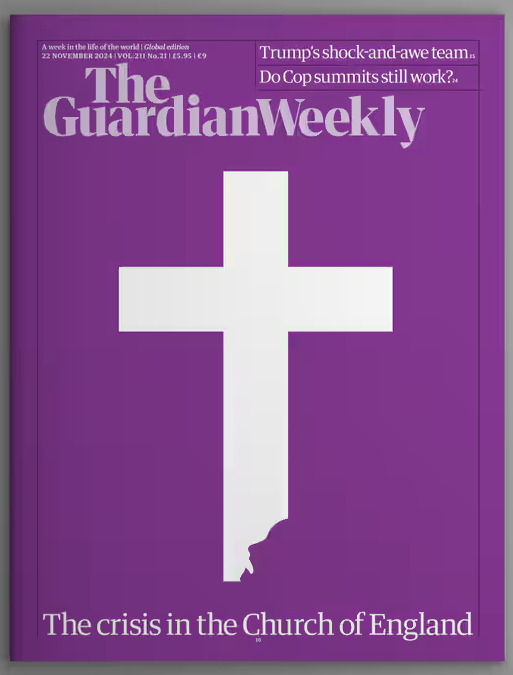
THE GUARDIAN WEEKLY – APRIL 3, 2026 PREVIEW

THE GUARDIAN WEEKLY: The latest issue features ‘The Tipping Point’ – A watershed moment for big tech’…

In a landmark case, a California jury last week found social media companies Meta and YouTube liable for deliberately designing addictive products. The ruling came the day after Meta, which owns Facebook and Instagram, was ordered to pay $375m after a jury in a separate trial in New Mexico found it misled consumers about the safety of its platforms.

Meta, YouTube, Snapchat and TikTok are facing thousands of similar lawsuits in US courts, while governments around the world are starting to introduce measures to curb social media’s grip on children’s attention.

Guardian technology editors Dan Milmo and Robert Booth assess whether what has been called a “big tobacco” moment for the industry will lead to significant change. And in our opinion section, Jonathan Freedland argues that the court verdicts must be just the start of a global fightback.

The big story | A war of regression
Weeks into a war that was going to take days and has cost billions, Donald Trump has bombed the US into a worse position with Iran, writes Patrick Wintour

Science | ‘On the shoulders of giants’
Plant specimens and teaching materials that inspired Charles Darwin have been unearthed and will be used for the first time to teach contemporary students about botany, Donna Ferguson reports

Feature | Circuit training
After touring 11 Chinese companies making humanoid robots, Chang Che asks: just how close are we to a robotic future?

Opinion | Labour needs a thinker
Ed Miliband’s stock is rising in a party in need of an old-style intellectual heavyweight, argues Gaby Hinsliff

Culture | Gimme shelter
Catherine Slessor visits Henry Moore’s former countryside home Hoglands, now home to studios and a vast sculpture garden, to learn about a new exhibition of the drawings he made as a war artist, capturing people as they took sanctuary from the blitz

THE GUARDIAN WEEKLY – MARCH 27, 2026 PREVIEW

THE GUARDIAN WEEKLY: The latest issue features ‘Strategy Backfires’ – Can Trump undo the mess he’s made in the Gulf?

Brinkmanship, the ability to take countries to the edge of conflict, was a staple of cold war diplomacy. The remnants of that finely balanced standoff, bound by a rules-based order and spheres of influence, has given way to a world in freefall; to an ever-widening war in the Gulf where the aims are as unclear as the endpoint.

It is approaching a month since the US and Israel launched their attacks on Iran, arguing they were acting to remove the country’s nuclear threat, destroy its ballistic missile capability and free the populace of a tyrannical theocratic regime. Yet it seems it is these civilians and neighbouring Gulf countries who are bearing the brunt of the campaign while the Iranian regime’s willingness to escalate the war seems undimmed.

Spotlight | The ‘anyone but’ election
Pippa Crerar looks ahead to local elections in the UK, where voters seem more concerned with who they want to keep out of political office than who they vote in

Science | Not-so silent nights
Can a “vacuum cleaner turned the other way” become a popular solution to snoring disorders? Natasha May explores the rise of Cpap machines

Feature | Gamifying government
Steeped in gaming and rightwing culture, Elon Musk’s Doge team set out to defeat the enemy of the United States: its people, write Ben Tarnoff and Quinn Slobodian

Opinion | Collateral damage
Attacks on synagogues and Jewish shops in the UK, Europe and the US don’t hurt Benjamin Netanyahu, says Jonathan Freedland, they just hurt ordinary Jews

Culture | Rock return
“Validation was an insatiable monster”: Dave Grohl talks to Ben Beaumont-Thomas about Foo Fighters, life after his infidelity and grief for bandmate Taylor Hawkins

The Spectator World Magazine – March 30, 2026

THE SPECTATOR WORLD: The latest issue features ‘The End Of Trumpism’….

The end of Trumpism

Having Donald Trump as President probably resembles being a heroin addict: you undergo regular episodes of sweating terror and mortal danger, the end result of which is to get you – at best – back to normal. A year ago, the Liberation Day tariffs nearly caused the American economy to seize up, before China mercifully let the matter drop. Then came the even more reckless decision to join Israel in bombing Iran’s Fordow nuclear installation; Iran agreed to halt hostilities just as it was figuring out how to penetrate Israeli airspace with its missiles. By Christopher Caldwell

Why Iran will hasten MAGA’s demise

Readers may disagree with the cover line of this issue. Pronouncing “the end of Trumpism” feels somewhat similar to declaring “the end of history” – a provocative, albeit less grandiose, statement that risks being mocked in the near future. We should start by saying we hope that we are wrong. Trumpism, as this magazine understands….

How Trump and FIFA’s Gianni Infantino teamed up to rebrand peace

When you attend the court of King Donald, it’s important to genuflect. Unfamiliar foreigners in need of pointers can look to the man who is currently the most assiduous non-American flatterer: FIFA president Gianni Infantino. By Matt McDonald

El Mencho’s last stand

Jalisco, Mexico No one seems to know exactly how El Mencho was killed. We are told the feared leader of the Jalisco New Generation Cartel was captured by the Mexican army during a firefight in late February, and subsequently died of his wounds. Beyond that, there is very little information. Why are the Mexican and

THE GUARDIAN WEEKLY – MARCH 20, 2026 PREVIEW

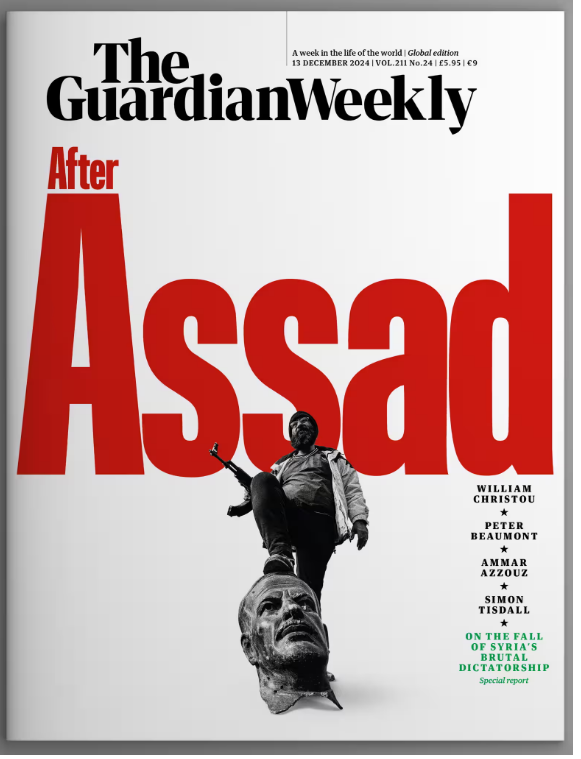
THE GUARDIAN WEEKLY: The latest issue features ‘The Squeeze’ – How Iran Blocked The Straight of Hormuz…and What Comes Next.

As fighting in the Middle East entered its third week, focus has shifted to Tehran’s closure of a key maritime passage, and the potentially huge global economic impact.

For our big story this week, Jillian Ambrose explains how the war in Iran has effectively blocked the Gulf states from exporting a fifth of the world’s oil supply through the strait of Hormuz. Peter Beaumont sets out the significance of the route and the possible options to counter the blockade, while Hannah Ellis-Petersen reports on the building anger and resentment in the region over being dragged into a war they did not start and had diplomatically tried to prevent.

Peter also looks at “the escalation trap” that lies ahead for both sides in the conflict, and we have on-the-ground reports from Jason Burke in northern Israel and William Christou in southern Lebanon, as well as a stark account of day-to-day life from inside Tehran.

Spotlight | ‘Extraordinary cruelty’
Kaamil Ahmed and Alex Clark examine the evidence that starvation is being used as a weapon of war in Sudan

Technology | Star fruit
As Apple reaches its half-century, Chris Stokel-Walker rounds up its biggest triumphs and flops

Feature | Feminism’s not dead!
In a stirring riposte to all those who have declared the death of the women’s movement, Rebecca Solnit outlines the advances that have been made and argues it’s no time to give up the fight

Opinion | The British right’s Maga obsession
UK conservatives were once hostile to the US, but now are keen to emphasise loyalty to Trump above all else, writes Kojo Koram

Culture | One win after another
After 11 nominations without a single win, film-maker Paul Thomas Anderson deservedly struck gold at the Oscars with One Battle After Another, says Xan Brooks

COMMENTARY MAGAZINE – APRIL 2026 PREVIEW

April 2026 – Commentary Magazine

COMMENTARY MAGAZINE: The latest issue features ‘IRANAMOK’ – ISRAEL HAS BEEN PREPARING FOR THIS FOR A GENERATION.

Regime Change Without Nation Building

by Jonathan Schanzer

America and Israel are at war with Iran, a fact that should be neither shocking nor surprising. Both countries have been targeted by the Islamic Republic since its inception in 1979. Both countries have engaged in painful battles with the regime’s proxies. Both nations battled Iran for 12 days last year; Israel targeted nuclear assets and other key military targets, paving the way for a crescendo of American strikes that hammered Iran’s nuclear capabilities.

They Should Have Listened to My Dad

by John Podhoretz

Editor’s Commentary

One American-Israeli Battle After Another

by Eli Lake

The Case for Trump’s War Is the Case for Bush’s War

by Tod Lindberg

Washington’s Foremost Con Artist

by James Kirchick

Washington Commentary

The Spectator World Magazine – March 16, 2026

THE SPECTATOR WORLD: The latest issue features ‘The Greater Game’ – Trump’s ultimate target in this war is China says Geoffrey Cain…

Trump’s ultimate target in this war is China

Geoffrey Cain

The United States and Israel killed Ayatollah Khamenei, and Xi Jinping’s decade-long project to build an alternative to the American-led order died with him. For years, Beijing quietly assembled a network of dictatorships and client states designed to blunt American power. Iran supplied China with cheap oil and kept Washington bogged down in the Middle

The Iran war has exacerbated the failure of European energy policies

Daniel McCarthy

The history of the global trading system is a story of narrow and vulnerable waterways: the Suez and Panama Canals, the St. Lawrence Seaway, the Straits of Dover and the Skagerrak, which defends the entrance to the Baltic. But none has the power to seize up the global economy as much as the Strait of…..

I spent 25 years fighting neocons. Then Trump became one

Like everyone, I’m glued to the news coming out of Iran. I’m experiencing some depression, as one might, upon realizing that much of what one has worked on for 25 years has suddenly gone up in smoke, destroyed when Donald Trump discovered he was pretty much a neocon after all. Like everyone else, I have…

America’s last war in the Middle East

Win or lose, Donald Trump has begun the last war the United States is ever likely to fight in the Middle East. That might sound wildly optimistic, but what it really means is that war with Iran has been decades in the making. If the mission succeeds, it will mark the end of an era.

Inside MAGA’s meltdown over Iran

Freddy Gray

When President George W. Bush invaded Mesopotamia in 2003, everybody laughed at Comical Ali, the bespectacled Iraqi information minister who kept insisting that the American “rats” were doomed as Saddam Hussein’s regime collapsed around him. The world moved on. Iran is not Iraq, as President Donald Trump’s supporters are so fond of saying, and Bush-eraOwen Matthews

Will Turkey intervene in Iran?

With the exception so far of a single missile intercepted over Turkish airspace and a strike on an Azeri-controlled territory near the Iranian border, Tehran has so far declined to mess with the Turks, and for good reasons. Turkey is a member of NATO and attacking it would trigger Article 5 mutual defense measures. And

Cover: Claremont Review Of Books – Winter 2026

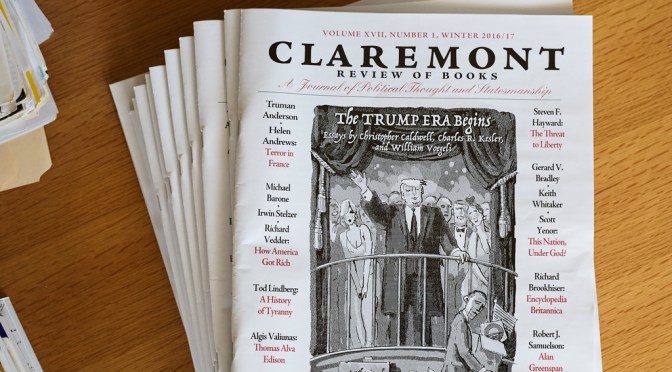
Claremont Review of Books: The latest issue features ‘Special Anniversary Double Issue’….

Palace Intrigues

by Barry Strauss

The Lives of the Caesars

Imagine sitting near the apex of power in an empire and then being shown the door. You might want to write a tell-all book about it. If so, however, you would be advised to proceed with caution. Now, imagine what would barely be conceivable today: that you undertook to write your exposé while you were still in office. You would need all the finesse of a tightrope walker. 

The Lives of the Caesars

One Score and Five

by Charles R. Kesler

This essay is adapted from remarks delivered at the Claremont Review of Books 25th anniversary gala, held at the Metropolitan Club in New York City on November 6, 2025.

Radical Republican

by Randy E. Barnett

Charles Sumner: Conscience of a Nation

Charles Sumner: Conscience of a Nation

In the early hours of March 11, 1874, word spread around Washington that Charles Sumner was on the brink of death. The 63-year-old senator from Massachusetts had suffered a massive heart attack the previous evening. By 9 a.m., a crowd of several hundred had gathered in front of his home on Lafayette Square. “Colored men and women mingled with white in knots about his home,” wrote The New-York Tribune. Government workers, merchants, shopmen, waiters, and even “old colored women with baskets and bundles on their arms” stood together. Many were crying and begging to be let inside. They were stopped by one of Sumner’s friends and two policemen standing guard at the front door.

Analysis: The World Ahead In 2026 – The Economist

The Economist The World Ahead 2026 (November 13, 2025):

This is Donald Trump’s world—we’re all just living in it. The disruptor-in-chief was the biggest factor shaping global affairs in 2025, and that will be the case for as long as he remains in the White House. His norm-shattering approach has caused turmoil in some areas (as in trade) but has also delivered diplomatic results (as in Gaza) and forced necessary change (as with European defence spending). As the Trumpnado spins on in 2026, here are ten trends and themes to watch in the coming year.

1. America’s 250th.

Expect to hear wildly diverging accounts of America’s past, present and future, as Republicans and Democrats describe the same country in irreconcilably different terms to mark the 250th anniversary of its founding. Voters will then give their verdict on America’s future in the midterm elections in November. But even if the Democrats take the House, Mr Trump’s rule by bullying, tariffs and executive orders will go on.

2. Geopolitical drift.

Foreign-policy analysts are divided: is the world in a new cold war, between blocs led by America and China, or will a Trumpian deal divide the planet into American, Russian and Chinese “spheres of influence”, in which each can do as they please? Don’t count on either. Mr Trump prefers a transactional approach based on instinct, not grand geopolitical paradigms. The old global rules-based order will drift and decay further. But “coalitions of the willing” will strike new deals in areas such as defence, trade and climate.

3. War or peace? Yes.

With luck, the fragile peace in Gaza will hold. But conflicts will grind on in Ukraine, Sudan and Myanmar. Russia and China will test America’s commitment to its allies with “grey-zone” provocations in northern Europe and the South China Sea. As the line between war and peace becomes ever more blurred, tensions will rise in the Arctic, in orbit, on the sea floor and in cyberspace.

4. Problems for Europe.

All this poses a particular test for Europe. It must increase defence spending, keep America on side, boost economic growth and deal with huge deficits, even though austerity risks stoking support for hard-right parties. It also wants to remain a leading advocate for free trade and greenery. It cannot do all of these at once. A splurge on defence spending may lift growth, but only slightly.

5. China’s opportunity.

China has its own problems, with deflation, slowing growth and an industrial glut, but Mr Trump’s “America First” policy opens up new opportunities for China to boost its global influence. It will present itself as a more reliable partner, particularly in the global south, where it is striking a string of trade agreements. It is happy to do tactical deals with Mr Trump on soyabeans or chips. The trick will be to keep relations with America transactional, not confrontational.With rich countries living beyond their means, the risk of a bond-market crisis is growing

6. Economic worries.

So far America’s economy is proving more resilient than many expected to Mr Trump’s tariffs, but they will dampen global growth. And with rich countries living beyond their means, the risk of a bond-market crisis is growing. Much will depend on the replacement of Jerome Powell as chair of the Federal Reserve in May; politicising the Fed could trigger a market showdown.

7. Concerns over AI.

Rampant spending on infrastructure for artificial intelligence may also be concealing economic weakness in America. Will the bubble burst? As with railways, electricity and the internet, a crash would not mean that the technology does not have real value. But it could have wide economic impact. Either way, concern about AI’s impact on jobs, particularly those of graduates, will deepen.

8. A mixed climate picture.

Limiting warming to 1.5°C is off the table, and Mr Trump hates renewables. But global emissions have probably peaked, clean tech is booming across the global south and firms will meet or exceed their climate targets—but will keep quiet about it to avoid Mr Trump’s ire. Geothermal energy is worth watching.

9. Sporting values.

Sport can always be relied upon to provide a break from politics, right? Well, maybe not in 2026. The football World Cup is being jointly hosted by America, Canada and Mexico, whose relations are strained. Fans may stay away. But the Enhanced Games, in Las Vegas, may be even more controversial: athletes can use performance-enhancing drugs. Is it cheating—or just different?

10. Ozempic, but better.

Better, cheaper GLP-1 weight-loss drugs are coming, and in pill form, too. That will expand access. But is taking them cheating? GLP-1s extend the debate about the ethics of performance-enhancing drugs to a far wider group than athletes or bodybuilders. Few people compete in the Olympics. But anyone can take part in the Ozempic games.

ZENDEGI-E NORMAL

After the theocracy’s fall, the search for a normal life becomes Iran’s quietest revolution.

By Michael Cummins, Editor | October 16, 2025

This speculative essay, based on Karim Sadjadpour’s Foreign Affairs essay “The Autumn of the Ayatollahs,”  transforms geopolitical forecast into human story. In the imagined autumn of the theocracy, when the last sermons fade into static, the search for zendegi normal—a normal life—becomes Iran’s most radical act.

“They said the revolution would bring light. I learned to live in the dark.”

The city now keeps time by outages. Twelve days of war, then the silence that follows artillery—a silence so dense it hums. Through that hum the old voice returns, drifting across Tehran’s cracked frequencies, a papery baritone shaped by oxygen tanks and memory. Victory, he rasps. Someone in the alley laughs—quietly, the way people laugh at superstition.

On a balcony, a scarf lifts and settles on a rusted railing. Its owner, Farah, twenty-three, hides her phone under a clay pot to muffle the state’s listening apps. Across the street, a mural once blazed Death to America. Now the paint flakes into harmless confetti. Beneath it, someone has stenciled two smaller words: zendegi normal.

She whispers them aloud, tasting the risk. Life, ordinary and dangerous, returning in fragments.

Her father, gone for a decade to Evin Prison, was a radio engineer. He used to say truth lived in the static between signals. Farah believed him. Now she edits protest footage in the dark—faces half-lit by streetlamps, each one a seed of defiance. “The regime is weakening day by day,” the exiled activist on BBC Persian had said. Farah memorized the phrase the way others memorize prayers.

Her mother, Pari, hears the whispering and sighs. “Hope is contraband,” she says, stirring lentils by candlelight. “They seize it at checkpoints.”

Pari had survived every iteration of promise. “They say ‘Death to America,’” she liked to remind her students in 1983, “but never ‘Long Live Iran.’” The slogans were always about enemies, never about home. She still irons her scarf when the power flickers back, as if straight lines could summon stability. When darkness returns, she tells stories the censors forgot to erase: a poet who hid verses in recipes, a philosopher who said tyranny and piety wear the same cloak.

Now, when Farah speaks of change—“The Ayatollah is dying; everything will shift”—Pari only smiles, thinly. “Everything changes,” she says, “so that everything can remain the same.”


Farah’s generation remembers only the waiting. They are fluent in VPNs, sarcasm, and workaround hope. Every blackout feels like rehearsal for something larger.

Across town, in a military café that smells of burnt sugar and strategy, General Nouri stirs his fourth espresso and writes three words on a napkin: The debt is settled. Dust lies thick on the portraits of the Supreme Leader. Nouri, once a devout Revolutionary Guard, has outlived his faith and most of his rivals.

He decides that tanks run on diesel, not divinity. “Revelation,” he mutters, “is bad logistics.” His aides propose slogans—National Dignity, Renewal, Stability—but he wants something purer: control without conviction. “For a nation that sees plots everywhere,” he tells them, “the only trust is force.”

When he finally appears on television, the uniform is gone, replaced by a tailored gray suit. He speaks not of God but of bread, fuel, electricity. The applause sounds cautious, like people applauding themselves for surviving long enough to listen.

Nouri does not wait for the clerics to sanction him; he simply bypasses them. His first decree dissolves the Assembly of Experts, calling the aging jurists “ineffective ballast.” It is theater—a slap at the theocracy’s façade. The next decree, an anticorruption campaign, is really a seizure of rival IRGC cartels’ assets, centralizing wealth under his inner circle. This is the new cynicism: a strongman substituting grievance-driven nationalism for revolutionary dogma. He creates the National Oversight Bureau—a polite successor to the intelligence services—charged not with uncovering American plots but with logging every official’s loyalty. The old Pahlavi pathology returns: the ruler who trusts no one, not even his own shadow. A new app appears on every phone—ostensibly for energy alerts—recording users’ locations and contacts. Order, he demonstrates, is simply organized suspicion.


Meanwhile Reza, the technocrat, learns that pragmatism can be treason. He studied in Paris and returned to design an energy grid that never materialized. Now the ministries call him useful and hand him the Normalization Plan.

“Stabilize the economy,” his superior says, “but make it look indigenous.” Reza smiles the way one smiles when irony is all that remains. At night he writes memos about tariffs but sketches a different dream in the margins: a library without checkpoints, a square with shade trees, a place where arguments happen in daylight.

At home the refrigerator groans like an old argument. His daughter asks if the new leader will let them watch Turkish dramas again. “Maybe,” he says. “If the Internet behaves.”

But the Normalization Plan is fiction. He is trying to build a modern economy in a swamp of sanctioned entities. When he opens ports to international shipping, the IRGC blocks them—its generals treat the docks as personal treasuries. They prefer smuggling profits to taxable trade. Reza’s spreadsheets show that lifting sanctions would inject billions into the formal economy; Nouri’s internal reports show that the generals would lose millions in black-market rents. Iran, he realizes, is not China; it is a rentier state addicted to scarcity. Every reformist since 1979 has been suffocated by those who prosper from isolation. His new energy-grid design—efficient, global—stalls when a single colonel controlling illicit oil exports refuses to sign the permit. Pragmatism, in this system, is a liability.


When the generator fails, darkness cuts mid-sentence. The air tastes metallic. “They promised to protect us,” Pari says, fumbling for candles. “Now we protect ourselves from their promises.”

“Fattahi says we can rebuild,” Farah answers. “A secular Iran, a democratic one.”
“Child, they buried those words with your father.”
“Then I’ll dig them out.”

Pari softens. “You think rebellion is new. I once wrote freedom on a classroom chalkboard. They called it graffiti.”

Farah notices, for the first time, the quiet defiance stitched into daily life. Pari still irons her scarf, a habit of survival, but Farah ties hers loosely, a small deliberate chaos. At the bakery, she sees other acts of color—an emerald coat, a pop song leaking from a car, a man selling forbidden books in daylight. A decade ago, girls lined up in schoolyards for hijab inspections; now a cluster of teenagers stands laughing, hair visible, shoulders touching in shared, unspoken defiance. The contradiction the feminist lawyer once described—“the situation of women shows all the contradictions of the revolution”—is playing out in the streets, private shame becoming public confidence.

Outside, the muezzin’s call overlaps with a chant that could be mourning or celebration. In Tehran, it is often both.


Power, Nouri decides, requires choreography. He replaces Friday prayers with “National Addresses.” The first begins with a confession: Faith divided us. Order will unite us. For a month, it works. Trucks deliver bread under camera lights; gratitude becomes policy. But soon the whispering returns: the old Ayatollah lives in hiding, dictating verses. Nouri knows the rumor is false—he planted it himself. Suspicion, he believes, is the purest form of control. Yet even he feels its poison. Each morning he finds the same note in the intelligence reports: The debt is settled. Is it loyalty—or indictment?


Spring creeps back through cracks in concrete. Vines climb the radio towers. In a basement, Farah’s father’s transmitter still hums, knobs smoothed by fear. “Tonight,” she whispers into the mic, “we speak of normal life.”

She reads messages from listeners: a woman in Mashhad thanking the blackout for showing her the stars; a taxi driver in Shiraz who has stopped chanting anything at all; a child asking if tomorrow the water will run. As the signal fades, Farah repeats the question like a prayer. Somewhere, a neighbor mistakes her voice for revelation and kneels toward the sound. The scarf on her balcony stirs in the dark.


The old voice never returns. Rumor fills the vacuum. Pari hangs laundry on the balcony; the scarf flutters beside her, now simply weather. Below, children chalk zendegi normal across the pavement and draw birds around the words—wings in white dust. A soldier passes, glances, and does nothing. She remembers writing freedom on that school chalkboard, the silence that followed, the summons to the principal’s office. Now no one erases the word. She turns up the radio just enough to catch Farah’s voice, low and steady: “Tonight, we speak of normal life.” In the distance, generators pulse like mechanical hearts.


Nouri, now called Marshal, prefers silence to titles. He spends mornings signing exemptions, evenings counting enemies. Each new name feels like ballast. He visits the shrine city he once scorned, hoping faith might offer cover. “You have replaced revelation with maintenance,” a cleric tells him.
“Yes,” Nouri replies, “and the lights stay on.”

That night the grid collapses across five provinces. From his balcony he watches darkness reclaim the skyline. Then, through the static, a woman’s voice—the same one—rises from a pirated frequency, speaking softly of ordinary life. He sets down his glass, almost reaches for the dial, then stops. The scarf lifts somewhere he cannot see.


Weeks later, Reza finds a memory stick in his mail slot—no note, only the symbol of a scarf folded into a bird. Inside: the civic network he once designed, perfected by unseen hands. In its code comments one line repeats—The debt is settled. He knows activation could mean death. He does it anyway.

Within hours, phones across Iran connect to a network that belongs to no one. People share recipes, poetry, bread prices—nothing overtly political, only life reasserting itself. Reza watches the loading bar crawl forward, each pixel a quiet defiance. He thinks of his grandfather, who told him every wire carries a prayer. In the next room, his daughter sleeps, her tablet tucked beneath her pillow. The servers hum. He imagines the sound traveling outward—through routers, walls, cities—until it reaches someone who had stopped believing in connection. For the first time in years, the signal clears.


Farah leans toward the microphone. “Tonight,” she says, “we speak of water, bread, and breath.” Messages flood in: a baker in Yazd who plays her signal during morning prep; a soldier’s mother who whispers her words to her son before he leaves for duty; a cleric’s niece who says the broadcast reminds her of lullabies. Farah closes her eyes. The scarf rises once more. She signs off with the whisper that has become ritual: Every revolution ends in a whisper—the sound of someone turning off the radio. Then she waits, not for applause, but for the hum.


By late October, Tehran smells of dust and pomegranates. Street vendors return, cautious but smiling. The murals are being repainted—not erased but joined—Death to America fading beside smaller, humbler words: Work. Light. Air. No one claims victory; they have learned better. The revolution, it turns out, did not collapse—it exhaled. The Ayatollah became rumor, the general a footnote, and the word that endured was the simplest one: zendegi. Life. Fragile, ordinary, persistent—like a radio signal crossing mountains.

The scarf lifts once more. The signal clears. And somewhere, faint but unmistakable, the hum returns.

“From every ruin, a song will rise.” — Forugh Farrokhzad

THIS ESSAY WAS WRITTEN AND EDITED UTILIZING AI

Responsive Elegance: AI’s Fashion Revolution

Responsive Elegance: How AI Is Rewriting the Code of Luxury Fashion
From Prada’s neural silhouettes to Hermès’ algorithmic resistance, a new aesthetic regime emerges—where beauty is no longer just crafted, but computed.

By Michael Cummins, Editor, August 18, 2025

The atelier no longer glows with candlelight, nor hums with the quiet labor of hand-stitching—it pulses with data. Fashion, once the domain of intuition, ritual, and artisanal mastery, is being reshaped by artificial intelligence. Algorithms now whisper what beauty should look like, trained not on muses but on millions of images, trends, and cultural signals. The designer’s sketchbook has become a neural network; the runway, a reflection of predictive modeling—beauty, now rendered in code.

This transformation is not speculative—it’s unfolding in real time. Prada has explored AI tools to remix archival silhouettes with contemporary streetwear aesthetics. Burberry uses machine learning to forecast regional preferences and tailor collections to cultural nuance. LVMH, the world’s largest luxury conglomerate, has declared AI a strategic infrastructure, integrating it across its seventy-five maisons to optimize supply chains, personalize client experiences, and assist in creative ideation. Meanwhile, Hermès resists the wave, preserving opacity, restraint, and human discretion.

At the heart of this shift are two interlocking innovations: generative design, where AI produces visual forms based on input parameters, and predictive styling, which anticipates consumer desires through data. Together, they mark a new aesthetic regime—responsive elegance—where beauty is calibrated to cultural mood and optimized for relevance.

But what is lost in this optimization? Can algorithmic chic retain the aura of the original? Does prediction flatten surprise?

Generative Design & Predictive Styling: Fashion’s New Operating System

Generative design and predictive styling are not mere tools—they are provocations. They challenge the very foundations of fashion’s creative process, shifting the locus of authorship from the human hand to the algorithmic eye.

Generative design uses neural networks and evolutionary algorithms to produce visual outputs based on input parameters. In fashion, this means feeding the machine with data: historical collections, regional aesthetics, streetwear archives, and abstract mood descriptors. The algorithm then generates design options that reflect emergent patterns and cultural resonance.

Prada, known for its intellectual rigor, has experimented with such approaches. Analysts at Business of Fashion note that AI-driven archival remixing allows Prada to analyze past collections and filter them through contemporary preference data, producing silhouettes that feel both nostalgic and hyper-contemporary. A 1990s-inspired line recently drew on East Asian streetwear influences, creating garments that seemed to arrive from both memory and futurity at once.

Predictive styling, meanwhile, anticipates consumer desires by analyzing social media sentiment, purchasing behavior, influencer trends, and regional aesthetics. Burberry employs such tools to refine color palettes and silhouettes by geography: muted earth tones for Scandinavian markets, tailored minimalism for East Asian consumers. As Burberry’s Chief Digital Officer Rachel Waller told Vogue Business, “AI lets us listen to what customers are already telling us in ways no survey could capture.”

A McKinsey & Company 2024 report concluded:

“Generative AI is not just automation—it’s augmentation. It gives creatives the tools to experiment faster, freeing them to focus on what only humans can do.”

Yet this feedback loop—designing for what is already emerging—raises philosophical questions. Does prediction flatten originality? If fashion becomes a mirror of desire, does it lose its capacity to provoke?

Walter Benjamin, in The Work of Art in the Age of Mechanical Reproduction (1936), warned that mechanical replication erodes the ‘aura’—the singular presence of an artwork in time and space. In AI fashion, the aura is not lost—it is simulated, curated, and reassembled from data. The designer becomes less an originator than a selector of algorithmic possibility.

Still, there is poetry in this logic. Responsive elegance reflects the zeitgeist, translating cultural mood into material form. It is a mirror of collective desire, shaped by both human intuition and machine cognition. The challenge is to ensure that this beauty remains not only relevant—but resonant.

LVMH vs. Hermès: Two Philosophies of Luxury in the Algorithmic Age

The tension between responsive elegance and timeless restraint is embodied in the divergent strategies of LVMH and Hermès—two titans of luxury, each offering a distinct vision of beauty in the age of AI.

LVMH has embraced artificial intelligence as strategic infrastructure. In 2023, it announced a deep partnership with Google Cloud, creating a sophisticated platform that integrates AI across its seventy-five maisons. Louis Vuitton uses generative design to remix archival motifs with trend data. Sephora curates personalized product bundles through machine learning. Dom Pérignon experiments with immersive digital storytelling and packaging design based on cultural sentiment.

Franck Le Moal, LVMH’s Chief Information Officer, describes the conglomerate’s approach as “weaving together data and AI that connects the digital and store experiences, all while being seamless and invisible.” The goal is not automation for its own sake, but augmentation of the luxury experience—empowering client advisors, deepening emotional resonance, and enhancing agility.

As Forbes observed in 2024:

“LVMH sees the AI challenge for luxury not as a technological one, but as a human one. The brands prosper on authenticity and person-to-person connection. Irresponsible use of GenAI can threaten that.”

Hermès, by contrast, resists the algorithmic tide. Its brand strategy is built on restraint, consistency, and long-term value. Hermès avoids e-commerce for many products, limits advertising, and maintains a deliberately opaque supply chain. While it uses AI for logistics and internal operations, it does not foreground AI in client experiences. Its mystique depends on human discretion, not algorithmic prediction.

As Chaotropy’s Luxury Analysis 2025 put it:

“Hermès is not only immune to the coming tsunami of technological innovation—it may benefit from it. In an era of automation, scarcity and craftsmanship become more desirable.”

These two models reflect deeper aesthetic divides. LVMH offers responsive elegance—beauty that adapts to us. Hermès offers elusive beauty—beauty that asks us to adapt to it. One is immersive, scalable, and optimized; the other opaque, ritualistic, and human-centered.

When Machines Dream in Silk: Speculative Futures of AI Luxury

If today’s AI fashion is co-authored, tomorrow’s may be autonomous. As generative design and predictive styling evolve, we inch closer to a future where products are not just assisted by AI—but entirely designed by it.

Louis Vuitton’s “Sentiment Handbag” scrapes global sentiment to reflect the emotional climate of the world. Iridescent textures for optimism, protective silhouettes for anxiety. Fashion becomes emotional cartography.

Sephora’s “AI Skin Atlas” tailors skincare to micro-geographies and genetic lineages. Packaging, scent, and texture resonate with local rituals and biological needs.

Dom Pérignon’s “Algorithmic Vintage” blends champagne based on predictive modeling of soil, weather, and taste profiles. Terroir meets tensor flow.

TAG Heuer’s Smart-AI Timepiece adapts its face to your stress levels and calendar. A watch that doesn’t just tell time—it tells mood.

Bulgari’s AR-enhanced jewelry refracts algorithmic lightplay through centuries of tradition. Heritage collapses into spectacle.

These speculative products reflect a future where responsive elegance becomes autonomous elegance. Designers may become philosopher-curators—stewards of sensibility, shaping not just what the machine sees, but what it dares to feel.

Yet ethical concerns loom. A 2025 study by Amity University warned:

“AI-generated aesthetics challenge traditional modes of design expression and raise unresolved questions about authorship, originality, and cultural integrity.”

To address these risks, the proposed F.A.S.H.I.O.N. AI Ethics Framework suggests principles like Fair Credit, Authentic Context, and Human-Centric Design. These frameworks aim to preserve dignity in design, ensuring that beauty remains not just a product of data, but a reflection of cultural care.

The Algorithm in the Boutique: Two Journeys, Two Futures

In 2030, a woman enters the Louis Vuitton flagship on the Champs-Élysées. The store AI recognizes her walk, gestures, and biometric stress markers. Her past purchases, Instagram aesthetic, and travel itineraries have been quietly parsed. She’s shown a handbag designed for her demographic cluster—and a speculative “future bag” generated from global sentiment. Augmented reality mirrors shift its hue based on fashion chatter.

Across town, a man steps into Hermès on Rue du Faubourg Saint-Honoré. No AI overlay. No predictive styling. He waits while a human advisor retrieves three options from the back room. Scarcity is preserved. Opacity enforced. Beauty demands patience, loyalty, and reverence.

Responsive elegance personalizes. Timeless restraint universalizes. One anticipates. The other withholds.

Ethical Horizons: Data, Desire, and Dignity

As AI saturates luxury, the ethical stakes grow sharper:

Privacy or Surveillance? Luxury thrives on intimacy, but when biometric and behavioral data feed design, where is the line between service and intrusion? A handbag tailored to your mood may delight—but what if that mood was inferred from stress markers you didn’t consent to share?

Cultural Reverence or Algorithmic Appropriation? Algorithms trained on global aesthetics may inadvertently exploit indigenous or marginalized designs without context or consent. This risk echoes past critiques of fast fashion—but now at algorithmic speed, and with the veneer of personalization.

Crafted Scarcity or Generative Excess? Hermès’ commitment to craft-based scarcity stands in contrast to AI’s generative abundance. What happens to luxury when it becomes infinitely reproducible? Does the aura of exclusivity dissolve when beauty is just another output stream?

Philosopher Byung-Chul Han, in The Transparency Society (2012), warns:

“When everything is transparent, nothing is erotic.”

Han’s critique of transparency culture reminds us that the erotic—the mysterious, the withheld—is eroded by algorithmic exposure. In luxury, opacity is not inefficiency—it is seduction. The challenge for fashion is to preserve mystery in an age that demands metrics.

Fashion’s New Frontier


Fashion has always been a mirror of its time. In the age of artificial intelligence, that mirror becomes a sensor—reading cultural mood, forecasting desire, and generating beauty optimized for relevance. Generative design and predictive styling are not just innovations; they are provocations. They reconfigure creativity, decentralize authorship, and introduce a new aesthetic logic.

Yet as fashion becomes increasingly responsive, it risks losing its capacity for rupture—for the unexpected, the irrational, the sublime. When beauty is calibrated to what is already emerging, it may cease to surprise. The algorithm designs for resonance, not resistance. It reflects desire, but does it provoke it?

The contrast between LVMH and Hermès reveals two futures. One immersive, scalable, and optimized; the other opaque, ritualistic, and elusive. These are not just business strategies—they are aesthetic philosophies. They ask us to choose between relevance and reverence, between immediacy and depth.

As AI evolves, fashion must ask deeper questions. Can responsive elegance coexist with emotional gravity? Can algorithmic chic retain the aura of the original? Will future designers be curators of machine imagination—or custodians of human mystery?

Perhaps the most urgent question is not what AI can do, but what it should be allowed to shape. Should it design garments that reflect our moods, or challenge them? Should it optimize beauty for engagement, or preserve it as a site of contemplation? In a world increasingly governed by prediction, the most radical gesture may be to remain unpredictable.

The future of fashion may lie in hybrid forms—where machine cognition enhances human intuition, and where data-driven relevance coexists with poetic restraint. Designers may become philosophers of form, guiding algorithms not toward efficiency, but toward meaning.

In this new frontier, fashion is no longer just what we wear. It is how we think, how we feel, how we respond to a world in flux. And in that response—whether crafted by hand or generated by code—beauty must remain not only timely, but timeless. Not only visible, but visceral. Not only predicted, but profoundly imagined.

THIS ESSAY WAS WRITTEN AND EDITED UTILIZING AI