
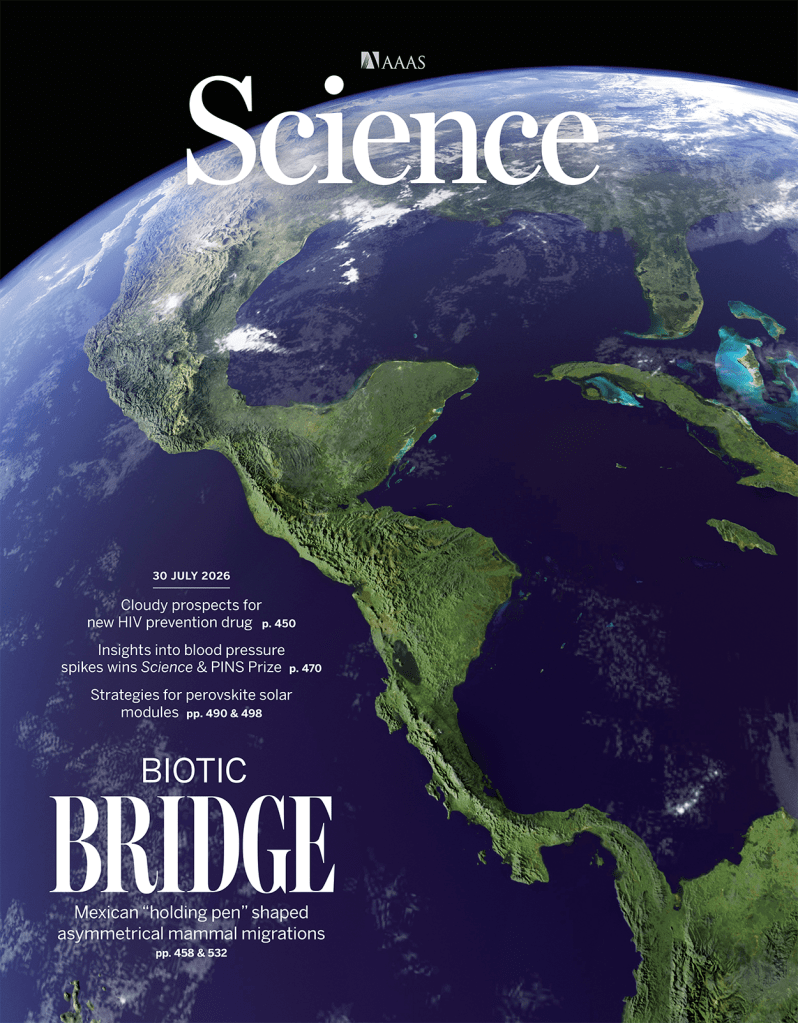
SCIENCE MAGAZINE: The latest issue features ‘Biotic Bridge’ – Mexican “holding pen” shaped asymmetrical mammal migrations….
A 10-million-year biogeographic holding pen primed the Great American Biotic Interchange
For millions of years after the breakup of the supercontinent Gondwana, South America was disconnected from other landforms, a time period that has been referred to as its “splendid isolation.” This isolation allowed for the evolution of mammals with distinctive features, including xenarthrans, sprassodont carnivores, and notoungulates. The formation of the Panamanian land bridge facilitated connection of North and South American faunas, with a bias from north to south. Tseng et al. looked at fossils from low latitudes in México and found that northern mammals accumulated in the region before the connection (see the Perspective by McGuire and Williams). This allowed for more rapid dispersal south and further supports that the land bridge first formed during the Pliocene rather than the Miocene.
How black holes get hitched
Analyses of hundreds of collisions find black holes pair up in at least three ways
AI’s top startups are barely publishing their research
More than half of AI “unicorns” have never published a paper or preprint
Ancient DNA shows how smallpox got to the Americas
“ Landmark” paper finds European contact introduced the disease
When mammals crossed between continents
The Great American Biotic Interchange informs the dynamics of modern species invasions
 Boomers Daily