

 In this month’s episode, we learn that human brains differentiate musical pitch a way that macaque monkeys do not. In fact, speech and music shaped the human brain’s hearing circuits. Researchers are studying these circuits with an eye on developing treatments for neurological disorders.
Tag Archives: Brain Research

Top New Books: “The Idea Of The Brain” By Matthew Cobb – “A Supercomputer”
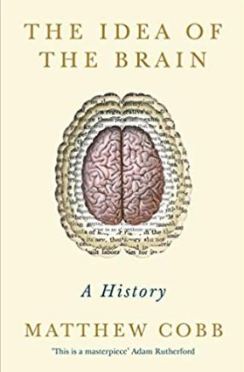 Although it might seem to be a story of ever-increasing knowledge of biology, Cobb shows how our ideas about the brain have been shaped by each era’s most significant technologies. Today we might think the brain is like a supercomputer. In the past, it has been compared to a telegraph, a telephone exchange, or some kind of hydraulic system. What will we think the brain is like tomorrow, when new technology arises?
For thousands of years, thinkers and scientists have tried to understand what the brain does. Yet, despite the astonishing discoveries of science, we still have only the vaguest idea of how the brain works. In The Idea of the Brain, scientist and historian Matthew Cobb traces how our conception of the brain has evolved over the centuries.
READ EXCERPT OF FIRST 30 PAGES
The result is an essential read for anyone interested in the complex processes that drive science and the forces that have shaped our marvelous brains.
Matthew Cobb is Professor of Zoology at the University of Manchester. His previous books include Life’s Greatest Secret:The Race to Discover the Genetic Code, which was shortlisted for the the Royal Society Winton Book Prize, and the acclaimed histories The Resistance and Eleven Days in August. He is also the award-winning translator of books on the history of molecular biology, on Darwin’s ideas and on the nature of life.
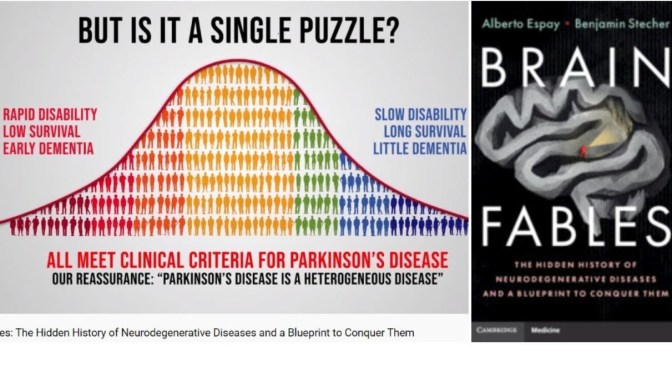
New Books: “Brain Fables – The Hidden History of Neurodegenerative Diseases” (Cambridge, 2020)
An estimated 80 million people live with a neurodegenerative disease, with this number expected to double by 2050. Despite decades of research and billions in funding, there are no medications that can slow, much less stop, the progress of these diseases. The time to rethink degenerative brain disorders has come. With no biological boundaries between neurodegenerative diseases, illnesses such as Parkinson’s and Alzheimer’s result from a large spectrum of biological abnormalities, hampering effective treatment.
Acclaimed neurologist Dr Alberto Espay and Parkinson’s advocate Benjamin Stecher present compelling evidence that these diseases should be targeted according to genetic and molecular signatures rather than clinical diagnoses. There is no Parkinson’s or Alzheimer’s, simply people with Parkinson’s or Alzheimer’s. An incredibly important story never before told, Brain Fables is a wakeup call to the scientific community and society, explaining why we have no effective disease-modifying treatments, and how we can get back on track.
Studies: Elderly In 3rd Highest Level Of Exercise Reduce Brain Shrinkage, Aging By 4 Years (AAN)
From a March 5, 2020 American Academy of Neurology release:
 “These results are exciting, as they suggest that people may potentially prevent brain shrinking and the effects of aging on the brain simply by becoming more active,” said study author Yian Gu, Ph.D., of Columbia University in New York and a member of the American Academy of Neurology.
“Recent studies have shown that as people age, physical activity may reduce the risk of cognitive decline and dementia. Our study used brain scans to measure the brain volumes of a diverse group of people and found that those who engaged in the top third highest level of physical activity had a brain volume the equivalent of four years younger in brain aging than people who were at the bottom third activity level.”
Older people who regularly walk, garden, swim or dance may have bigger brains than their inactive peers, according to a preliminary study to be presented at the American Academy of Neurology’s 72nd Annual Meeting in Toronto, Canada, April 25 to May 1, 2020. The effect of exercise was equal to four fewer years of brain aging. The study used magnetic resonance imaging (MRI) scans to measure the brains of people with a range of activity levels, including those who were inactive to those who were very active. The scans showed less active people had smaller brain volume.
Intense (VO2peak) Aerobic Exercise Raises Cognition, Alzheimer’s Disease Risks Lowered In Older Adults
From the Brain Plasticity Journal (Dec 26, 2019):
 In conclusion, increased CRF (cardiorespiratory fitness) following this six-month intervention was associated with enhanced brain glucose metabolism in the PCC (posterior cingulate cortex), a region linked to AD, and cognition among late-middle-aged individuals at risk for AD. If these findings are supported by a larger-scale study, this would provide strong evidence that adults at risk for AD may enhance brain function and cognition by engaging in aerobic exercise training.
PCC glucose metabolism correlated positively with change in VO2peak (the highest value of VO2 attained upon an incremental or other high-intensity exercise test, designed to bring the sub- ject to the limit of tolerance)…Improvement in executive function correlated with increased VO2peak. Favorable CRF adaptation after 26 weeks of aerobic exercise training was associated with improvements in PCC glucose metabolism and executive function, important markers of AD.
Aerobic exercise has been associated with reduced burden of brain and cognitive changes related to Alzheimer’s disease (AD). However, it is unknown whether exercise training in asymptomatic individuals harboring risk for AD improves outcomes associated with AD. We investigated the effect of 26 weeks of supervised aerobic treadmill exercise training on brain glucose metabolism and cognition among 23 late-middle-aged adults from a cohort enriched with familial and genetic risk of AD.
Medical Research Video: “Synthesizing Speech From Brain Signals” (JAMA)
Imagine you’re paralyzed and can’t move or speak. How would you communicate with the world? This video describes the principles of early brain-computer interfaces (BCIs) designed to read electrical brain signals, analyze how brain activity patterns contribute to vocal tract movements, and reproduce the sound patterns as speech. The model is a first step toward one day restoring paralyzed individuals’ natural rate of communication and quality of life.
For more information see https://ja.ma/37dfVSx and https://www.nature.com/articles/s4158….

New Neuroscience Books: “Physical Intelligence” By Scott Grafton (Jan 2020)
 Through the prisms of behavioral neurology and cognitive neuroscience, Scott Grafton brilliantly accounts for the design and workings of the action-oriented brain in synchronicity with the body in the natural world, and he shows how physical intelligence is inherent in all of us—and always in problem-solving mode. Drawing on insights gleaned from discoveries by engineers who have learned to emulate the sophisticated solutions Mother Nature has created for managing complex behavior, Grafton also demonstrates the relevance of physical intelligence with examples that each of us might face—whether the situation is mundane, exceptional, extreme, or compromised.
Elegantly written and deeply grounded in personal experience—works by Oliver Sacks come to mind—Physical Intelligence gives us a clear, illuminating examination of the intricate, mutually responsive relationship between the mind and the body as they engage (or don’t engage) in all manner of physical action.

Science & Technology: Reviewing Caltech’s “Decade Of Discovery”
From a Caltech online article:
 During this decade, as in previous decades, Caltech scientists and engineers reinvented the landscape of scientific endeavor: from the first detection of gravitational waves and the discovery of evidence for a ninth planet in the solar system; to bold missions to explore and understand the solar system; to the development of new methods to see inside the body and the brain and understand the universe around us; to the invention of devices to improve human health, some taking inspiration from nature; to the initiation of a transformative new effort to support research into the most pressing challenges in environmental sustainability.
 Though the brain orchestrates how we experience the world, many questions remain about its complex workings. During the past 10 years, Caltech scientists have discovered how the brain recognizes faces and drives and quenches thirst, and learned about the pathways that govern sleep. A major focus has been on understanding the experience of non-neurotypical individuals, such as those who have autism or those who are missing a brain hemisphere. New realms of neuroscience research were made possible in 2016, when philanthropists Tianqiao and Chrissy Chen announced a gift to establish the Tianqiao and Chrissy Chen Institute for Neuroscience at Caltech.
 As modern technology advances, so do the possibilities for treating medical conditions that were previously considered untreatable. Caltech researchers used an electrode array to help a paralyzed patient stand and move his legs voluntarily and developed a novel method for preventing the spread of diseases, contact lenses for preventing blindness in diabetic patients, an app that monitors heart health, gene therapy for repairing nerves in the brain, and a robotic arm controlled by a paralyzed patient’s intent to move. The decade also saw the establishment of the Merkin Institute for Translational Research, which aims to advance medical technologies, and a continued commitment to the Donna and Benjamin M. Rosen Bioengineering Center.
To read more: https://www.caltech.edu/about/news/decade-of-discovery
Studies: “Why Your Brain Needs Exercise” (Scientific American)
From a Scientic American online article:
 In our own study of more than 7,000 middle-aged to older adults in the U.K., published in 2019 in Brain Imaging and Behavior, we demonstrated that people who spent more time engaged in moderate to vigorous physical activity had larger hippocampal volumes. Although it is not yet possible to say whether these effects in humans are related to neurogenesis or other forms of brain plasticity, such as increasing connections among existing neurons, together the results clearly indicate that exercise can benefit the brain’s hippocampus and its cognitive functions.
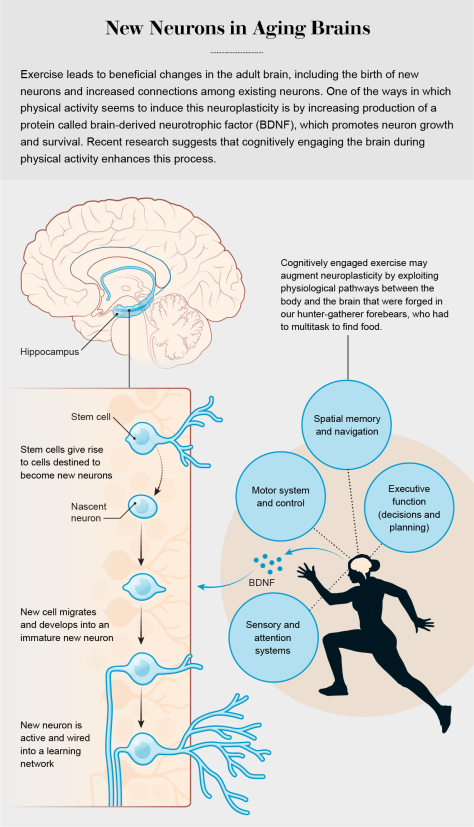
In fact, a growing body of research suggests that exercise that is cognitively stimulating may indeed benefit the brain more than exercise that does not make such cognitive demands. For example, Gerd Kempermann and his colleagues at the Center for Regenerative Therapies Dresden in Germany explored this possibility by comparing the growth and survival of new neurons in the mouse hippocampus after exercise alone or after exercise combined with access to a cognitively enriched environment. They found an additive effect: exercise alone was good for the hippocampus, but combining physical activity with cognitive demands in a stimulating environment was even better, leading to even more new neurons. Using the brain during and after exercise seemed to trigger enhanced neuron survival.
To read more: https://www.scientificamerican.com/article/why-your-brain-needs-exercise/
Health: “Understanding Parkinson’s Disease” (Nature Videos)
Parkinson’s disease is a neurological condition that affects the brain and other parts of the nervous system. The gradual loss of nerve cells leads to a suite of characteristic motor and non-motor symptoms.
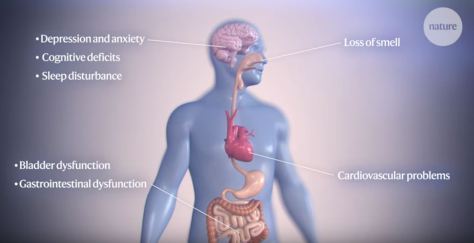
What causes these cells to die and how the pathology develops in the nervous system are not yet clear but multiple lines of investigation are being pursued to answer these questions. In this animation, we explore some of the latest in Parkinson’s disease research.
 Boomers Daily