
Tag Archives: Bees

The New York Times Book Review – March 10, 2024

Image

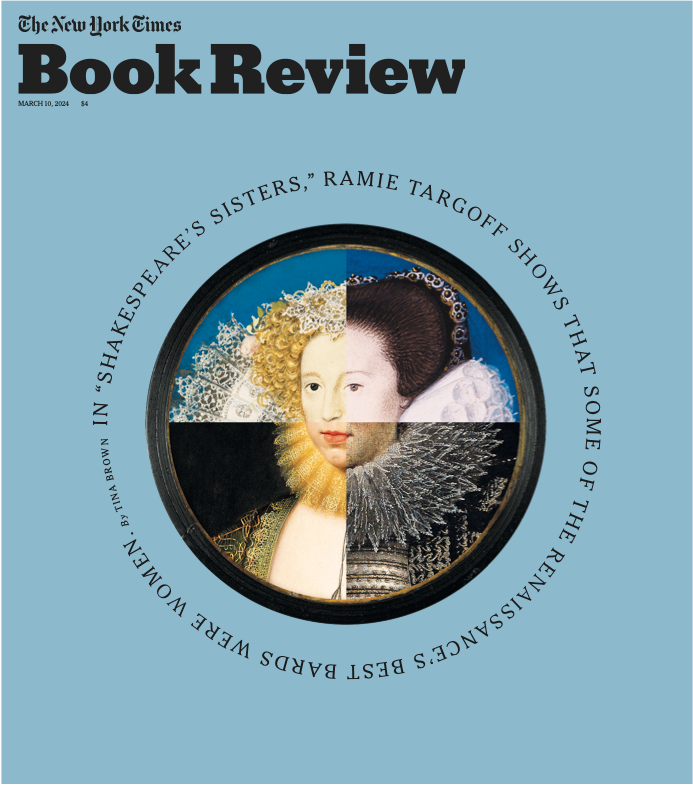
THE NEW YORK TIMES BOOK REVIEW (March ,8 2024): The latest issue features Renaissance scholar Ramie Targoff’s new book, “Shakespeare’s Sisters,” which sets out to show modern readers that the Elizabethan era did indeed produce its share of great women writers, and she details four of them across a range of disciplines. 

Some of the Best Bards Were Women

A round portrait is composed from the quadrants of four different medieval women’s faces.

In “Shakespeare’s Sisters,” the Renaissance scholar Ramie Targoff presents an astounding group of Elizabethan women of letters.

By Tina Brown

SHAKESPEARE’S SISTERS: How Women Wrote the Renaissance, by Ramie Targoff


Judith Shakespeare, Virginia Woolf’s imaginary sister of the Bard, was for years the accepted portrait of the nonexistent writer of Renaissance England. In “A Room of One’s Own,” her seminal feminist essay, Woolf concluded that any glimmer of female creativity in Shakespeare’s time would have been expunged by a pinched life as a breeding machine of children who so often died, disallowed opinions of her own. Had any woman survived these conditions, wrote Woolf, “whatever she had written would have been twisted and deformed, issued from a strained and morbid imagination.”

A Bee’s-Eye View of the World

A photo of a flower with stamen and pistils that appear to glow yellow, purple and orange in UV light.

Using clever camera methods, a new photo book illuminates how honeybees see plants and flowers.

By William Atkins

In WHAT THE BEES SEE: The Honeybee and Its Importance to You and Me, Craig P. Burrows’s ultraviolet-lit photographs mimic the fluorescence his botanical subjects emit when exposed to sunlight, revealing colors and textures usually obscured by the dazzle of visible light. Because bees see in the ultraviolet spectrum, Burrows’s method can afford us a glimpse of the world as they perceive it: His portraits of plants are, in part, prompts for interspecies empathy at a time when bees are under attack on multiple fronts, from air pollution to pesticides.

Culture & Tradition: The Beekeepers Of Slovenia

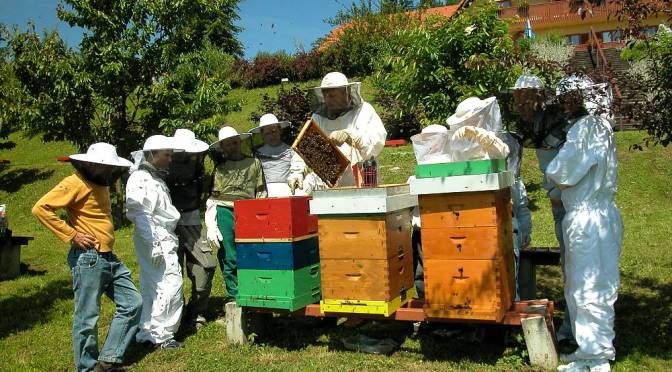
UNESCO – In Slovenia, beekeeping is a way of life for many individuals, families and communities, who obtain bee products for food and traditional medicine and use their knowledge and skills to care for the honeybees and the environment.

Communities express a loving and respectful attitude towards bees, and the knowledge, skills and practices relating to their keeping are shaped by centuries of tradition and transmitted from generation to generation. Beekeepers view their bees as teachers and friends. They expand their knowledge and skills through constant research.

World Economic Forum: Top Stories – Nov 25, 2022

World Economic Forum – Top stories of the week of November 25, 2022:

0:15 This island nation has moved to the metaverse – Rising seas are due to swamp Tuvalu by the end of the century. So the Pacific archipelago of 12,000 people has taken a remarkable step, declaring itself the world’s ‘first digital nation’.

1:39 Crosswords battle memory loss – Researchers studied 107 elderly people with mild cognitive impairment. 4 times a week, they spent half an hour either doing a crossword or completing tasks on a popular brain-training computer platform. Then they were reassessed after 12 and 66 weeks. Crossword players scored better on cognitive decline and daily functioning tests.

2:50 UK is rolling out ‘buzz’ stops for bees – The UK is planting bee-friendly native flowers on the roofs of roadside bus shelters, creating a parallel transport network for bugs. Management company Clear Channel aims to convert 1,000 shelters overall with native plants such as pansies and thyme.

4:05 Entrepreneur running 200 marathons for water – Guli is an Australian entrepreneur and environmental activist. She plans to complete Run Blue in time for the UN Conference on Water in March 2023 and to inspire as many people as possible along the way. Guli’s mission has taken her to the front lines of the global water crisis.

_____________________________________________

The World Economic Forum is the International Organization for Public-Private Cooperation. The Forum engages the foremost political, business, cultural and other leaders of society to shape global, regional and industry agendas. We believe that progress happens by bringing together people from all walks of life who have the drive and the influence to make positive change.

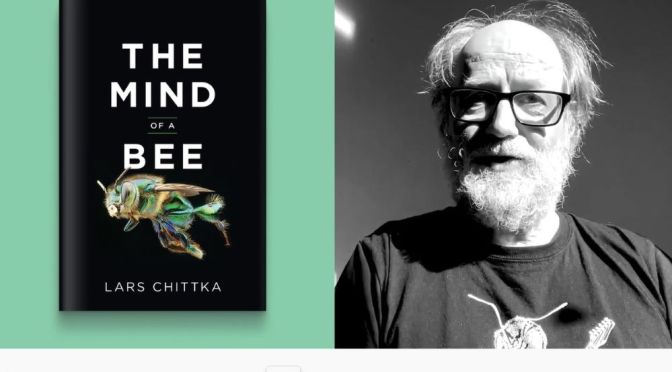
New Books: ‘The Mind Of A Bee’ – Lars Chittka (2022)

Most of us are aware of the hive mind—the power of bees as an amazing collective. But do we know how uniquely intelligent bees are as individuals? In The Mind of a Bee, Lars Chittka draws from decades of research, including his own pioneering work, to argue that bees have remarkable cognitive abilities.

He shows that they are profoundly smart, have distinct personalities, can recognize flowers and human faces, exhibit basic emotions, count, use simple tools, solve problems, and learn by observing others. They may even possess consciousness. Taking readers deep into the sensory world of bees, Chittka illustrates how bee brains are unparalleled in the animal kingdom in terms of how much sophisticated material is packed into their tiny nervous systems.

He looks at their innate behaviors and the ways their evolution as foragers may have contributed to their keen spatial memory. Chittka also examines the psychological differences between bees and the ethical dilemmas that arise in conservation and laboratory settings because bees feel and think. Throughout, he touches on the fascinating history behind the study of bee behavior. Exploring an insect whose sensory experiences rival those of humans, The Mind of a Bee reveals the singular abilities of some of the world’s most incredible creatures.

Science: 890 Million-Year-Old Sponge, Caffeinated Bees, Greenland Glaciers

Researchers debate whether an ancient fossil is the oldest animal yet discovered, and a new way to eavesdrop on glaciers.

In this episode:

01:04 Early sponge

This week in Nature, a researcher claims to have found a fossil sponge from 890-million-years-ago. If confirmed, this would be more than 300-million-years older than the earliest uncontested animal fossils but not all palaeontologists are convinced.

Research Article: Turner

10:13 Research Highlights

A caffeine buzz appears to improve bees’ memory, and reconstructing an Iron Age man’s final meal.

Research Highlight: A caffeine buzz gives bees flower power

Research Highlight: The guts of a ‘bog body’ reveal sacrificed man’s final meal

12:34 Eavesdropping on a glacier’s base

We hear about one researcher’s unorthodox attempt to listen in to the seismic-whisper at the foot of a Greenland glacier – a method that might reveal more about conditions under these enormous blocks of ice.

Research Article: Podolskiy et al.

Wildlife: Top ‘Hornet Moments’ (BBC Earth)

From overthrowing an empire to battling with bees, here are some of our most memorable hornet moments.

The Asian giant hornet, including the color form referred to as the Japanese giant hornet, is the world’s largest hornet. It is native to temperate and tropical East Asia, South Asia, Mainland Southeast Asia, and parts of the Russian Far East.

Foods: ‘Expert Beekeepers Harvesting Honey From Two Million Bees’ (Video)

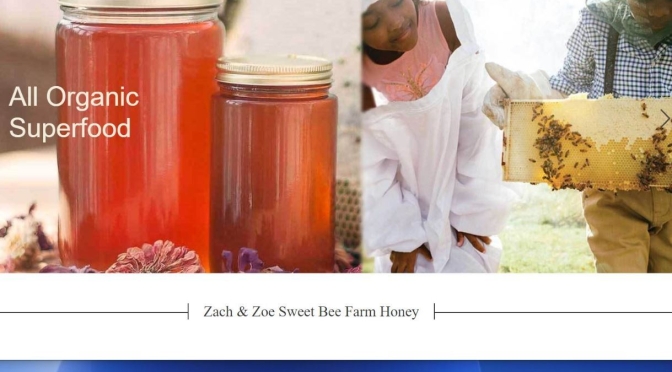
Zach & Zoe Sweet Bee Farm owners Kam and Summer Johnson started keeping bees after learning how raw and local honey could benefit their son, who suffered with asthma and seasonal allergies. After studying how to best keep bees, harvest honey, and keep up their own bee farm, they were able to sell their local honey to restaurants around NYC, and even have a shop in Chelsea Market. https://zachandzoe.co/

Nature & Science: Making Flowers Of Food Plants More Attractive To Insect Pollinators (Cambridge)

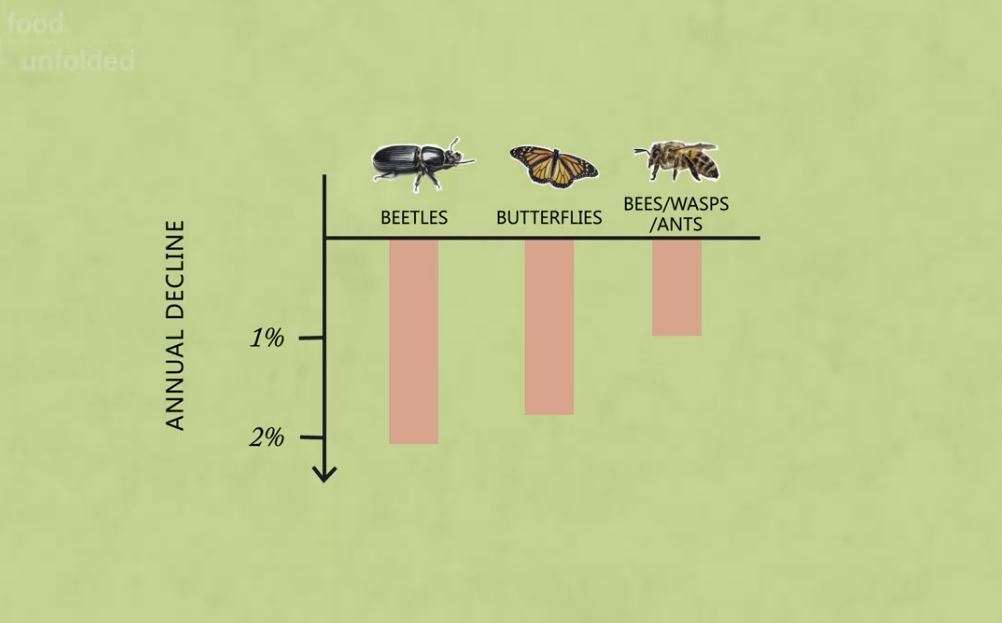
A rising world population means we’ll need more food in the coming years. But much of our food relies on insect pollination, and insects are in decline around the world. Can we make flowers better at being pollinated, to help solve this problem?

Improving flowers to help feed the world Cambridge University Video January 21 2020

Research from the Glover Lab (https://twitter.com/Beverley_CUBG) in the Department of Plant Sciences (https://twitter.com/PlantSci)

Engineering In Nature: “Honeybees Use Their Wings For Water Surface Locomotion” (Caltech)

From a Caltech online article:

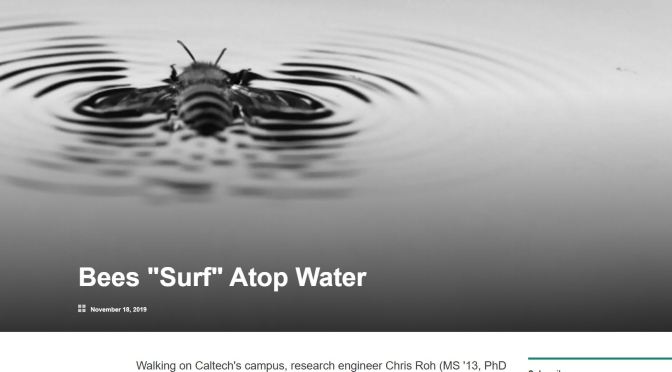
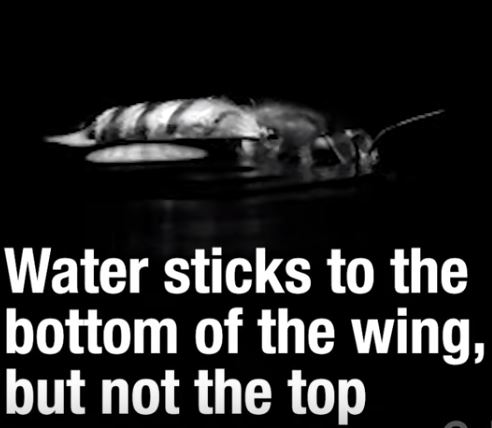
Bees Surf Atop Water to escape CaltechWhen a bee lands on water, the water sticks to its wings, robbing it of the ability to fly. However, that stickiness allows the bee to drag water, creating waves that propel it forward. In the lab, Roh and Gharib noted that the generated wave pattern is symmetrical from left to right. A strong, large-amplitude wave with an interference pattern is generated in the water at the rear of the bee, while the surface in front of the bee lacks the large wave and interference. This asymmetry propels the bees forward with the slightest of force—about 20 millionths of a Newton.

Walking on Caltech’s campus, research engineer Chris Roh (MS ’13, PhD ’17) happened to see a bee stuck in the water of Millikan Pond. Although it was a common-enough sight, it led Roh and his advisor, Mory Gharib (PhD ’83), to a discovery about the potentially unique way that bees navigate the interface between water and air.

To read more: https://www.caltech.edu/about/news/bees-surf-atop-water