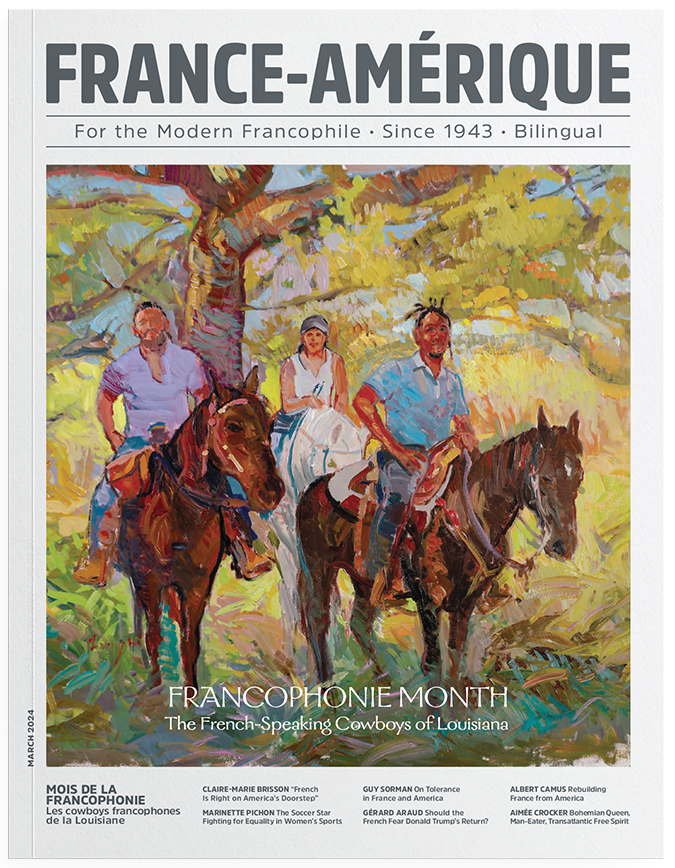
France-Amérique Magazine – March 1, 2024 – The new issue features ‘Francophonie Month’ – The French-Speaking Cowboys of Louisiana.
Meet Drake LeBlanc, the French- and Creole-speaking cowboy, filmmaker, and cofounder of Télé-Louisiane; read our interview with Harvard professor Claire-Marie Brisson on the North American Francosphere; and discover why “Molière may be dead, but his language is alive and well.”
CYRIL DEWAVRIN – The American Dream of a Serial Bookseller
Founding a French neighborhood bookstore in New York City was the madcap challenge undertaken by this avid reader and busy entrepreneur. The Frenchman has just opened La Joie de Vivre near Chelsea, a space offering books in French and English, coffee, and pastries.
By Benoît Georges
Also in this issue, Albert Camus travels to America; former ambassador Gérard Araud analyzes the White House race and its potential consequences for France and Europe; and French soccer star and LGBTQ+ advocate Marinette Pichon discusses her U.S. career and her fight for equality in women’s sports.
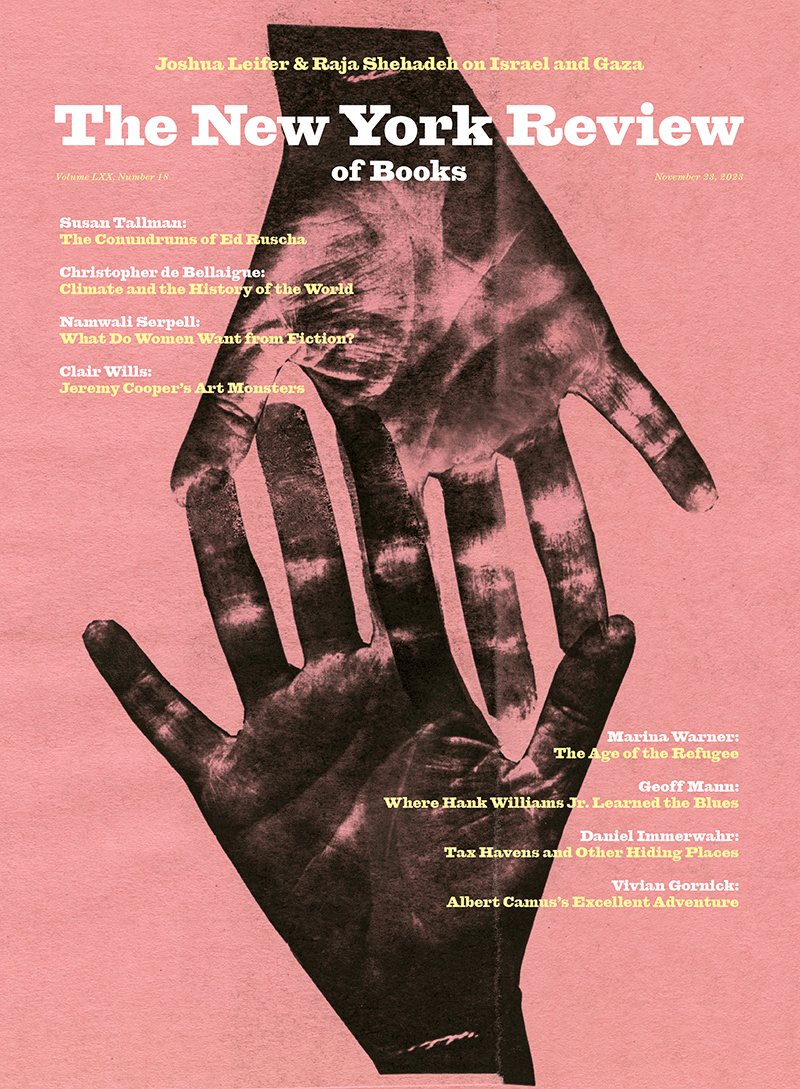
The New York Review of Books (November 23, 2023) – The latest features Inhumane Times – Israel’s current war, the punishment of the Palestinian people and an offensive against Hamas; Camus on Tour – Travels in the Americas: Notes and Impressions of a New World by Albert Camus; Zoning Out – Crack-Up Capitalism: Market Radicals and the Dream of a World Without Democracy by Quinn Slobodian, and more…
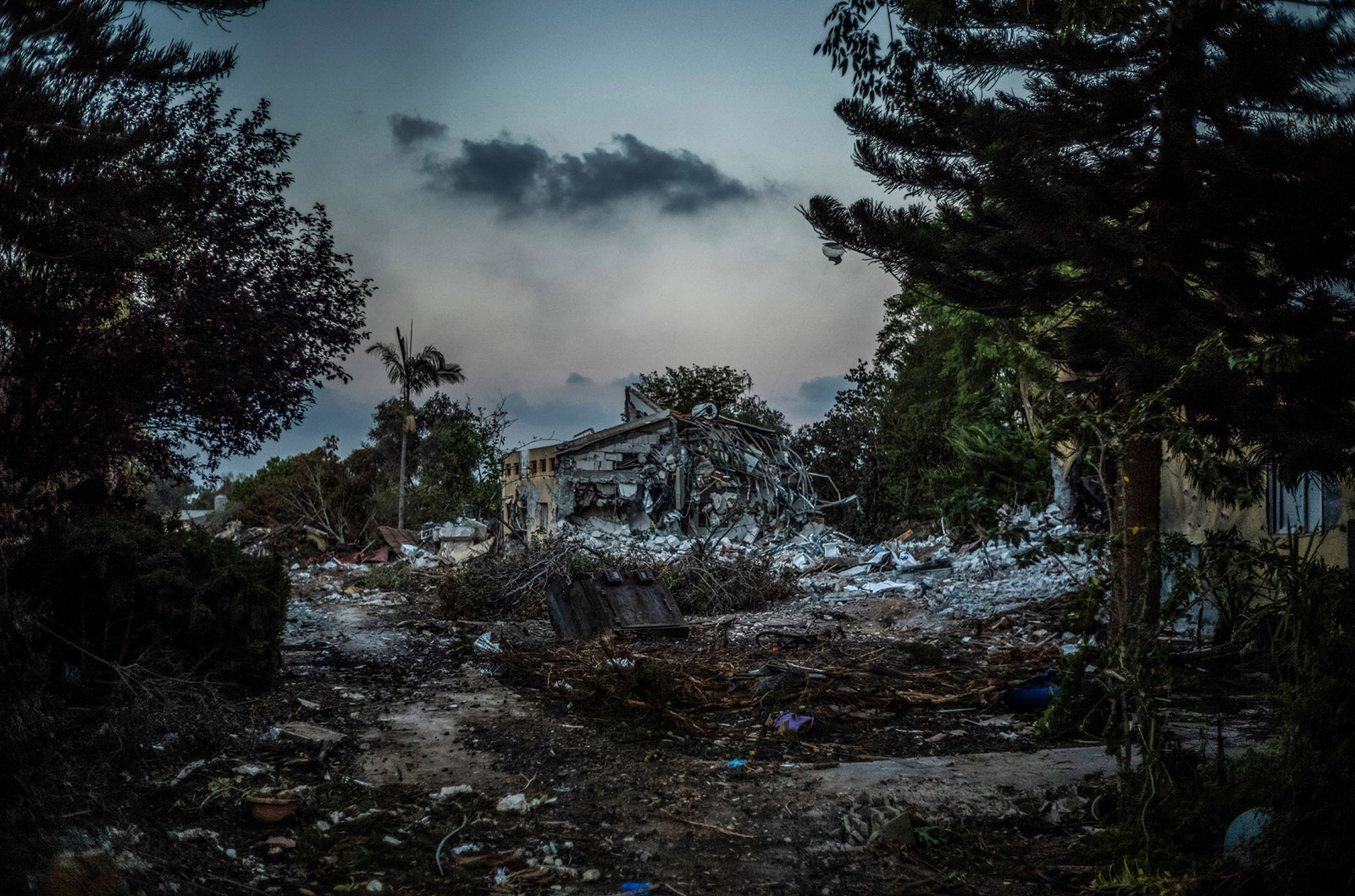
The scenes of devastation in Israel’s south on October 7 were almost beyond description. Children killed in their beds, babies taken from their mothers’ arms, the elderly slaughtered in their kitchens. Kfar Aza, a kibbutz close to the separation barrier with Gaza, was burned nearly to the ground: a charnel house. Between a quarter and a third of nearby Kibbutz Nir Oz’s residents were killed or kidnapped. Roughly 10 percent of Kibbutz Be’eri’s population was murdered. At least a dozen of tiny Kibbutz Holit’s two hundred members are dead. The streets of the city of Sderot were littered with bodies. At an outdoor rave near Kibbutz Reim, more than 260 young men and women were gunned down as they tried to flee.
Most of Albert Camus’s evaluations from his promotional trips across the Atlantic are superficial or laughably snotty. What’s intriguing is how quickly he demands that things make sense.
Nothing in a professional writer’s life more resembles the life of a traveling salesman than the literary book tour. The superficial difference between writers on tour and salesmen on the road is that writers are encouraged to imagine themselves prized personae whose pitch is eagerly awaited by the anonymous crowd, whereas salesmen know themselves to be an intrusion, albeit one with an edge. While both are beggars at the gate, each one singing for a bit of supper, salesmen are independent entrepreneurs, pretty much calling their own shots; writers, on the other hand, are performers in someone else’s show—a talk at ten, a class at twelve, a panel at three, a reading at seven, and oh, did I forget the ten or twelve interviews tucked in at every break in the day?—all the while being dragged around by people otherwise known as “handlers” who every half-hour tell them how much they are loved, how much their work is prized, how many lives it has changed, and yes, they know how tired you must be by now, but would you mind giving just one more very small interview, this guy’s been waiting all day to talk to you.
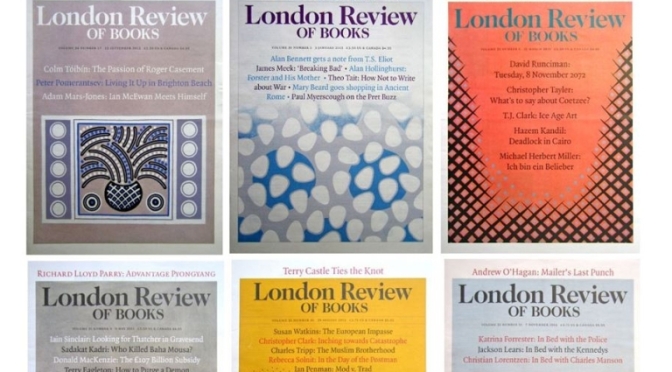
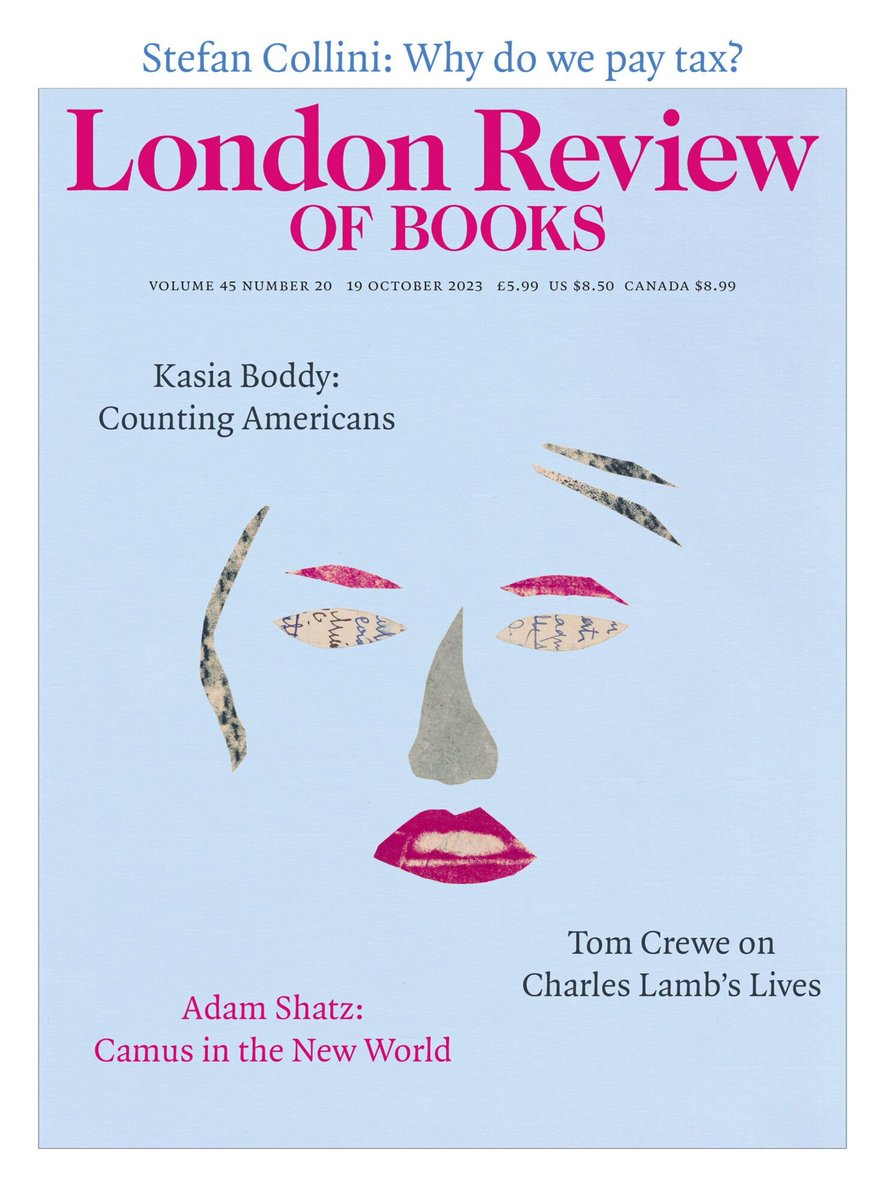
London Review of Books (LRB) – October 19, 2023: The new issue features Camus in the New World; Charles Lamb’s Lives; The Dictionary People: The Unsung Heroes who Created the Oxford English Dictionary and At the Met: On Cecily Brown….
Travels in the Americas: Notes and Impressions of a New World by Albert Camus, edited by Alice Kaplan, translated by Ryan Bloom
Bruno Schulz: An Artist, a Murder and the Hijacking of History by Benjamin Balint
On Nagorno-Karabakh
Democracy’s Data: The Hidden Stories in the US Census by Dan Bouk
March 1946. Albert Camus has just spent two weeks at sea on the SS Oregon, a cargo ship transporting passengers from Le Havre to New York City. He’s made several friends during this transatlantic passage.
In his poem “After Avery R. Young,” the Pulitzer Prize–winning poet Jericho Brown writes, “The blk mind / Is a continuous mind.” These lines emerge for me as a guiding principle—as a mantra, even—when I consider the work of Black poetry in America, which insists upon the centrality of Black lives to the human story, and offers the terms of memory, music, conscience, and imagination that serve to counteract the many erasures and distortions riddling the prevailing narrative of Black life in this country.
As I was going to enter college that fall my parents felt that I should build myself up at a summer camp of some sort. They sent me down to a place in the Ozarks on a beautiful lake. It was called a camp but it was not just for boys. It was for both sexes and all ages. It was a rustic, comfortable place. But I was disappointed to find that most of the young people went to another camp several miles down the lake toward the dam. I spent a great deal of time by myself that summer, which is hardly good for a boy of seventeen.
Albert Camus was a French philosopher, author, and journalist. He won the Nobel Prize in Literature at the age of 44 in 1957, the second-youngest recipient in history. His works include The Stranger, The Plague, The Myth of Sisyphus, The Fall, and The Rebel. Camus was born in Algeria to French Pieds Noirs parents.
Powerful quotations from the great French philosopher Albert Camus. Narrated by Chris Lines. Song: Quiet by Eleven Tales
This week, we’re putting the focus on Nobel Prize-winning French author Albert Camus. As 2020 saw France mark 60 years since his death in a car crash, Camus’s seminal work “The Plague” was unexpectedly thrust back into the spotlight by the Covid-19 pandemic.
From the UK to Japan, the 1947 novel established itself as a global sensation, topping sales charts and pushing publishers into a rushed reprint. But Camus’s prolific and multi-faceted career extends far beyond this viral hit. We tell you more about the author’s life, starting with his humble beginnings in French-ruled Algeria.
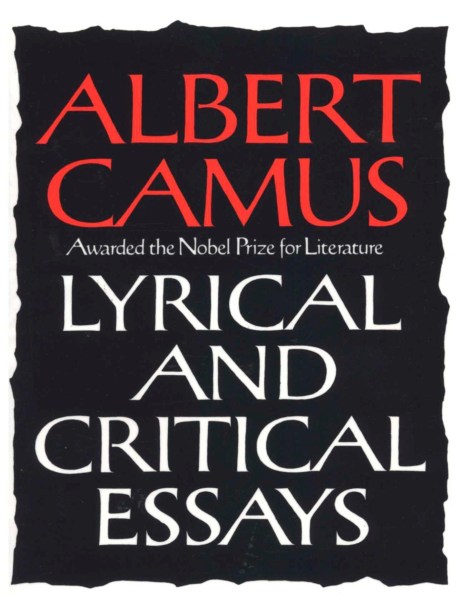
Albert Camus’ lyrical essay… where he found In the midst of winter, there was, within himself, an invincible summer.
Excerpt from “Return To Tipasa” by Alber Camus
You have navigated with raging soul far from the paternal home, passing beyond the sea’s double rocks, and you now inhabit a foreign land.
–Medea
For five days rain had been falling ceaselessly on Algiers and had finally wet the sea itself. From an apparently inexhaustible sky, constant downpours, viscous in their density, streamed down upon the gulf. Gray and soft as a huge sponge, the sea rose slowly in the ill-defined bay. But the surface of the water seemed almost motionless under the steady rain. Only now and then a barely perceptible swelling motion would raise above the sea’s surface a vague puff of smoke that would come to dock in the harbor, under an arc of wet boulevards. The city itself, all its white walls dripping, gave off a different steam that went out to meet the first steam. Whichever way you turned, you seemed to be breathing water, to be drinking the air.
News, Views and Reviews For The Intellectually Curious










 You have navigated with raging soul far from the paternal home, passing beyond the sea’s double rocks, and you now inhabit a foreign land.
 Boomers Daily