Profiles: Swiss Artist Builds His Own Habitat

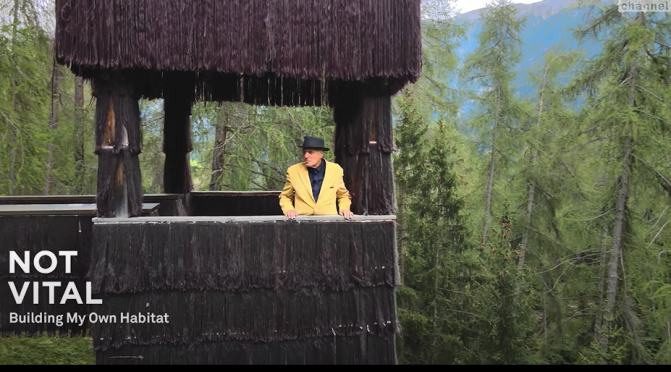
“If you’re a painter, you need a canvas. If you’re a sculptor, you need marble or plaster. And if you build a house, you need a piece of land.” Welcome to the wonderful world of Not Vital. The Swiss multi-faceted artist shows us his sculpture park, foundation, and castle in this video.

We meet Not Vital in his studio in Sent, the town in Switzerland where he grew up and one of the places where he still lives. Building places to live have been with him since childhood: “My first work was more related to trying to build a house or a habitat. The first one was when I was only three years old in 1951. There was so much snow that my brother and I built a tunnel,” he says and continues: “I think that it was the first time I realised that I like to build my own habitat.

Even though it was much more comfortable to live in the house, I spent the day in the tunnel. I remember the light, the smell of the snow. I just felt great.” Through the years, Vital has led a nomadic life, seeking and building homes in various cities around the globe: Paris, New York, Beijing, Rio de Janeiro. He has bought an island made of Marble in Patagonia, called NotOna.

In Niger, he has built a house whose only purpose is to watch the sunset. He calls these hybrids of sculpture and architecture ‘Scarch’: “It opened up a whole new world for me, which became very important. I’m calling that ‘Scarch’ because it’s a kind of sculpture and architecture. Because I’m not an architect, I didn’t want to be an architect or study architecture because I would probably have gone in a different direction.” Buying pieces of land worldwide is essential for his artistic practice.

He explains: “If you’re a painter, you need a canvas. If you’re a sculptor, you need marble or plaster. And if you build a house, you need a piece of land. That’s kind of all related.” ‘Scarch’ is not the only thing Vital makes. He also creates sculptures in silver, makes humorous wordplays with antlers and paints portraits: “I want to show the way I see. I don’t want to change anything.”

The portraits he started painting in 2008. Often they depict the people surrounding him. Other times, it is significant artists such as a young Rembrandt and Nina Simone. “When I paint, I think about a lot of Rothko. The colours. How to put two colours together. But of course, this is figurative,” Vital reflects and continues: “Actually, they have everything in it. They have eyes and noses.

And that’s great by painting that whatever you put in the canvas stays in the canvas. Even though you paint it over, it’s still there.” Not Vital does not differ between the many different artforms he works with: “Art is one. It doesn’t matter if it’s the 15th century or if it’s now. It’s all related.” Not Vital (b. 1948) is a Swiss artist who works in diverse media across installations, paintings, drawings and sculptures, typically integrating architecture. Vital divides his time between the U.S., Niger, Italy, China and Switzerland, and his art is centred on personal impressions and experiences from around the world. This somewhat anthropological approach is also reflected in how his career is structured into sections, e.g. glass blowers in Murano or paper artists in Bhutan. Vital’s work has been featured in the 49th Venice Biennale in Italy (2001), and he has held significant exhibitions at prominent venues such as the Kunsthalle Bielefeld in Germany (2005), The Arts Club of Chicago in the U.S. (2006), Ullens Center For Contemporary Art in Beijing, China (2011), the Museo d’arte di Mendrisio in Switzerland (2014-15) and Galerie Thaddaeus Ropac, London (2021).
Walking Tours: Liège In Eastern Belgium (4K)

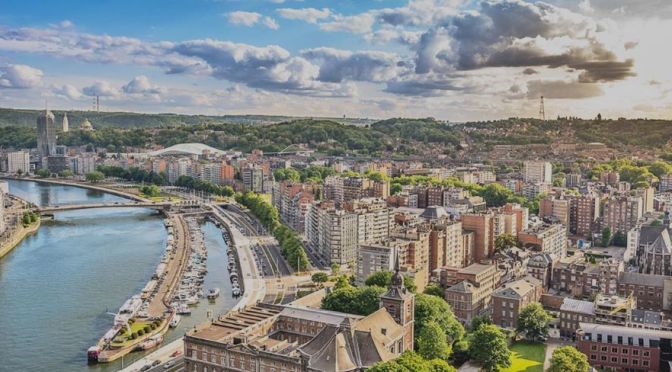
Liège, a city along the Meuse River in Belgium’s French-speaking Wallonia region, has long been a commercial and cultural hub. Its old town is filled with landmarks dating to the medieval era, including the Romanesque Church of St. Bartholomew. The Grand Curtius museum houses archaeological treasures and art within a 17th-century mansion, while Opéra Royal de Wallonie has staged operas since 1820. 

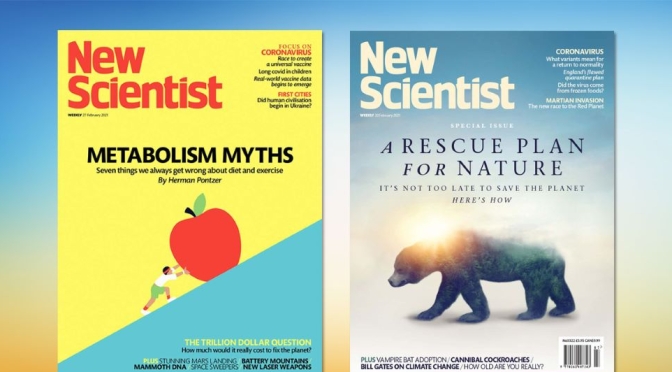
Previews: New Scientist Magazine – February 5

New Scientist Default Image

COVER STORIES

  • CULTUREClimate fiction has come of age – and these fabulous books show why
  • FEATURESDo we create space-time? A new perspective on the fabric of reality
  • FEATURESChristopher Jackson interview: How geologists can fight climate change
  • FEATURESInteroception: This ‘sixth sense’ could be key to better mental health
  • NEWS160,000-year-old fossil may be the first Denisovan skull we’ve found
  • NEWSSome bee colonies have to kill thousands of ‘selfish’ wannabe queens
  • NEWS

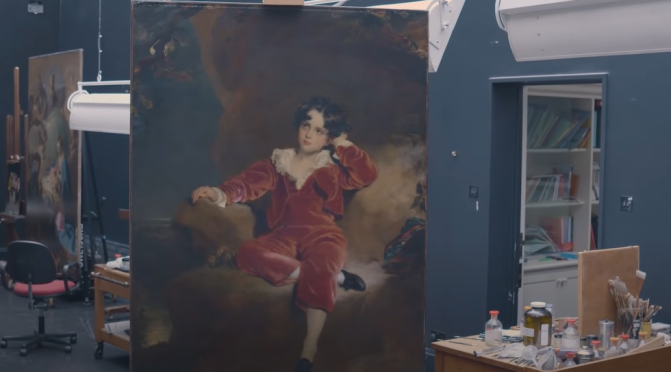
Inside British Art: ‘The Red Boy’ By Thomas Lawrence

Restorer Paul Ackroyd gets ‘The Red Boy’ ready to be displayed in the Gallery.

The Red Boy, or Master Lambton, are popular names for a portrait made in 1825 by Sir Thomas Lawrence. It is officially entitled with the name of its subject, Charles William Lambton, who was the elder son of John Lambton.

Paul Ackroyd, restorer, is cleaning ‘The Red Boy’, an iconic painting by Sir Thomas Lawrence. It was so popular it was the first-ever painting to feature on a British postage stamp.

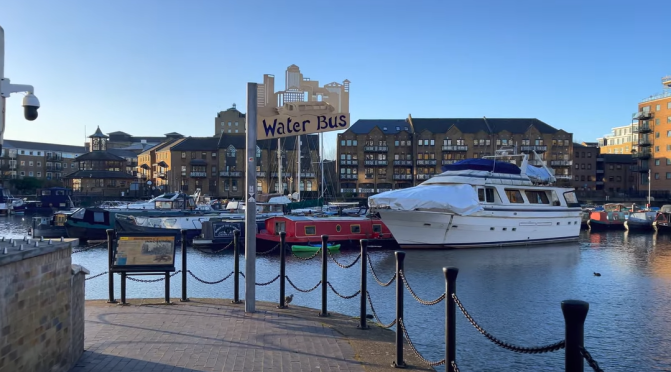
Riverfront Walks: The London Docklands (4K)

Early morning walk in London’s Docklands, starting from Limehouse Basin to St Katherine’s Dock on January 31, 2022.

London Docklands is the riverfront and former docks in London. It is located in inner east and southeast London, in the boroughs of Southwark, Tower Hamlets, Lewisham, Newham, and Greenwich. The docks were formerly part of the Port of London, at one time the world’s largest port.

Morning News: French Election Polls, Soaring Debt, Saudi Weddings

In the first instalment of the series, we unveil our forecast model and visit one of the quiet suburbs where the vote’s outcome will probably be decided

Debt has soared as borrowing costs stayed low; we examine who will foot the enormous interest bills as rates rise. And the one place where marriages increased in the pandemic era. 

New Books: ‘South To America’ By Imani Perry

In her new book “South to America,” author Imani Perry seeks to change how people view the American South and, thus, the country’s history as a whole. Jeffrey Brown spoke with Perry, who traveled through the southern regions of the U.S. and explored the complexities and misperceptions she found along the way.

Science: Water Flow And Quantum Friction, Super Soap Bubbles, Hippos

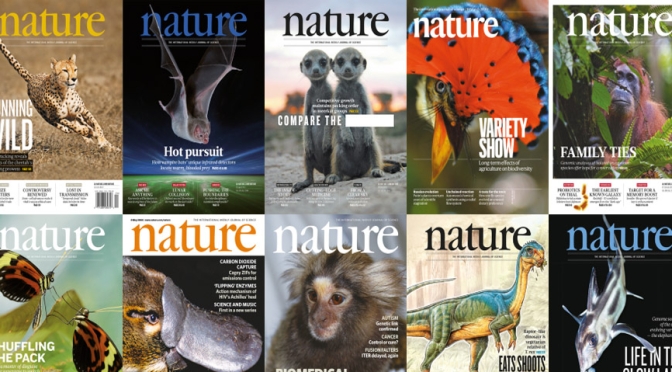
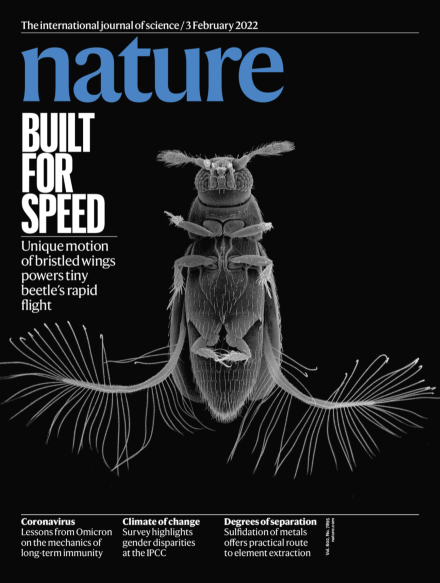
How quantum friction explains water’s strange flows in carbon nanotubes, and the latest from the Nature Briefing.

In this episode:

00:53 A theory for water’s baffling behaviour in carbon nanotubes

At large scales, water flows faster through a wider pipe than a narrower one. However, in tiny carbon nanotubes flow-rate is flipped, with water moving faster through the narrowest channels. This week, researchers have come up with a new explanation for this phenomenon: quantum friction. If validated, it could allow material designers to fine-tune flows through tiny channels, which could be useful in processes such as water purification.

Research Article: Kavokine et al.

06:43 Research Highlights

Creating soap bubbles that last 200,000 times longer, and hippos’ habit of aggressively spraying dung when they hear a stranger.

Research Highlight: No bursting for these record-breaking bubbles

Research Highlight: Hippos know strangers’ voices — and make a filthy reply

09:08 Briefing Chat

We discuss some highlights from the Nature Briefing. This time, a global study reveals how antibiotic-resistant infections have led to millions of deaths, and a genetic mutation that plays a big role in a dog’s size.

Nature News: The staggering death toll of drug-resistant bacteria

Nature News: Big dog, little dog: mutation explains range of canine sizes

Nature Video: 

News, Views and Reviews For The Intellectually Curious