

Expensive, massive and lethal, the aircraft carrier has been the cornerstone of American security for close to a century, but with advances in missile design, will it remain on top? Aircraft carriers are expensive. The latest carrier in the U.S. Navy, part of what’s called the Ford class, costs $12.8 billion per ship, and that’s before the cost of fixing new technology, aircraft flying off the deck and the cost of operating the carrier in the high seas for months at a time. The U.S. has more active aircraft carriers than every other country in the world combined. The U.S. Navy currently has ten Nimitz-class carriers, one Ford-class carrier and nine amphibious assault ships, which are smaller and focus on helicopters and short takeoff and vertical landing aircraft. A Nimitz-class carrier can carry a mix of F/A-18E/F Super Hornets, E-2D Hawkeye surveillance aircraft and an assortment of other support aircraft and helicopters. The carrier fighter of the future is the F-35C. But to field the new aircraft, most U.S. carriers will need to be upgraded.
Category Archives: Technology

World Economy: ‘China’s New Silk Road’ (Video)
The “New Silk Road” is an enormous Chinese international development project. It’s a trade network that involves Asia, Africa, and Europe — and more than 70 countries are already involved. It may turn the old world order upside down. China is investing in bridges, port facilities, railroads, and roads around the world. Beijing is spending several hundred billion euros on what it calls the “Silk Road Economic Belt.” Eastern European and the Balkan countries in particular are interested in Chinese loans and investments, as they look beyond the EU for sources of capital. In turn, the region is attractive to China because of its strategic position as a gateway to the West. A new coal-fired power plant is being built in Tuzla, Bosnia, with the help from China. But not everyone is in favor of the project. While the new plant will emit fewer emissions which will have a positive effect on air-quality, some question the country’s decision to commit to using coal for decades to come.
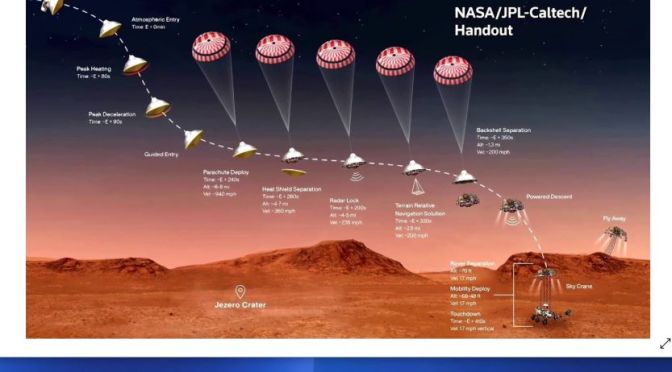
Space Flight: NASA Rover ‘Perseverance’ Lands on Mars To Search for Life
NASA’s science rover Perseverance, the most advanced astrobiology laboratory ever sent to another world, streaked through the Martian atmosphere and landed safely on the floor of a vast crater.

Investigation: Why The Emergency ‘911 System’ Is Broken’ (CNBC Video)
More than 80% of calls to 911 come from a cellphone and often from a high-rise. But the over 5,000 locally run 911 centers, or public safety answering points (PSAP) aren’t easily able to track those callers. Fixing the system could save more than 10,000 lives and $97 billion per year according to the FCC.
Major companies like Apple, Google, Motorola and startups like RapidSOS have tried to fill the technology gap, but so far, that’s not enough. Watch the video to understand the conundrum of a large and fragmented national system that is run and funded locally, and how the federal government may be its only hope for a complete overhaul. “We’re talking about diversity of equipment connecting across these IP networks in a very complex manner,” said Capt. Mel Maier of the Oakland County Sheriff’s Office in Michigan.
“And if there are proprietary interfaces anywhere in between there, they’re not going to be able to talk. … Our technology is continually trying to catch up and playing catch up.” A number of companies including Apple, Motorola and start-ups are trying to fill the technology gap. RapidSOS is a data integration platform that has been adopted free of charge in about 4,800 PSAPs. According to the company, it covers about 92% of the country and assists in 150 million emergencies per year.
“We’re just scratching the surface of the amount of data that we could be using,” said Michael Martin, CEO of RapidSOS. “We’re passing precise location for most 911 calls now. But you can imagine all the capabilities, like in a fire if your building could talk or if your device could detect a heart attack and immediately transmit that through.” According to Maier, who is also chairman of the Public Safety Next Generation 9-1-1 Coalition, the tech industry can’t do it on its own.
He says carriers also have a responsibility, especially when it comes to addressing the altitude problem. But in the end, he says, the federal government is needed. He’s hoping Congress will pass legislation for $15 billion toward a complete overhaul. In July, a $1.5 trillion infrastructure bill that included $12 billion toward 911 passed the House but stalled in the Senate.

Aviation: The Challenges Ahead For Electric Planes
It’s been a tough 12 months for the airline industry, hit hard by the Covid-19 #pandemic. But there are also ongoing concerns about the environmental impact of air travel. Could electric planes be a way forward? They are already being trialled in Slovenia and fully #electric, commercial flights could be ready to take off in just 10 years’ time. Our colleagues from France 2 report, with FRANCE 24’s James Vasina.

Reviews: ’10 Best Electric Bikes Under $2,000′ (Video)
Looking for the best electric bikes for under $2000? Beginning only a fun fad and an interesting twist on the humble bicycle, electric bikes have seen a considerable rise in popularity over the past decade. Improved designs, high-capacity batteries, and fast charging capabilities have transformed the electric bike into a multi-billion-dollar industry. So, let’s check out our picks for the 10 best electric bikes in 2021, highly-rated and affordable, between $600 and $1699.

Racing Design: ‘Airspeeder’ Flying Electric Car (Video)
“It’s not a concept anymore, it’s not abstract anymore – it’s real.” Meet flying racing car Head Designer Felix Pierron, tasked with creating future flying machines.
Airspeeder is the world’s first racing series for electric flying cars. Our mission will accelerate eVTOL (electric vertical take-off and landing) advanced aviation technology through intense sporting competition. This mobility revolution, underpinned by future tech will transform urban air mobility (UAM), global logistics and even medical applications with a clean-air electric vehicle (EV) solution.
Our racing multicopters are developed at our advanced aerospace engineering hub in Adelaide, South Australia by engineers drawn from elite motorsports, automotive, aviation and even FPV drone, electric plane, electric vehicles and passenger drone backgrounds. Airspeeder’s vision will deliver the most exciting and future focused motorsport on the planet. Following an inaugural unmanned season, elite pilots will take to the skies to race prop-to-prop while navigating electronically governed racetracks in the skies above some of the most visually arresting scenery in the world.
These manned multirotor electric vehicles will define a new era in advanced air mobility (AAM). Airspeeder’s first unmanned air race is scheduled for 2021 and will feature a full grid of multirotor unmanned Airspeeder Mk3 racing craft. The best pilots from drone racing will utilise latest RPAS (remotely piloted aircraft systems) in aerial battles across the globe. Our innovations will hasten the arrival of new advanced air mobility (AAM) technologies. Close but safe air racing is assured through latest LiDAR and radar technologies that create virtual forcefields around the sport’s cutting edge quadcopter format flying cars.
Rapid hair-pin turning manoeuvrability is delivered using a multicopter layout. This pioneering approach to aircraft design also enhances stability while electronic speed control (ESC) systems empower pilots to exploit the full potential of our advanced electric powertrains.

Review: ‘Pocketalk S Voice Translator’ – Better Than Learning New Language?
Can a device replace the need to learn a new language? WSJ asked Alex Rawlings, author of “How To Speak Any Language Fluently,” and an expert in over 15 languages, to test out the new Pocketalk S Voice Translator on the streets of Barcelona.

Exercise : A Review Of Top High-Tech Fitness Apps And Equipment (Video)
Now that the season is behind us, former NFL legend Clay Matthews and CNET’s Kara Tsuboi demonstrate how to use tech to train like the pros.

Space Programs: ‘The Search For Life On Mars’
China, the UAE and the U.S. all have spacecraft visiting Mars in February to study the Red Planet. WSJ explains how out-of-this-world technology is being used by NASA’s Perseverance and China’s Tianwen-1 in the search for evidence of life beyond our planet. Photo: NASA
 Boomers Daily