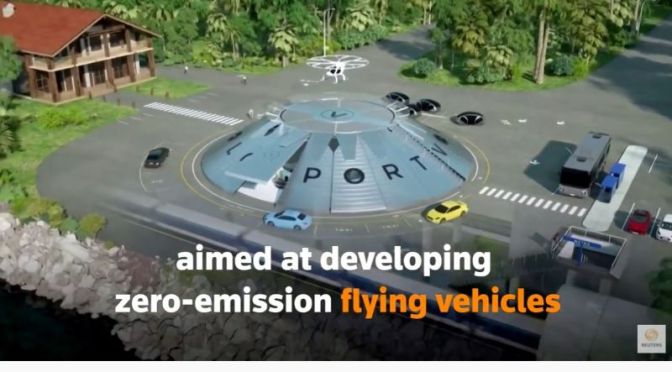
An airport for flying cars will thrust the English city of Coventry into the future later this year, with a project aimed at demonstrating how air taxis will work in urban centers.
Category Archives: Technology
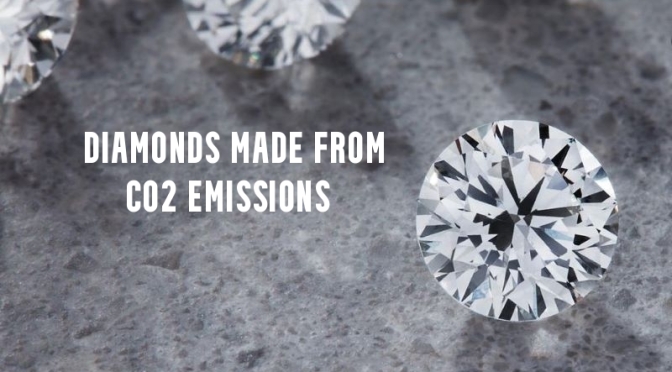
Innovation: Diamonds Made From CO2 Emissions
A UK company named Skydiamond hopes to revolutionize the traditional diamond mining industry by using carbon capture technology to do just that. The company calls it a ‘zero-impact diamond’ because the process pulls carbon dioxide right out of the air.
Although, a diamond traps only a modest amount of carbon — one carat contains just 200 milligrams. Pure carbon can take many forms — it all depends on how the atoms are arranged. Graphite is arranged into multiple layers, graphene in a single layer, and if it’s rolled-up, it forms carbon nanotubes. But when each carbon forms 4 strong bonds in a tetrahedral structure, it becomes a diamond.
Most natural diamonds were formed over a billion years ago, more than 120 kilometers beneath the Earth’s surface. This is where intense temperature and pressure cause carbon atoms to strongly bond together and arrange into crystal structures. Volcanic eruptions bring these crystals embedded in magma to the surface. When the magma cools, it hardens in long vertical shafts called kimberlite pipes. And these pipes are what’s sought after in the mining industry.
Analysis: How America Can Build & Run A 100% Clean Electric Grid (Video)
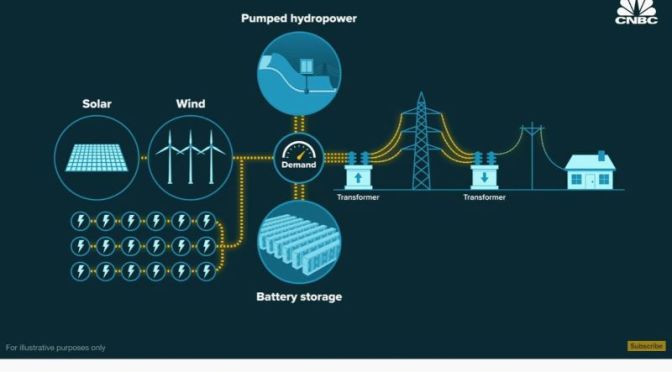
The U.S. electric grid is outdated. Designed for a world that runs on fossil fuels, our grid needs some major tech upgrades in order to transition to a more distributed, all-renewable system. That means smart, internet connected hardware working in tandem with advanced data analytics software to ensure that supply and demand are balanced, even when the sun isn’t shining or the wind isn’t blowing.
Analysis: ‘Preventing The Next Pandemic’ – Bill Gates
The unfortunate reality is that COVID-19 might not be the last pandemic. The threat of the next pandemic will always be hanging over our heads—unless the world takes steps to prevent it. You can learn more about this topic in our 2021 Annual Letter at http://gatesnot.es/3a5KOLU
Next-Gen Food: ‘Vertical & Underwater Farming’
Vertical Farming might have some implications but there is an unknown farming method that could revolutionize the industry and help us fight climate change.
Digital Health: The Future Of Wearable Devices


Currently, smartwatches provide information such as heart rate, sleep time and activity patterns. In the future, this could be augmented with new classes of wearable devices that monitor, for example, concentrations of cortisol for tracking stress (using electronic epidermal tattoos), biomarkers of inflammation and levels of blood O2 (microneedle patches), skin temperature (electronic textiles), blood pressure (smart rings), concentration of ions (wristbands), intraocular pressure (smart contact lenses), the presence of airborne pathogens and breathing anomalies (face masks), and the concentration of therapeutic drugs (on-teeth sensors)2,10,12,13,14,15,16. Such emerging low-cost wearable sensing technologies, monitoring both physical parameters and biochemical markers, could be used to identify symptomatic and pre-symptomatic cases in future pandemics. The devices could also be used to remotely monitor the recovery of individuals undergoing treatment or self-isolating at home.
Analysis: ‘Why Credit Card Fraud Is Rising’ (Video)
In 2019, payment card fraud losses reached nearly $28 billion worldwide. The United States alone is responsible for more than a third of the total global loss making America the most card fraud-prone country in the world. The economic cost of credit card fraud goes far beyond the cost of illegally purchased merchandise; businesses often spend millions to protect themselves from fraud, buying software and hiring security experts to monitor transactions. Experts say there aren’t enough regulations to help protect the U.S. economy, especially small businesses from card fraud.
High-Speed Transport: ‘Hyperloop TT vs Virgin’
Seven years after Elon Musk first challenged innovators to develop a functioning hyperloop system, Richard Branson-backed Virgin Hyperloop and Hyperloop TT are in a race to bring the high-speed transportation technology into the real world. Photo illustration: George Downs
Science & Wildlife: ‘The Bird Genoscape Project’
Billions of birds migrate annually across the Western Hemisphere… but if we don’t know where they go when they leave their breeding grounds, how can we protect them? By extracting DNA from individual feathers (and borrowing cutting-edge technology from the Human Genome Project) scientists can map bird migration with greater precision than ever before. The result is the Bird Genoscape Project, and it’s revolutionizing bird conservation by connecting migratory birds – and the people who care about them – across the Americas. This work was funded by the National Geographic Society. Learn more at http://www.natgeo.org.
Analysis: China’s Aircraft Manufacturer ‘Comac’ Tests New Passenger Jet
As the pandemic continues to weigh on the aviation industry, Chinese aircraft manufacturer Comac has been pushing ahead with testing a new passenger jet. If successful, the C919 could rival Boeing and Airbus in the largest aviation market in the world. Photo illustration: Sharon Shi