
Category Archives: Economics

Opinion: Global Fertility’s Crash, Scotland Populism Unravels, Bad Bunny Rises

‘Editor’s Picks’ Podcast (June 5, 2023) A selection of three essential articles read aloud from the latest issue of The Economist. This week, the economic consequences of the global collapse in fertility, Scotland’s holiday from reality (10:10) and the business of the rapper, Bad Bunny (18:10). 

Global fertility has collapsed, with profound economic consequences

What might change the world’s dire demographic trajectory?

Even as artificial intelligence (ai) leads to surging optimism in some quarters, the baby bust hangs over the future of the world economy.

Scotland has been on a ten-year holiday from reality

Populism can unravel quickly. But its effects are long-lasting

Scotland was the first part of Britain to get high on populist referendums. In 2014, two years before the Brexit vote, the Scottish independence campaign exhorted people to ignore the experts and revel in a glorious national renewal.

Bad Bunny, a superstar rapper, is good business

PHILADELPHIA, PENNSYLVANIA - SEPTEMBER 04: Bad Bunny attends Made In America Festival on September 04, 2022 in Philadelphia, Pennsylvania. (Photo by Shareif Ziyadat/WireImage)

On Spotify and Netflix Spanish seems to be taking over the world

In November Spotify crowned Bad Bunny, a rapper from Puerto Rico, its most-streamed artist for the third year in a row.

Previews: The Economist Magazine – June 3, 2023

Image

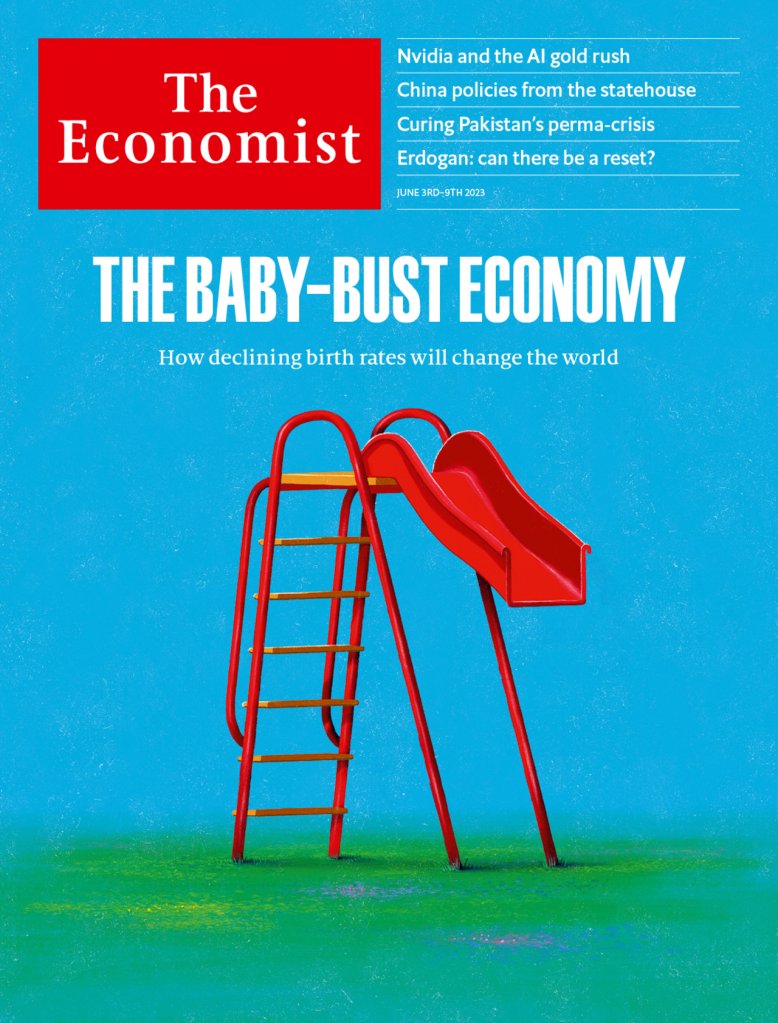
The Economist Magazine– June 3, 2023 issue: The baby-bust economy: How declining birth rates will change the world.

Global fertility has collapsed, with profound economic consequences

What might change the world’s dire demographic trajectory?

In the roughly 250 years since the Industrial Revolution the world’s population, like its wealth, has exploded. Before the end of this century, however, the number of people on the planet could shrink for the first time since the Black Death. The root cause is not a surge in deaths, but a slump in births. Across much of the world the fertility rate, the average number of births per woman, is collapsing. Although the trend may be familiar, its extent and its consequences are not. Even as artificial intelligence (ai) leads to surging optimism in some quarters, the baby bust hangs over the future of the world economy.

How to make the re-election of Recep Tayyip Erdogan less bad news

Turkish President and People's Alliance's presidential candidate Recep Tayyip Erdogan gestures to supporters at the presidential palace, in Ankara, Turkey, Sunday, May 28, 2023. Turkey President Recep Tayyip Erdogan won reelection Sunday, extending his increasingly authoritarian rule into a third decade as the country reels from high inflation and the aftermath of an earthquake that leveled entire cities. (AP Photo/Ali Unal)

There is a chance for a partial reset

It certainly wasn’t fair. Nor was it entirely free. But, like it or not, the victory on May 28th of Recep Tayyip Erdogan in Turkey’s presidential election is a fact. For the next five years Turkey, Europe and the wider world will have to deal with a prickly and authoritarian populist. That is bad news on many fronts: economically, democratically and regionally. And yet pragmatists have a duty to search for chinks of light in the gloom.

It’s not just a fiscal fiasco: greying economies also innovate less

That compounds the problems of shrinking workforces and rising bills for health care and pensions

“Adam is a special child,” says the voice-over, as the camera pans across abandoned classrooms and deserted maternity wards. “He’s the last child born in Italy.” The short film made for Plasmon, an Italian brand of baby food owned by Kraft-Heinz, a giant American firm, is set in 2050. It imagines an Italy where babies are a thing of the past. It is exaggerating for effect, of course, but not by as much as you might imagine. The number of births in Italy peaked at 1m in 1964; by 2050, the un projects, it will have shrunk by almost two-thirds, to 346,000.

Opinion: Trump Will Win GOP Bid, National Health Service Fix, “Away Days”

‘Editor’s Picks’ Podcast (May 29, 2023) Three essential articles read aloud from the latest issue of The Economist. This week, why Donald Trump is very likely to be the Republican nominee for president, how to fix Britain’s National Health Service (09:55) and companies’ “away days” are getting unnecessarily creative (17:15).

Previews: The Economist Magazine – May 27, 2023

Image

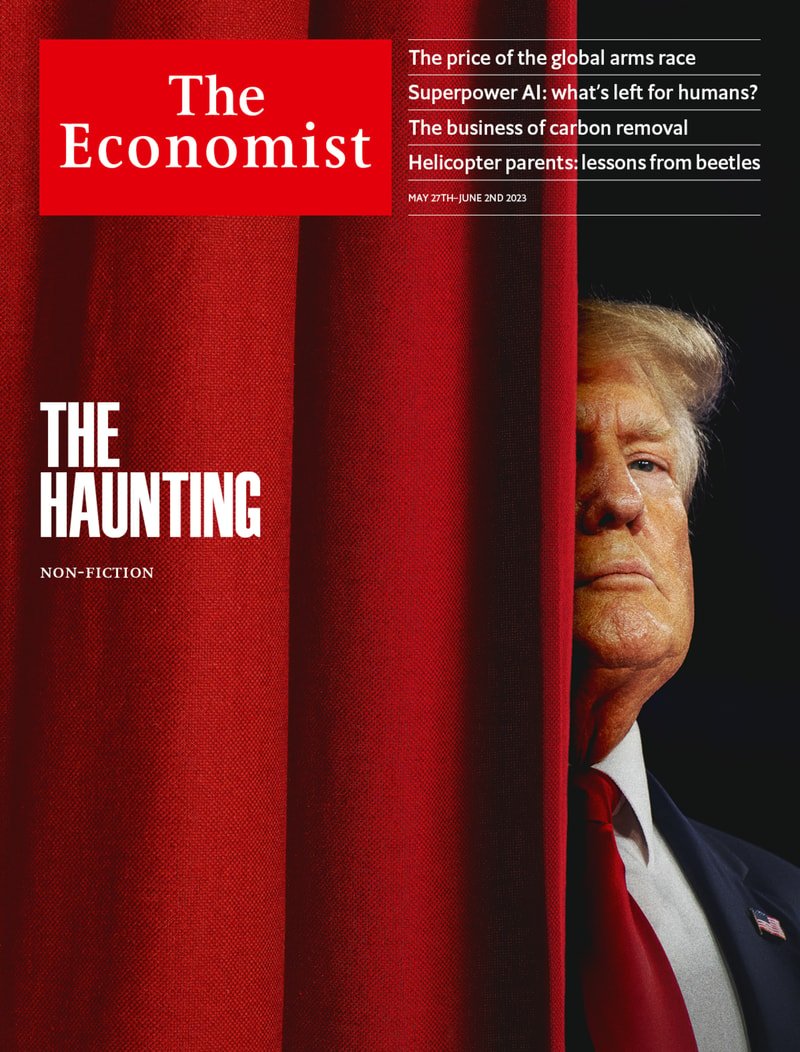
The Economist Magazine– May 27, 2023 issue: The race to become the Republican nominee for the presidential election in America next year is properly under way. And Donald Trump has a huge, perhaps insurmountable, lead. 

Ron DeSantis has little chance of beating Donald Trump

Hopes of depriving the former president of the Republican nomination are fading

Belatedly and nervously, the would-be assassins have been lining up. On May 22nd Tim Scott, a senator from South Carolina, became the latest Republican to announce a run for president. Greater fanfare accompanied the official declaration (on Twitter) on May 24th that Ron DeSantis, the governor of Florida, is joining the race for the Republican nomination. He has been widely heralded as the candidate with the best chance of defeating the favourite, Donald Trump. But even as more plotters step forward, the chances of a successful coup to overthrow Mr Trump are growing slimmer by the day.

What would humans do in a world of super-AI?

A thought experiment based on economic principles

In “wall-e”, a film released in 2008, humans live in what could be described as a world of fully automated luxury communism. Artificially intelligent robots, which take wonderfully diverse forms, are responsible for all productive labour. People get fat, hover in armchairs and watch television. 

Hungary is becoming more important to China

Viktor Orban and Xi Jinping bond over their anti-Americanism

To ears accustomed to a swelling chorus of China-scepticism in the European Union, the language of Hungarian diplomats is striking. Not for them the common talk of European officials about the need to “de-risk” relations with China and to treat it as a “systemic rival”. Co-operation between Hungary and China presents “opportunities rather than risks”, said Hungary’s foreign minister, Peter Szijjarto, in Beijing on May 15th. Wang Yi, China’s foreign-affairs overlord, told him that relations between the countries had entered their “best period in history”.

Politics: The Independent Review – Spring 2023

The Independent Review - Spring 2023 https://scientificmagazines.top/the -independent-review-spring-2023 | VK


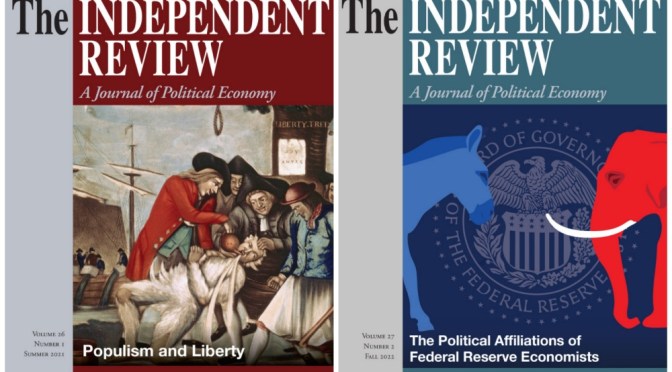
Independent Institute (May 22, 2023) – In this issue: A tongue-in-cheek playbook for the national-security elite on how to run wars; monetary policy during the Great Depression and Great Recession; a critical review of child support enforcement; the history of labor rights in Brazil; and more.

Crisis and Credit Allocation: The Effect of Ideology on Monetary Policy during the Great Depression and the Great Recession

By James L. Caton

The Lords of Easy Money: How the Federal Reserve Broke the American Economy

By Christopher Leonard

The Economic Weapon: The Rise of Sanctions as a Tool of Modern War

By Nicholas Mulder

Opinion: Kissinger’s World Order, Digital Payments, Taliban’s Animal Welfare

‘Editor’s Picks’ Podcast (May 22 , 2023) A selection of three essential articles read aloud from the latest issue of The Economist. This week, Henry Kissinger on the new world order, how the fight for digital payments is going global (10:50) and why the Taliban is going big on animal welfare (17:10). 

Previews: The Economist Magazine – May 20, 2023

Business | May 20th 2023 Edition

The Economist – May 20, 2023 issue:

Joe Biden’s global vision is too timid and pessimistic

The president underestimates America’s strengths and misunderstands how it acquired them

In the 1940s and early 1950s America built a new world order out of the chaos of war. For all its shortcomings, it kept the peace between superpowers and underpinned decades of growth that lifted billions out of poverty. Today that order, based on global rules, free markets and an American promise to uphold both, is fraying. Toxic partisanship at home has corroded confidence in America’s government. 

China and the West take a step to ease Africa’s debt crisis

A deal for Ghana is the first test case for a new approach

A man holds a 100 cedis, the Ghana currency, note in Accra, Ghana, on December 1, 2022. - Ghana is battling its worst economic crisis in decades.The government on December 14, 2022 signed a $3 billion bailout deal with the International Monetary Fund in a bid to shore up its public finances, but economic stability is still a way off.Once applauded as a haven of economic stability and security in a region plagued by coups and jihadist wars, Ghana has steadily lost investor confidence as its economy slipped into crisis. (Photo by Nipah Dennis / AFP) (Photo by NIPAH DENNIS/AFP via Getty Images)

Ghana made history when it led the wave of sub-Saharan African countries that won independence more than six decades ago. It may now be making history again, as the first test case for a new approach to debt relief. China and Western governments may have overcome one barrier to restructuring the billions of dollars owed by countries with unsustainable debts.

Financial Technology: Is There A Crypto Future?

The Economist (May 18, 2023) – The financial revolution once promised by cryptocurrencies has been knocked off course by regulators and allegations of fraud. So what does the future hold for crypto?

Video timeline: 00:00 – The crypto party is over 01:06 – The history 03:30 – What is crypto? 04:38 – Uses around the world 06:07 – Layer 2 solutions 07:12 – Web3 08:51 – Data and privacy 10:04 – What is the future of crypto?

Opinion: China’s Power Is Peaking, Jobs Safe From A.I., Mexico Criminal Gangs

The Economist ‘Editor’s Picks’ Podcast (May 15 , 2023) Is Chinese power about to peak? Why your job is (probably) safe from artificial intelligence (11:00) and how Mexico’s gangs are becoming criminal conglomerates (35:00).

Previews: The Economist Magazine – May 13, 2023

Is Chinese power about to peak? | The Economist

The Economist – May 6, 2023 issue:

Is Chinese power about to peak?

The country’s historic ascent is levelling off. That need not make it more dangerous

The rise of China has been a defining feature of the world for the past four decades. Since the country began to open up and reform its economy in 1978, its gdp has grown by a dizzying 9% a year, on average. That has allowed a staggering 800m Chinese citizens to escape from poverty. Today China accounts for almost a fifth of global output. The sheer size of its market and manufacturing base has reshaped the global economy. Xi Jinping, who has ruled China for the past decade, hopes to use his country’s increasing heft to reshape the geopolitical order, too.

Small, sensible steps could help ease America’s border woes

The art of the practical in dealing with migrants, drugs and gangs

The rehabilitation of Syria’s dictator raises awkward questions for the West

Clearer principles about how and when to ease sanctions are needed