

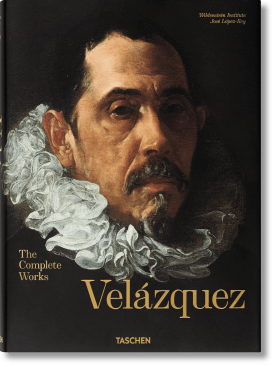
 Manet called him “the greatest painter of all.” Picasso was so inspired by his masterpiece Las Meninas that he painted 44 variations of it. Francis Bacon painted a study of his portrait of Pope Innocent X. Monet and Renoir, Corot and Courbet, Degas and Dalí…for so many champions of art history, the ultimate soundboard was—and remains—Diego Rodríguez de Silva y Velázquez (1599-1660).

This updated catalog raisonné brings together Velázquez’s complete works, jaw-droppingly reproduced in extra-large format, with a selection of enlarged details and brand new photography of recently restored paintings, achieved through the joint initiative of TASCHEN and Wildenstein. The book’s dazzling images are accompanied by insightful commentary from José López-Rey on Velázquez’s interest in human life and his equal attention to all subjects, from an old woman frying eggs to a pope or king, as well as his commitment to color and light, which would influence the Impressionists over two centuries later.







 Peggy Cyphers has a persistent vision of nature that she translates into richly colored and textured quasi-abstract paintings. She pours and lightly brushes countless layers of paint and sand onto the canvas until she achieves luminous and sumptuous surface. Approaching each canvas as a kind of garden where organic and geometric elements intermingle with intense light, she nurtures elaborate hybrid forms. David Ebony, ArtNet Magazine


 In the summer of 1891, Claude Monet began to paint a row of poplar trees that lined the river Epte near his house at Giverny. The trees were auctioned off for timber shortly thereafter, but Monet made a deal with the purchaser to delay cutting them so he could continue to paint the trees through the autumn. Using a shallow rowboat that had slots in the bottom capable of holding several canvases at once, Monet painted twenty-four pictures of the poplars from his floating studio.
  Boomers Daily