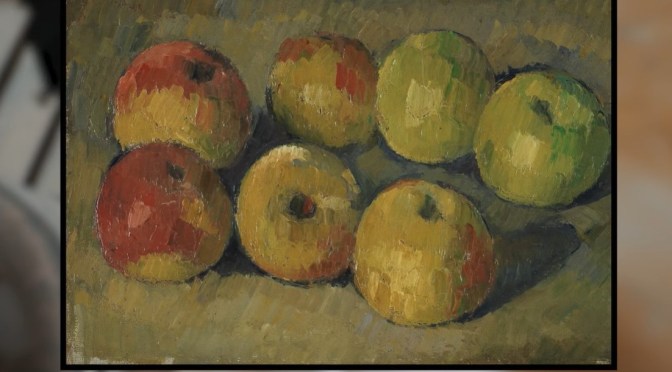
The Fitzwilliam Museum – This painting was executed sometime between 1877, when Cézanne exhibited for the second and last time with the Impressionist painters, and 1878, when he returned to live in Provence. Cézanne himself claimed that he planned to conquer Paris with an apple, and his paintings of this single fruit have in fact proved to be among his most admired works.
Bought by Degas for 100 francs in January 1896, it was acquired in Paris by John Maynard Keynes at the sale of the contents of Degas’s studio in March 1918. It is one of the most celebrated of all his still-lifes, and, through Keynes’s friendship with the painter and writer Roger Fry, and the circle of Bloomsbury writers, came to be crucial in the dissemination of knowledge of Cézanne’s work in England.
The Getty Magazine – Fall 2022: Featuring Conserving Black Modernism, our recently launched effort to conserve Modern Movement architecture by Black architects and designers, plus more behind-the-scenes info on all things Getty.
The Art of Exhibition Design
How to put on a really 16 great show
Egyptomania!
An international passion for Egypt fueled the discovery of King Tut’s 22 tomb
Art Shopping is held in Paris on 21 to 23 October 2022 showing the companies news of France and internationals related to sectors Modern Art, Photography, Sculpture, Contemporary design, Arts, Art.
This week: we talk to Emma Brown of Just Stop Oil about why the group targeted Vincent Van Gogh’s Sunflowers in the National Gallery, London, for its climate emergency protest.
Stacy Boldrick, assistant professor of museum studies at the University of Leicester, discusses the climate protests in the context of the long history of iconoclasm and attacks on works of art. The first version of Paris+, Art Basel’s fair in the French capital, opened this week, and we ask Melanie Gerlis, a columnist for the Financial Times and The Art Newspaper, how it compares to Paris’s previous fair, Fiac, and to the Frieze fairs in London last week.
And this episode’s Work of the Week is Frank Bowling’s Suncrush (1976), which features in an exhibition of the Guyana-born artist’s work at the Museum of Fine Arts in Boston. Reto Thüring, the curator of the show, tells us about the painting and Bowling’s 10-year stay in America in the 1960s and 1970s.
Links:juststopoil.orgStacy Boldrick, Iconoclasm and the Museum, Routledge, 212pp, £27.99, $35.96 (pb)Paris+, until 23 October.Melanie Gerlis, The Art Fair Story: a Rollercoaster Ride, Lund Humphries, 104pp, £19.99, $34.99 (hb)Frank Bowling’s Americas, Museum of Fine Arts, Boston, 22 October-9 April 2023; San Francisco Museum of Modern Art, 13 May-10 September next year. Related shows: Equals 6: A Sum Effect of Frank Bowling’s 5+1, University Hall Gallery, UMass Boston, 14 November-18 February 2023; Revisiting 5+1, Paul W. Zuccaire Gallery, Staller Center for the Arts, Stony Brook University, 10 November-23 February 2023.
England, under the volatile Tudor dynasty, was a thriving home for the arts. An international community of artists and merchants, many of them religious refugees, navigated the high-stakes demands of royal patrons, including England’s first two reigning queens. Against the backdrop of shifting political relationships with mainland Europe, Tudor artistic patronage legitimized, promoted, and stabilized a series of tumultuous reigns, from Henry VII’s seizure of the throne in 1485 to the death of his granddaughter Elizabeth I in 1603.
The Tudor courts were truly cosmopolitan, boasting the work of Florentine sculptors, German painters, Flemish weavers, and Europe’s best armorers, goldsmiths, and printers, while also contributing to the emergence of a distinctly English style. Join Elizabeth Cleland, Curator in the Department of European Sculpture and Decorative Arts, and Adam Eaker, Associate Curator in the Department of European Paintings, to explore The Tudors: Art and Majesty in Renaissance England, which traces the transformation of the arts in Tudor England through more than 100 objects—including iconic portraits, spectacular tapestries, manuscripts, sculpture, and armor—from both The Met collection and international lenders.
Paris+, par Art Basel is the fourth event of its kind in the portfolio of Art Basel, the world’s biggest art fair. Other, related editions are regularly held in Hong Kong, Miami Beach, and the Swiss city of Basel, where its tentpole fair is held. Expect big sales and even bigger crowds, as has long been the case with Art Basel’s other editions.
Join us on a journey of learning and find out why Impressionism was considered so shocking in the 19th century and how it paved the way for the artistic revolutions that were to come.
Think you know about the Impressionists? Louvre Abu Dhabi, in partnership with the Musée d’Orsay, invites you to think again with Impressionism: Pathways to Modernity, one of the most significant Impressionist exhibitions ever to be held outside France.
Featuring pioneering works by Manet, Degas, and Monet, Pissarro, Renoir, and Cézanne, the exhibition brings together more than 150 masterpieces alongside etchings, costumes, film and photography to explore why Impressionism was considered so shocking in the 19th century and how it paved the way for the artistic revolutions that were to come.
Born at a time of profound social, political, and cultural upheaval, Impressionism was more than mere artistic rebellion. It saw some of history’s bravest and most visionary painters embrace and extoll new ways of seeing, making art, and living. They celebrated this thrilling new reality, representing truthful observations of nature and modern life.
The result was a fundamentally new and different kind of art, unburdened by artistic and academic convention or tradition, whose radicalism, honesty, and bravery continues to inspire artists to this day.
News, Views and Reviews For The Intellectually Curious