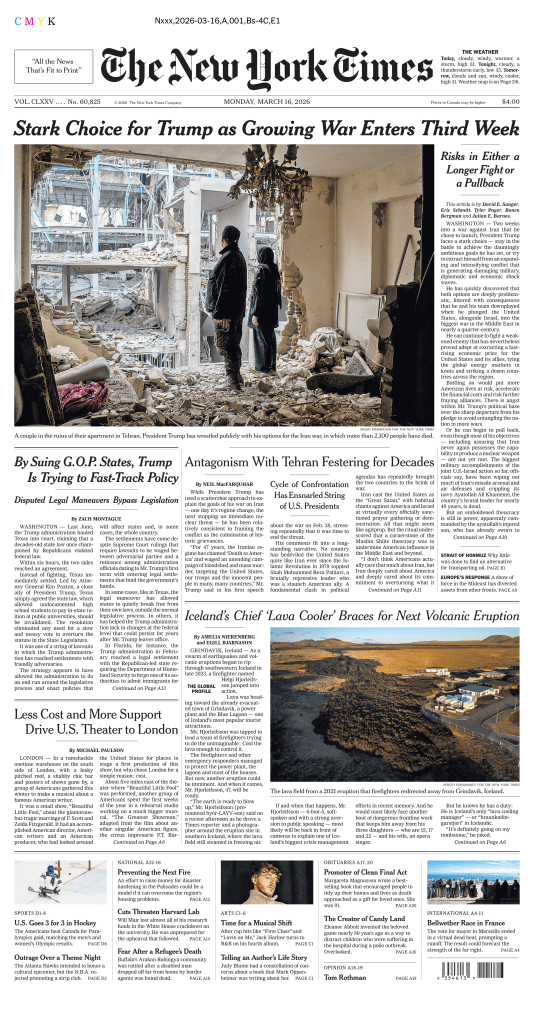
Prime Minister Keir Starmer of Britain told President Trump that it would be wrong for him to tariff NATO allies as part of a campaign to control Greenland.
Europe’s dependence on the U.S. for NATO security limits its options. Its strongest response would be a trade “bazooka,” and other options are possible.
Kristi Noem, the homeland security secretary, said officers had not used pepper spray and similar measures before being confronted with a contradictory video.
In the contemporary Chinese context, the idea that crucial parts of the central government could simply cease to operate for more than a month, as part of a procedural standoff between rival governing factions, would beggar belief. And in turn, to an American observer, the thought that miles of new high-speed rail lines could simply materialize by bureaucratic fiat, unencumbered by years of legislative horse-trading, environmental review, suburban backlash, and budgetary overshoot, is no less astonishing.
Adams will be remembered for his petty corruption, his self-mythologizing, and his ignominious dealmaking with the Trump White House; but he should also be remembered as the mayor who got New Yorkers to stop tossing giant bags of trash onto city sidewalks as if there were no alternative. You can laugh at a New York mayor who walks into a press conference wheeling out a trash can, beaming as if he invented the contraption, while “Empire State of Mind” blares triumphantly in the background. But truly, Adams’s proclaimed “trash revolution” represented a tremendous advance over abysmal past practice.
“Men make their own history,” Marx wrote, “but they do not make it as they please; they do not make it under self-selected circumstances, but under circumstances existing already, given and transmitted from the past.” That may be broadly true, but Dick Cheney got to make history under the exact circumstances he would have chosen.
THE NEW YORK TIMES MAGAZINE:The 1.18.26 Issue features Robert Draper on Marjorie Taylor Greene; Ferris Jabr on a science experiment to help make the oceans less acidic; Jonathan Mahler on Christian Zionism and MAGA; and more.
Imagine yourself on an isolated mountain pass. The wind is whipping, the air is thin, there is nothing around you except the sky and the sound of your feet hitting the craggy ground. Many of us have experienced the wonder and exertion that comes with a great hike in a wild landscape. These are places we may love to visit, but for Kílian Jornet, this is where he is most at home.
Europe’s dependence on the United States for NATO security limits its options. Its strongest response could be retaliating with its own trade “bazooka.”
The investigation into Gov. Tim Walz and Mayor Jacob Frey is a major escalation in the state-federal battle over the conduct of immigration agents in Minneapolis.
President Trump has María Corina Machado’s medal, but he is not recognized as the Nobel laureate. She did not win his endorsement to become Venezuela’s president.
In the largest Venezuelan community outside the Americas, many cheered Nicolás Maduro’s capture, but were adapting to the fact that his allies remained in charge.
On a Bahamian island, in a landlocked lagoon, the planet’s densest collection of seahorses is offering scientists new insights into the secret lives of one of the world’s most mysterious fish.