
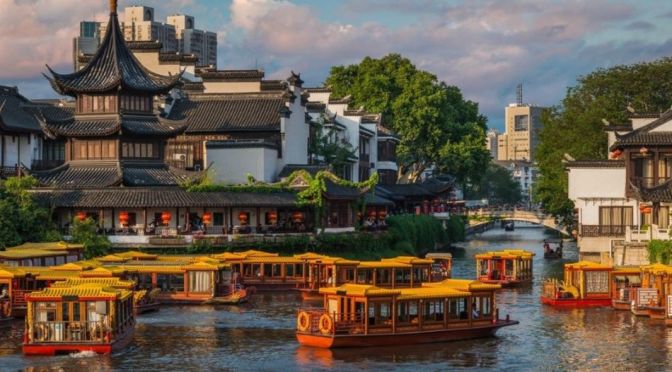
Nanjing, capital of China’s eastern Jiangsu province, is roughly 300km up the Yangtze River from the city of Shanghai. It was the national capital during part of the Ming dynasty. Many monuments and landmarks remain, including Zhonghua Gate (Gate of China), a preserved 14th-century section of the massive wall that contained the old city’s southern entrance.
Tag Archives: Videos

Aerial Views: Meteora Monasteries In Greece
The Meteora is a rock formation in central Greece hosting one of the largest and most precipitously built complexes of Eastern Orthodox monasteries, second in importance only to Mount Athos. The six monasteries are built on immense natural pillars and hill-like rounded boulders that dominate the local area.
The word “meteora,” means “hovering in the air” which, whist a literal description of the famous monasteries, also shows just how otherworldly they seem.
The complex is made up of twenty-four Eastern Orthodox monasteries that were built on giant sandstone rock pillars between the 14th and 16th centuries.

Medicine: Kidney Disease Explained (Mayo Clinic)
Chronic kidney disease, also called chronic kidney failure, involves a gradual loss of kidney function. Your kidneys filter wastes and excess fluids from your blood, which are then removed in your urine. Advanced chronic kidney disease can cause dangerous levels of fluid, electrolytes and wastes to build up in your body.
Video timeline: 0:31 What is kidney disease? 1:09 Who gets kidney disease/risk factors? 2:24 Kidney disease symptoms 3:03 How is kidney disease diagnosed? 3:53 Treatment options 5:23 Coping methods/ What now? 6:16 Ending

Analysis: Federal Reserve Tapering Explained (WSJ)
The Federal Reserve says it will accelerate the wind-down of its bond-buying program, the biggest step the central bank has taken in reversing its pandemic-era stimulus. Here’s how tapering works, and why it sends markets on edge. Photo illustration: Adele Morgan/WSJ

Education: Can Science Help Poor Kids Earn More?
The wide gap in development between rich and poor children could be closed with the help of neuroscience. Might a controversial focus on genetics also help? Film supported by @Mishcon de Reya LLP
Video timeline: 00:00– The achievement gap between rich and poor kids 00:55 – Words matter in childhood development 03:16 – Conversation can combat childhood inequality 05:09 – Can genetics help close the achievement gap? 07:30 – Genetics can be controversial
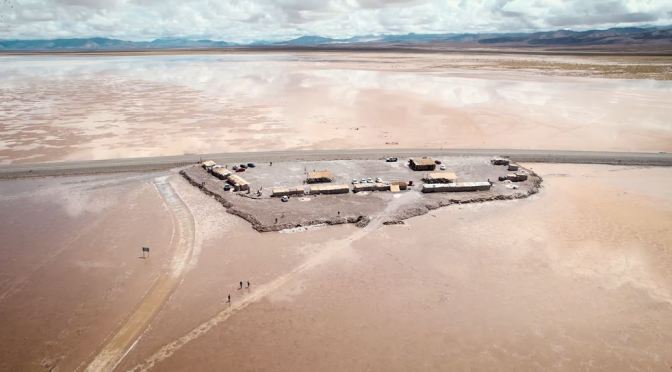
Travel Views: Salta & Jujuy Provinces, Argentina (4K)
Salta, a province in northwest Argentina, encompasses parts of the Andes Mountains, Yungas forests and semiarid Gran Chaco lowlands. The capital, also called Salta, has colonial architecture including the neoclassical Cathedral of Salta. It’s the departure point for the Tren a las Nubes, a high-altitude railway. Small-town Cafayate is a gateway to wineries and the dramatic rock formations of the Calchaquí Valleys.
Jujuy, a province in Argentina’s remote northwest, is defined by the dramatic rock formations and hills of the Quebrada de Humahuaca. This valley and its indigenous Quechuan villages lie north of the provincial capital and regional gateway, San Salvador de Jujuy. In the valley’s south, the iconic, multicolored Cerro de los Siete Colores’ rocky slopes tower over the Spanish colonial village of Purmamarca.

Home Renovations: 18th C. Colonial In Longmeadow, Massachusetts (Video)
Today on Architectural Digest we visit Longmeadow, Massachusetts to tour a colonial-era home with a ton of potential but needing lots of work. Contractor Nick Schiffer from NS Builders takes us through this 18th century relic room by room – laying out the possibilities for restoring the historic flourishes while bringing the property into the present day.

Travel Views: Budapest – Capital Of Hungary (4K)
Budapest, Hungary’s capital, is bisected by the River Danube. Its 19th-century Chain Bridge connects the hilly Buda district with flat Pest. A funicular runs up Castle Hill to Buda’s Old Town, where the Budapest History Museum traces city life from Roman times onward. Trinity Square is home to 13th-century Matthias Church and the turrets of the Fishermen’s Bastion, which offer sweeping views.
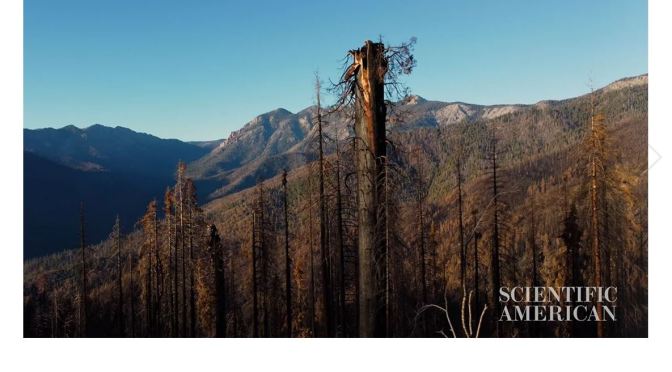
Wildfires: The Alder Creek Giant Sequoia Graveyard
On a dead still November morning in the Sierra Nevada, two researchers walk through a graveyard of giants. Below their feet: a layer of ash and coal. Above their heads: a charnel house of endangered trees.
This is Alder Creek Grove, a once idyllic environment for a majestic and massive specimen: the giant sequoia. It is now a blackened monument to a massive wildfire—and humankind’s far-reaching impact on the environment. But these two researchers have come to do more than pay their respects.
Linnea Hardlund and Alexis Bernal, both of the University of California, Berkeley, are studying the effects of record-breaking fires such as the one that destroyed large swaths of Alder Creek Grove in the hopes that their findings will inform forest management that might preserve giant sequoias for future generations.
So far, those findings are grim: mortality in Alder Creek Grove is near 100 percent. Of the mighty trees that stood watch for thousands of years, only charred skeletons remain. About a century of aggressive fire suppression and a warming, drier climate have created a perfect environment for unprecedented fire.
On August 19, 2020, it came to the Giant Sequoia National Monument. The SQF Complex was two fires—the Castle and Shotgun fires—that burned for more than four months, affecting nearly 175,000 acres. And a preliminary report on the Castle Fire estimated that 10 to 14 percent of all living giant sequoias were destroyed.
Hardlund, who is also at the nonprofit Save the Redwoods League, and Bernal fear that, without scientifically informed intervention, such fires will continue to return to the Sierra Nevada—leaving the once proud guardians of the forest a memory and another casualty of our ecological failure.
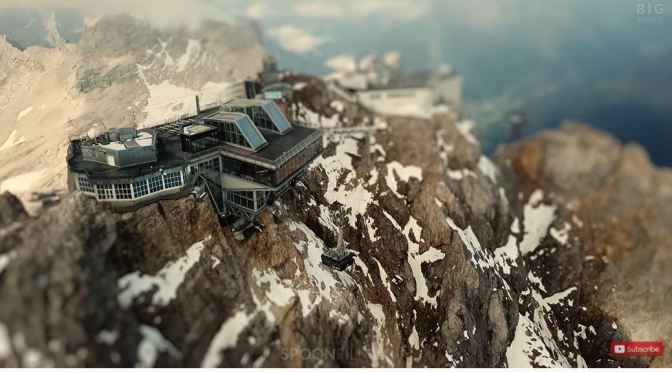
Tilt-Shift Views: Garmisch Partenkirchen, Germany
Garmisch-Partenkirchen is a German ski resort in Bavaria, formed when 2 towns united in 1935. It’s a prominent destination for skiing and ice skating as well as hiking. The town lies near the Zugspitze, Germany’s highest peak, with a 2,962m summit accessed by cogwheel train and cable car. Garmisch is considered the more fashionable section, while Partenkirchen’s cobblestone streets retain a traditional Bavarian feel.
 Boomers Daily