
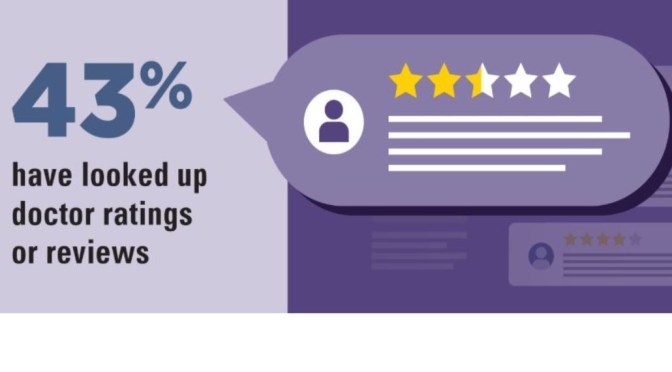
From a National Poll on Aging (Univ. of Michigan) online release:
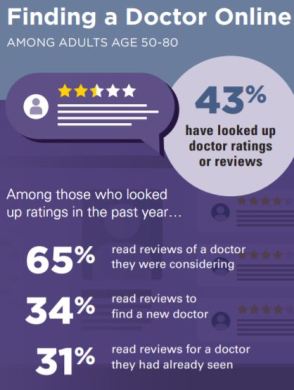 Among older adults age 50–80, 43% had ever reviewed doctor ratings; 14% had reviewed ratings more than once in the past year, 19% had done so once in the past year, and 10% had reviewed ratings more than one year ago.
Among older adults who had looked up doctor ratings within the past year, 65% read reviews of a doctor they were considering, 34% read reviews to find a new doctor, and 31% read reviews for a doctor they had already seen.
 Ratings and reviews for nearly everything can be found online these days, including doctors. How are older adults using these ratings in their decisions about choosing doctors? In May 2019, the University of Michigan National Poll on Healthy Aging asked a
national sample of adults age 50–80 about their use and perceptions of online doctor ratings.
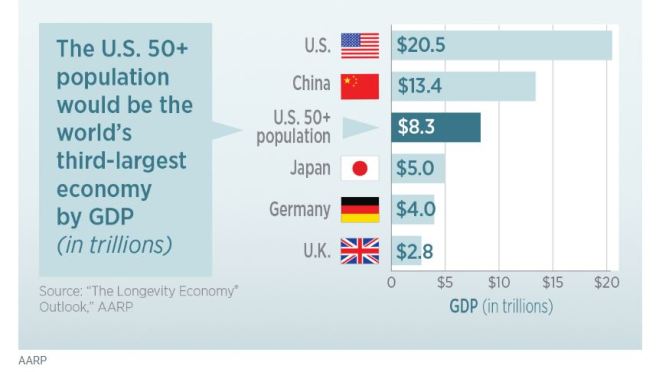
 “As the number of people over 50 grows, that age cohort is transforming markets and sparking new ideas, products and services across our economy,” AARP CEO Jo Ann Jenkins says. “And as people extend their work lives, they are fueling economic growth past the traditional retirement age.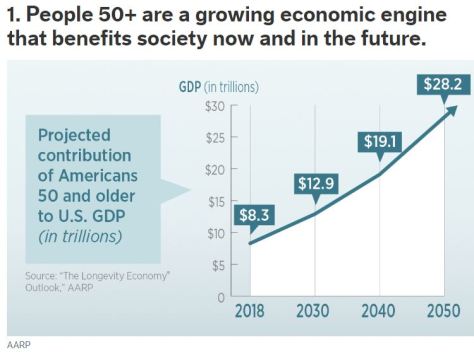


 A third of the nurses who took the survey are baby boomers and 20% of survey takers said they planned to retire in the next five years. More than a quarter, 27%, said they were unlikely to be working at their current job in a year.
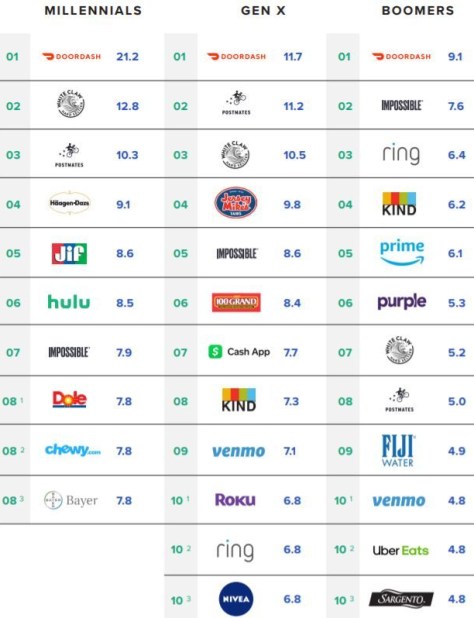
 According to a recent survey of 1,000 U.S. consumers from advertising platform Criteo, 48% of millennial and Gen Z respondents use online grocery delivery services, compared to 37% of Gen X respondents and only 30% of baby boomer respondents.
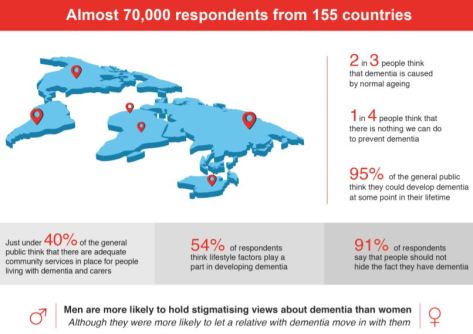
 LSE developed the survey to target four key groups:
 In the survey analysis we highlight the behavioural element first, giving prominence to the voices and experiences of people living with dementia as direct assessment of actual behaviour is central to discrimination and is the closest representation of the true impact of stigma on people living with dementia.
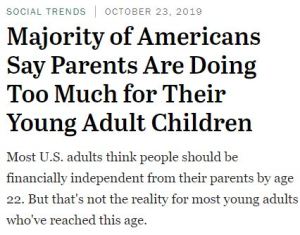 There’s a sense among a majority of Americans that parents are doing too much for their young adult children these days – 55% of all adults say this, while only 10% say parents are doing too little for their young adult children. About a third (34%) say parents are doing about the right amount.
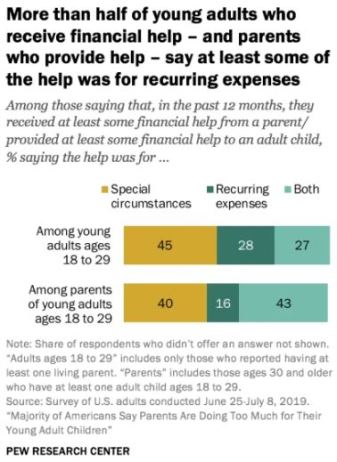 Among adults ages 18 to 29, 45% say they received a lot of (24%) or some (21%) financial help from their parents in the past 12 months. About one-in-five (21%) say they received only a little financial help, and 34% say they received none.
 Boomers Daily