Tag Archives: Social Media

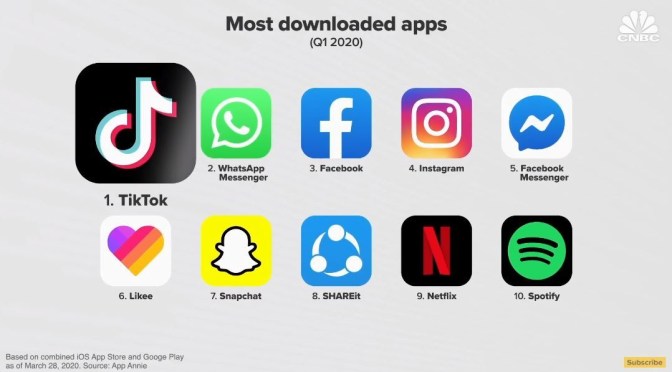
Social Media Video: What’s Behind “The Rise Of TikTok”


TikTok is the most downloaded app of 2020, as quarantines have spurred more and more users to hop onboard and learn about the latest dance trends and memes. But the app also faces a slew of regulatory hurdles, privacy concerns, and allegations of censorship, issues experts say will be new CEO Kevin Mayer’s top priority.

Health: “The Vital Importance Of Social Distancing” To Stop Spread Of Coronavirus

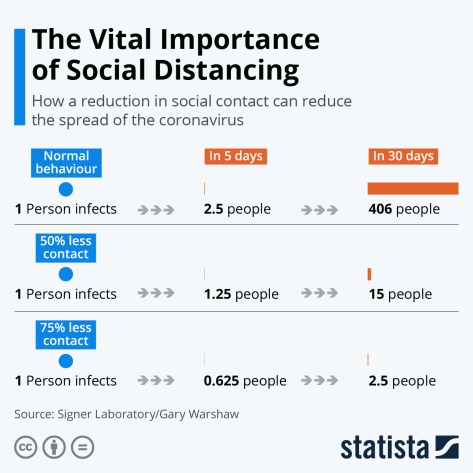
Social Distancing to reduce spread of Coronavirus Covid-19 Statista infographic March 23 2020

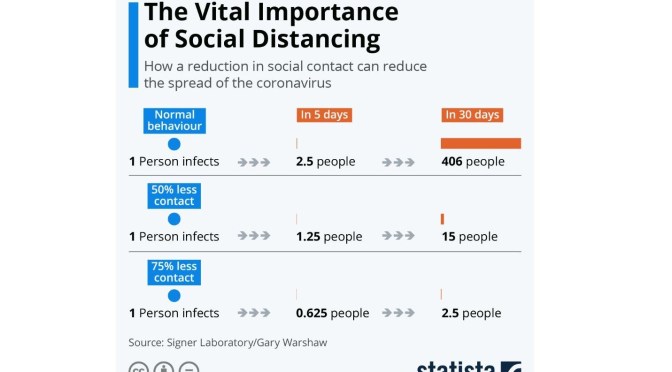
In order to stem the spread of the coronavirus, social interactions around the world are being restricted. This infographic, based on calculations by Robert A. J. Signer, Assistant Professor of Medicine at the University of California San Diego, shows how this so-called social distancing can reduce the spread of the virus.

With no changes to social behaviour, one infected person will on average pass the virus to 2.5 people within five days. After 30 days, the figure would rise to a devastating 406 new infections. The number can be significantly reduced though by engaging in less social contact. With a 50 percent reduction, the number of new infections caused by the average person after 30 days is just 15 people. A 75 percent change would result in an even lower 2.5 new cases – greatly reducing the burden on health services and, if followed by everybody, allowing a country to ‘flatten the curve’ of new infections.

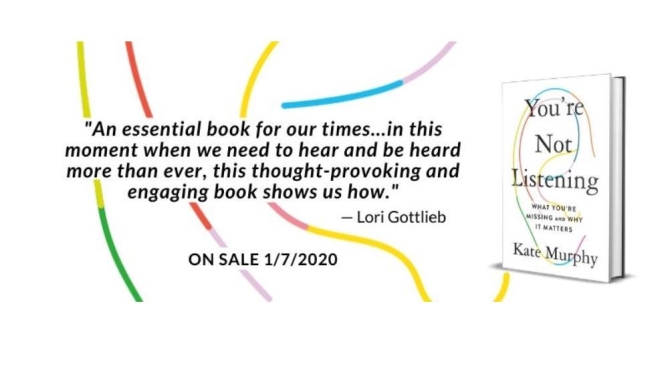
New Books: “You’re Not Listening – What You’re Missing and Why It Matters” By Kate Murphy

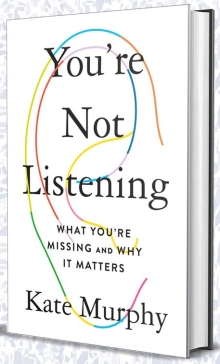
You're Not Listening What You're Missing and Why It Matters Kate Murphy Celadon Books January 2020“When you listen and really grasp what another person is saying, your brainwaves and those of the speaker are literally in sync. By looking at brain scans, neuroscientists have found that the greater overlap and similarity of neural impulses between speaker and listener, the greater the understanding. It’s observable, measurable proof of listening, comprehension, and connection. You know it’s happening when you have that “Oh I get it” moment or sense of clarity when someone else is talking. You’re on the same wavelength, even if you don’t necessarily agree.”

In her new book You’re Not Listening, Kate Murphy draws attention to the worldwide epidemic of not listening, exposing the profound impact that it is having on us all and showing what we can do about it.

In this always illuminating and often humorous deep dive, Murphy explains why we’re not listening, what it’s doing to us, and how we can reverse the trend. She makes accessible the psychology, neuroscience, and sociology of listening while also introducing us to some of the best listeners out there (including a CIA agent, focus group moderator, bartender, radio producer, and top furniture salesman). Equal parts cultural observation, scientific exploration, and rousing call to action that’s full of practical advice, You’re Not Listening is to listening what Susan Cain’s Quiet was to introversion. It’s time to stop talking and start listening.

Read more or purchase

Animation Artists: James Curran Creates World’s Top “Looping GIF’s” (Video)

A selection of GIFs from my NYC, LA and Tokyo Gifathons remastered in 3D. Each inspired by something that happened during my 30 day stays in each city.

See all the looping GIFs on Twitter and Instagram with #3DGifathon

twitter.com/slimjimstudios
instagram.com/slimjimstudios
slimjimstudios.com

New Years Resolutions: “Stop Making Excuses Not To Exercise!!” (NY Times)

From a New York Times online article:

The New York Time logoAt the moment, about two-thirds of Americans do not meet the standard exercise guidelines of about 30 minutes a day of moderate exercise, such as walking.
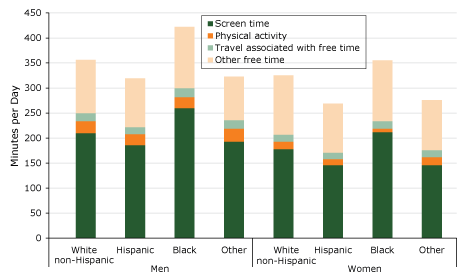

These findings might suggest that, if we adjusted our schedules and turned off the TV, phone or computer, most of us would have plenty of time to work out.

Screen Time vs Physical Activity vs Free Time Chart CDC

Almost all of the respondents — whatever their income, age, gender or ethnicity — reported about five hours a day of leisure time. Men tended to have more free time than women, older people more than the young, and African-American women the least of all. But no group reported less than about four and a half hours a day of free time.

To read more

Media: 41% Of Americans Believe News Has Become Less Reliable, 44% No Change (Rand Corp, 2019)

From a Rand.org online release:

Rand Corporation LogoMany people (41 percent) indicated that they believed that news has become less reliable than in the past; a similar number (44 percent) said they believed there has been no change; and 15 percent said they thought news is more reliable now.

Different demographic groups get their news in different ways

  • People whose primary news sources are social media and in-person contacts are generally younger and female, and they tend to have less education than a college degree and lower household incomes.
  • People whose primary news sources are print publications and broadcast television tend to be be significantly older, and they are less likely to be married.
  • People whose primary news source is radio are significantly more likely to be male, less likely to be retired, and more likely to have a college degree.
  • People whose primary news sources are online platforms are significantly younger, more likely to be male and have a college degree and higher income, and less likely to be black.

Attitudes toward the reliability of news are mixed

  • Overall, 44 percent reported that they believed “the news is as reliable now as in the past.”
  • Nearly the same amount — 41 percent — reported a belief that the news has become less reliable.
  • A minority (15 percent) said that they believed that the news is more reliable now.
  • There was an association between news consumption profiles and perceptions of reliability — people who relied more heavily on online, radio, and social media/in-person platforms to obtain news were less likely to say that news is more reliable now than in the past.

Rand News Study Respondents' Most Used News Source

Rand News Study Respondents' Top Two Most-Used News Source


To view full Rand Study: https://www.rand.org/pubs/research_reports/RR4212.html?utm_source=WhatCountsEmail&utm_medium=RAND%20Policy%20Currents+AEM:%20%20Email%20Address%20NOT%20LIKE%20DOTMIL&utm_campaign=AEM:631600804