Tag Archives: Social Media

THE ALGORITHM OF IMMEDIATE RESPONSE

How outrage became the fastest currency in politics—and why the virtues of patience are disappearing.

By Michael Cummins, Editor | October 23, 2025

In an age where political power moves at the speed of code, outrage has become the most efficient form of communication. From an Athenian demagogue to modern AI strategists, the art of acceleration has replaced the patience once practiced by Baker, Dole, and Lincoln—and the Republic is paying the price.


In a server farm outside Phoenix, a machine listens. It does not understand Cleon, but it recognizes his rhythm—the spikes in engagement, the cadence of outrage, the heat signature of grievance. The air is cold, the light a steady pulse of blue LEDs blinking like distant lighthouses of reason, guarding a sea of noise. If the Pnyx was powered by lungs, the modern assembly runs on lithium and code.

The machine doesn’t merely listen; it categorizes. Each tremor of emotion becomes data, each complaint a metric. It assigns every trauma a vulnerability score, every fury a probability of spread. It extracts the gold of anger from the dross of human experience, leaving behind a purified substance: engagement. Its intelligence is not empathy but efficiency. It knows which words burn faster, which phrases detonate best. The heat it studies is human, but the process is cold as quartz.

Every hour, terabytes of grievance are harvested, tagged, and rebroadcast as strategy. Somewhere in the hum of cooling fans, democracy is being recalibrated.

The Athenian Assembly was never quiet. On clear afternoons, the shouts carried down from the Pnyx, a stone amphitheater that served as both parliament and marketplace of emotion. Citizens packed the terraces—farmers with olive oil still on their hands, sailors smelling of the sea, merchants craning for a view—and waited for someone to stir them. When Cleon rose to speak, the sound changed. Thucydides called him “the most violent of the citizens,” which was meant as condemnation but functioned as a review. Cleon had discovered what every modern strategist now understands: volume is velocity.

He was a wealthy tanner who rebranded himself as a man of the people. His speeches were blunt, rapid, full of performative rage. He interrupted, mocked, demanded applause. The philosophers who preferred quiet dialectic despised him, yet Cleon understood the new attention graph of the polis. He was running an A/B test on collective fury, watching which insults drew cheers and which silences signaled fatigue. Democracy, still young, had built its first algorithm without realizing it. The Republican Party, twenty-four centuries later, would perfect the technique.

Grievance was his software. After the death of Pericles, plague and war had shaken Athens; optimism curdled into resentment. Cleon gave that resentment a face. He blamed the aristocracy for cowardice, the generals for betrayal, the thinkers for weakness. “They talk while you bleed,” he shouted. The crowd obeyed. He promised not prosperity but vengeance—the clean arithmetic of rage. The crowd was his analytics; the roar his data visualization. Why deliberate when you can demand? Why reason when you can roar?

The brain recognizes threat before comprehension. Cognitive scientists have measured it: forty milliseconds separate the perception of danger from understanding. Cleon had no need for neuroscience; he could feel the instant heat of outrage and knew it would always outrun reflection. Two millennia later, the same principle drives our political networks. The algorithm optimizes for outrage because outrage performs. Reaction is revenue. The machine doesn’t care about truth; it cares about tempo. The crowd has become infinite, and the Pnyx has become the feed.

The Mytilenean debate proved the cost of speed. When a rebellious island surrendered, Cleon demanded that every man be executed, every woman enslaved. His rival Diodotus urged mercy. The Assembly, inflamed by Cleon’s rhetoric, voted for slaughter. A ship sailed that night with the order. By morning remorse set in; a second ship was launched with reprieve. The two vessels raced across the Aegean, oars flashing. The ship of reason barely arrived first. We might call it the first instance of lag.

Today the vessel of anger is powered by GPUs. “Adapt and win or pearl-clutch and lose,” reads an internal memo from a modern campaign shop. Why wait for a verifiable quote when an AI can fabricate one convincingly? A deepfake is Cleon’s bluntness rendered in pixels, a tactical innovation of synthetic proof. The pixels flicker slightly, as if the lie itself were breathing. During a recent congressional primary, an AI-generated confession spread through encrypted chats before breakfast; by noon, the correction was invisible under the debris of retweets. Speed wins. Fact-checking is nostalgia.

Cleon’s attack on elites made him irresistible. He cast refinement as fraud, intellect as betrayal. “They dress in purple,” he sneered, “and speak in riddles.” Authenticity became performance; performance, the brand. The new Cleon lives in a warehouse studio surrounded by ring lights and dashboards. He calls himself Leo K., host of The Agora Channel. The room itself feels like a secular chapel of outrage—walls humming, screens flickering. The machine doesn’t sweat, doesn’t blink. It translates heat into metrics and metrics into marching orders. An AI voice whispers sentiment scores into his ear. He doesn’t edit; he adjusts. Each outrage is A/B-tested in real time. His analytics scroll like scripture: engagement per minute, sentiment delta, outrage index. His AI team feeds the system new provocations to test. Rural viewers see forgotten farmers; suburban ones see “woke schools.” When his video “They Talk While You Bleed” hits ten million views, Leo K. doesn’t smile. He refreshes the dashboard. Cleon shouted. The crowd obeyed. Leo posted. The crowd clicked.

Meanwhile, the opposition labors under its own conscientiousness. Where one side treats AI as a tactical advantage, the other treats it as a moral hazard. The Democratic instinct remains deliberative: form a task force, issue a six-point memo, hold an AI 101 training. They build models to optimize voter files, diversity audits, and fundraising efficiency—work that improves governance but never goes viral. They’re still formatting the memo while the meme metastasizes. They are trying to construct a more accountable civic algorithm while their opponents exploit the existing one to dismantle civics itself. Technology moves at the speed of the most audacious user, not the most virtuous.

The penalty for slowness has consumed even those who once mastered it. The Republican Party that learned to weaponize velocity was once the party of patience. Its old guardians—Howard Baker, Bob Dole, and before them Abraham Lincoln—believed that democracy endured only through slowness: through listening, through compromise, through the humility to doubt one’s own righteousness.

Baker was called The Great Conciliator, though what he practiced was something rarer: slow thought. He listened more than he spoke. His Watergate question—“What did the President know, and when did he know it?”—was not theater but procedure, the careful calibration of truth before judgment. Baker’s deliberation depended on the existence of a stable document—minutes, transcripts, the slow paper trail that anchored reality. But the modern ecosystem runs on disposability. It generates synthetic records faster than any investigator could verify. There is nothing to subpoena, only content that vanishes after impact. Baker’s silences disarmed opponents; his patience made time a weapon. “The essence of leadership,” he said, “is not command, but consensus.” It was a creed for a republic that still believed deliberation was a form of courage.

Bob Dole was his equal in patience, though drier in tone. Scarred from war, tempered by decades in the Senate, he distrusted purity and spectacle. He measured success by text, not applause. He supported the Americans with Disabilities Act, expanded food aid, negotiated budgets with Democrats. His pauses were political instruments; his sarcasm, a lubricant for compromise. “Compromise,” he said, “is not surrender. It’s the essence of democracy.” He wrote laws instead of posts. He joked his way through stalemates, turning irony into a form of grace. He would be unelectable now. The algorithm has no metric for patience, no reward for irony.

The Senate, for Dole and Baker, was an architecture of time. Every rule, every recess, every filibuster was a mechanism for patience. Time was currency. Now time is waste. The hearing room once built consensus; today it builds clips. Dole’s humor was irony, a form of restraint the algorithm can’t parse—it depends on context and delay. Baker’s strength was the paper trail; the machine specializes in deletion. Their virtues—documentation, wit, patience—cannot be rendered in code.

And then there was Lincoln, the slowest genius in American history, a man who believed that words could cool a nation’s blood. His sentences moved with geological patience: clause folding into clause, thought delaying conclusion until understanding arrived. “I am slow to learn,” he confessed, “and slow to forget that which I have learned.” In his world, reflection was leadership. In ours, it’s latency. His sentences resisted compression. They were long enough to make the reader breathe differently. Each clause deferred judgment until understanding arrived—a syntax designed for moral digestion. The algorithm, if handed the Gettysburg Address, would discard its middle clauses, highlight the opening for brevity, and tag the closing for virality. It would miss entirely the hesitation—the part that transforms rhetoric into conscience.

The republic of Lincoln has been replaced by the republic of refresh. The party of Lincoln has been replaced by the platform of latency: always responding, never reflecting. The Great Compromisers have given way to the Great Amplifiers. The virtues that once defined republican governance—discipline, empathy, institutional humility—are now algorithmically invisible. The feed rewards provocation, not patience. Consensus cannot trend.

Caesar understood the conversion of speed into power long before the machines. His dispatches from Gaul were press releases disguised as history, written in the calm third person to give propaganda the tone of inevitability. By the time the Senate gathered to debate his actions, public opinion was already conquered. Procedure could not restrain velocity. When he crossed the Rubicon, they were still writing memos. Celeritas—speed—was his doctrine, and the Republic never recovered.

Augustus learned the next lesson: velocity means nothing without permanence. “I found Rome a city of brick,” he said, “and left it a city of marble.” The marble was propaganda you could touch—forums and temples as stone deepfakes of civic virtue. His Res Gestae proclaimed him restorer of the Republic even as he erased it. Cleon disrupted. Caesar exploited. Augustus consolidated. If Augustus’s monuments were the hardware of empire, our data centers are its cloud: permanent, unseen, self-repairing. The pattern persists—outrage, optimization, control.

Every medium has democratized passion before truth. The printing press multiplied Luther’s fury, pamphlets inflamed the Revolution, radio industrialized empathy for tyrants. Artificial intelligence perfects the sequence by producing emotion on demand. It learns our triggers as Cleon learned his crowd, adjusting the pitch until belief becomes reflex. The crowd’s roar has become quantifiable—engagement metrics as moral barometers. The machine’s innovation is not persuasion but exhaustion. The citizens it governs are too tired to deliberate. The algorithm doesn’t care. It calculates.

Still, there are always philosophers of delay. Socrates practiced slowness as civic discipline. Cicero defended the Republic with essays while Caesar’s legions advanced. A modern startup once tried to revive them in code—SocrAI, a chatbot designed to ask questions, to doubt. It failed. Engagement was low; investors withdrew. The philosophers of pause cannot survive in the economy of speed.

Yet some still try. A quiet digital space called The Stoa refuses ranking and metrics. Posts appear in chronological order, unboosted, unfiltered. It rewards patience, not virality. The users joke that they’re “rowing the slow ship.” Perhaps that is how reason persists: quietly, inefficiently, against the current.

The Algorithmic Republic waits just ahead. Polling is obsolete; sentiment analysis updates in real time. Legislators boast about their “Responsiveness Index.” Justice Algorithm 3.1 recommends a twelve percent increase in sentencing severity for property crimes after last week’s outrage spike. A senator brags that his approval latency is under four minutes. A citizen receives a push notification announcing that a bill has passed—drafted, voted on, and enacted entirely by trending emotion. Debate is redundant; policy flows from mood. Speed has replaced consent. A mayor, asked about a controversial bylaw, shrugs: “We used to hold hearings. Now we hold polls.”

To row the slow ship is not simply to remember—it is to resist. The virtues of Dole’s humor and Baker’s patience were not ornamental; they were mechanical, designed to keep the republic from capsizing under its own speed. The challenge now is not finding the truth but making it audible in an environment where tempo masquerades as conviction. The algorithm has taught us that the fastest message wins, even when it’s wrong.

The vessel of anger sails endlessly now, while the vessel of reflection waits for bandwidth. The feed never sleeps. The Assembly never adjourns. The machine listens and learns. The virtues of Baker, Dole, and Lincoln—listening, compromise, slowness—are almost impossible to code, yet they are the only algorithms that ever preserved a republic. They built democracy through delay.

Cleon shouted. The crowd obeyed. Leo posted. The crowd clicked. Caesar wrote. The crowd believed. Augustus built. The crowd forgot. The pattern endures because it satisfies a human need: to feel unity through fury. The danger is not that Cleon still shouts too loudly, but that we, in our republic of endless listening, have forgotten how to pause.

Perhaps the measure of a civilization is not how fast it speaks, but how long it listens. Somewhere between the hum of the servers and the silence of the sea, the slow ship still sails—late again, but not yet lost.

THIS ESSAY WAS WRITTEN AND EDITED UTILIZING AI
AI, Smartphones, and the Student Attention Crisis in U.S. Public Schools

By Michael Cummins, Editor, August 19, 2025

In a recent New York Times focus group, twelve public-school teachers described how phones, social media, and artificial intelligence have reshaped the classroom. Tom, a California biology teacher, captured the shift with unsettling clarity: “It’s part of their whole operating schema.” For many students, the smartphone is no longer a tool but an extension of self, fused with identity and cognition.

Rachel, a teacher in New Jersey, put it even more bluntly:

“They’re just waiting to just get back on their phone. It’s like class time is almost just a pause in between what they really want to be doing.”

What these teachers describe is not mere distraction but a transformation of human attention. The classroom, once imagined as a sanctuary for presence and intellectual encounter, has become a liminal space between dopamine hits. Students no longer “use” their phones; they inhabit them.

The Canadian media theorist Marshall McLuhan warned as early as the 1960s that every new medium extends the human body and reshapes perception. “The medium is the message,” he argued — meaning that the form of technology alters our thought more profoundly than its content. If the printed book once trained us to think linearly and analytically, the smartphone has restructured cognition into fragments: alert-driven, socially mediated, and algorithmically tuned.

The philosopher Sherry Turkle has documented this cultural drift in works such as Alone Together and Reclaiming Conversation. Phones, she argues, create a paradoxical intimacy: constant connection yet diminished presence. What the teachers describe in the Times focus group echoes Turkle’s findings — students are physically in class but psychically elsewhere.

This fracture has profound educational stakes. The reading brain that Maryanne Wolf has studied in Reader, Come Home — slow, deep, and integrative — is being supplanted by skimming, scanning, and swiping. And as psychologist Daniel Kahneman showed, our cognition is divided between “fast” intuitive processing (System 1) and “slow” deliberate reasoning (System 2). Phones tilt us heavily toward System 1, privileging speed and reaction over reflection and patience.

The teachers in the focus group thus reveal something larger than classroom management woes: they describe a civilizational shift in the ecology of human attention. To understand what’s at stake, we must see the smartphone not simply as a device but as a prosthetic self — an appendage of memory, identity, and agency. And we must ask, with urgency, whether education can still cultivate wisdom in a world of perpetual distraction.


The Collapse of Presence

The first crisis that phones introduce into the classroom is the erosion of presence. Presence is not just physical attendance but the attunement of mind and spirit to a shared moment. Teachers have always battled distraction — doodles, whispers, glances out the window — but never before has distraction been engineered with billion-dollar precision.

Platforms like TikTok and Instagram are not neutral diversions; they are laboratories of persuasion designed to hijack attention. Tristan Harris, a former Google ethicist, has described them as slot machines in our pockets, each swipe promising another dopamine jackpot. For a student seated in a fluorescent-lit classroom, the comparison is unfair: Shakespeare or stoichiometry cannot compete with an infinite feed of personalized spectacle.

McLuhan’s insight about “extensions of man” takes on new urgency here. If the book extended the eye and trained the linear mind, the phone extends the nervous system itself, embedding the individual into a perpetual flow of stimuli. Students who describe feeling “naked without their phone” are not indulging in metaphor — they are articulating the visceral truth of prosthesis.

The pandemic deepened this fracture. During remote learning, students learned to toggle between school tabs and entertainment tabs, multitasking as survival. Now, back in physical classrooms, many have not relearned how to sit with boredom, struggle, or silence. Teachers describe students panicking when asked to read even a page without their phones nearby.

Maryanne Wolf’s neuroscience offers a stark warning: when the brain is rewired for scanning and skimming, the capacity for deep reading — for inhabiting complex narratives, empathizing with characters, or grappling with ambiguity — atrophies. What is lost is not just literary skill but the very neurological substrate of reflection.

Presence is no longer the default of the classroom but a countercultural achievement.

And here Kahneman’s framework becomes crucial. Education traditionally cultivates System 2 — the slow, effortful reasoning needed for mathematics, philosophy, or moral deliberation. But phones condition System 1: reactive, fast, emotionally charged. The result is a generation fluent in intuition but impoverished in deliberation.


The Wild West of AI

If phones fragment attention, artificial intelligence complicates authorship and authenticity. For teachers, the challenge is no longer merely whether a student has done the homework but whether the “student” is even the author at all.

ChatGPT and its successors have entered the classroom like a silent revolution. Students can generate essays, lab reports, even poetry in seconds. For some, this is liberation: a way to bypass drudgery and focus on synthesis. For others, it is a temptation to outsource thinking altogether.

Sherry Turkle’s concept of “simulation” is instructive here. In Simulation and Its Discontents, she describes how scientists and engineers, once trained on physical materials, now learn through computer models — and in the process, risk confusing the model for reality. In classrooms, AI creates a similar slippage: simulated thought that masquerades as student thought.

Teachers in the Times focus group voiced this anxiety. One noted: “You don’t know if they wrote it, or if it’s ChatGPT.” Assessment becomes not only a question of accuracy but of authenticity. What does it mean to grade an essay if the essay may be an algorithmic pastiche?

The comparison with earlier technologies is tempting. Calculators once threatened arithmetic; Wikipedia once threatened memorization. But AI is categorically different. A calculator does not claim to “think”; Wikipedia does not pretend to be you. Generative AI blurs authorship itself, eroding the very link between student, process, and product.

And yet, as McLuhan would remind us, every technology contains both peril and possibility. AI could be framed not as a substitute but as a collaborator — a partner in inquiry that scaffolds learning rather than replaces it. Teachers who integrate AI transparently, asking students to annotate or critique its outputs, may yet reclaim it as a tool for System 2 reasoning.

The danger is not that students will think less but that they will mistake machine fluency for their own voice.

But the Wild West remains. Until schools articulate norms, AI risks widening the gap between performance and understanding, appearance and reality.


The Inequality of Attention

Phones and AI do not distribute their burdens equally. The third crisis teachers describe is an inequality of attention that maps onto existing social divides.

Affluent families increasingly send their children to private or charter schools that restrict or ban phones altogether. At such schools, presence becomes a protected resource, and students experience something closer to the traditional “deep time” of education. Meanwhile, underfunded public schools are often powerless to enforce bans, leaving students marooned in a sea of distraction.

This disparity mirrors what sociologist Pierre Bourdieu called cultural capital — the non-financial assets that confer advantage, from language to habits of attention. In the digital era, the ability to disconnect becomes the ultimate form of privilege. To be shielded from distraction is to be granted access to focus, patience, and the deep literacy that Wolf describes.

Teachers in lower-income districts report students who cannot imagine life without phones, who measure self-worth in likes and streaks. For them, literacy itself feels like an alien demand — why labor through a novel when affirmation is instant online?

Maryanne Wolf warns that we are drifting toward a bifurcated literacy society: one in which elites preserve the capacity for deep reading while the majority are confined to surface skimming. The consequences for democracy are chilling. A polity trained only in System 1 thinking will be perpetually vulnerable to manipulation, propaganda, and authoritarian appeals.

The inequality of attention may prove more consequential than the inequality of income.

If democracy depends on citizens capable of deliberation, empathy, and historical memory, then the erosion of deep literacy is not a classroom problem but a civic emergency. Education cannot be reduced to test scores or job readiness; it is the training ground of the democratic imagination. And when that imagination is fractured by perpetual distraction, the republic itself trembles.


Reclaiming Focus in the Classroom

What, then, is to be done? The teachers’ testimonies, amplified by McLuhan, Turkle, Wolf, and Kahneman, might lead us toward despair. Phones colonize attention; AI destabilizes authorship; inequality corrodes the very ground of democracy. But despair is itself a form of surrender, and teachers cannot afford surrender.

Hope begins with clarity. We must name the problem not as “kids these days” but as a structural transformation of attention. To expect students to resist billion-dollar platforms alone is naive; schools must become countercultural sanctuaries where presence is cultivated as deliberately as literacy.

Practical steps follow. Schools can implement phone-free policies, not as punishment but as liberation — an invitation to reclaim time. Teachers can design “slow pedagogy” moments: extended reading, unbroken dialogue, silent reflection. AI can be reframed as a tool for meta-cognition, with students asked not merely to use it but to critique it, to compare its fluency with their own evolving voice.

Above all, we must remember that education is not simply about information transfer but about formation of the self. McLuhan’s dictum reminds us that the medium reshapes the student as much as the message. If we allow the medium of the phone to dominate uncritically, we should not be surprised when students emerge fragmented, reactive, and estranged from presence.

And yet, history offers reassurance. Plato once feared that writing itself would erode memory; medieval teachers once feared the printing press would dilute authority. Each medium reshaped thought, but each also produced new forms of creativity, knowledge, and freedom. The task is not to romanticize the past but to steward the present wisely.

Hannah Arendt, reflecting on education, insisted that every generation is responsible for introducing the young to the world as it is — flawed, fragile, yet redeemable. To abdicate that responsibility is to abandon both children and the world itself. Teachers today, facing the prosthetic selves of their students, are engaged in precisely this work: holding open the possibility of presence, of deep thought, of human encounter, against the centrifugal pull of the screen.

Education is the wager that presence can be cultivated even in an age of absence.

In the end, phones may be prosthetic selves — but they need not be destiny. The prosthesis can be acknowledged, critiqued, even integrated into a richer conception of the human. What matters is that students come to see themselves not as appendages of the machine but as agents capable of reflection, relationship, and wisdom.

The future of education — and perhaps democracy itself — depends on this wager. That in classrooms across America, teachers and students together might still choose presence over distraction, depth over skimming, authenticity over simulation. It is a fragile hope, but a necessary one.

THIS ESSAY WAS WRITTEN AND EDITED UTILIZING AI

REBUILDING A BROKEN PATH FROM BOYHOOD TO MAN

By Michael Cummins, Editor, August 14, 2025

Imagine a world where, in a single decade, half the laughter shared between friends vanishes. Imagine a childhood where time spent outdoors is cut by a third and the developmental benefits of reading are diminished by two-thirds. This is not a dystopian fantasy. According to social psychologist Jonathan Haidt, in a “Prof G Podcast with Scott Galloway published on August 14, 2025, it is the stark reality for a generation that has been systematically disconnected from the real world and shackled to the virtual. “We have overprotected our children in the real world,” Haidt argues, “and underprotected them in the virtual world.”

This profound dislocation is the epicenter of a “perfect storm” disproportionately harming boys and young men—a crisis fueled by predatory technology, economic precarity, and the collapse of institutions that once guided them into manhood. It is a crisis, as a growing chorus of thinkers like Haidt, Brookings scholar Richard Reeves, and professor Scott Galloway have illuminated, born not from a single cause, but from a collective, intergenerational failure. It is a betrayal of the implicit promise that each generation will leave the world better for the next, a promise broken by a society that has become, in Galloway’s stark assessment, “a generation of takers, not givers.”

The Digital Dislocation: A Generation Adrift Online

The most abrupt change to the landscape of youth has been technological. Haidt identifies the years between 2010 and 2015 as the “pivot point” when a “play-based childhood” was supplanted by a “phone-based childhood.” This was not a simple evolution from the television sets of the past. The smartphone is a uniquely invasive tool—a supercomputer delivering constant, algorithmically curated interruptions. It extracts data on its user’s deepest desires while creating a feedback loop of social comparison and judgment, resulting in a documented catastrophe for mental health. It is no coincidence that between 2010 and 2021, the suicide rate for American boys aged 10-14 nearly tripled, according to CDC data highlighted by Haidt.

The Lure of the Manosphere

This digital vacuum has been eagerly filled by what Scott Galloway calls the “great white sharks” of the tech industry. The most insidious outcome of their engagement-at-all-costs model is the weaponization of social validation into a system of industrialized shame. “Imagine growing up in a minefield,” Haidt suggests. “You would walk really carefully.” This pervasive fear suppresses healthy risk-taking, a crucial component of adolescent development, particularly for boys who learn competence through trial, error, and recovery.

This isolation is especially damaging for boys who, as scholar Warren Farrell argues, already suffer from a crisis of “dad-deprivation” and a lack of positive male mentorship. “A boy’s search for a father,” Farrell writes in The Boy Crisis, “is a search for a purpose-driven life.” Into this void step not fathers or coaches, but the algorithmic sirens of the “manosphere.” These figures thrive because they offer a counterfeit version of the very thing Farrell identifies as missing: a strong, authoritative male voice providing direction, however misguided. Figures like Andrew Tate have built empires by offering lonely or insecure young men a seductive, off-the-shelf identity, often paired with dubious get-rich-quick schemes that prey directly on their economic anxieties. The algorithms on platforms like TikTok and YouTube are ruthlessly efficient, creating a pipeline that can push a boy from mainstream gaming content to nihilistic or misogynistic ideologies in a matter of weeks. This is not a moral failing of young men; it is the predictable result of a human need for guidance meeting a machine optimized for radicalizing engagement.

The Economic Squeeze: A Broken Promise of Prosperity

This digital betrayal is compounded by an economic one, as the foundational promises of prosperity have been broken for an entire generation. The traditional path to stability—education, career, family, homeownership—has become fractured. As Galloway argues, older generations have effectively “figured out that the downside of democracy is that old people… can continue to vote themselves more money,” leaving the young to face a brutal housing market and stagnant wages. He describes it as a conscious “pulling up of the ladder,” where asset inflation benefits the old at the direct expense of the young.

From Precarious Work to Deaths of Despair

This economic anxiety shatters the “get rich slowly” ethos and replaces it with a desperate search for a shortcut. And in 2018, the state effectively handed this desperate generation a loaded gun in the form of frictionless, legalized sports betting. The Supreme Court decision placed, as Reeves describes it, a “casino in everyone’s pocket,” making gambling dangerously accessible to a demographic of young men who are biologically more prone to risk-taking and socially more isolated than ever. The statistics are damning: young men are the fastest-growing group of problem gamblers, and in states that legalize online betting, bankruptcy filings often spike.

The consequences are existential. This trend is the leading edge of the “deaths of despair” phenomenon identified by economists Anne Case and Angus Deaton, who documented rising mortality among men without college degrees from suicide, overdose, and alcohol-related illness. Their research concluded these deaths were “less about the sting of poverty and more about the pain of a life without meaning.” When a young man, steeped in economic anxiety and disconnected from real-world support, takes a huge financial risk and fails, the shame can be unbearable. Haidt delivers a chillingly direct warning of the foreseeable consequences: “you’re gonna have dead young men.”

The Social Vacuum: An Abandonment of Guidance and Guardrails

Underpinning both the technological and economic crises is a deeper social one: the systematic dismantling of the institutions, norms, and rituals that once guided boys into healthy manhood. Society has become deinstitutionalized, removing the “guardrails” that once channeled youthful energy.

The Crisis in the Classroom

This is acutely visible in education. The modern classroom, with its emphasis on quiet compliance and verbal-emotive skills, is often a poor fit for the learning styles more common in boys. As author Christina Hoff Sommers has argued for years, “For more than a decade, our schools have been enforcing a zero-tolerance policy for any behavior that suggests boyishness.” The result is a widening gender gap at every level. Women now earn nearly 60% of all bachelor’s degrees in the U.S. Boys are more likely to be diagnosed with a learning disability, more likely to face disciplinary action, and have largely abandoned reading for pleasure. We are, in effect, pathologizing boyhood and then wondering why boys are checking out of school.

The Search for Structure

This deinstitutionalization extends beyond the schoolhouse. The decline of institutions like the Boy Scouts, whose membership has plummeted in recent decades, local sports leagues, and church groups has removed arenas for mentorship and character formation. From an anthropological perspective, this is a catastrophic failure. “Wherever you have initiation rights,” Haidt notes, “they’re always harsher, stricter, tougher for boys because it’s a much bigger jump to turn a boy into a man.” This journey requires structure, discipline, and challenge. Yet modern society, in its quest for safety, has stripped away opportunities for healthy risk, leaving boys to “just vegetate.”

Into this vacuum has rushed a toxic cultural narrative that pits the sexes against each other. But the hunger for meaning has not disappeared. Reeves’s powerful anecdote of visiting a Latin Mass in Denver on a Sunday night and finding it “full of young men, most of them on their own,” speaks volumes. They are not seeking chaos; they are desperately searching for “structure and discipline and purpose and institutions that will help them become men.” They are looking for the very things society has stopped providing.

Forging a New Path: A Framework for Renewal

Recognizing this betrayal is the first step. The next is to act. This requires moving past the gender wars and embracing a bold, pro-social agenda to rebuild the structures that turn boys into thriving men.

1. Rebuild the Guardrails: Institutional and Economic Solutions The most immediate need is to create viable, non-collegiate pathways to success and dignity. We must champion a massive expansion of vocational and technical education, celebrating the mastery of a trade as equal in status to a four-year degree. As Mike Rowe, a vocal advocate for skilled labor, has stated, “We are lending money we don’t have to kids who can’t pay it back to train them for jobs that no longer exist. That’s nuts.” Imagine a modern Civilian Conservation Corps, where young men from all backgrounds work side-by-side to rebuild crumbling infrastructure or restore national parks—learning a trade while forging bonds of shared purpose and earning a tangible stake in the country they are helping to build.

2. Create Modern Rites of Passage: Community and Mentorship Communities must step into the void left by failing institutions. This means a national push to fund and expand mentorship programs. Research from MENTOR National shows that at-risk youth with a mentor are 55% more likely to enroll in college and 130% more likely to hold leadership positions. It means local leaders creating their own modern “rites of passage”—challenging, team-based programs that teach resilience, problem-solving, and civic responsibility through tangible projects. As Reeves bluntly puts it, “pain produces growth,” and we must reintroduce healthy, structured struggle back into the lives of boys.

3. A Pro-Social Vision: Redefining Honorable Masculinity The most crucial task is cultural. We must stop telling boys that their innate nature is toxic and instead offer them a noble vision of what it can become. We must define honorable manhood not as domination or material wealth, but as competence, responsibility, and protectiveness. This means redefining competence not just as physical strength, but as technical skill, emotional regulation, and intellectual curiosity. It means redefining protectiveness not just against physical threats, but against the digital and psychological dangers that poison our discourse and harm the vulnerable. It is a masculinity defined by what it builds and who it cares for—the courage to be a provider for one’s family, a pillar of one’s community, and a steward of a just society.

Conclusion: Repairing the Intergenerational Compact

We have stranded a generation of boys in a digital “Guyland,” a perilous limbo between a childhood they were forced to abandon and an adulthood they see no clear path to reaching. We have told them their natural instincts are a problem while simultaneously exposing them to the most predatory, high-risk temptations ever devised. This is more than a crisis; it is a profound societal malpractice.

The choice we face is stark. We can continue our slide into a zero-sum society of horizontal, gendered conflict, or we can recognize this crisis for what it is: a vertical, intergenerational failure that harms everyone. We must have the courage to declare that the well-being of our sons is not in opposition to the well-being of our daughters. As Richard Reeves has said, the goal is to “get to a world which is better for both men and women.” This is not a zero-sum game; it is a positive-sum imperative.

This requires a new intergenerational compact, one rooted in action, not grievance. It demands we stop pathologizing boyhood and start building the institutions that mold it. It requires that we offer our young men not frictionless temptation, but meaningful struggle. It insists that we provide them not with algorithmic influencers, but with real-world mentors who can show them the path to an honorable life.

The hour is late, and the damage is deep. But in the quiet hunger of young men for purpose, in the fierce love of parents for their children, and in the courage of thinkers willing to speak uncomfortable truths, lies the hope that we can yet forge a new path. The work is not to turn back the clock, but to build a better future—one where we finally keep our promise to the next generation.

THIS ESSAY WAS WRITTEN AND EDITED UTILIZING AI

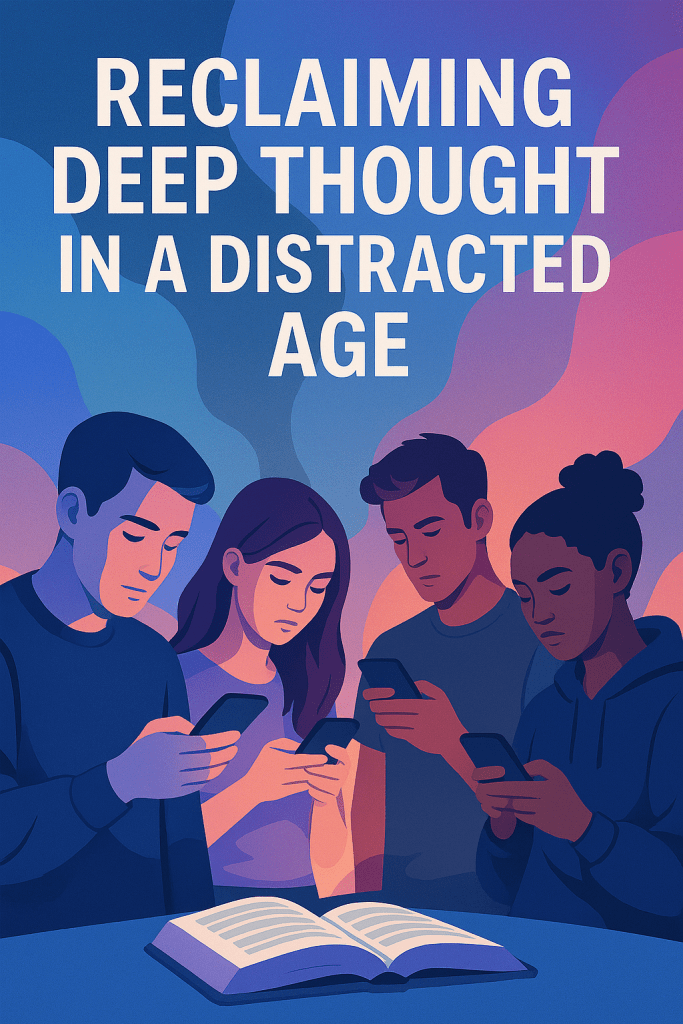
Reclaiming Deep Thought in a Distracted Age

This essay was written and edited by Intellicurean utilizing AI:

In the age of the algorithm, literacy isn’t dying—it’s becoming a luxury. This essay argues that the rise of short-form digital media is dismantling long-form reasoning and concentrating cognitive fitness among the wealthy, catalyzing a quiet but transformative shift. As British journalist Mary Harrington writes in her New York Times opinion piece “Thinking Is Becoming a Luxury Good” (July 28, 2025), even the capacity for sustained thought is becoming a curated privilege.

“Deep reading, once considered a universal human skill, is now fragmenting along class lines.”

What was once assumed to be a universal skill—the ability to read deeply, reason carefully, and maintain focus through complexity—is fragmenting along class lines. While digital platforms have radically democratized access to information, the dominant mode of consumption undermines the very cognitive skills that allow us to understand, reflect, and synthesize meaning. The implications stretch far beyond classrooms and attention spans. They touch the very roots of human agency, historical memory, and democratic citizenship—reshaping society into a cognitively stratified landscape.


The Erosion of the Reading Brain

Modern civilization was built by readers. From the Reformation to the Enlightenment, from scientific treatises to theological debates, progress emerged through engaged literacy. The human mind, shaped by complex texts, developed the capacity for abstract reasoning, empathetic understanding, and civic deliberation. Martin Luther’s 95 Theses would have withered in obscurity without a literate populace; the American and French Revolutions were animated by pamphlets and philosophical tracts absorbed in quiet rooms.

But reading is not biologically hardwired. As neuroscientist and literacy scholar Maryanne Wolf argues in Reader, Come Home: The Reading Brain in a Digital World, deep reading is a profound neurological feat—one that develops only through deliberate cultivation. “Expert reading,” she writes, “rewires the brain, cultivating linear reasoning, reflection, and a vocabulary that allows for abstract thought.” This process orchestrates multiple brain regions, building circuits for sequential logic, inferential reasoning, and even moral imagination.

Yet this hard-earned cognitive achievement is now under siege. Smartphones and social platforms offer a constant feed of image, sound, and novelty. Their design—fueled by dopamine hits and feedback loops—favors immediacy over introspection. In his seminal book The Shallows: What the Internet Is Doing to Our Brains, Nicholas Carr explains how the architecture of the web—hyperlinks, notifications, infinite scroll—actively erodes sustained attention. The internet doesn’t just distract us; it reprograms us.

Gary Small and Gigi Vorgan, in iBrain: Surviving the Technological Alteration of the Modern Mind, show how young digital natives develop different neural pathways: less emphasis on deep processing, more reliance on rapid scanning and pattern recognition. The result is what they call “shallow processing”—a mode of comprehension marked by speed and superficiality, not synthesis and understanding. The analytic left hemisphere, once dominant in logical thought, increasingly yields to a reactive, fragmented mode of engagement.

The consequences are observable and dire. As Harrington notes, adult literacy is declining across OECD nations, while book reading among Americans has plummeted. In 2023, nearly half of U.S. adults reported reading no books at all. This isn’t a result of lost access or rising illiteracy—but of cultural and neurological drift. We are becoming a post-literate society: technically able to read, but no longer disposed to do so in meaningful or sustained ways.

“The digital environment is designed for distraction; notifications fragment attention, algorithms reward emotional reaction over rational analysis, and content is increasingly optimized for virality, not depth.”

This shift is not only about distraction; it’s about disconnection from the very tools that cultivate introspection, historical understanding, and ethical reasoning. When the mind loses its capacity to dwell—on narrative, on ambiguity, on philosophical questions—it begins to default to surface-level reaction. We scroll, we click, we swipe—but we no longer process, synthesize, or deeply understand.


Literacy as Class Privilege

In a troubling twist, the printed word—once a democratizing force—is becoming a class marker once more. Harrington likens this transformation to the processed food epidemic: ultraprocessed snacks exploit innate cravings and disproportionately harm the poor. So too with media. Addictive digital content, engineered for maximum engagement, is producing cognitive decay most pronounced among those with fewer educational and economic resources.

Children in low-income households spend more time on screens, often without guidance or limits. Studies show they exhibit reduced attention spans, impaired language development, and declines in executive function—skills crucial for planning, emotional regulation, and abstract reasoning. Jean Twenge’s iGen presents sobering data: excessive screen time, particularly among adolescents in vulnerable communities, correlates with depression, social withdrawal, and diminished readiness for adult responsibilities.

Meanwhile, affluent families are opting out. They pay premiums for screen-free schools—Waldorf, Montessori, and classical academies that emphasize long-form engagement, Socratic inquiry, and textual analysis. They hire “no-phone” nannies, enforce digital sabbaths, and adopt practices like “dopamine fasting” to retrain reward systems. These aren’t just lifestyle choices. They are investments in cognitive capital—deep reading, critical thinking, and meta-cognitive awareness—skills that once formed the democratic backbone of society.

This is a reversion to pre-modern asymmetries. In medieval Europe, literacy was confined to a clerical class, while oral knowledge circulated among peasants. The printing press disrupted that dynamic—but today’s digital environment is reviving it, dressed in the illusion of democratization.

“Just as ultraprocessed snacks have created a health crisis disproportionately affecting the poor, addictive digital media is producing cognitive decline most pronounced among the vulnerable.”

Elite schools are incubating a new class of thinkers—trained not in content alone, but in the enduring habits of thought: synthesis, reflection, dialectic. Meanwhile, large swaths of the population drift further into fast-scroll culture, dominated by reaction, distraction, and superficial comprehension.


Algorithmic Literacy and the Myth of Access

We are often told that we live in an era of unparalleled access. Anyone with a smartphone can, theoretically, learn calculus, read Shakespeare, or audit a philosophy seminar at MIT. But this is a dangerous half-truth. The real challenge lies not in access, but in disposition. Access to knowledge does not ensure understanding—just as walking through a library does not confer wisdom.

Digital literacy today often means knowing how to swipe, search, and post—not how to evaluate arguments or trace the origin of a historical claim. The interface makes everything appear equally valid. A Wikipedia footnote, a meme, and a peer-reviewed article scroll by at the same speed. This flattening of epistemic authority—where all knowledge seems interchangeable—erodes our ability to distinguish credible information from noise.

Moreover, algorithmic design is not neutral. It amplifies certain voices, buries others, and rewards content that sparks outrage or emotion over reason. We are training a generation to read in fragments, to mistake volume for truth, and to conflate virality with legitimacy.


The Fracturing of Democratic Consciousness

Democracy presumes a public capable of rational thought, informed deliberation, and shared memory. But today’s media ecosystem increasingly breeds the opposite. Citizens shaped by TikTok clips and YouTube shorts are often more attuned to “vibes” than verifiable facts. Emotional resonance trumps evidence. Outrage eclipses argument. Politics, untethered from nuance, becomes spectacle.

Harrington warns that we are entering a new cognitive regime, one that undermines the foundations of liberal democracy. The public sphere, once grounded in newspapers, town halls, and long-form debate, is giving way to tribal echo chambers. Algorithms sort us by ideology and appetite. The very idea of shared truth collapses when each feed becomes a private reality.

Robert Putnam’s Bowling Alone chronicled the erosion of social capital long before the smartphone era. But today, civic fragmentation is no longer just about bowling leagues or PTAs. It’s about attention itself. Filter bubbles and curated feeds ensure that we engage only with what confirms our biases. Complex questions—on history, economics, or theology—become flattened into meme warfare and performative dissent.

“The Enlightenment assumption that reason could guide the masses is buckling under the weight of the algorithm.”

Worse, this cognitive shift has measurable political consequences. Surveys show declining support for democratic institutions among younger generations. Gen Z, raised in the algorithmic vortex, exhibits less faith in liberal pluralism. Complexity is exhausting. Simplified narratives—be they populist or conspiratorial—feel more manageable. Philosopher Byung-Chul Han, in The Burnout Society, argues that the relentless demands for visibility, performance, and positivity breed not vitality but exhaustion. This fatigue disables the capacity for contemplation, empathy, or sustained civic action.


The Rise of a Neo-Oral Priesthood

Where might this trajectory lead? One disturbing possibility is a return to gatekeeping—not of religion, but of cognition. In the Middle Ages, literacy divided clergy from laity. Sacred texts required mediation. Could we now be witnessing the early rise of a neo-oral priesthood: elites trained in long-form reasoning, entrusted to interpret the archives of knowledge?

This cognitive elite might include scholars, classical educators, journalists, or archivists—those still capable of sustained analysis and memory. Their literacy would not be merely functional but rarefied, almost arcane. In a world saturated with ephemeral content, the ability to read, reflect, and synthesize becomes mystical—a kind of secular sacredness.

These modern scribes might retreat to academic enclaves or AI-curated libraries, preserving knowledge for a distracted civilization. Like desert monks transcribing ancient texts during the fall of Rome, they would become stewards of meaning in an age of forgetting.

“Like ancient scribes preserving knowledge in desert monasteries, they might transcribe and safeguard the legacies of thought now lost to scrolling thumbs.”

Artificial intelligence complicates the picture. It could serve as a tool for these new custodians—sifting, archiving, interpreting. Or it could accelerate the divide, creating cognitive dependencies while dulling the capacity for independent thought. Either way, the danger is the same: truth, wisdom, and memory risk becoming the property of a curated few.


Conclusion: Choosing the Future

This is not an inevitability, but it is an acceleration. We face a stark cultural choice: surrender to digital drift, or reclaim the deliberative mind. The challenge is not technological, but existential. What is at stake is not just literacy, but liberty—mental, moral, and political.

To resist post-literacy is not mere nostalgia. It is an act of preservation: of memory, attention, and the possibility of shared meaning. We must advocate for education that prizes reflection, analysis, and argumentation from an early age—especially for those most at risk of being left behind. That means funding for libraries, long-form content, and digital-free learning zones. It means public policy that safeguards attention spans as surely as it safeguards health. And it means fostering a media environment that rewards truth over virality, and depth over speed.

“Reading, reasoning, and deep concentration are not merely personal virtues—they are the pillars of collective freedom.”

Media literacy must become a civic imperative—not only the ability to decode messages, but to engage in rational thought and resist manipulation. We must teach the difference between opinion and evidence, between emotional resonance and factual integrity.

To build a future worthy of human dignity, we must reinvest in the slow, quiet, difficult disciplines that once made progress possible. This isn’t just a fight for education—it is a fight for civilization.

Why “Hamlet” Matters In Our Technological Age

INTELLICUREAN (JULY 22, 2025):

“The time is out of joint: O cursed spite, / That ever I was born to set it right!” — Hamlet, Act I, Scene V

In 2025, William Shakespeare’s Hamlet no longer reads as a distant Renaissance relic but rather as a contemporary fever dream—a work that reflects our age of algorithmic anxiety, climate dread, and existential fatigue. The tragedy of the melancholic prince has become a diagnostic mirror for our present: grief-stricken, fragmented, hyper-mediated. Written in a time of religious upheaval and epistemological doubt, Hamlet now stands at the crossroads of collective trauma, ethical paralysis, and fractured memory.

As Jeremy McCarter writes in The New York Times essay Listen to ‘Hamlet.’ Feel Better., “We are Hamlet.” That refrain echoes across classrooms, podcasts, performance spaces, and peer-reviewed journals. It is not merely identification—it is diagnosis.

This essay weaves together recent scholarship, creative reinterpretations, and critical performance reviews to explore why Hamlet matters—right now, more than ever.

Grief and the Architecture of Memory

Hamlet begins in mourning. His father is dead. His mother has remarried too quickly. His place in the kingdom feels stolen. This grief—raw, intimate, but also national—is not resolved; it metastasizes. As McCarter observes, Hamlet’s sorrow mirrors our own in a post-pandemic, AI-disrupted society still reeling from dislocation, death, and unease.

In Hamlet, architecture itself becomes a mausoleum: Elsinore Castle feels less like a home and more like a prison of memory. Recent productions, including the Royal Shakespeare Company’s Hamlet: Hail to the Thief and the Mark Taper Forum’s 2025 staging, emphasize how space becomes a character. Set designs—minimalist, surveilled, hypermodern—render castles as cages, tightening Hamlet’s emotional claustrophobia.

This spatial reading finds further resonance in Jeffrey R. Wilson’s Essays on Hamlet (Harvard, 2021), where Elsinore is portrayed not just as a backdrop but as a haunted topography—a burial ground for language, loyalty, and truth. In a world where memories are curated by devices and forgotten in algorithms, Hamlet’s mourning becomes a radical act of remembrance.

Our own moment—where memories are stored in cloud servers and memorialized through stylized posts—finds its counter-image in Hamlet’s obsession with unfiltered grief. His mourning is not just personal; it is archival. To remember is to resist forgetting—and to mourn is to hold meaning against its erasure.

Madness and the Diseased Imagination

Angus Gowland’s 2024 article Hamlet’s Melancholic Imagination for Renaissance Studies draws a provocative bridge between early modern melancholy and twenty-first-century neuropsychology. He interprets Hamlet’s unraveling not as madness in the theatrical sense, but as a collapse of imaginative coherence—a spiritual and cognitive rupture born of familial betrayal, political corruption, and metaphysical doubt.

This reading finds echoes in trauma studies and clinical psychology, where Hamlet’s soliloquies—“O that this too too solid flesh would melt” and “To be, or not to be”—become diagnostic utterances. Hamlet is not feigning madness; he is metabolizing a disordered world through diseased thought.

McCarter’s audio adaptation of the play captures this inner turmoil viscerally. Told entirely through Hamlet’s auditory perception, the production renders the world as he hears it: fragmented, conspiratorial, haunted. The sound design enacts the “nutshell” of Hamlet’s consciousness—a sonic echo chamber where lucidity and delusion merge.

Gowland’s interdisciplinary approach, melding humoral theory with neurocognitive frameworks, reveals why Hamlet remains so psychologically contemporary. His imagination is ours—splintered by grief, reshaped by loss, and destabilized by unreliable truths.

Existentialism and Ethical Procrastination

Boris Kriger’s Hamlet: An Existential Study (2024) reframes Hamlet’s paralysis not as cowardice but as ethical resistance. Hamlet delays because he must. His world demands swift vengeance, but his soul demands understanding. His refusal to kill without clarity becomes an act of defiance in a world of urgency.

Kriger aligns Hamlet with Sartre’s Roquentin, Camus’s Meursault, and Kierkegaard’s Knight of Faith—figures who suspend action not out of fear, but out of fidelity to a higher moral logic. Hamlet’s breakthrough—“The readiness is all”—is not triumph but transformation. He who once resisted fate now accepts contingency.

This reading gains traction in modern performances that linger in silence. At the Mark Taper Forum, Hamlet’s soliloquies are not rushed; they are inhabited. Pauses become ethical thresholds. Audiences are not asked to agree with Hamlet—but to wait with him.

In an era seduced by velocity—AI speed, breaking news, endless scrolling—Hamlet’s slowness is sacred. He does not react. He reflects. In 2025, this makes him revolutionary.

Isolation and the Politics of Listening

Hamlet’s isolation is not a quirk—it is structural. The Denmark of the play is crowded with spies, deceivers, and echo chambers. Amid this din, Hamlet is alone in his need for meaning.

Jeffrey Wilson’s essay Horatio as Author casts listening—not speaking—as the play’s moral act. While most characters surveil or strategize, Horatio listens. He offers Hamlet not solutions, but presence. In an age of constant commentary and digital noise, Horatio becomes radical.

McCarter’s audio adaptation emphasizes this loneliness. Hamlet’s soliloquies become inner conversations. Listeners enter his psyche not through spectacle, but through headphones—alone, vulnerable, searching.

This theme echoes in retellings like Matt Haig’s The Dead Father’s Club, where an eleven-year-old grapples with his father’s ghost and the loneliness of unresolved grief. Alienation begins early. And in our culture of atomized communication, Hamlet’s solitude feels painfully modern.

We live in a world full of voices but starved of listeners. Hamlet exposes that silence—and models how to endure it.

Gender, Power, and Counter-Narratives

If Hamlet’s madness is philosophical, Ophelia’s is political. Lisa Klein’s novel Ophelia and its 2018 film adaptation give the silenced character voice and interiority. Through Ophelia’s eyes, Hamlet’s descent appears not noble, but damaging. Her own breakdown is less theatrical than systemic—borne from patriarchy, dismissal, and grief.

Wilson’s essays and Yan Brailowsky’s edited volume Hamlet in the Twenty-First Century (2023) expose the structural misogyny of the play. Hamlet’s world is not just corrupt—it is patriarchally decayed. To understand Hamlet, one must understand Ophelia. And to grieve with Ophelia is to indict the systems that broke her.

Contemporary productions have embraced this feminist lens. Lighting, costuming, and directorial choices now cast Ophelia as a prophet—her madness not as weakness but as indictment. Her flowers become emblems of political rot, and her drowning a refusal to play the script.

Where Hamlet delays, Ophelia is dismissed. Where he soliloquizes, she sings. And in this contrast lies a deeper truth: the cost of male introspection is often paid by silenced women.

Hamlet Reimagined for New Media

Adaptations like Alli Malone’s Hamlet: A Modern Retelling podcast transpose Hamlet into “Denmark Inc.”—a corrupt corporate empire riddled with PR manipulation and psychological gamesmanship. In this world, grief is bad optics, and revenge is rebranded as compliance.

Malone’s immersive audio design aligns with McCarter’s view: Hamlet becomes even more intimate when filtered through first-person sensory experience. Technology doesn’t dilute Shakespeare—it intensifies him.

Even popular culture—The Lion KingSons of Anarchy, countless memes—draws from Hamlet’s genetic code. Betrayal, grief, existential inquiry—these are not niche themes. They are universal templates.

Social media itself channels Hamlet. Soliloquies become captions. Madness becomes branding. Audiences become voyeurs. Hamlet’s fragmentation mirrors our own feeds—brilliant, performative, and crumbling at the edges.

Why Hamlet Still Matters

In classrooms and comment sections, on platforms like Bartleby.com or IOSR Journal, Hamlet remains a fixture of moral inquiry. He endures not because he has answers, but because he never stops asking.

What is the moral cost of revenge?
Can grief distort perception?
Is madness a form of clarity?
How do we live when meaning collapses?

These are not just literary questions. They are existential ones—and in 2025, they feel acute. As AI reconfigures cognition, climate collapse reconfigures survival, and surveillance reconfigures identity, Hamlet feels uncannily familiar. His Denmark is our planet—rotted, observed, and desperate for ethical reawakening.

Hamlet endures because he interrogates. He listens. He doubts. He evolves.

A Final Benediction: Readiness Is All

Near the end of the play, Hamlet offers a quiet benediction to Horatio:

“If it be now, ’tis not to come. If it be not to come, it will be now… The readiness is all.”

No longer raging against fate, Hamlet surrenders not with defeat, but with clarity. This line—stripped of poetic flourish—crystallizes his journey: from revenge to awareness, from chaos to ethical stillness.

“The readiness is all” can be read as a secular echo of faith—not in divine reward, but in moral perception. It is not resignation. It is steadiness.

McCarter’s audio finale invites listeners into this silence. Through Hamlet’s ear, through memory’s last echo, we sense peace—not because Hamlet wins, but because he understands. Readiness, in this telling, is not strategy. It is grace.

Conclusion: Hamlet’s Sacred Relevance

Why does Hamlet endure in the twenty-first century?

Because it doesn’t offer comfort. It offers courage.
Because it doesn’t resolve grief. It honors it.
Because it doesn’t prescribe truth. It wrestles with it.

Whether through feminist retellings like Ophelia, existential essays by Kriger, cognitive studies by Gowland, or immersive audio dramas by McCarter and Malone, Hamlet adapts. It survives. And in those adaptations, it speaks louder than ever.

In an age where memory is automated, grief is privatized, and moral decisions are outsourced to algorithms, Hamlet teaches us how to live through disorder. It reminds us that delay is not cowardice. That doubt is not weakness. That mourning is not a flaw.

We are Hamlet.
Not because we are doomed.
But because we are still searching.
Because we still ask what it means to be.
And what it means—to be ready.

THIS ESSAY WAS WRITTEN AND EDITED BY INTELLICUREAN USING AI

The Curated Persona vs. The Cultivated Spirit

“There is pleasure in the pathless woods,
There is rapture on the lonely shore,
There is society where none intrudes,
By the deep sea, and music in its roar.”
— Lord Byron, Childe Harold’s Pilgrimage

Intellicurean (July 20, 2025):

We are living in a time when almost nothing reaches us untouched. Our playlists, our emotions, our faces, our thoughts—all curated, filtered, reassembled. Life itself has been stylized and presented as a gallery: a mosaic of moments arranged not by meaning, but by preference. We scroll instead of wander. We select instead of receive. Even grief and solitude are now captioned.

Curation is no longer a method. It is a worldview. It tells us what to see, how to feel, and increasingly, who to be. What once began as a reverent gesture—a monk illuminating a manuscript, a poet capturing awe in verse—has become an omnipresent architecture of control. Curation promises freedom, clarity, and taste. But what if it now functions as a closed system—resisting mystery, filtering out surprise, and sterilizing transformation?

This essay explores the spiritual consequences of that system: how the curated life may be closing us off from the wildness within, the creative rupture, and the deeper architecture of meaning—the kind once accessed by walking, wandering, and waiting.

Taste and the Machinery of Belonging

Taste used to be cultivated: a long apprenticeship shaped by contradiction and immersion. One learned to appreciate Bach or Baldwin not through immediate alignment, but through dedicated effort and often, difficulty. This wasn’t effortless consumption; it was opening oneself to a demanding process of intellectual and emotional growth, engaging with works that pushed against comfort and forced a recalibration of understanding.

Now, taste has transformed. It’s no longer a deep internal process but a signal—displayed, performed, weaponized. Curation, once an act of careful selection, has devolved into a badge of self-justification, less about genuine appreciation and more about broadcasting allegiance.

What we like becomes who we are, flattened into an easily digestible profile. What we reject becomes our political tribe, a litmus test for inclusion. What we curate becomes our moral signature, a selective display designed to prove our sensibility—and to explicitly exclude others who don’t share it. This aesthetic alignment replaces genuine shared values.

This system is inherently brittle. It leaves little room for the tension, rupture, or revision essential for genuine growth. We curate for coherence, not depth—for likability, not truth. We present a seamless, unblemished self, a brand identity without flaw. The more consistent the aesthetic, the more brittle the soul becomes, unable to withstand the complexities of real life.

Friedrich Nietzsche, aware of human fragility, urged us in The Gay Science to “Become who you are.” But authentic becoming requires wandering, failing, and recalibrating. The curated life demands you remain fixed—an unchanging exhibit, perpetually “on brand.” There’s no space for the messy, contradictory process of self-discovery; each deviation is a brand inconsistency.

We have replaced moral formation with aesthetic positioning. Do you quote Simone Weil or wear linen neutrals? Your tastes become your ethics, a shortcut to moral authority. But what happens when we are judged not by our love or actions, but by our mood boards? Identity then becomes a container, rigidly defined by external markers, rather than an expansive horizon of limitless potential.

James Baldwin reminds us that identity, much like love, must be earned anew each day. It’s arduous labor. Curation offers no such labor—only the performative declaration of arrival. In the curated world, to contradict oneself is a failure of brand, not a deepening of the human story.

Interruption as Spiritual Gesture

Transformation—real transformation—arrives uninvited. It’s never strategic or trendy. It arrives as a breach, a profound disruption to our constructed realities. It might be a dream that disturbs, a silence that clarifies, or a stranger who speaks what you needed to hear. These are ruptures that stubbornly refuse to be styled or neatly categorized.

These are not curated moments. They are interruptions, raw and unmediated. And they demand surrender. They ask that we be fundamentally changed, not merely improved. Improvement often implies incremental adjustments; change implies a complete paradigm shift, a dismantling and rebuilding of perception.

Simone Weil wrote, “Attention is the rarest and purest form of generosity.” To give genuine attention—not to social media feeds, but to the world’s unformatted texture—is a profoundly spiritual act. It makes the soul porous, receptive to insights that transcend the superficial. It demands we quiet internal noise and truly behold.

Interruption, when received rightly, becomes revelation. It breaks the insidious feedback loop of curated content. It reclaims our precious time from the relentless scroll. It reminds us that meaning is not a product, but an inherent presence. It calls us out of the familiar, comfortable loop of our curated lives and into the fertile, often uncomfortable, unknown.

Attention is not surveillance. Surveillance consumes and controls. Attention, by contrast, consecrates; it honors sacredness. It is not monitoring. It is beholding, allowing oneself to be transformed by what is perceived. In an age saturated with infinite feeds, sacred attention becomes a truly countercultural act of resistance.

Wilderness as Revelation

Before curation became the metaphor for selfhood, wilderness was. For millennia, human consciousness was shaped by raw, untamed nature. Prophets were formed not in temples, but in the harsh crucible of the wild.

Moses wandered for forty years in the desert before wisdom arrived. Henry David Thoreau withdrew to Walden Pond not to escape, but to immerse himself in fundamental realities. Friedrich Nietzsche walked—often alone and ill—through the Alps, where he conceived eternal recurrence, famously declaring: “All truly great thoughts are conceived by walking.”

The Romantic poets powerfully echoed this truth. William Wordsworth, in Tintern Abbey, describes a profound connection to nature, sensing:

“A sense sublime / Of something far more deeply interfused, / Whose dwelling is the light of setting suns…”

John Keats saw nature as a portal to the eternal.

Yet now, even wilderness is relentlessly curated. Instagrammable hikes. Hashtagged retreats. Silence, commodified. We pose at the edge of cliffs, captioning our solitude for public consumption, turning introspection into performance.

But true wilderness resists framing. It is not aesthetic. It is initiatory. It demands discomfort, challenges complacency, and strips away pretense. It dismantles the ego rather than decorating it, forcing us to confront vulnerabilities. It gives us back our edges—the raw, unpolished contours of our authentic selves—by rubbing away the smooth veneers of curated identity.

In Taoism, the sage follows the path of the uncarved block. In Sufi tradition, the Beloved is glimpsed in the desert wind. Both understand: the wild is not a brand. It is a baptism, a transformative immersion that purifies and reveals.

Wandering as Spiritual Practice

The Romantics knew intuitively that walking is soulwork. John Keats often wandered through fields for the sheer presence of the moment. Lord Byron fled confining salons for pathless woods, declaring: “I love not Man the less, but Nature more.” His escape was a deliberate choice for raw experience.

William Wordsworth’s daffodils become companions, flashing upon “that inward eye / Which is the bliss of solitude.” Walking allows a convergence of external observation and internal reflection.

Walking, in its purest form, breaks pattern. It refuses the algorithm. It is an act of defiance against pre-determined routes. It offers revelation in exchange for rhythm, the unexpected insight found in the meandering journey. Each footstep draws us deeper into the uncurated now.

Bashō, the haiku master, offered a profound directive:

“Do not seek to follow in the footsteps of the wise. Seek what they sought.”

The pilgrim walks not primarily to arrive at a fixed destination, but to be undone, to allow the journey itself to dismantle old assumptions. The act of walking is the destination.

Wandering is not a detour. It is, in its deepest sense, a vocation, a calling to explore the contours of one’s own being and the world without the pressure of predetermined outcomes. It is where the soul regains its shape, shedding rigid molds imposed by external expectations.

Creation as Resistance

To create—freely, imperfectly, urgently—is the ultimate spiritual defiance against the tyranny of curation. The blank page is not optimized; it is sacred ground. The first sketch is not for immediate approval. It is for the artist’s own discovery.

Samuel Taylor Coleridge defined poetry as “the best words in the best order.” Rainer Maria Rilke declared, “You must change your life.” Friedrich Nietzsche articulated art’s existential necessity: “We have art so that we do not perish from the truth.” These are not calls to produce content for an audience; they are invitations to profound engagement with truth and self.

Even creation is now heavily curated by metrics. Poems are optimized for engagement. Music is tailored to specific moods. But art, in its essence, is not engagement; it is invocation. It seeks to summon deeper truths, to ask questions the algorithm can’t answer, to connect us to something beyond the measurable.

To make art is to stand barefoot in mystery—and to respond with courage. To write is to risk being misunderstood. To draw is to embrace the unpolished. This is not inefficiency. This is incarnation—the messy, beautiful process of bringing spirit into form.

Memory and the Refusal to Forget

The curated life often edits memory for coherence. It aestheticizes ancestry, reducing complex family histories to appealing narratives. It arranges sentiment, smoothing over rough edges. But real memory is a covenant with contradiction. It embraces the paradoxical coexistence of joy and sorrow.

John Keats, in his Ode to a Nightingale, confronts the painful reality of transience and loss: “Where youth grows pale, and spectre-thin, and dies…” Memory, in its authentic form, invites this depth, this uncomfortable reckoning with mortality. It is not a mood board. It is a profound reckoning, where pain and glory are allowed to dwell together.

In Jewish tradition, memory is deeply embodied. To remember is not merely to recall a fact; it is to retell, to reenact, to immerse oneself in the experience of the past, remaining in covenant with it. Memory is the very architecture of belonging. It does not simplify complex histories. Instead, it deepens understanding, allowing generations to draw wisdom and resilience from their heritage.

Curation flattens, reducing multifaceted experiences to digestible snippets. Memory expands, connecting us to the vast tapestry of time. And in the sacred act of memory, we remember how grace once broke into our lives, how hope emerged from despair. We remember so we can genuinely hope again, with a resilient awareness of past struggles and unexpected mercies.

The Wilderness Within

The final frontier of uncuration is profoundly internal: the wilderness within. This is the unmapped territory of our own consciousness, the unruly depths that resist control.

Søren Kierkegaard called it dread—not fear, but the trembling before the abyss of possibility. Nietzsche called it becoming—not progression, but metamorphosis. This inner wilderness resists styling, yearns for presence instead of performance, and asks for silence instead of applause.

Even our inner lives are at risk of being paved over. Advertisements and algorithmic suggestions speak to us in our own voice, subtly shaping desires. Choices feel like intuition—but are often mere inference. The landscape of our interiority, once a refuge for untamed thought, is being meticulously mapped and paved over for commercial exploitation, leaving little room for genuine self-discovery.

Simone Weil observed: “We do not obtain the most precious gifts by going in search of them, but by waiting for them.” The uncurated life begins in this waiting—in the ache of not knowing, in the quiet margins where true signals can penetrate. It’s in the embrace of uncertainty that authentic selfhood can emerge.

Let the Soul Wander

“Imagination may be compared to Adam’s dream—he awoke and found it truth.” — Keats

To live beyond curation is to choose vulnerability. It is to walk toward complexity, to embrace nuances. It is to let the soul wander freely and to cultivate patience for genuine waiting. It is to choose mystery over mastery, acknowledging truths revealed in surrender, not control.

Lord Byron found joy in pathless woods. Percy Bysshe Shelley sang alone, discovering his creative spirit. William Wordsworth found holiness in leaves. John Keats touched eternity through birdsong. Friedrich Nietzsche walked, disrupted, and lived with intensity.

None of these lives were curated. They were entered—fully, messily, without a predefined script. They were lives lived in engagement with the raw, untamed forces of self and world.

Perhaps / The truth depends on a walk around a lake, / A composing as the body tires, a stop. // To see hepatica, a stop to watch. / A definition growing certain…” Wallace Stevens

So let us make pilgrimage, not cultivate a profile. Let us write without audience, prioritizing authentic expression. Let us wander into ambiguity, embracing the unknown. And let us courageously welcome rupture, contradiction, and depth, for these are the crucibles of genuine transformation.

And there—at the edge of control, in the sacred wilderness within, where algorithms cannot reach—
Let us find what no curated feed can ever give.
And be profoundly changed by it.

THIS ESSAY WAS WRITTEN AND EDITED BY INTELLICUREAN USING

REVIEW: “Donald Trump, Zohran Mamdani, and Posting as Politics”

An AI Review: “Donald Trump, Zohran Mamdani, and Posting as Politics”

In The New Yorker essay “Donald Trump, Zohran Mamdani, and Posting as Politics,” Kyle Chayka explores how social media has become not merely a communication tool for political figures but the primary arena in which politics itself now unfolds. The piece contrasts the digital personas of Donald Trump and Zohran Mamdani to illustrate how posting has evolved into a core exercise of power and a new form of political identity.

Chayka begins by chronicling former President Trump’s frenetic use of Truth Social, the platform he created after leaving Twitter. Trump does not merely announce decisions online; he appears to make them there. For instance, in June 2025, Trump unilaterally declared and publicized a ceasefire between Israel and Iran on Truth Social after having ordered strikes on Iranian nuclear facilities only days earlier. He issued warnings and taunts in the same all-caps style he once used to brag about the size of his nuclear arsenal compared to Kim Jong Un’s. The essay argues that this real-time posting has compressed world-shaking events into casual, ephemeral updates, trivializing violence and policy into the equivalent of viral content.

Yet Trump is not alone in harnessing the power of constant broadcasting. Chayka turns to Zohran Mamdani, a 33-year-old New York State assembly member and Democratic nominee for New York City mayor, who embodies a different approach to digital politics. Where Trump’s style is bombastic and combative, Mamdani’s presence on TikTok and Instagram is more polished and warm. His short-form videos—some produced by the creative agency Melted Solids—blend documentary realism with the aesthetics of viral influencer content. Clips of Mamdani walking through Manhattan or spontaneously greeting his filmmaker mother, Mira Nair, have garnered millions of views. His collaborations with high-profile digital creators like the Kid Mero and Emily Ratajkowski reflect an understanding that modern campaigns are not only about policy but about generating a steady stream of engaging material.

Chayka underscores that both politicians are symptoms of the same phenomenon: social media has swallowed the traditional infrastructure of political communication. No longer is there a clear boundary between a politician’s private musings and official pronouncements. The medium has become the message—and often the entire substance. Even memes have turned into flash points of political conflict. The article recounts how U.S. border officials detained a Norwegian tourist, Mads Mikkelsen, who carried a satirical meme of Vice President J.D. Vance on his phone, suggesting that political images have acquired the power to implicate their holders in ideological battles.

This transformation, Chayka argues, has significant consequences. Trump’s unfiltered posts, once viewed as a sideshow, have become a primary instrument of governance, with the potential to inflame conflicts or disrupt alliances. Meanwhile, Mamdani’s refined authenticity—crafted through video diaries and collaborations—illustrates how even progressive candidates must adopt the same always-online posture to cultivate a political following. While Mamdani’s style is less aggressive than Trump’s, it similarly depends on projecting a version of authenticity that is inseparable from performance.

The essay closes by reflecting on the future of American politics in this environment. The Democratic Party has struggled to counter Trump’s cultural dominance, as shown by tone-deaf spectacles like a Pride concert at the Kennedy Center with anti-Trump parodies of Les Misérables. In contrast, Mamdani’s campaign has generated genuine enthusiasm. Yet Chayka raises an open question: can the idealistic energy of this new digital-first politics survive the compromises of actual governance? If online performance has become the main credential for leadership, it is unclear whether any politician—no matter their ideology—can avoid the pressures of perpetual self-promotion.

In the end, Chayka’s essay offers a clear warning: social media has transformed politics into a theater of the immediate, where every post carries the weight of policy and every meme can become an instrument of power. Whether this dynamic can be reconciled with the demands of responsible government remains the central challenge of the digital age.

Strengths of the Essay

  1. Compelling Illustrations of Digital-First Governance
    • The article effectively juxtaposes Trump’s all-caps proclamations with Mamdani’s handheld videos.
    • Vivid examples: Trump’s posts about Iranian bombings feel almost satirical in their triviality—like “food grams”—yet they are deadly serious.
    • The Vance meme incident (Norwegian tourist Mikkelsen denied entry partly over a meme) underscores how digital artifacts can become politically consequential.
  2. Clear Argument
    • Chayka convincingly demonstrates that posting is no longer merely a marketing tactic—it is a form of exercising power.
    • The phrase “influencer-in-chief” encapsulates this new paradigm succinctly.
  3. Timeliness and Relevance
    • The piece captures the unsettling normalcy of this phenomenon—how we now expect statecraft to be conducted via apps.
    • It connects to broader anxieties about the erosion of institutional boundaries between governance and entertainment.
  4. Balanced Comparison
    • The contrast between Trump’s aggression and Mamdani’s optimism avoids simple equivalence.
    • The essay suggests that while style differs, both are beholden to the same dynamics: immediacy, spectacle, and performative authenticity.

Areas For Further Exploration

  1. A Critique of Consequences
    • While Chayka notes the trivialization of serious decisions (e.g., bombings posted like selfies), he stops short of examining the systemic dangers—the erosion of deliberative processes, the collapse of public trust, and the incentivizing of extremism.
    • A deeper dive into why social media rewards such maximalist performances—and how this affects democracy—would have been valuable.
  2. An Exploration of Audience Complicity
    • The essay portrays politicians as the main actors, but it could interrogate how audiences co-produce this environment: what are the incentives to consume, share, and reward this content?
    • Do voters really want “authenticity,” or simply entertainment masquerading as politics?
  3. Further developed Historical Context
    • While the piece references Trump’s first term, it could have drawn richer parallels with earlier media transformations:
      • Roosevelt’s radio “Fireside Chats”
      • Kennedy’s TV charisma
      • Obama’s early social media campaigns
    • This would help readers situate today’s moment within a longer trajectory.

Broader Implications

The essay ultimately raises unsettling questions:

  • If the performance of authenticity is now the primary qualification for political power, how do policy substance and institutional competence survive?
  • Is there any way for governance to reassert seriousness, or will the logic of virality always prevail?
  • What happens when online theater collides with offline consequences—wars, economies, civic life?

These questions feel especially urgent given that the piece suggests this dynamic is not limited to Trump’s right-wing populism but has also infiltrated progressive candidates.

*THIS ESSAY WAS WRITTEN BY CHAT GPT AND EDITED BY INTELLICUREAN.

The New York Times —- Saturday, Dec. 21, 2024

Image

Congress Approves Spending Extension, Ending Shutdown Crisis

The Senate passed the measure, sending it to President Biden’s desk, shortly after the midnight deadline for funding to lapse.

Insurers Are Deserting Homeowners as Climate Shocks Worsen

Without insurance, it’s impossible to get a mortgage; without a mortgage, most Americans can’t buy a home.

Weight Loss Drugs Changed Their Lives. Then They Lost Coverage.

In Michigan, the state’s largest insurer has tightened restrictions around medications like Wegovy. Patients are panicking.

Al-Assad’s Soldiers Hope for Amnesty. First, They Have to Take a Number.

Syria’s new rulers say they will spare conscripts of Bashar al-Assad and pursue those who oversaw his regime’s abuses. Hundreds are lining up to learn which promise applies to them.

Politics: The Guardian Weekly-December 13, 2024

Image

The Guardian Weekly (December 11, 2024): The new issue features The fall of Syria’s brutal dictatorship. Plus The best books of 2024.

Not even the most optimistic of rebels could have predicted the rapid collapse, last weekend, of the Assad dynasty that ruled Syria with an iron fist for more than 50 years. Yet while there was relief and joy both inside Syria and among the nation’s vast displaced diaspora, it was also accompanied by apprehension over what might come next.

1

Spotlight | Russia and Ukraine wait warily for Trump transition
The idea of the US president-election as a saviour for Ukraine, as unlikely as it may seem, holds an appeal for an exhausted nation without a clear path to victory. Shaun Walker and Pjotr Sauer report

2

Environment | The jailed anti-whaler defiant in face of extradition threat
Capt Paul Watson talks to Daniel Boffey about his arrest on behalf of the Japanese government, his ‘interesting’ Greenland prison, and separation from his children

3

Feature | The growing threat of firearms that can be made at home
One far-right cell wanted to use 3D-printed guns to cause ‘maximum confusion and fear’ on the streets of Finland. Could the police intercept them in time? By Samira Shackle

4

Opinion | Farage is lying in wait. Britain can’t afford for Starmer to fail
It is not enough for the Labour leader’s ‘milestones’ to be achieved. Voters must feel the improvement in their daily lives, says Guardian columnist Jonathan Freedland

5

Culture | The best books of 2024
From a radical retelling of Huckleberry Finn to Al Pacino’s autobiography, our critics round up their favourite reads of the year

Research Preview: Nature Magazine – Dec. 12, 2024

Volume 636 Issue 8042

Nature Magazine – December 11, 2024: The latest issue features ‘Digestive Tracks’ – Fossilized vomit and poo reveal how dinosaurs came to dominate ancient ecosystems…

Do you drink coffee? Ask your gut

Largest study of links between consumption of the beverage and gut diversity finds coffee-loving bacteria.

Has Venus ever had an ocean? Its volcanoes hint at an answer

Chemistry of the planet’s atmosphere suggests that its interior has never held water.

Ancient stacks of dishes tell tale of society’s dissolution

Artefacts from a Mesopotamian archaeological site suggest that people in the region founded and later rejected an early form of the organized state.