Tag Archives: September 2025

DO I WAKE OR SLEEP?

A Speculative Morning with Keats

By Michael Cummins, Editor, September 25, 2025

“As if I were dissolving.” — John Keats, letter to his brother George, April 1819

In Hampstead, on a spring morning in 1819, John Keats sat beneath a plum tree and wrote “Ode to a Nightingale.” This is how the lines may have come to him—half vision, half dissolution.

Brown clatters a cup somewhere inside. The sound is an unwelcome punctuation mark on the morning’s silence, a reminder of the relentless normalcy of domestic life. The room has felt too narrow for breath, not just for my ailing lungs, but for the grief that keeps the curtains drawn. Barely six months since my brother Tom slipped away, the house still smells faintly of smoke, paper, and the sweet-sick residue of medicine. His absence hangs in the air. That weight has driven me to the grass, away from the claustrophobia of the sickroom.

The garden receives me. The grass is damp, pressing cool blades into my palms. Light filters through the plum tree leaves, breaking into fragments on the soil. The blossoms drift like a quiet snowfall, powdering my sleeve with pale dust as if testing whether the body still belongs to earth. Beyond the hedge, a cart rattles, a dog barks, a bell tolls faintly from Hampstead. Life continues its tedious bookkeeping. But here, there is only the hush before song.

Brown’s footsteps echo faintly, a rhythm too human for the stillness I crave. Even his voice, when it rises in greeting, feels like a tether to the mundane. I do not resent him; I envy his ease with the world. He pours tea, hums to himself, and carries on. I am fixed under the plum tree, waiting for something less ordinary to speak.

And then the nightingale begins. The sound is not a tune but a force: poured, unbroken, radically unselfconscious. It arrives without the stutter of human intention, as if the bird is nothing but the channel of its own liquid note. The song alters the air. I feel it in the chest before I write a word. I steady my paper, and the ink pools like shadow, metallic and alive. It smells of iron and inevitability. Each stroke is a pulse, each word a breath I cannot take.

My heart aches, and a drowsy numbness pains
My sense, as though of hemlock I had drunk,

The line comes of its own accord. The ache is not complaint but aperture. Pain is the friction that opens the door. Numbness clears the chatter of reason. The poem begins in crisis, a shock both physical and metaphysical.

Or emptied some dull opiate to the drains
One minute past, and Lethe-wards had sunk:

Lethe does not erase; it suspends. In its waters, memory floats unmoored, waiting for a name. Tom is gone, ferried by the same current. His silence hovers in the ink. Yet the river here is not despair but narcotic kindness, a place where debts and illness dissolve into rhythm. I do not summon the myth; it summons me. Byron writes like a storm—quick, unrelenting. I write like a wound: slow, deliberate, pulsing. And yet today the hand runs faster, driven by the bird’s current.

’Tis not through envy of thy happy lot,
But being too happy in thine happiness,—

I do not covet. I am saturated. The bird’s happiness is no possession but a weather spilling into the morning. I am not resentful; I am simply overflowed. The pen scratches faster when I abandon self-pity and admit the sheer fact of joy.

That thou, light-winged Dryad of the trees,
In some melodious plot

The Dryad arrives without strain. Myth is not invention but recognition. The bird’s song is timeless, deserving of a classical name.

Of beechen green, and shadows numberless,
Singest of summer in full-throated ease.

Ease—I do not have it. My lungs constrict, my chest rasps, nights punctuated by the cough that writes mortality into every breath. Yet I put the phrase down because the bird teaches it. A line must do what it says: open, breathe, pour.

The song intoxicates more than wine. My lips are dry, yet the body reels as though stained purple at the mouth.

O for a draught of vintage! that hath been
Cool’d a long age in the deep-delved earth,

The cellar rises: cool, stony, damp. This is no ornament but a transcription of sensation.

Tasting of Flora and the country green,
Dance, and Provençal song, and sunburnt mirth!

I have never seen Provence, but the imagination persuades me otherwise. The song conjures the vineyard. These sensations are not decoration; they are human joy remembered in the body.

O for a beaker full of the warm South,
Full of the true, the blushful Hippocrene,

The beaker is not a vessel but the bird itself, brimming with myth. Hippocrene flows because the song requires its name.

With beaded bubbles winking at the brim,
And purple-stained mouth;

To drink is to be marked. The mouth is stained because it has been altered. Poetry demands transformation; ecstasy must leave a trace.

But intoxication fades. What remains is grief.

Fade far away, dissolve, and quite forget
What thou among the leaves hast never known,

The bird is blessed in its ignorance. It does not know poverty. It does not know longing. It does not know the ache of an empty chair.

Tom once sat beneath this tree, sketching the shape of a bird in flight. He said silence was the soul’s canvas. Now that silence is heavier, less blank, more bruised. His face—thin as paper—rises when I write “youth grows pale.” The ode becomes his memorial as much as mine.

The weariness, the fever, and the fret
Here, where men sit and hear each other groan;

The line steadies itself on blunt fact. Tom. Debt. The cough. No flourish can soften them.

Where palsy shakes a few, sad, last grey hairs,
Where youth grows pale, and spectre-thin, and dies;

He is there again, spectre-thin, his breath shallow. The cadence is the only mercy.

Where but to think is to be full of sorrow
And leaden-eyed despairs,

Thought itself betrays when it offers no hope forward. To write is to wrestle despair into cadence.

I call for wings—not Bacchus’s painted team but the invisible kind I know.

Away! away! for I will fly to thee,
Not charioted by Bacchus and his pards,

Wine is a lie. Fancy, too. Only poesy can lift.

But on the viewless wings of Poesy,
Though the dull brain perplexes and retards:

The brain resists, heavy, skeptical. Poesy ignores resistance. The moment I write “Away!” I am gone.

Already with thee! tender is the night,
And haply the Queen-Moon is on her throne,

Daylight floods Hampstead, yet the moon rises on the page. The imagination enthrones her, and that suffices.

Cluster’d around by all her starry Fays;
But here there is no light,

Contradiction is permitted. This is Negative Capability as I once named it: to remain “in uncertainties, Mysteries, doubts, without any irritable reaching after fact and reason.” The ode does not solve; it dwells.

Death arrives then, companionable, not hostile.

Now more than ever seems it rich to die,
To cease upon the midnight with no pain,

“Rich”—the word startles, but I keep it. Death here is plenitude, not theft.

While thou art pouring forth thy soul abroad
In such an ecstasy!

The bird pours, my ribs echo. Death feels like completion.

Still wouldst thou sing, and I have ears in vain—
To thy high requiem become a sod.

Yet honesty must break the dream: if I am earth, I cannot hear. Even rapture admits silence.

The song itself, though, is older than me, older than kings.

Thou wast not born for death, immortal Bird!
No hungry generations tramp thee down;

Mortality is mine, not yours. Your song belongs to recurrence.

The voice I hear this passing night was heard
In ancient days by emperor and clown:

Emperors and clowns alike have bent their ears. Beauty makes no distinction.

Perhaps the self-same song that found a path
Through the sad heart of Ruth, when, sick for home,

The “perhaps” is everything. Certainty would bruise compassion.

I think, too, of Fanny Brawne. Her presence lingers behind the lines, as urgent as my cough. She is near, but a partition stands—of health, of propriety, of fate itself. To love her is to ache for what cannot be promised. The bird’s song is boundless, but my breath is measured. Desire sharpens sorrow into necessity.

The garden dissolves. Casements open in the skull.

Charm’d magic casements, opening on the foam
Of perilous seas, in faery lands forlorn,

The peril saves the vision from cloying. A blossom falls on my sleeve like ash from a cooling fire.

Forlorn! the very word is like a bell
To toll me back from thee to my sole self!

One word tolls, and the spell breaks.

Adieu! the fancy cannot cheat so well
As she is fam’d to do, deceiving elf.

I do not scold the Fancy. I thank it. Its deception is mercy.

The music vanishes. Not fading, but gone.

Fled is that music:—Do I wake or sleep?

I stop. I do not answer. The question is the ode’s truest symmetry.

The ink is still damp, smelling of iron. I glance back at the start, weighing first heat against last stillness.

My heart aches, and a drowsy numbness pains… Fled is that music:—Do I wake or sleep?

Between these poles lies a morning: a poet beneath a plum tree, a body already failing, a bird whose song endures.

I think of what I wrote not long ago—that the world is a vale of Soul-making. Do you not see how necessary a World of Pains and troubles is to school an Intelligence and make it a Soul? Suffering is the furnace, imagination the hammer. The ode is not escape from the furnace but evidence of the forging itself.

Perhaps a widow will read this, her fingers trembling on the page. Or a child, too young to name sorrow, will feel something loosen in the chest. Or a soldier, resting between battles, will find a measure of stillness in the lines. Beauty is not ornament but survival. If the poem steadies even one breath, it has earned its place among the leaves.

Brown steps out, squinting in the morning light. I gather the pages, careful as if any breeze could undo the morning. I hand him the sheaf and say what is exact: “I have been writing.”

He will tell this story later and say I wrote under the plum tree in one morning, which is true in the way truth sometimes fits a simple sentence. I go back inside. The cough finds me at the foot of the stair; it always does. But the air in my chest is changed by the shape the morning carved in it. The bird sang, and I answered. Whether I wake or sleep, the song remains.

THIS ESSAY WAS WRITTEN AND EDITED UTILIZING AI

SCIENCE MAGAZINE – SEPTEMBER 25, 2025

Science issue cover

SCIENCE MAGAZINE: The latest issue features ‘The Color of Prey’ – Selection for warning coloration and camouflage.

Buried salt is abetting Arctic thaw

Ancient layers of saline permafrost are melting below zero, deepening lakes and weakening coasts

Gardening strategies of termite farmers

Termites use microbe-infused soil to protect a fungal symbiont

Understanding avian influenza mortality

Three theories could explain why the North American H5N1 epidemic has not been more deadly

An inheritance of long life

Parental lysosomes modify epigenetic signaling to influence offspring life span

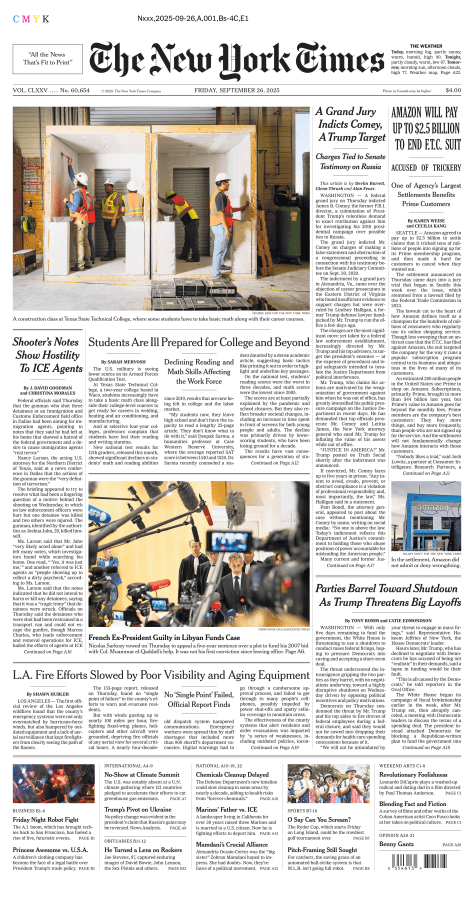
THE NEW YORK TIMES – FRIDAY, SEPTEMBER 26, 2025

Former F.B.I. Director Comey Indicted After Pressure From Trump

The indictment of James Comey is a culmination of President Trump’s push for retribution over the investigation of his 2016 campaign for possible Russia ties.

Trump Gets the Retribution He Sought, and Shatters Justice Dept. Norms

The indictment trampled the department’s tradition of keeping a distance from politics and the White House, and raised the prospect of more arbitrary charges.

Netanyahu to Address World Leaders as Gaza War Nears 2-Year Mark

Prime Minister Benjamin Netanyahu of Israel will speak to an audience of world leaders, not long after many of them recognized a Palestinian state.

Trump Will Slap Tariffs on Imported Drugs, Trucks and Household Furnishings

The president said his tariffs would range from 25 to 100 percent and go into effect next week.

New Tariffs Shock Countries Reeling From Trump’s Chaotic Trade War

Throughout Asia, the source of about 40 percent of U.S. imports, countries have little to show for weeks of talks trying to finalize deals.

THE ECONOMIST MAGAZINE – SEPTEMBER 27, 2025 PREVIEW

THE ECONOMIST MAGAZINE: The latest issue featuresFree speech in America‘…

Donald Trump is trying to silence his critics. He will fail

But the country could still lose

The desperate search for superstar talent

Too much potential goes to waste

Fixing the rot in Ukraine

Things are going wrong away from the front line. Europe needs to help

How to stop AI’s “lethal trifecta”

Coders need to start thinking like mechanical engineers

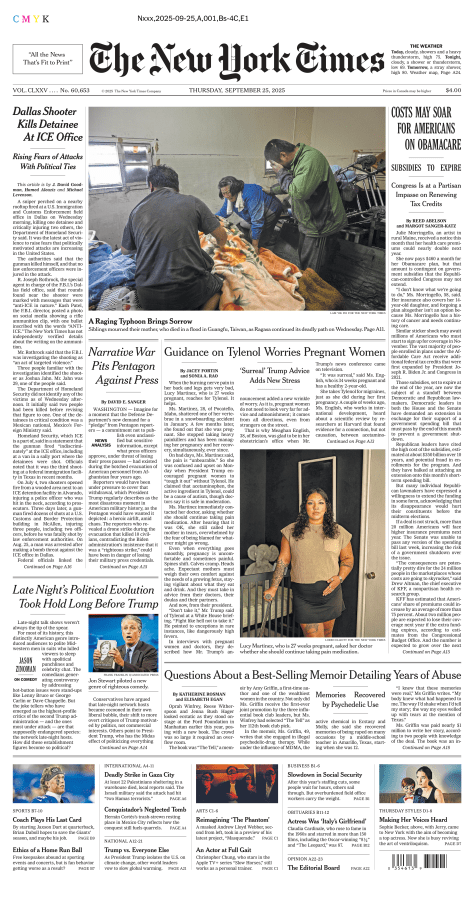
THE NEW YORK TIMES – THURSDAY, SEPT. 25, 2025

A Diminished Social Security Work Force, and Its Customers, Feel the Strain

After this year’s staffing cuts, some people wait for hours, while others sail through. But overburdened field office workers carry the weight.

With His Pivot on Ukraine, Trump May Be Washing His Hands of the War

President Trump has shown dwindling interest in mediating a peace accord, joining European “security guarantees” for Ukraine or providing aid and intelligence.

For Trump, Data Is Often ‘Phony,’ Unless It Supports His Views

The president has ping-ponged between boasts about jobs and crime and attacks on their data sources. Here’s how he is threatening trust in public data.

After Dallas Shooting, a Rush to Score Political Points Before the Facts Are In

The deadly attack at an ICE facility prompted a high-profile clash between Vice President JD Vance and Jon Favreau, a progressive podcast host.

SILENCE AFTER THE BELL

Bashō’s narrow road, re-imagined in ink and light

By Michael Cummins, Editor, September 24, 2025

In the spring of 1689, Matsuo Bashō set out from Edo with his inkstone and his disciple, walking north through Japan’s interior. This essay imagines the painter Ogata Kōrin at his side, brush catching what haiku left unsaid: the lantern’s glow, a fox’s mischief, the silence after sound.

The morning I left Edo, the sky was thick with petals. Cherry blossoms fell in sudden gusts, scattering across canals and clinging to the backs of merchants. Someone in the crowd said my name. “Bashō—the man of stillness.” The words felt like a shroud. Stillness was not peace. Stillness was suffocation.

I carried only a robe, a small pack, and my inkstone. I gave no notice, offered no farewell. A poet should know the difference between an entrance and an exit, and Edo was drowning in entrances—recitations in smoky salons, verses pinned to pillars, applause echoing in courtyards. To slip away silently was my only true poem.

Sora, my disciple, waited by the gate, his journal tied at his side. Beside him stood Ogata Kōrin, carrying brushes wrapped in cloth, a small box of pigments, and sheets of fine paper. He was famed for painting bold pines and cranes against gold, but he wanted to walk with us, to see if paint could keep pace with words.

“You walk for silence,” he said as we stepped into the road.

“And you?” I asked.

“I will paint the sound.”


A crow on a bare branch—
autumn evening.

Walking unstitched illusions. You cannot hurry rain. You cannot plead with a mountain. Each step was a reminder of smallness.

Oku—the interior—was more than geography. It was the hidden chamber within things. To walk north into deep country was to step into the interior of myself.

The road gave humility: a thin robe against spring wind, an empty belly by sundown, blistered feet in straw sandals. Hunger was not a lack but a space for the world to fill. Only when stripped of comfort could I hear the world breathe.


By the second month, rains thickened. Each evening Sora dried our sandals by the inn’s hearth, though by morning they were heavy again.

At a mountain temple, a monk struck the great bell. The sound swelled, then emptied into air.

“Not the ringing,” he whispered, “the silence after—that is the true temple.”

Kōrin ground his ink and left behind a circle fading into white paper. I looked at it and felt the hush expand. His first gift of the journey.

Pine shadow—
the road bends
to meet it.


Summer pressed down like a hand. Cicadas shrieked in the trees, their chorus burning itself away. At a roadside inn, a farmer’s wife handed me a bowl of barley and salt.

“Why walk in this heat?” she asked.

“To see what words cannot hold,” I said. She laughed, shaking her head.

That night, I listened to the cicadas outside the window. Kōrin painted their wings in silver strokes. Sora struggled to describe them, blotting his brush, sighing. Not every moment can be pinned to the page.

One afternoon, a girl chased dragonflies, sleeves spread like wings. She caught none, but her laughter rang sharper than capture. Kōrin caught her mid-flight in vermilion. He pressed the paper into Sora’s hands. “If you cannot hold it with words,” he said, “let color remind you.”


We reached Matsushima, where pine-covered islets scattered like jewels across the bay. Some places do not need words. Kōrin’s blues and greens glowed even at dusk.

That night, fireflies pressed against the paper walls of our hut, their glow brighter than the lamp. I set down my brush. Some nights call for silence more than lines.

Later, in a fishing village, I collapsed with fever. A fisherman’s wife placed cloths on my brow and whispered prayers to the sea.

When I woke, Kōrin held out a small painting of a lantern’s glow against dark waves. The flame was steadier than I had felt in days.

Lantern flickers—
the sea’s hush louder
than my pulse.


By August, the barley fields had turned gold. The harvest moon rose red above the stubble. Villagers poured sake and sang. A boy ran over with a cup. “Drink, master!”

“The moon is already enough,” I said.

Snow still lingered in the high passes. The mountain does not flatter. It does not care if a man is poet or beggar. It accepts only attention.

Winter gust—
even the inkstone
holds the wind.


Crossing a frozen river, I slipped. A peasant caught my arm. “Careful, master. The ice breaks without warning.”

“So does the self,” I said.

Even in silence, the self lingered like a shadow. I imagined my words drifting northward, reaching readers yet unborn. But the further I walked, the thinner that dream became. What immortality is there in syllables, when rivers change their course and mountains crumble?

In Edo, applause had filled the air like thunder. On the road, there was only silence. Silence wounds, but it also heals.

The answer came not in thunder but in a sparrow’s wing. Write not to endure, but to attend. Not for tomorrow, but for now.


Near a riverbank, a boy approached with a scroll of verses. “Master, how do I make my poems last?”

“Write what you see,” I said. “Then write what you feel when you see it. Then tear it up and walk.”

The boy bowed. Kōrin added, softly: “Or paint the emptiness left behind.”

River mist—
the boy’s scroll
left unopened.


In the mountains I met a man from the north whose dialect I could not follow. He pointed to the sky, then to the river, then to his chest. We shared tea in silence. I realized then that language is not the vessel, but the gesture. Poetry lives in the space between.

One morning, I watched a fox dart through a field, a rice ball clutched in its mouth. The farmer cursed, but I laughed. Even hunger has mischief. Kōrin’s brush caught the moment in quick ink.

Fox in the field—
the rice ball warmer
than the sun.


Toward the end of our walk, Sora counted the ri that remained. “Two thousand and more behind us,” he said. His journal pages were full of weather, distances, small observations.

“I counted shadows,” I told him. “I counted pauses.”

Kōrin smiled. “I painted both.”

At last, beneath a cedar, I placed the inkstone on my lap and listened. Snow weighed heavy on the branches. The air was sharp with winter. The wind moved through ridges and needles and into the hollow of the stone. For a moment it seemed the ink itself stirred.

I wrote one last haiku, not as conclusion but as surrender. The road has no end. Only pauses where breath gathers.

Wind in the cedar—
the inkstone deepens
into silence.


When these fragments later formed Oku no Hosomichi, I wondered what I had left behind. Not a record of steps, but a trace of listening. The form belonged not to me but to the rhythm of walking.

Kōrin returned to Edo with his scrolls. I with my scattered lines. Yet three small works stayed with me: the fading bell, the glowing lantern, the fox with his rice ball. They were his haiku in color, brief offerings to impermanence.

If others take their own narrow roads, let them not follow our footsteps but their own shadows. The road is never the same twice. Neither traveler nor mountain remains unchanged.

Perhaps one day, a traveler will walk with a pen of light, or a scroll made of glass. They will pause beneath a cedar, not knowing my name, not knowing Kōrin’s brush, but feeling the same hush. The road will whisper to them, as it did to us. And they will listen—not to the words, nor the colors, but to the breath between.

Digital ink—
the silence still.

THIS ESSAY WAS WRITTEN AND EDITED UTILIZING AI

COUNTRY LIFE MAGAZINE – SEPTEMBER 24, 2025

Cover of Country Life 24 September 2025

COUNTRY LIFE MAGAZINE: The latest issue features St Michael’s Mount at low tide.

The roads less travelled

Now you see them, now you don’t: Roger Morgan-Grenville treads the ephemeral sea paths of Britain, those often-ancient routes at the mercy of the tides

Spreads from Life Country Life 24 September 2025

A stitch in time

Deborah Nicholls-Lee unearths Mr Darcy’s shirt, Bertie Wooster’s dressing gown and Poldark’s tricorn hat in a fascinating trawl through the Cosprop wardrobes

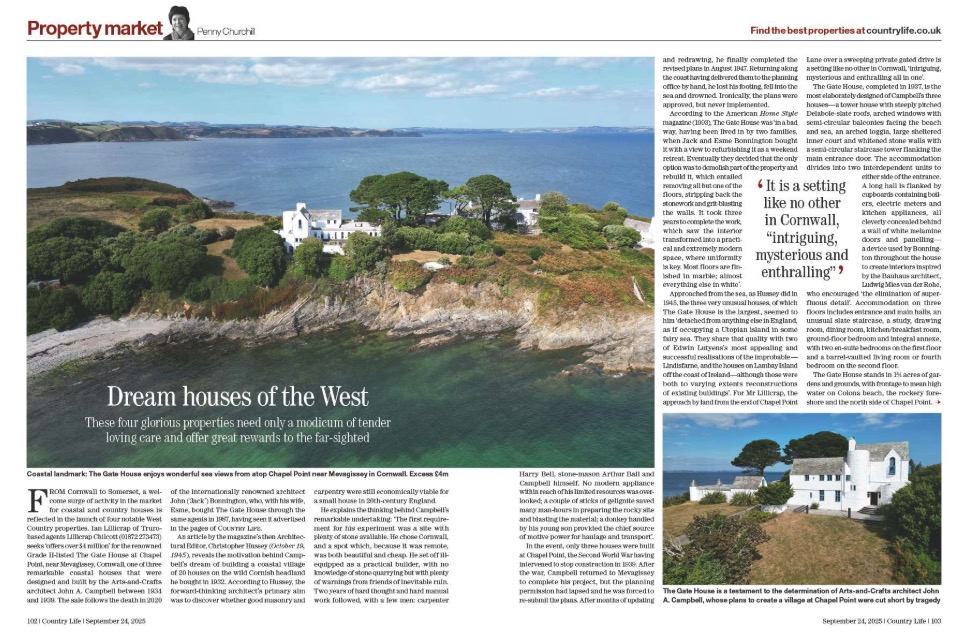
Property market

A quartet of significant West Country houses is seeking buyers, reports Penny Churchill

Properties of the week

A Devon longhouse, Cornwall cottage and Somerset thatch catch Arabella Youens’s eye

Spreads from Life Country Life 24 September 2025

When your art is in the right place

To whom do the experts turn for the best in framing, restoring and valuing? Leading art and antique dealers open their little black books for Amelia Thorpe

Leslie MacLeod Miller’s favourite painting

The impresario picks a portrait of a 19th-century singing sensation

Country-house treasures

The fortunes of a Cumbrian castle rest with the ‘Luck of Muncaster’, finds John Goodall

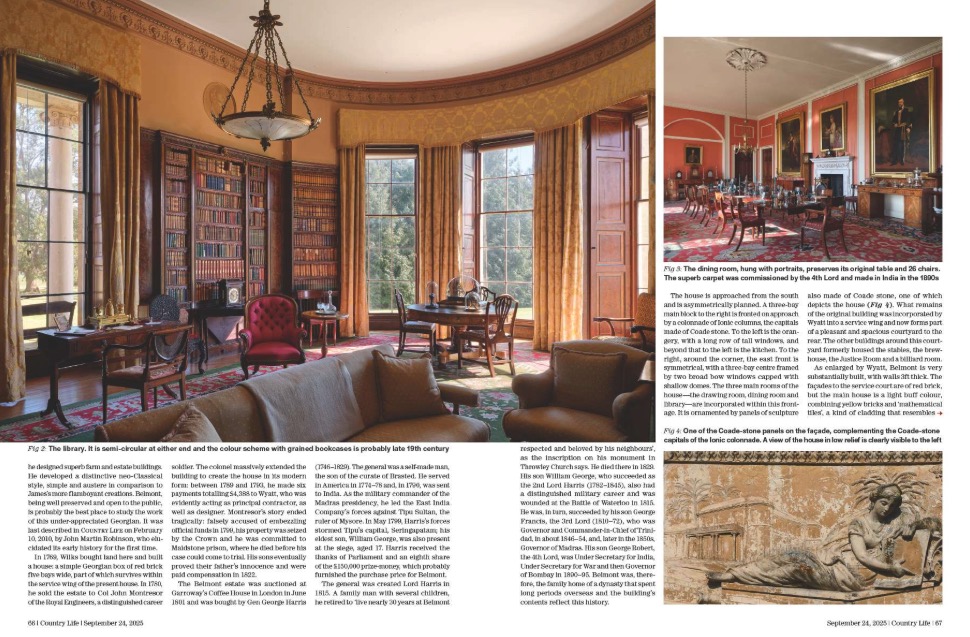
A Regency prospect

Steven Brindle looks at the remarkable story behind a fine Georgian creation — Samuel Wyatt’s Belmont House in Kent

Spreads from Life Country Life 24 September 2025

The legacy

Emma Hughes toasts the genius of Dennis Potter, the man who gave us the darkly comic and gritty Singing Detective

Beginning to see the light

John Lewis-Stempel and his dogs are up with the skylark to witness the dawning of a spectacular September day

Luxury

Amie Elizabeth White on tartan, tweed, timepieces and fruity jewels, plus a few of Victoria Pendleton’s favourite things

Interiors

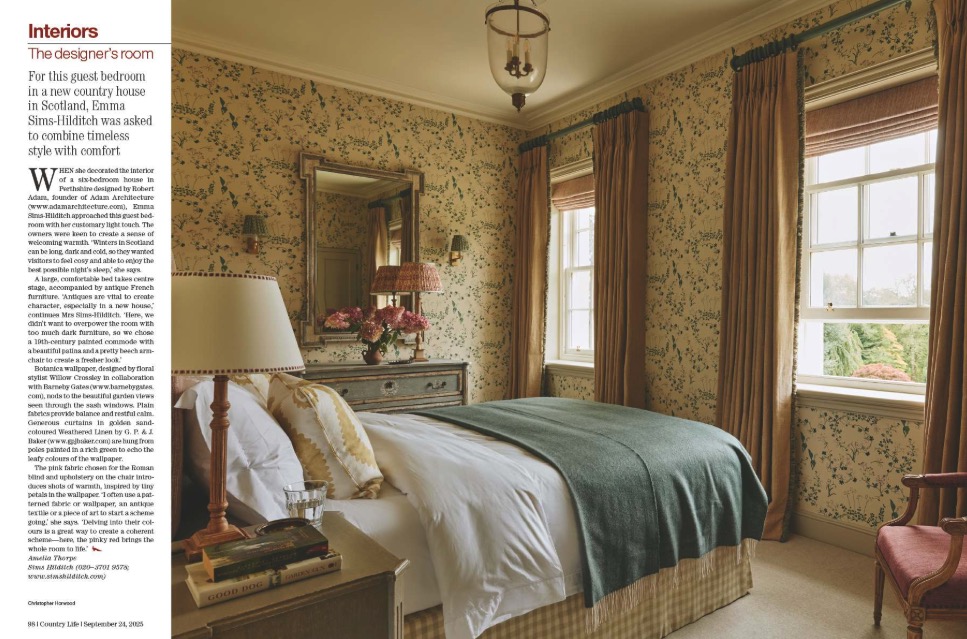
Amelia Thorpe admires the makeover of a guest bedroom at a Scottish country house and picks the best bedside tables

Spreads from Life Country Life 24 September 2025

Plum advice

Charles Quest-Ritson shares his favourite forms of plum, gage, mirabelle and damson from the 20-plus varieties he has grown

Slightly foxed

Second-hand bookshops can be a goldmine of gardening wisdom, says John Hoyland

Scale model

David Profumo is transported back to childhood by the spiny, swashbuckling stickleback

Travel

Mark Hedges takes a break from reality on Bryher, a heather-clad haven in the Isles of Scilly

Arts & antiques

Art dealer John Martin tells Carla Passino why he can never part with a panel he stumbled upon by Nigerian sculptor Asiru Olatunde

THE NEW YORK TIMES – WEDNESDAY, SEPT. 24, 2025

Jimmy Kimmel, Somber but Defiant, Defends Free Speech in Return to ABC

The late-night star said he had not intended to make light of Charlie Kirk’s murder, but he also called President Trump’s threats against ABC “anti-American.”

Trump’s F.C.C. Chair Plans to Keep Going After the Media

While “Jimmy Kimmel Live!” returned to ABC, Brendan Carr has promised to continue his campaign against what he sees as liberal bias in broadcasts.

Zelensky Issues Call to Arms After Trump Signals Shift on War in Ukraine

President Volodymyr Zelensky criticized Russian attacks and appealed for more military aid in his address to the annual U.N. meeting.

Ukrainians Are Grateful but Skeptical After Trump’s Turnabout on the War

At Least One Dead and Two Wounded in Dallas ICE Facility Shooting

Federal authorities said detainees were among the victims and no federal agents had been shot. Investigators were still trying to determine a motive.

THE NEW YORK TIMES – TUESDAY, SEPT. 23, 2025

I Hate My Opponent’: Trump’s Remarks at Kirk Memorial Distill His Politics

President Trump has been fueled by grievance and animosity over the course of his political and public life.

Defense Department Delays Cleanup of ‘Forever Chemicals’ Nationwide

The new timeline could slow cleanup in some communities by nearly a decade. The chemicals, widely used in the military, are linked to cancers and other health risks.

Jihadist, Rebel, Statesman: The Many Faces of Syria’s Leader

President Ahmed al-Shara of Syria shifted shapes many times during his rise to power. This week he is expected to speak at the U.N.

Trump to Address U.N. as He Jettisons Aid and Recasts U.S. Role

President Trump plans to address the U.N. General Assembly at a moment when he is increasingly isolated in his approach to crises around the world.

THE NEW YORK TIMES – MONDAY, SEPT. 22, 2025

Europe Talks Big on Gaza but Struggles to Act

Even as criticism of Israel ramps up and a growing number of countries say they’ll recognize a Palestinian state, concrete actions remain limited.

For Arab Nations With Ties to Israel, Attacks Raise Anxiety

The Middle Eastern states closest to Israel see the attack on Hamas in Qatar and the invasion of Gaza City as signs of potential threats to their own security.

Trump Remembers Kirk as a Martyr While Attacking Political Opponents

President Trump oscillated between honoring Charlie Kirk’s life and attacking his opponents, saying he hated them and they “cheated like dogs.”

Trump Appointees Roll Back Enforcement of Fair Housing Laws

Interviews and internal documents show that signature civil rights protections in housing are being dismissed as ideologically driven and D.E.I. in disguise.

8 min read