Fly west across the United Arab Emirates from Fujairah, a tanker-filled port on the Gulf of Oman, towards the Persian Gulf and you get a sense of the vulnerability arid lands have to climate change. The farms around Dhaid provide a splash of green, but homegrown food is scarce, homegrown staples next to non-existent. Drinkable water comes mostly from desalination plants. The heat is growing inhumane; outside work is banned during the hottest hours of summer afternoons.
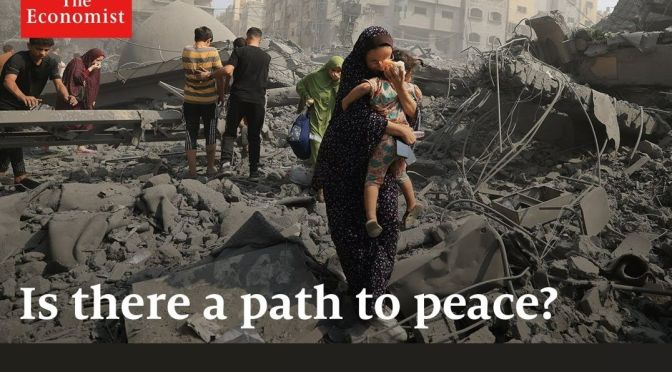
The Economist (February 8, 2024) – Things look bleak in the Middle East after Binyamin Netanyahu scorned America’s push for an end to the fighting. But in private he’s said to be more flexible. Could diplomacy actually work?
Video timeline: 00:00 – The Saudi normalisation deal 00:42 – Israel and Saudi Arabia’s history 01:10 – How to solve the Israeli-Palestinian conflict 02:26 – Will the deal happen?
The Globalist Podcast (December 6, 2023) – As fighting in Gaza rages on, we examine Vladimir Putin’s trip to Saudi Arabia and the UAE to discuss the Israel-Hamas conflict.
Also, Austria pushes to speed up EU accession talks with the Western Balkan and the latest theatre news.
The Week In Art Podcast (September 28, 2023): This week: three big London shows, in depth. As Marina Abramović draws huge crowds to the Royal Academy of Arts in London, we interview her about the exhibition—the first ever dedicated to a woman artist in the Royal Academy’s main galleries.
At the National Gallery, meanwhile, is a remarkable survey of the paintings of the 17th-century Dutch master Frans Hals, which will tour next year to Amsterdam and Berlin. We take a tour with Bart Cornelis, curator of the National’s incarnation of the show. And this episode’s Work of the Week is Peter Paul Rubens’s Three Nymphs with a Cornucopia of around 1625 to 1628 (painted with Frans Snyders). In the collection of the Prado in Madrid, it is one of a number of major loans to the exhibition Rubens and Women at the Dulwich Picture Gallery in London. Amy Orrock, one of the curators of the exhibition, tells us more.
Marina Abramović, Royal Academy of Arts, London, until 1 January 2024. You can hear our interview with Marina during the Covid lockdown in our episode from 8 May 2020, and a conversation with Tate Modern’s Catherine Wood about Ulay, following his death in 2020, in the episode from 6 March that year.
The Week In Art Podcast (September 21, 2023): This week: the latest controversies prompted by the Unesco World Heritage Committee. As we mentioned last week, the 45th session of the committee is taking place in the Saudi Arabian capital, Riyadh, and continues until 25 September.
The founder of The Art Newspaper, Anna Somers Cocks, joins host Ben Luke to look at the latest sites granted World Heritage status and at the Committee’s decision not to add Venice to the organisation’s endangered list. We ask: is Unesco so mired in politics that it cannot adequately perform its role? The Colombian artist Fernando Botero died last week, aged 91, and we talk to the gallerist Stéphane Custot, of Waddington Custot galleries in London, about this painter and sculptor who drew ire from many critics but achieved widespread public acclaim.
And this episode’s Work of the Week is October’s Gone . . . Goodnight (1973) by Barkley L. Hendricks. As a group of paintings by Hendricks goes on display among the masters at Frick Madison in New York, Aimee Ng, co-curator of the exhibition, tells us about the painting.
Barkley L. Hendricks: Portraits at the Frick, Frick Madison, New York, until 7 January 2024.
The Week In Art Podcast (September 15, 2023): A Unesco conference and archeological summit in Saudi Arabia are the latest examples of the country’s increasing focus on culture as part of the so-called Vision 2030 programme.
We look at Saudi Arabia’s unprecedented and lavishly funded focus on contemporary and ancient culture and how that relates to ongoing concerns about artistic freedom and human rights abuses in the kingdom. Alia Al-Senussi, a cultural strategist, and senior advisor at Art Basel and to the Saudi Ministry of Culture, joins host Ben Luke to discuss the contemporary art scene, and Melissa Gronlund, a reporter on the Middle East for The Art Newspaper, tells us about the push to reveal hitherto underexplored Saudi heritage.
The Sierra Leone-born, London-based artist and poet Julianknxx this week unveiled a new project at London’s Barbican Centre, Chorus in Rememory of Flight. The multi-screen installation features performers and choirs from the African diaspora who Julianknxx met on a 4,000-mile trip around European cities with colonial histories, from Lisbon via Marseille, Rotterdam and Berlin to London. We talk to him about this epic endeavour. And this episode’s Work of the Week is among the greatest works on paper ever made: Michelangelo’s studies in red chalk for the Libyan Sibyl, one of the most distinctive figures on his Sistine Chapel ceiling. The drawing features in Michelangelo and Beyond at the Albertina in Vienna and one of its curators, Constanze Malissa, tells us more about it.
Art in Saudi Arabia: A New Creative Economy? by Rebecca Anne Proctor, with Alia Al-Senussi, published 30 November, Lund Humphries, £19.99.
Julianknxx: Chorus in Rememory of Flight, The Curve, Barbican Centre, London, and online on WePresent, until 11 February 2024; Julianknxx is in A World in Common: Contemporary African Photography, Tate Modern, until 14 January 2024.
Michelangelo and Beyond, Albertina, Vienna, 15 September-14 January 2024.
The Globalist Podcast (September 5, 2023) – Who is Ukraine’s new defence minister, Rustem Umerov? Monocle’s Kyiv correspondent, Olga Tokariuk, profiles the Crimean Tatar with experience in Russian negotiations.
Plus: US officials visit Saudi Arabia to discuss Palestine, Olaf Scholz’s government slumps in the polls and we review the latest Indian newspapers.
The Guardian Weekly (August 25, 2023)– The issue features ‘Fever Pitch’ – The unstoppable rise of women’s football; ‘Trust me, I’m a nurse’ – How a British child serial killer went undetected, and Art, where you least expect it…
The conviction and sentencing of Lucy Letby,who murdered seven babies while working as a hospital nurse, shocked Britain this week.As she becomes only the country’s fourth woman to receive a whole-life imprisonment term, Josh Halliday recounts her dreadful crimes and why she was not investigated for so long, despite several colleagues’ suspicions.
Sports writer Paul MacInnes reports from Jeddah on Saudi Arabia’s bid to buy up chunks of world sport using its $600bn public investment fund, a makeover project that is particularly pertinent in the light of allegations in a Human Rights Watch report this week.
Culture catches up with Devo, the new wave band from Akron, Ohio, who are hanging up their curious “energy dome” hats after 50 years. And there’s a lovely feature by Claire Armitstead about hidden art, from underwater sculpture parks to pinhole dioramas concealed inside traffic bollards.
‘Editor’s Picks’ Podcast (August 14, 2023) – Three essential articles read aloud from the latest issue of The Economist. This week, why Biden’s China strategy isn’t working, Saudi Arabia’s plan to dominate global sport (10:20) and how green is your electric vehicle, really? (17:55).
The Economist Magazine (August 12, 2023 issue): Why Biden’s China strategy is not working; Saudi Arabia upends sport; The attack on universal values; Twitternomics lives on; How green is your EV and more…
Supply chains are becoming more tangled and opaque
On august 9th President Joe Biden unveiled his latest weapon in America’s economic war with China. New rules will police investments made abroad by the private sector, and those into the most sensitive technologies in China will be banned. The use of such curbs by the world’s strongest champion of capitalism is the latest sign of the profound shift in America’s economic policy as it contends with the rise of an increasingly assertive and threatening rival.
The countries’ economic ties are more profound than they appear
image: alberto miranda
When it comes to tracing the geography of global supply chains, few companies provide a better map than Foxconn, the world’s largest contract manufacturer. This year the Taiwanese giant has built or expanded factories in India, Mexico, Thailand and Vietnam. The Chinese production sites once loved by Western companies are firmly out of fashion. Souring relations between the governments in Washington and Beijing have made businesses increasingly fretful about geopolitical risks. As a consequence, in the first half of the year, America traded more with Mexico and Canada than it did with China for the first time in almost two decades. The map of global trade is being redrawn.
News, Views and Reviews For The Intellectually Curious




 The Economist








 Boomers Daily