MIT Technology Review (Novemer 24, 2024): This week’s round up includes Google DeepMind has a new way to look inside an AI’s “mind”. Inside Clear’s ambitions to manage your identity beyond the airport. Who’s to blame for climate change? And more.
How this grassroots effort could make AI voices more diverse A massive volunteer-led effort to collect training data in more languages, from people of more ages and genders, could help make the next generation of voice AI more inclusive and less exploitative.
The rise of Bluesky, and the splintering of social You may have read that it was a big week for Bluesky. If you’re not familiar, Bluesky is, essentially, a Twitter clone that publishes short-form status updates.
Ben Zhao remembers well the moment he officially jumped into the fight between artists and generative AI: when one artist asked for AI bananas.
MIT Technology Review (Novemer 17, 2024): This week’s round up includes Generative AI taught a robot dog to scramble around a new environment; The AI lab waging a guerrilla war over exploitative AI; Life-seeking, ice-melting robots could punch through and Europa’s icy shell.
The tools Glaze and Nightshade are giving artists hope that they can fight back against AI that hoovers internet data to train. Are they enough?
Generative AI taught a robot dog to scramble around a new environment
A new system could help train robots entirely in generated worlds.
Why AI could eat quantum computing’s lunch
Rapid advances in applying artificial intelligence to simulations in physics and chemistry have some people questioning whether we will even need quantum computers at all.
AI search could break the web
Life-seeking, ice-melting robots could punch through Europa’s icy shell
Researchers are working on technology that could follow NASA’s Europa Clipper mission and hunt for life in the ocean of Jupiter’s moon.
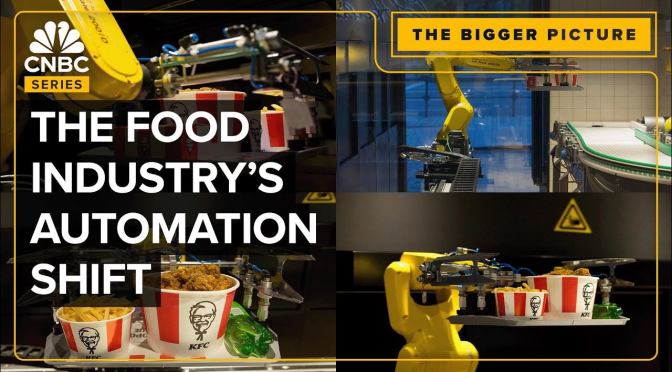
CNBC (July 15, 2024): Fully autonomous fast-food chains to smart carts lining grocery store parking lots, the way the food industry looks is changing due to massive investment in AI technology.
Chapters: 0:00 Introduction 2:34 CH 1. Digitizing food retail 5:35 CH 2. The risk and reward from robots 8:30 CH 3. What’s next?
The American consumer is starting to pull back on spending and rising food and labor costs are causing the food industry to invest more into automation to lower labor costs and improve sales, in order to stay competitive and take advantage of shifting consumer taste.
Smithsonian Magazine (December 2023) –The latest issue features ‘Can A Robot Replace the World’s Greatest Artists?; A tiny reindeer enjoys its day in the sun; In Ukraine, war reshapes a Holocaust Memorial; the Rebirth of a Lost American Wine Region, and more…
0:15 AI can predict your risk of Parkinson’s – RETFound was trained using 1.6 million retinal images which gave it a picture of a healthy retina. Then its creators added images of eyes from people with certain conditions. Our eyes are a window to our health. They’re the only place where doctors can directly observe capillaries, our smallest blood vessels, enabling detection of cardiovascular illnesses such as hypertension. Eyes are also linked to the central nervous system, giving an insight into neural tissue, too. The RETFound tool was best at picking up eye diseases such as diabetic retinopathy. On Parkinson’s, stroke and heart disease, it performed not quite as well but still beat other AI models.
2:08These are the most detailed heat maps of our planet – They use imagery from a satellite called HotSat-1 which can detect heat and cold at a resolution of 3.5 metres. The satellite can precisely map the fronts of forest fires, detect and monitor heat islands in cities and measure the thermal efficiency of buildings. This information can drive more effective decision-making.
3:51AI designed this robot in 26 seconds – Researchers from Northwestern University gave an AI a simple prompt. ‘Design a robot that can walk across a flat surface’. By the 9th iteration, the AI had successfully met its brief. The robot could walk half its own body length per second. The entire iteration process took just 26 seconds and it ran on a laptop.
6:26 Norway completed it’s largest rewilding project – It’s centred around Sveagruva, a 100-year-old mining town on the Arctic island of Svalbard. Norway decided to close the town and its mining operations in 2017 and return the area to its natural state, restoring biodiversity and the local ecosystem.
_____________________________________________
The World Economic Forum is the International Organization for Public-Private Cooperation. The Forum engages the foremost political, business, cultural and other leaders of society to shape global, regional and industry agendas. We believe that progress happens by bringing together people from all walks of life who have the drive and the influence to make positive change.
World Economic Forum (October 14, 2023) – This week’s top stories of the week include:
0:15Why engagement in the news is in decline – A massive media survey looked at trust and engagement in the news and found both are in steady decline. Just 48% of people say they are very or extremely interested in the news in 2023 down from 63% in 2017. Trust in the news has fallen 2 percentage points in a year. Now, only 40% say they trust the news most of the time and 36% say they actively avoid the news sometimes or often.
1:53This robot can help people with disabilities dress – The robot was designed by a team at Carnegie Mellon University (CMU). They used a simulation to teach it how to perform its task. The team used an AI-driven approach called ‘reinforcement learning’. The robot was rewarded each time it correctly placed a shirt further along an arm.
3:25Company captures and stores CO2 with limestone – Heirloom takes crushed limestone and heats it in a kiln powered by renewable energy. The reaction generates two products. These are CO2, which can be permanently stored underground or in materials like concrete and a powder, which is hydrated with water to make calcium hydroxide. When the calcium hydroxide is spread onto trays, it absorbs CO2 from the air to become limestone and the whole process can begin again.
5:24How to use ChatGPT more safely – ChatGPT is an AI tool that gives detailed, natural language answers to prompts based on a database of 300 billion words drawn from books and articles. The AI learns from its interactions with you, so here are 5 ways to ensure you’re using it safely.
_____________________________________________
The World Economic Forum is the International Organization for Public-Private Cooperation. The Forum engages the foremost political, business, cultural and other leaders of society to shape global, regional and industry agendas. We believe that progress happens by bringing together people from all walks of life who have the drive and the influence to make positive change.
MIT Technology Review – July/August 2023: ‘The Accessibility issue’ features Connecting climate change and the digital divide. A blind educator working to make images accessible to everyone. How the app meant to streamline immigration at the border may be making things worse. Plus regulating robotaxis, Metaverse attorneys, and the forgotten history of highway photologs.
We need to take steps toward a more inclusive future—one that we all can inhabit.
“Technology,” wrote the late historian of technology Melvin Kranzberg Jr., “is neither good nor bad, nor is it neutral.” It’s an observation that often doesn’t stick with people as they think about technologies related to accessibility.
For people who can’t speak, there has been depressingly little innovation in technology that helps them communicate.
A piece of hardware, however impressively designed and engineered, is only as valuable as what a person can do with it. After the iPad’s release, the flood of new, easy-to-use AAC apps that LoStracco, Shevchenko, and their clients wanted never came.
World Economic Forum (May 20, 2023) – This week’s top stories of the week include:
0:15 Greece makes nearly 200 beaches wheelchair accessible – Seatrac bathing chairs glide into the sea. Wheelchair users reach the Seatrac by an accessible wooden path, transfer to a recliner, then ‘drive’ into the sea using a remote control. At the water’s edge, they can sit and cool off or go for a swim, heading back to the chair for a break. Seatrac chairs are solar-powered and Greek-designed. Enabling people with disabilities to enjoy the sea independently without negotiating the sand, which can be tricky for some.
1:39 This robot surfs over grain, protecting farmers – The robot crawls over grain heaps, while a smaller partner robot burrows in to check the grain is being stored efficiently. Farmers need to check the condition of stored grains such as wheat and barley regularly to protect them from mould and insects. Typically, a person walks on top of the grain bulk and samples it with spears but this method is arduous, time-consuming and dangerous as the grain can shift suddenly and trap them underneath. In 2019, 38 grain engulfments led to 23 deaths in the US alone. Some companies don’t monitor their grain at all because of the dangers involved. These robots are made by Edinburgh start-up Crover.
2:52 These simple measures could save 1 million babies a year – Globally, 1 in 4 babies are born either too soon or too small. Vulnerabilities like these are behind more than half of all newborn deaths and their foundations are laid during pregnancy. Doctors say 1 million neonatal deaths in the developing world could be avoided if we administer simple, low-cost measures during pregnancy. Such as progesterone, help to stop smoking and insecticide-treated mosquito nets. That’s according to a new study in The Lancet…
4:20 The link between green energy and forever chemicals – ‘Forever chemicals’ is a nickname given to some per- and polyfluoroalkyl substances (PFAS). Many PFAS are highly resistant to high temperatures, oil, water or corrosion. For this reason, they’re used in many products including some fundamental to the energy transition. From wind turbines to solar panels the batteries in electric vehicles and the semiconductor chips at the heart of energy technologies. They’re also used in thousands of everyday products, from non-stick pans to clothing and fire-repellent foam, but these chemicals pose risks to human health. PFAS have been linked to cancer, thyroid disease and low fertility among many other conditions.
_____________________________________________
The World Economic Forum is the International Organization for Public-Private Cooperation. The Forum engages the foremost political, business, cultural and other leaders of society to shape global, regional and industry agendas. We believe that progress happens by bringing together people from all walks of life who have the drive and the influence to make positive change.
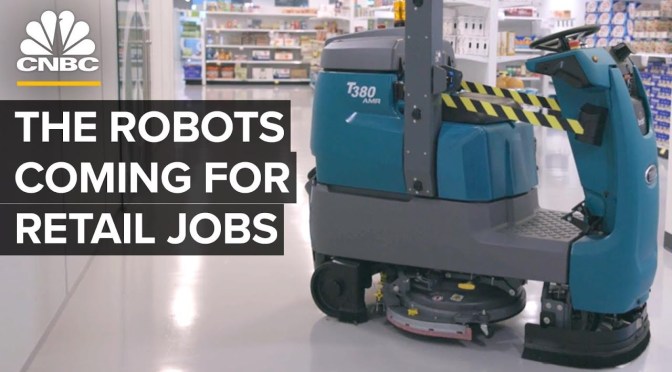
CNBC (April 22, 2023) – Outfitted with cameras and sensors, autonomous inventory robots can verify price signs and look for out-of-stock items. Inventory is one of the biggest challenges retailers face.
Missed sales from empty shelves and out-of-stock items cost U.S. retailers $82 billion in 2021, according to NielsenIQ. But an army of inventory robots is being deployed that could help retailers appease angry customers, boost sales and respond to the ongoing worker shortage.
Our annual look at 10 Breakthrough Technologies—including CRISPR for high cholesterol, battery recycling, AI that makes images, and the James Webb Space Telescope—that will have a profound effect on our lives. Plus care robots, 3-D printing pioneers, and chasing bugs on the blockchain.




 Inside Clear’s ambitions to manage your identity beyond the airport
 Google DeepMind has a new way to look inside an AI’s “mind”
 How this grassroots effort could make AI voices more diverse
 Who’s to blame for climate change? It’s surprisingly complicated.The world’s biggest polluters, by the numbers.
 The rise of Bluesky, and the splintering of social




:focal(1200x903:1201x904)/https://tf-cmsv2-smithsonianmag-media.s3.amazonaws.com/filer_public/e4/28/e428555a-52f9-4b8a-ad26-a59dc5bee98b/smithsonian_stamp9310-2.jpg)
:focal(700x527:701x528)/https://tf-cmsv2-smithsonianmag-media.s3.amazonaws.com/filer_public/9a/2c/9a2cba95-e4f2-452a-b1a8-47bf88c71ccd/josephine.jpg)







 Boomers Daily