Tag Archives: Politics

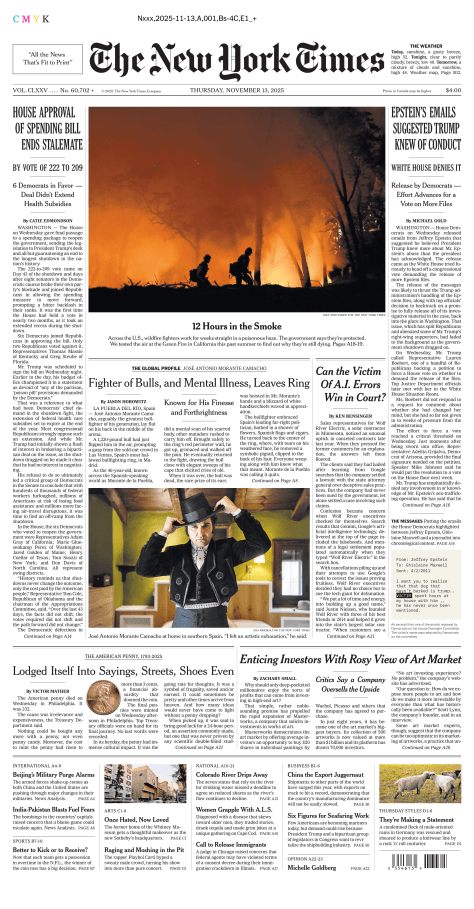
THE NEW YORK TIMES – FRIDAY, AUGUST 29, 2025

How the Future of the Fed Came to Rest on Lisa Cook

President Trump’s effort to oust the Federal Reserve governor has started a legal battle that will have major consequences for the institution’s independence.

2 Weeks, 1,000 Arrests: How a Surge of Federal Agents Changed D.C. Policing

Crime has fallen since agents began policing the streets of Washington in large numbers. Records show that the focus has often been on low-level offenses.

Trump Revokes Kamala Harris’s Secret Service Protection

President Trump terminated an extension to Kamala Harris’s Secret Service protection arranged by President Biden. She will lose her detail on Monday.

The Shattering of Wednesday Mass: Minnesota Parish Reels From Attack

Annunciation Catholic Church and School has been a neighborhood anchor in Minneapolis for more than a century.

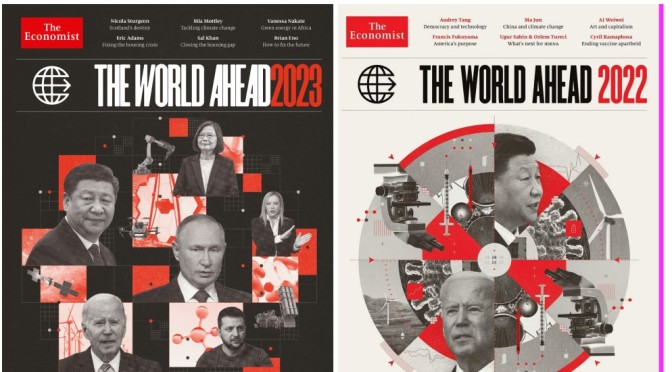
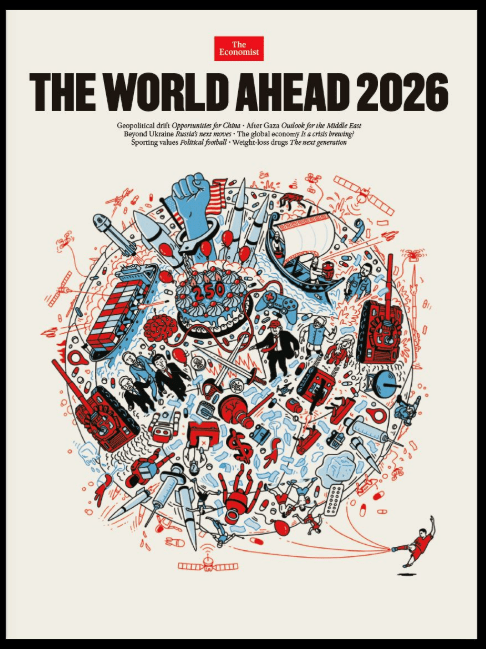
THE ECONOMIST MAGAZINE – AUGUST 30, 2025 PREVIEW

THE ECONOMIST MAGAZINE: The latest issue features ‘What Brazil Can Teach America’

Brazil offers America a lesson in democratic maturity

It is a test case for how countries recover from a populist fever

Humiliation, vindication—and a giant test for India

Trump has triggered a trade and defence crisis: how should Modi respond?

How much danger is America’s central bank in?

Whether Lisa Cook stays or goes, important norms have been broken

France’s government is on the brink of collapse, again

Emmanuel Macron looks likely to lose another prime minister over an attempt to curb public debt

Don’t forget the downsides of China’s innovation push

China’s industrial policy attracts fans abroad, critics at home

THE NEW YORK TIMES – THURSDAY, AUGUST 28, 2025

Fired C.D.C. Director’s Lawyers Say Kennedy Is Weaponizing Public Health

Susan Monarez was said to have refused to adopt Robert F. Kennedy Jr.’s stance on vaccinations. A lawyer for Dr. Monarez said the firing was “legally deficient.”

The Fate of the Fed May Turn on Two Words: ‘For Cause’

The Supreme Court has said the Federal Reserve Board’s independence warrants protection. President Trump’s effort to fire a member will test that commitment.

Russian Missile and Drone Attack Kills at Least 15 in Kyiv

The strikes on Ukraine’s capital, nearly two weeks after the U.S.-Russia summit in Alaska, injured at least 45 people, officials said.

Russian Drones Are Flying Over U.S. Weapons Routes in Germany, Officials Say

U.S. and European military officials are increasingly concerned about the flights, even as Russian acts of sabotage have declined.

THE NEW YORK TIMES – WEDNESDAY, AUG. 27, 2025

The A.I. Spending Frenzy Is Propping Up the Real Economy, Too

The trillions of dollars that tech companies are pouring into new data centers are starting to show up in economic growth. For now, at least.

Full Weight of U.S. Tariffs Slams Into India

As punishment for buying Russian oil, President Trump doubled the tariff on goods from India to 50 percent, jeopardizing its relationship with the U.S.

Trump’s Appointees Could Rule the Federal Reserve for Decades

If President Trump succeeds in replacing Lisa Cook, his nominees will make up a majority of the central bank’s seven-person board.

THE NEW YORK TIMES – TUESDAY, AUGUST 26, 2025

Seeking to Control Fed, Trump Risks Upending a Pillar of the Global Economy

President Trump’s attempt to fire Lisa Cook, a Fed governor, will set off a long legal battle and could lead to higher inflation and government borrowing costs.

Judge Dismisses Trump Administration Suit Against Federal Bench in Maryland

The judge took President Trump and some of his top aides to task for having repeatedly attacked other judges who have dared to rule against the White House.

Israel Faces Growing Pressure Over Hostages and Gaza Offensive

As rallies spread, the country’s security cabinet was to meet for the first time since Hamas agreed to a new cease-fire proposal, officials said.

Trump Wants Europe to Stop Regulating Big Tech. Will It Bend?

The White House suggested that countries with regulations restricting U.S. tech companies could face penalties.

The Envelope of Democracy

How a practice born on Civil War battlefields became the latest front in America’s fight over trust, law, and the vote.

By Michael Cummins, Editor, August 23, 2025

On a raw November morning in 1864, somewhere in a Union encampment in Virginia, soldiers bent over makeshift tables to mark their ballots. The war was not yet won; Grant’s men were still grinding through the trenches around Petersburg. Yet Abraham Lincoln insisted that these men, scattered across muddy fields and far from home, should not be denied the right to vote. Their ballots were gathered, sealed, and carried by courier and rail to their home states, where clerks would tally them beside those cast in person. For the first time in American history, large numbers of citizens voted from a distance—an innovation spread across 19 Union states by hasty wartime statutes and improvised procedures (National Park ServiceSmithsonian).

Lincoln understood the stakes. After the votes were counted, he marveled that “a people’s government can sustain a national election, in the midst of a great civil war” (Library of Congress). To deny soldiers their ballots was to deny the Union the very legitimacy for which it fought. Then, as now, critics fretted about fraud and undue influence: Democrats accused Republicans of manufacturing ballots in the field; rumors spread of generals pressuring soldiers to vote for Lincoln. Newspapers thundered warnings about the dilution of the franchise. But the republic held. Soldiers voted, the ballots were counted, and Lincoln was re-elected.

A century and a half later, the envelope has become a battlefield again. Donald Trump has promised to “end mail-in ballots” and scrap voting machines, declaring them corrupt, even while bipartisan experts explain that nearly all U.S. ballots are already paper, with machines used only for tabulation and auditing (APBipartisan Policy Center). The paradox is striking: modern tabulators are faster and more accurate than human tallies, while hand counts are prone to fatigue and error (Time).

But how did a practice with Civil War pedigree come to be portrayed as a threat to democracy itself? What, at root, do Americans fear when they fear the mailed ballot?

In a Phoenix suburb not long ago, a first-time voter—call her Teresa—dropped her ballot at a post office with pride. She liked the ritual: filling it out at her kitchen table, checking the boxes twice, signing carefully. Weeks later, she learned her ballot had been rejected for a signature mismatch with an old ID on file. She had, without knowing it, missed the deadline to “cure” her ballot. “It felt like I didn’t exist,” one young Arizonan told NPR, voicing the frustration of many. Across the country, younger and minority voters are disproportionately likely to have their mail ballots rejected for administrative reasons such as missing signatures or late arrival. If fraud by mail is vanishingly rare, disenfranchisement by process is not.

Meanwhile, on the factory floor of American vote-by-mail, the ordinary hum of democratic labor continues. Oregon has conducted its elections almost entirely by mail for a quarter century, with consistently high participation and confidence (Oregon Secretary of State). Colorado followed with its own all-mail model, paired with automatic registration, ballot tracking, and risk-limiting audits (Colorado Secretary of State). Washington and Utah have joined in similar fashion. Election officials talk about the efficiency of central counting centers, the ease of auditing paper ballots, the increased access for rural and working-class voters. One clerk described her office during election week as “a warehouse of democracy,” envelopes stacked in trays, staff bent over machines that scan and sort. In one corner, a team compares signatures with the care of art historians verifying provenance. The scene is not sinister but oddly moving: democracy reduced to thousands of small acts of faith, each envelope a declaration that one voice counts.

And yet suspicion lingers. Part of it is ritual. The image of democracy for generations has been the polling place: chalkboard schedules, folding booths, poll books fat with names. The mailed ballot decentralizes the ceremony. It moves civic action into kitchens and break rooms, onto couches and barracks bunks. For some, invisibility breeds mistrust; for others, it is the genius of the thing—citizenship woven into home life, not just performed in public.

Part of the anxiety is legal. The Constitution’s Elections Clause gives the states authority over the “Times, Places and Manner” of congressional elections but empowers Congress to “make or alter such Regulations” (Constitution Annotated). Presidents have no such power. The White House cannot ban absentee ballots by decree. Congress could attempt to standardize or limit the use of mail ballots in federal elections—though any sweeping restriction would run headlong into litigation from voters who cannot be present on Election Day, from soldiers on deployment to homebound citizens.

And we have seen how precarious counting can be when law and logistics collide. In 2000, Florida’s election—and the presidency—turned not on fraud but on ballots: “hanging chads,” the ambiguous punch-card remnants that confounded machines and humans alike. The Supreme Court’s decision in Bush v. Gore halted a chaotic recount and left many Americans convinced that the true count would forever be unknowable (Oyez). The lesson was not that ballots are fraudulent, mailed or otherwise, but that the process of counting and verifying them is fragile, and that the legitimacy of outcomes depends on rules agreed to before the tally begins.

It is tempting, in moments of panic, to look abroad for calibration. In the United Kingdom, postal ballots are an ordinary convenience governed by clear rules (UK Electoral Commission). Canadians deploy a “special ballot” system that lets voters cast by post from the Yukon to Kandahar (Elections Canada). The Swiss have made postal voting a workaday part of civic life (Swiss Confederation). Fraud exists everywhere—but serious cases are exceptional, detected, and punished.

Back home, the research is blunt. The Brennan Center for Justice finds that fraud in mail balloting is “virtually nonexistent.” A Stanford–MIT study found that universal vote-by-mail programs in California, Utah, and Washington had no partisan effect—undercutting claims that the method “rigs” outcomes rather than simply broadening access. And those claims that machines slow results? Election administrators, backed by Wisconsin Watch, explain that hand counts tend to be slower and less accurate, while scanners paired with paper ballots and audits deliver both speed and verifiability.

Still, mistrust metastasizes, not from facts but from fear. A rumor in Georgia about “suitcases of ballots,” long debunked, lingers as a meme. A Michigan voter insists he saw a neighbor mail five envelopes, unaware they were for a household of five registered voters. Conspiracy thrives in the gap between visibility and imagination.

Yet even as the mailed ballot feels embattled, the next frontier is already under debate. In recent years, pilot projects have tested whether citizens might someday cast votes on their phones or laptops, secured not by envelopes but by cryptographic ledgers. The mobile voting platform Voatz, used experimentally in West Virginia and a few municipal elections, drew headlines for its promise of accessibility but also for its flaws: researchers at MIT found vulnerabilities tied to third-party cloud storage and weak authentication, prompting urgent warnings (MIT Technology Review). GoatBytes’ 2023 review noted that blockchain frameworks like Hyperledger Sawtooth and Fabric might one day offer stronger, verifiable digital ballots, and even the U.S. Postal Service has patented a blockchain-based mobile voting system (USPTO Patent). Capitol Technology University traced this shift as the latest stage in the long evolution from paper to punch cards to optical scanners, with AI now assisting ballot tabulation (Capitol Tech University). For proponents, mobile systems are less about novelty than necessity: the disabled veteran, the soldier abroad, the homebound elder—all could vote with a tap.

But here, too, the fault lines are visible. The American Bar Association recently cautioned that while blockchain and smartphone voting might expand access, they raise thorny questions about privacy, coercion, and verification—how to ensure a vote cast on a personal device is both secret and authentic. TIME Magazine spotlighted the allure of digital voting for those long underserved by the system, even as groups like Verified Voting warned that premature adoption could expose elections to risks far graver than those posed by paper mail ballots (TIME). In this telling, technology is Janus-faced: a path to broaden democracy’s reach, and a Pandora’s box of new vulnerabilities. If the mailed envelope embodies trust carried by hand, the mobile ballot would ask citizens to entrust their franchise to lines of code. Whether Americans are ready to make that leap remains an open question.

If there is a flaw to worry about, it is not the specter of rampant fraud, but the small, fixable frictions that disenfranchise well-meaning voters: needlessly strict signature-match policies, short cure windows, postal delays for ballots requested late, confusing instructions, and uneven funding for local election offices. The remedy comes not from abolishing the envelope, but from investing in the infrastructure around it: clear statewide standards for verification and cure; robust voter education about deadlines; modernized voter registration databases; secure drop boxes; and the budget lines that let county clerks hire and train staff.

In the end, the mailed ballot is less a departure from American tradition than a continuation of it. The ritual has changed—less courthouse, more kitchen table—but the bargain is the same. When a soldier in 1864 dropped his folded ballot into a wooden box, he entrusted strangers to carry it home. When a modern voter seals an envelope in Denver or Tacoma, she entrusts a chain of clerks, scanners, and auditors. Trust, not spectacle, is the beating heart of the system.

And perhaps that is why the envelope matters so much now. To defend it is not merely to defend convenience; it is to defend a vision of democracy capacious enough to reach the absent, the disabled, the far-flung, the over-scheduled—our fellow citizens whose lives do not always bend to a Tuesday line at a nearby gym. To reject it is to narrow the franchise to those who can appear on command.

Imagine Lincoln again, weary at the White House in the fall of 1864, reading dispatches about alleged fraud in soldier ballots and still insisting the votes be counted. Imagine a first-time voter in Phoenix who lost her chance over a mismatched squiggle, and the next one who won’t because the state clarified its cure rules. Imagine the county clerk who will never trend on social media, but who builds public confidence day by day with plain procedures and paper trails.

At the end of the day, American democracy may still come down to envelopes—white, yellow, blue—carried in postal bins, stacked in counting rooms, marked by the smudges of human hands. They are fragile, yes, but they are resilient too. The Civil War ballots survived trains and rivers; today’s ballots survive disinformation and delay. The act is the same: a citizen marks a choice, seals it, and sends it forth with faith that it will be received. If democracy is government of, by, and for the people, then every envelope is its emissary.

What would we lose if we tore that emissary up? Not only the votes of those who cannot stand in line, but the habit of trust that keeps the republic breathing. Better, then, to do what we have done at our best moments—to keep counting, keep auditing, keep improving, keep faith. The mailed ballot is not a relic of pandemic panic; it is a tested tool of a sprawling republic that has always asked its citizens to speak from wherever they are.

THIS ESSAY WAS WRITTEN AND EDITED UTILIZING AI

THE NEW YORKER MAGAZINE – SEPT. 1 & 8, 2025 PREVIEW

A GIF switching the profiles of the dandy Eustace Tilley and the artist Condy Sherman.

THE NEW YORKER MAGAZINE: The latest cover features ‘Cindy Sherman’s and Rea Irvin’s Eustace Tilley – A special nod to celebrate a centenary of cultural coverage.

The Trump Administration’s Efforts to Reshape America’s Past

Ahead of next year’s two-hundred-and-fiftieth anniversary of the Declaration of Independence, the White House has issued a directive to the Smithsonian. By Jill Lepore

A.I. Is Coming for Culture

We’re used to algorithms guiding our choices. When machines can effortlessly generate the content we consume, though, what’s left for the human imagination? By Joshua Rothman

How a Billionaire Owner Brought Turmoil and Trouble to Sotheby’s

Patrick Drahi made a fortune through debt-fuelled telecommunications companies. Now he’s bringing his methods to the art market. By Sam Knight

THE NEW YORK TIMES – MONDAY, AUGUST 25, 2025

Kilmar Abrego Garcia Is Detained by Immigration Authorities, Lawyer Says

Kilmar Armando Abrego Garcia, the immigrant who was wrongfully deported to El Salvador, had arrived for an immigration check-in and was taken into ICE custody, according to his lawyer.

FEMA Employees Warn That Trump Is Gutting Disaster Response

After Hurricane Katrina, Congress passed a law to strengthen the nation’s disaster response. FEMA employees say the Trump administration has reversed that progress.

Trump Relies on Personal Diplomacy With Putin. The Result Is a Strategic Muddle.

More than a week after President Trump met with Russia’s leader in Alaska, progress toward ending the war in Ukraine appears to have ground to a stop.

How China Influences Elections in America’s Biggest City

THE NEW YORK TIMES MAGAZINE – August 24, 2025

Current cover

THE NEW YORK TIMES MAGAZINE: The 8.24.25 Issue features Shane Bauer writes about the disappeared children of Syria; Lauren Larson on the difficulties of setting a Guinness World Record in the modern era, Linda Kinstler on why wars no longer end; David Marchese interviews the negotiation expert Chris Voss; and more.

How Georgia Went From the Vanguard of Democracy to the Front Lines of Autocracy

Two decades after the Rose Revolution, the former Soviet satellite is turning away from the West and back toward Russia. What happened?

They Were Treated Like Orphans. But They Knew the Truth.

In Syria, the Assad regime took hundreds of children away from their parents. A Times investigation reveals the workings of the operation — and how one family fought to reunite. By Shane Bauer and Jim Huylebroek

Wholesome, Noble Superheroes Are Back. (A Wholesome, Noble World Is Not.)

This summer’s blockbusters leave behind the era of dark, “edgy” champions for heroes who can’t help but listen to their consciences. By Mike Mariani

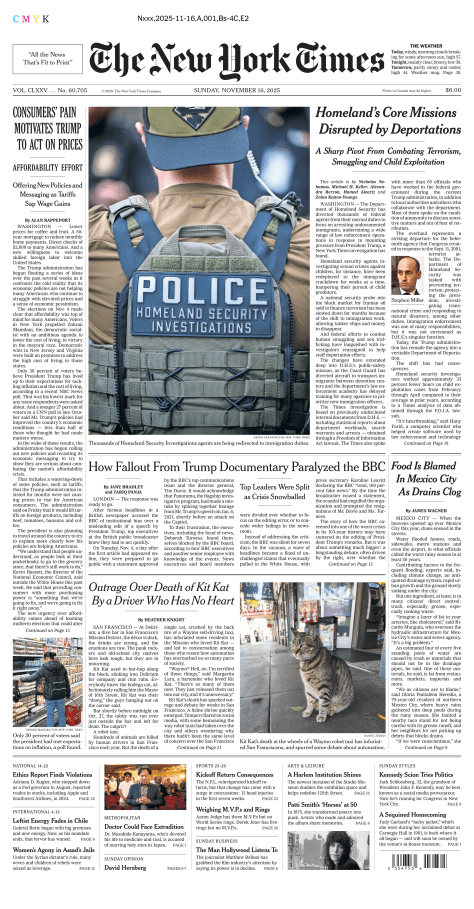
THE NEW YORK TIMES – SUNDAY, AUGUST 24, 2025

Reframing Jan. 6: After the Pardons, the Purge

The Trump Justice Department has fired or demoted more than two dozen Jan. 6 prosecutors, even as those they sent to prison walk free.

Fed Officials Try to Keep Focus on Economy as Trump Intensifies Attacks

President Trump’s pressure campaign for lower borrowing costs created an inescapable distraction at this year’s Jackson Hole conference.

Peace Talks in Ukraine All Lead to the Donbas

The contested region is where Russia’s war in Ukraine began a decade ago. Scores of Ukrainian soldiers have died defending it. Would Ukraine give it up now?

Why Haven’t Sanctions on Russia Stopped the War? The Money Is Still Flowing.

For decades, companies feared being on the wrong side of U.S. sanctions. That’s not always true anymore.