Tag Archives: Politics

Arts/Politics: The Atlantic Magazine – December 2023

Image

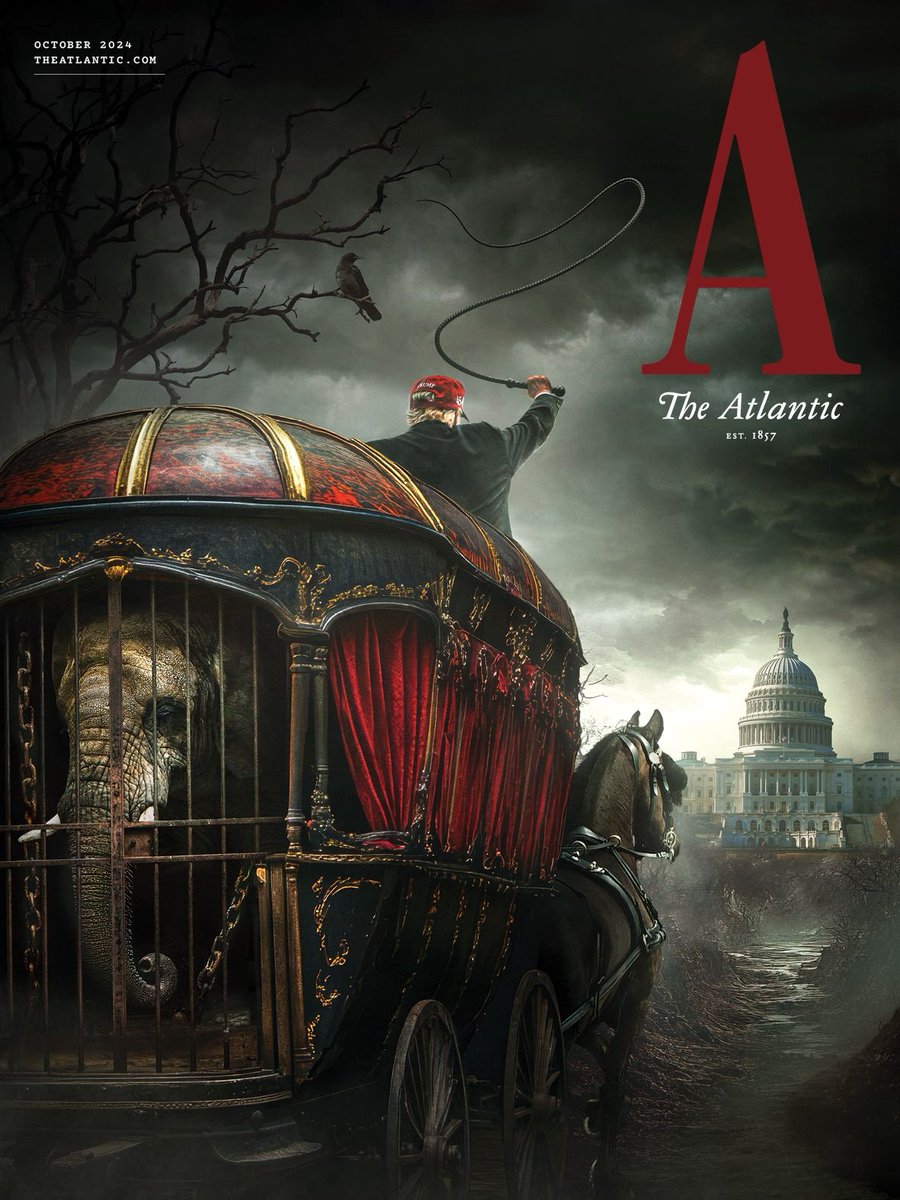
The Atlantic Magazine – December 2023 issue: For the first time since the publication of our first series of stories on Reconstruction, in 1901, The Atlantic is examining “the enduring consequences of Reconstruction’s tragic fall at a moment—yet another moment—when the cause of racial progress faces sustained pressure”…

This Ghost of Slavery

A play of past and present

By ANNA DEAVERE SMITH

The Questions That Most Need Asking

The Atlantic revisits Reconstruction

.By JEFFREY GOLDBERG

Why Is America Afraid of Black History?

No one should fear a history that asks a country to live up to its highest ideals.

By LONNIE G. BUNCH III

How Black Americans Kept Reconstruction Alive

The federal government abandoned Reconstruction in 1877, but Black people didn’t give up on the moment’s promise.

By PENIEL E. JOSEPH

Analysis: The World Ahead In 2024 – The Economist

The Economist The World Ahead 2024 (November 14, 2023)Future-gazing analysis, predictions and speculation including Ten trends to watch in 2024; 2024 will be stressful for those who care about liberal democracy; America will need a new vocabulary to discuss its presidential election; Europe needs to step up support for Ukraine; Don’t give up on peace in the Middle East, and more…
Tom Standage’s ten trends to watch in 2024

A letter from the editor of The World Ahead

By Tom Standage

Life comes at you fast. Whether it’s the upsurge in armed conflict, the redrawing of the global energy-resources map or rapid progress in artificial intelligence (ai), the world is changing at mind-boggling speed. From the situation in the Middle East to the adoption of electric vehicles to the treatment of obesity, things look very different from the way they did just a year or two ago. Our aim is to help you keep your worldview up to date—and tell you what might be coming next. To kick things off, here are ten themes to watch in the coming year.

2024 will be stressful for those who care about liberal democracy

In theory it should be a triumphant year for democracy. In practice it will be the opposite

By Zanny Minton Beddoes

More than half the people on the planet live in countries that will hold nationwide elections in 2024, the first time this milestone has been reached. Based on recent patterns of voter turnout, close to 2bn people in more than 70 countries will head to the polls. Ballots will be cast from Britain to Bangladesh, from India to Indonesia. Yet what sounds like it should be a triumphant year for democracy will be the opposite.

The world must try to break a vicious cycle of insecurity 

A stick of dynamite with a lit fuse in the shape of a world map

The fragility of the Western coalition is a crucial weakness

By Patrick Foulis

As 2023 drew to a close, wars were raging in Africa, Israel and Gaza, and Ukraine. These crises are explosive in their own right. Combine them with a presidential race in America and 2024 promises to be a make-or-break year for the post-1945 world order.

The 2020s were destined to be dangerous. The West’s share of world gdp has fallen towards 50% for the first time since the 19th century. Countries such as India and Turkey believe the global institutions created after 1945 do not reflect their concerns. China and Russia want to go further and subvert this system.

Previews: The New Yorker Magazine – Nov 20, 2023

Image

The New Yorker – November 20, 2023 issue: The new issue features The A.I. Issue – Joshua Rothman on the godfather of A.I., Eyal Press on facial-recognition technology, Anna Wiener on Holly Herndon, and more…

Why the Godfather of A.I. Fears What He’s Built

Geoffrey Hinton has spent a lifetime teaching computers to learn. Now he worries that artificial brains are better than ours.

By Joshua Rothman

In your brain, neurons are arranged in networks big and small. With every action, with every thought, the networks change: neurons are included or excluded, and the connections between them strengthen or fade. This process goes on all the time—it’s happening now, as you read these words—and its scale is beyond imagining. You have some eighty billion neurons sharing a hundred trillion connections or more. Your skull contains a galaxy’s worth of constellations, always shifting.

Does A.I. Lead Police to Ignore Contradictory Evidence?

A profile of a face overlaid with various panels.

Too often, a facial-recognition search represents virtually the entirety of a police investigation.


By Eyal Press

On March 26, 2022, at around 8:20 a.m., a man in light-blue Nike sweatpants boarded a bus near a shopping plaza in Timonium, outside Baltimore. After the bus driver ordered him to observe a rule requiring passengers to wear face masks, he approached the fare box and began arguing with her. “I hit bitches,” he said, leaning over a plastic shield that the driver was sitting behind. When she pulled out her iPhone to call the police, he reached around the shield, snatched the device, and raced off. The bus driver followed the man outside, where he punched her in the face repeatedly. He then stood by the curb, laughing, as his victim wiped blood from her nose.

Personal HistoryA Coder Considers the Waning Days of the Craft

Coding has always felt to me like an endlessly deep and rich domain. Now I find myself wanting to write a eulogy for it.

By James Somers

Saturday Morning: News And Stories From London

Monocle on Saturday, November 11, 2023: Charles Hecker on Suella Braverman’s uncertain future, whether the tide is changing on the US stance in the Middle East and Iceland’s state of emergency.

Plus: which factors change our perception of beauty? Monocle’s Steph Chungu speaks to Janis Li, the curator of the new Wellcome Collection exhibition, ‘The Cult of Beauty’. Join Georgina Godwin every week to discover the latest global news and culture.

Special Report: ‘China’s Armed Forces’ (NOV 2023)

Image

The Economist SPECIAL REPORTS – CHINA’S ARMED FORCES (NOVEMBER 11, 2023): Overestimating China’s armed forces would be dangerous; Unknown soldiers – The People’s Liberation Army is not yet as formidable as the West fears; Rank indifference – China is struggling to recruit enough highly skilled troops; Weapons of woe – From hypersonic missiles to undersea drones, the PLA is making leaps…

The People’s Liberation Army is not yet as formidable as the West fears

Overestimating China’s armed forces would be dangerous, argues Jeremy Page

In 1957 america was gripped by fears of a “missile gap” with the Soviet Union. The Kremlin had stunned the world with a test flight of an intercontinental ballistic missile (icbm) and the launch of Sputnik. An American intelligence report predicted that by 1962, the Soviets could have 500 icbms, outstripping America’s arsenal. When word of that leaked, a political furore erupted. Eyeing the presidency from his Senate seat, John F. Kennedy demanded action to prevent a Soviet “shortcut to world domination”.

China is struggling to recruit enough highly skilled troops

The PLA needs them to operate all its new weapons

From hypersonic missiles to undersea drones, the PLA is making leaps

But China’s military tech still lags behind the West’s

Preview: London Review Of Books – Nov 16, 2023

Image

London Review of Books (LRB) – November 16, 2023: The latest issue feature The Inside Story of the NHS Infected Blood Scandal; Elizabeth Taylor’s Magic; The UK government has become increasingly hostile to Freedom of Information requests on arms, and more…

Bad Blood – ‘We’ve messed up, boys’

‘In the UK between 1970 and 1991, about 1250 people with bleeding disorders were infected with HIV (and many of them with Hepatitis C, too); by the time the Infected Blood Inquiry began, about three-quarters had died, the majority of them from HIV-related causes.

By Florence Sutcliffe-Braithwaite

The Poison Line: A True Story of Death, Deception and Infected Blood 
by Cara McGoogan.

Death in the Blood: The Inside Story of the NHS Infected Blood Scandal 
by Caroline Wheeler.

Elizabeth Taylor’s Magic

‘Nearly eighty years after she first starred in a film, Taylor is famous for two things: her intense screen beauty and her many marriages (eight of them, two to Richard Burton). But at least as central to her life were her close and enduring friendships with men.’

By Bee Wilson

Previews: The New Yorker Magazine – Nov 13, 2023

Two people under a red umbrella walking in the rain near the Brooklyn Bridge.

The New Yorker – November 13, 2023 issue: The new issues cover features Kadir Nelson’s “Dumbo” – The artist discusses the seasonal energy of the city, and his sources of inspiration.

Ridley Scott’s “Napoleon” Complex

Ridley Scott photographed by Christopher Anderson.

Does the director of “Alien,” “Blade Runner,” and “Gladiator” see himself in the hero of his epic new film?

By Michael Schulman

On the morning of the Battle of Waterloo, Napoleon Bonaparte was full of catastrophic confidence. His seventy-three thousand troops were camped on a ridge near a tavern called La Belle Alliance. His nemesis, the Duke of Wellington, occupied a slope across the fields, with a mere sixty-seven thousand troops. Over breakfast, Napoleon predicted, “If my orders are well executed, we will sleep in Brussels this evening.” When his chief of staff offered a word of caution, Napoleon snapped, “Wellington is a bad general and the English are bad troops. The whole affair will not be more serious than swallowing one’s breakfast.”

How Can Determinists Believe in Free Will?

By Nikhil Krishnan

Some people think that we can’t be held responsible for what we do, given that our actions are the inevitable consequence of the laws of nature. They’re only half right.

Eclipsed in his Era, Bayard Rustin Gets to Shine in Ours

The civil-rights mastermind was sidelined by his own movement. Now he’s back in the spotlight. What can we learn from his strategies of resistance?

By Adam Gopnik

Reinventing the Dinosaur

Life on Our Planet,” a new Netflix nature documentary, renews our fascination with our most feared and loved precursors.

By Rivka Galchen

Saturday Morning: News And Stories From London

Monocle on Saturday, November 4, 2023: Georgina Godwin hosts with Latika Bourke on Anthony Blinken’s visit to Jordan today, the Australian PM Anthony Albanese’s historic visit to China, and the mushroom murder case in Australia that is cripp;ing the world.

Also, Monocle’s Robert Bound speaks to the founder of C2C festival taking place in Turin this weekend, and Honestly Tasty’s co-founder, Michael Moore, proves that vegan can, in fact, be very tasty. 

Culture: The Hedgehog Review – Fall 2023

THE HEDGEHOG REVIEW (FALL 2023): MARKETS AND THE GOOD – Thinking beyond the tyranny of economics; The Myth of the Friedman Doctrine; Hamilton’s System; How We Obscure the Common Plight of Workers; Profit, Power, and Purpose and more…

Introduction: Markets and the Good

Introduction: Markets and the Good | Markets and the Good | Issues | The Hedgehog  Review

Thinking beyond the tyranny of economics.

By Jay Tolson, editor of The Hedgehog Review

Only three decades ago, amid what was hailed as a new “Springtime of Nations,” post–Cold War exuberance fueled widespread confidence in the triumphant spread of liberal democracy and free-market capitalism to all parts of the globe, including those few remaining redoubts of “truly existing socialism,” with their fusty politburos and dysfunctional command economies. The brutal 1989 Tiananmen Square crackdown notwithstanding, even the People’s Republic of China was thought to be on the road to democracy thanks to its earlier adoption of a hybrid form of capitalism with “Chinese characteristics.” Though not alone in predicting that the opening up of China’s economy would lead to the liberalization of its politics and society, the editorial pages of the Wall Street Journal were among the louder cheerleaders for that optimistic line of economic determinism. 

The Myth of the Friedman Doctrine

The Myth of the Friedman Doctrine | Markets and the Good | Issues | The  Hedgehog Review

And the stubborn persistence of a powerful idea.

By Kyle Edward Williams, senior editor of The Hedgehog Review and the author of a forthcoming book on the history of American business, Taming the Octopus: The Long Battle for the Soul of the Corporation

Americans were once deeply worried about the danger posed by powerful corporations. They may be useful, wrote James Madison to a friend in 1827, “but they are at best a necessary evil only.”1 This was an old republican intuition: Concentrated power in whatever form threatened the body politic. In recent years, however, business leaders have come to believe that what Madison considered a “necessary evil” is actually the last great institution capable of making the world a better place. For Silicon Valley entrepreneurs no less than Fortune 500 CEOs, the bottom line is out, and amelioration is in. Call it conscious capitalism. Or corporate social responsibility or environmental, social, and corporate governance (ESG) investing. Many consumers, regulators, and activists expect big-business executives to act like responsible citizens and steer their firms accordingly—maybe more now than ever before. Even 92 percent of executives in a 2022 survey agreed that corporate leaders should take a stand on social issues.2


Profit, Power, and Purpose

The greatest challenge presented by modern corporations, small as well as large, involves purpose.

Michael Lind

The New Prince

Deneen’s politics of resentment primarily seeks to seize power from political enemies.

Andrew Lynn

Current Affairs: Prospect Magazine – December 2023

Image

Prospect Magazine (December 2023) – The latest issue features Oh, the humanities! – History, literature, film studies; I still dream of peace – How Israel might emerge from the Gaza horror, and more…

I still dream of peace

My country will emerge from this horror—and when it does the peacemakers, not the zealots, will reign, writes a former speaker of the Israeli Knesset

By Avraham Burg

The following words were written amid the storm of battle. Planes constantly circling in the sky, the bedroom turned into a shelter, the radio telling of new atrocities, the heart torn with fear as to the fate of missing persons. The days are now devoted to funerals and condolences, and the evenings to guarding our small community. I have participated in many demonstrations against the terrible folly of Benjamin Netanyahu, which found its outcome in the revenge and rage in Gaza on 7th October. Today, I try to be available for acts of support and solidarity with the victims on all sides. This beautiful land between the Jordan River and the Mediterranean Sea weeps bitterly, its two communities refusing to be comforted. 

Oh, the humanities!

History, literature, film studies—these subjects expand our understanding and enrich our democracy. They are also under assault

Priyamvada Gopal