


To the Success of Our Hopeless Cause: The Many Lives of the Soviet Dissident Movement by Benjamin Nathans
By Michael Wood

By Michael Wood
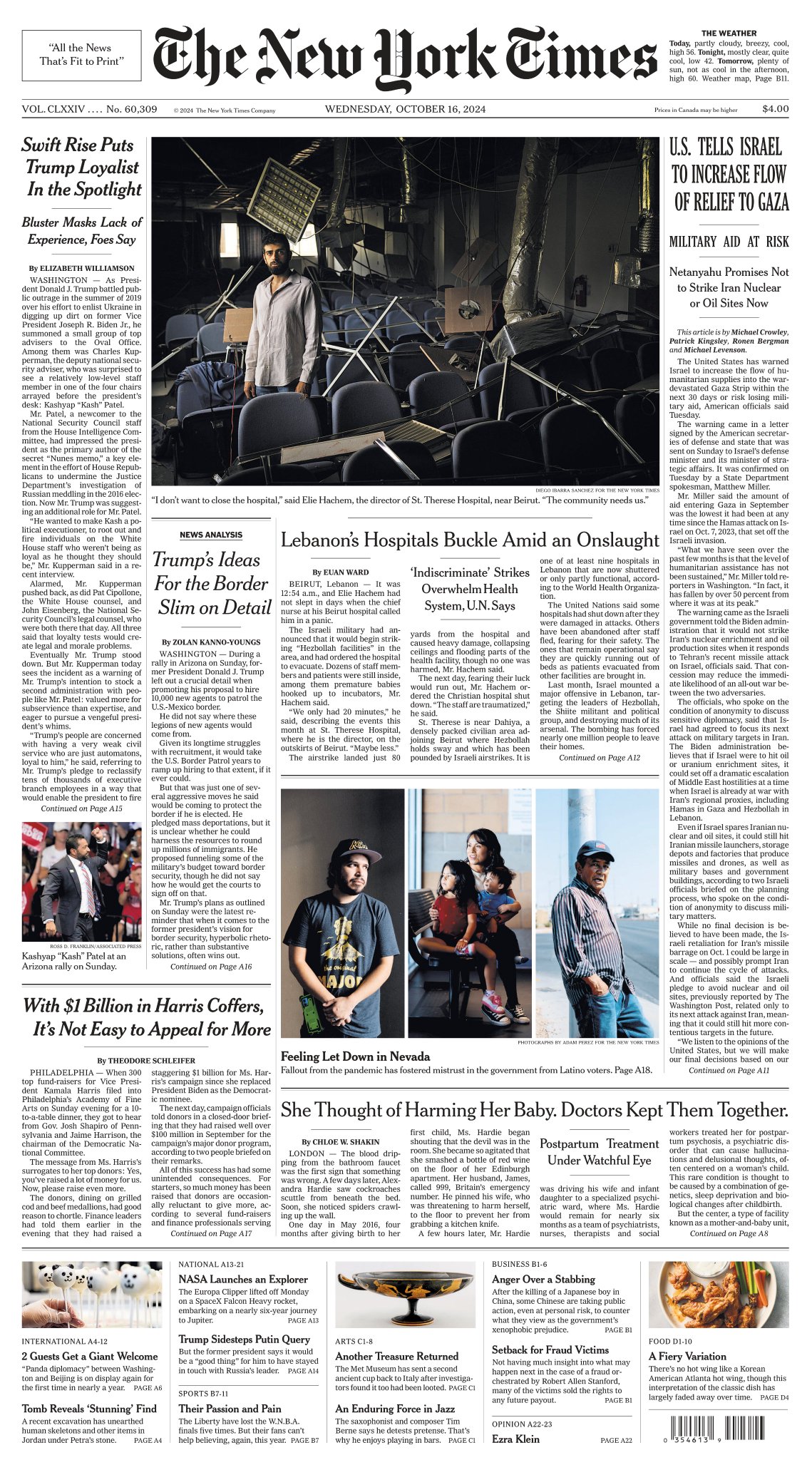
The demand from Israel’s closest ally came amid reports that the humanitarian catastrophe in the Gaza Strip has grown still worse in recent weeks.
The United Nations says “the targeting of health and relief operations is broadening” in Lebanon. Hospitals say they have been forced to close or are struggling to operate.
The former president’s sweeping immigration proposals face daunting challenges, but voters still trust his positions more than his opponent’s.
The MAGA loyalist Mr. Patel aims to run the C.I.A. if Donald Trump wins the presidency. But critics say his swagger masks deep inexperience.


The American economy has left other rich countries in the dust. Expect that to continue, argue Simon Rabinovitch and Henry Curr


The GOP’s identity crisis by Lauren Oyler
On minor characters and human possibility by Yiyun Li
From Mysticism, which was published last month by New York Review Books. by Simon Critchley

The Wall Street Journal (October 15, 2024): In Ukraine and the Red Sea, low-tech drones are changing the way wars are fought. The U.S. and other countries are investing in a new and inexpensive way to retaliate: lasers.
Chapters: 0:00 Laser weapon systems 1:03 The LOCUST 2:57 Targets 3:40 Weaknesses 4:56 Future challenges and deployment
Compared with traditional weapons, lasers present some key challenges: they have a shorter range, limited power and can be harder to fix when issues arise. WSJ explains how the BlueHalo LOCUST laser weapon system works and why the tech is so difficult to perfect.
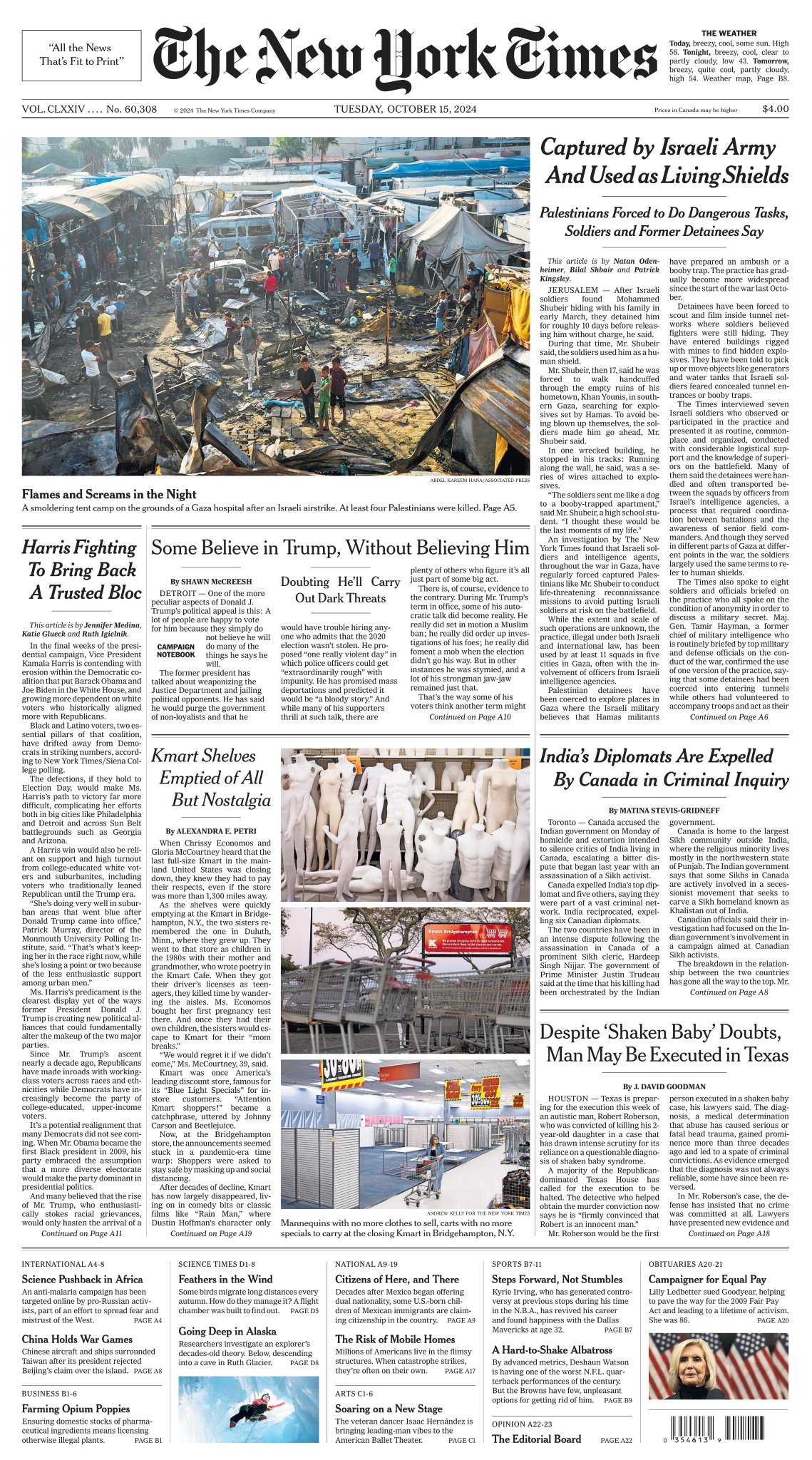
Israeli soldiers and Palestinian former detainees say troops have regularly forced captured Gazans to carry out life-threatening tasks, including inside Hamas tunnels.
When the former president endorses violence and proposes using the government to attack his enemies, many of his supporters assume it’s just an act.
Defections from Black and Latino voters are making Kamala Harris more dependent on white, suburban voters — and complicating her path to victory.
As the last full-size Kmart in the continental United States prepares to close, shoppers reminisced about the store that once sold everything, everywhere.
The Wall Street Journal (October 14, 2024): “Darwin” is one of Ukraine’s deadliest drone pilots in its war against Russia.
Chapters: 0:00 A race to adapt 1:38 “Darwin” 2:48 Artillery strikes 4:01 Personal evolution 6:37 In the bunker 8:32 Drone strike 12:20 Just the beginning
But the 20-year-old must contend with his own personal evolution after hundreds of successful missions in a modern survival of the fittest.



Even many of the ex-President’s opponents haven’t grasped the scale of the man’s villainy. By Adam Gopnik
After the 2016 election, progressives blamed white women for Hillary Clinton’s loss. This year, Black men have come under special scrutiny. By Jelani Cobb
The Russian opposition leader’s account of his last years and his admonition to his country and the world. By Alexei Navalny

Both parties are frenetically chasing votes in the counties that could very well decide the election. In many places, inexperienced conservative groups are going up against a more tightly organized Democratic operation.
Nepalis have complained that China’s breaches of the border threaten their land and their way of life.
Donald J. Trump is feeling aggrieved, unappreciated by donors and fenced in by security concerns in the final stretch of the race.
A second Trump administration would be expected to shred climate polices. California officials are devising ways to insulate its environmental regulations.
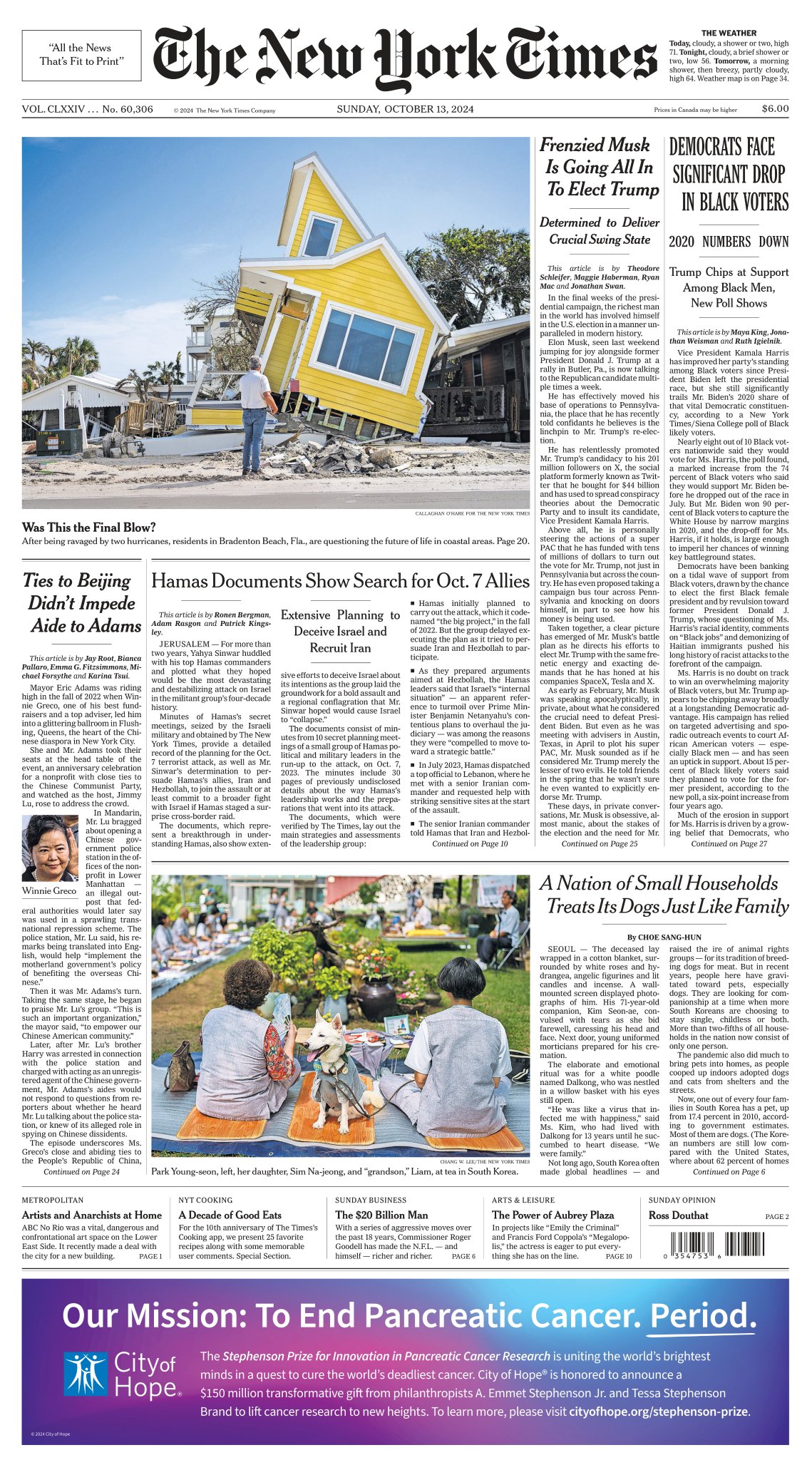
Vice President Kamala Harris is on track to win a majority of Black voters, and has brought many back to her party since taking over for President Biden. Still, a significant gap in support persists.
The Times reviewed the minutes of 10 meetings among Hamas’s top leaders. The records show the militant group avoided several escalations since 2021 to falsely imply it had been deterred — while seeking Iranian support for a major attack.
Elon Musk is planting himself in Pennsylvania, has brought his brain trust to help and may even knock on doors himself.
They have become pampered family members in South Korea, which has the world’s lowest birthrate and where much of the population lives alone.




 Boomers Daily