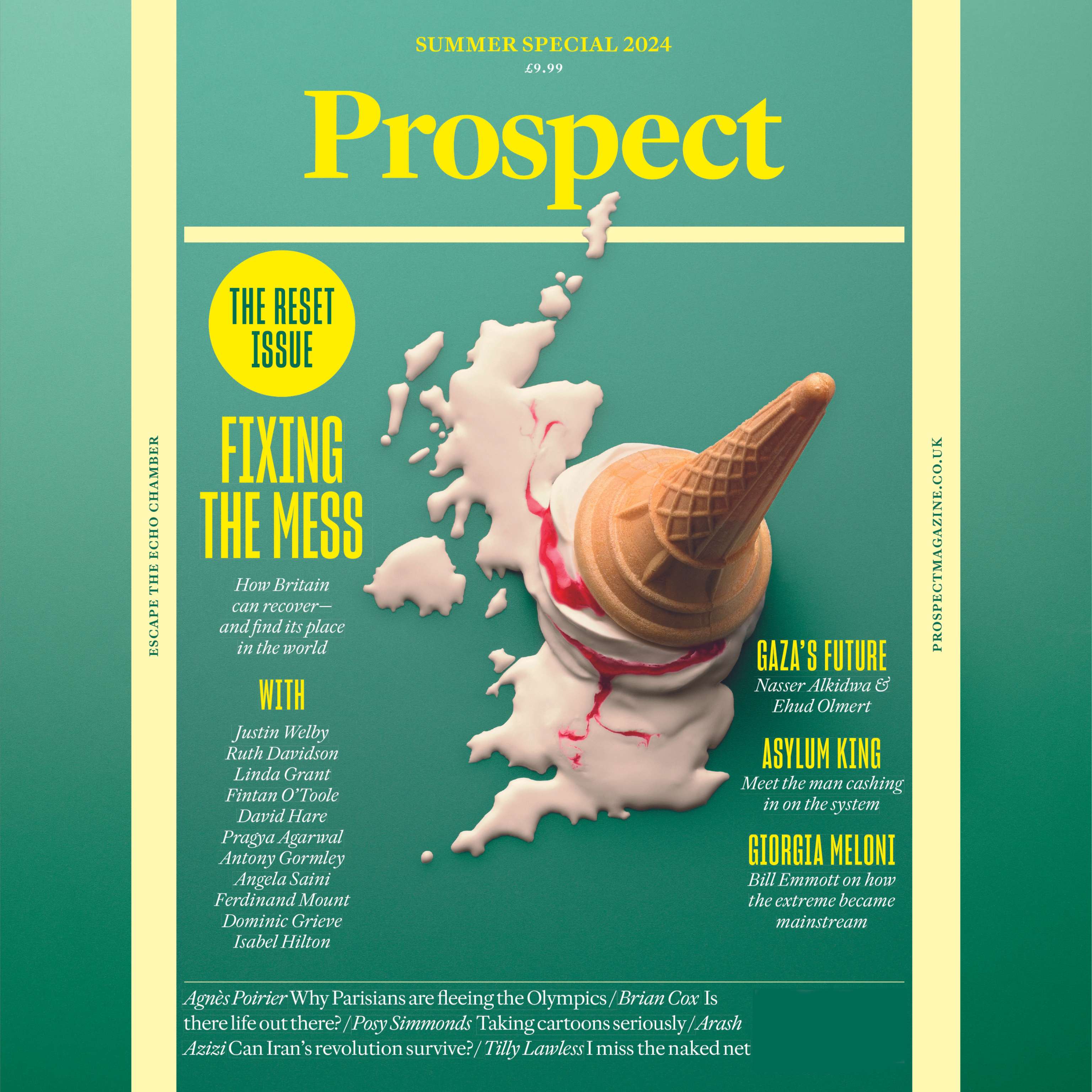
Tag Archives: Politics

Culture/Politics: Harper’s Magazine – May 2024

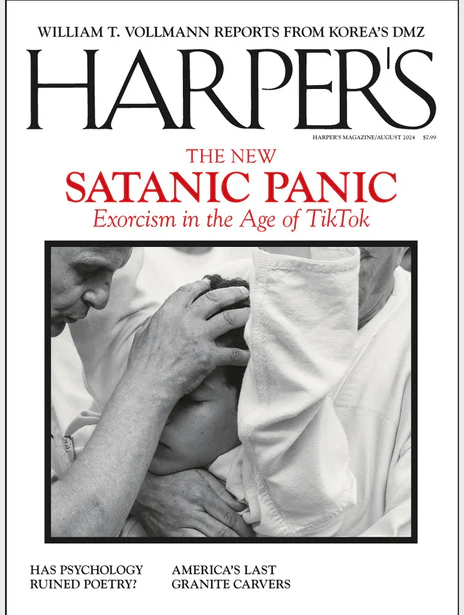
HARPER’S MAGAZINE – April 15, 2024: The latest issue features The Life and Death of Hollywood – Film and television writers face an existential threat; The Race for Second Place – The Republican primaries as farce

The Life and Death of Hollywood

Photo illustration by Nicolás Ortega

Film and television writers face an existential threat

by Daniel Bessner

In 2012, at the age of thirty-two, the writer Alena Smith went West to Hollywood, like many before her. She arrived to a small apartment in Silver Lake, one block from the Vista Theatre—a single-screen Spanish Colonial Revival building that had opened in 1923, four years before the advent of sound in film.

Smith was looking for a job in television. She had an MFA from the Yale School of Drama, and had lived and worked as a playwright in New York City for years—two of her productions garnered positive reviews in the Times. But playwriting had begun to feel like a vanity project: to pay rent, she’d worked as a nanny, a transcriptionist, an administrative assistant, and more. There seemed to be no viable financial future in theater, nor in academia, the other world where she supposed she could make inroads.

The Race for Second Place

Illustration by Nate Sweitzer

The Republican primaries as farce

by Kyle Paoletta

On the Saturday before the Iowa caucuses, the super PAC supporting Florida governor Ron DeSantis staged a “drop by” for the candidate at its headquarters in West Des Moines. Outside the modernist office park, much of the Upper Midwest was under a deep freeze brought on by a low-pressure system that had deposited more than a foot of snow in advance of a surge of arctic air that brought the wind chill into the negative thirties. Despite the atrocious road conditions, DeSantis was keeping his schedule as a “special guest” of the Never Back Down PAC, beginning the day at the far western end of Iowa, in Council Bluffs, and concluding it three hundred miles east, in Davenport.

Previews: The New Yorker Magazine – April 22, 2024

Image

The New Yorker (April 15, 2024): The new issue‘s cover features Ana Juan’s “Clickbait” – The artist captures the mesmerizing—and distracting—glow of modern entertainment.

Can the World Be Simulated?

Video-game engines were designed to closely mimic the mechanics of the real world. They’re now used for movies, TV shows, architecture, military trainings, virtual reality, and the metaverse.

Are Flying Cars Finally Here?

They have long been a symbol of a future that never came. Now a variety of companies are building them—or something close.

By Gideon Lewis-Kraus

Saturday Morning: News And Stories From London

Monocle on Saturday Podcast (April 6, 2024): Terry Stiastny updates Georgina Godwin on the Wirecard fugitive case and discusses the honeytrap scandal that has rattled Westminster this week.

We examine the history of honeytrap scandals and look back at the lives of two extraordinary people: journalist Hella Pick and author Lynne Reid Banks. Plus: twins Dina and Rosabella Gregory take us through their new opera, ‘The Haberdasher Prince’, and Louise Doughty joins to talk about her guest edition of Writers Mosaic, ‘Blood and belonging: Traveller Writers’.

New Books: ‘Children Of A Modest Star”(April 2024)

Stanford University Press (April 5, 2024): Jonathan S. Blake and Nils Gilman introduce their new book Children of a Modest Star: Planetary Thinking for an Age of Crises.

Cover of Children of a Modest Star by Jonathan S. Blake and Nils Gilman

A clear-eyed and urgent vision for a new system of political governance to manage planetary issues and their local consequences.

Deadly viruses, climate-changing carbon molecules, and harmful pollutants cross the globe unimpeded by national borders. While the consequences of these flows range across scales, from the planetary to the local, the authority and resources to manage them are concentrated mainly at one level: the nation-state. This profound mismatch between the scale of planetary challenges and the institutions tasked with governing them is leading to cascading systemic failures.

Produced by Studio B. at the Berggruen Institute

Animation by Meysam Qaderi

Illustration by Akram Esmaili

Politics: The Guardian Weekly – April 5, 2024

Image

The Guardian Weekly (April 5, 2024) – The new issue features ‘Lone Star’ – Have the UN vote and questions about its conduct in Gaza left Israel isolated?; Liz Truss bids for political resurrection; Will IS strike again?; Nick Cave’s devilish change of direction…

Spotlight | IS affiliates could launch new wave of terror on the west

Islamic State has stalled in Iraq and Syria but officials believe it has been planning new attacks on the west for years, reports Jason Burke; while Angelique Chrisafis writes that France’s interior minister has met intelligence services to assess the terrorist threat to the country ahead of this summer’s Olympic Games

Environment | True cost of a city built from scratch

Nusantara is billed as a state-of-the-art capital city that will coexist with nature – but not all residents of Borneo’s Balikpapan Bay are happy, find. By Rebecca Ratcliffe and Richaldo Hariandja

Feature | 49 days later

Liz Truss trashed the economy as Britain’s shortest-serving prime minister. But she is back, launching a new conservative movement and spreading her ideology across the world. You just can’t keep a bad politician down, argues David Runciman

Culture | The devil in the details

In the past nine years, Nick Cave has lost two sons – an experience he explores in a deeply personal new ceramics project. He discusses mercy, forgiveness, making and meaning with Simon Hattenstone

Architecture | A Māori-built environment

A new wave of Indigenous architects are behind a series of stunning buildings embracing tribal identity in Aotearoa New Zealand, Oliver Wainwright discovers

Technology Quarterly: ‘Health And AI’ (April 2024)

Technology Quarterly: A new prescription

The Economist (April 1, 2024): The latest issue of THE ECONOMIST TECHNOLOGY QUARTERLY is focused on:

A new prescription

AIs will make health care safer and better, reports Natasha Loder. It may even get cheaper too

AIs will make health care safer and better

Artificial intelligence has long been improving diagnoses

Medical AIs with human faces are on their way

Artificial intelligence is taking over drug development

Can artificial intelligence make health care more efficient?

Read full report

Previews: The New Yorker Magazine – April 8, 2024

A person's silhouette walks up stairs toward a busy city street.

The New Yorker (April 1, 2024): The new issue‘s cover features Pascal Campion’s “Into the Light” – The artist depicts stepping out of the subway into the overwhelming glow of the city.

So You Think You’ve Been Gaslit

An anthropomorphic lantern being lit by a man.

What happens when a niche clinical concept becomes a ubiquitous cultural diagnosis.

By Leslie Jamison

When Leah started dating her first serious boyfriend, as a nineteen-year-old sophomore at Ohio State, she had very little sense that sex was supposed to feel good. (Leah is not her real name.) In the small town in central Ohio where she grew up, sex ed was basically like the version she remembered from the movie “Mean Girls”: “Don’t have sex, because you will get pregnant and die.”

Black Holes Are Even Weirder Than You Imagined

An artistic rendering of two supermassive black holes.

It’s now thought that they could illuminate fundamental questions in physics, settle questions about Einstein’s theories, and even help explain the universe.

By Rivka Galchen

Black holes are, of course, awesome. But, for scientists, they are more awesome. If a rainbow is marvellous, then understanding how all the colors of the rainbow are present, unified, in ordinary white light—that’s more marvellous. (Though, famously, in his poem “Lamia,” John Keats disagreed, blaming “cold philosophy” for unweaving the rainbow.) In recent years, the amount of data that scientists have discovered about black holes has grown exponentially. In January, astronomers announced that the James Webb Space Telescope had observed the oldest black hole yet—one present when the universe was a mere four hundred million years old. (It’s estimated that it’s now 13.8 billion years old.) Recently, two supermassive black holes, with a combined mass of twenty-eight billion suns, were measured and shown to have been rotating tightly around each other, but not colliding, for the past three billion years. And those are just the examples that are easiest for the public to make some sense of. To me, a supermassive black hole sounds sublime; to a scientist, it can also be a test of wild hypotheses. “Astrophysics is an exercise in incredible experiments not runnable on Earth,” Avery Broderick, a theoretical physicist at the University of Waterloo and at the Perimeter Institute, told me. “And black holes are an ideal laboratory.”

London Review Of Books – April 4, 2024 Preview

London Review of Books (LRB) – March 27, 2024: The latest issue features Brandon Taylor – Two Years With Zola,,,

Mary Wellesley – Mother Tongue: The Surprising History of Women’s Words by Jenni Nuttall

Moshé Machover, James McAuley, Avital Balwit, Brian Vickers, Pat Butcher, Joe Oldaker, Arthur M. Shapiro, Penny Collier, John Potts

Mike Jay – Mapping the Darkness: The Visionary Scientists Who Unlocked the Mysteries of Sleep by Kenneth Miller

T.J. Clark – Poem: ‘Clapham in March’

Michael Ledger-Lomas: Andrew Lang: Writer, Folklorist, Democratic Intellect by John SloanTroubled by Faith: Insanity and the Supernatural in the Age of the Asylum by Owen Davies

Michael Hofmann – The Islander: A Biography of Halldór Laxness by Halldór Guðmundsson, translated by Philip Roughton

Brandon Taylor – Is it even good?

Previews: The New Yorker Magazine – April 1, 2024

A dog looks out a window.

The New Yorker (March 25, 2024): The new issue‘s cover features Mark Ulriksen’s “Standing Guard” – The artist depicts the tail-wagging occasion of the first signs of spring.

Bryan Stevenson Reclaims the Monument, in the Heart of the Deep South

“The Caring Hand” by Eva Oertli and Beat Huber.
“The Caring Hand,” by Eva Oertli and Beat Huber, is one of more than fifty sculptures at the new Freedom Monument Sculpture Park.Photographs by Kris Graves for The New Yorker

The civil-rights attorney has created a museum, a memorial, and, now, a sculpture park, indicting the city of Montgomery—a former capital of the domestic slave trade and the cradle of the Confederacy.

By Doreen St. Félix

The National Monument to Freedom, in Montgomery, Alabama, is a giant book, standing forty-three feet high and a hundred and fifty feet wide. The book is propped wide open, and engraved on its surface are the names of more than a hundred and twenty thousand Black people, documented in the 1870 census, who were emancipated after the Civil War. On the spine of the book is a credo written for the dead:

A Dutch Architect’s Vision of Cities That Float on Water

The Thâtre LÎle Ô in Lyon seen across the water.

Your children love you.
The country you built must honor you.
We acknowledge the tragedy of your enslavement.
We commit to advancing freedom in your name.

What if building on the water could be safer and sturdier than building on flood-prone land?

By Kyle Chayka

In a corner of the Rijksmuseum hangs a seventeenth-century cityscape by the Dutch Golden Age painter Gerrit Berckheyde, “View of the Golden Bend in the Herengracht,” which depicts the construction of Baroque mansions along one of Amsterdam’s main canals. Handsome double-wide brick buildings line the Herengracht’s banks, their corniced façades reflected on the water’s surface. Interspersed among the new homes are spaces, like gaps in a young child’s smile, where vacant lots have yet to be developed.

Opinion & Politics: Reason Magazine – May 2024

Magazine

REASON MAGAZINE (March 21, 2024)The latest issue features ‘What If America Runs Out Of Bombs?’ – Due to overzealous interventionism, the U.S. is dispensing munitions faster than they can be replaced…

What if America Runs Out of Bombs?

An illustration of Uncle Sam as a PEZ dispenser, dispensing bombs | Photo: Julian Dufort; Wikimedia

The U.S. is dispensing munitions to Ukraine and Israel faster than they can be replaced.

By MATTHEW PETTI 

How Capitalism Beat Communism in Vietnam

Two photos illustrate Vietnam's progress over time | Photo: Hanoi, Vietnam, 1985; Christopher Pillitz/Gettya; Photo: Hanoi, Vietnam, 2020; Manan Vatsyayana/AFP via Getty

It only took a generation to go from ration cards to exporting electronics.

RAINER ZITELMANN

Anti-Chinese Xenophobia Fueled America’s First Drug War

opium | Photo: An opium den in Chinatown, San Francisco, California, in 1898; REASON 31 Strohmeyer & Wyman/Library of Congress

Opium dens in San Francisco were patronized “by the vicious and the depraved,” politicians of the 1800s claimed.

JACOB SULLUM