
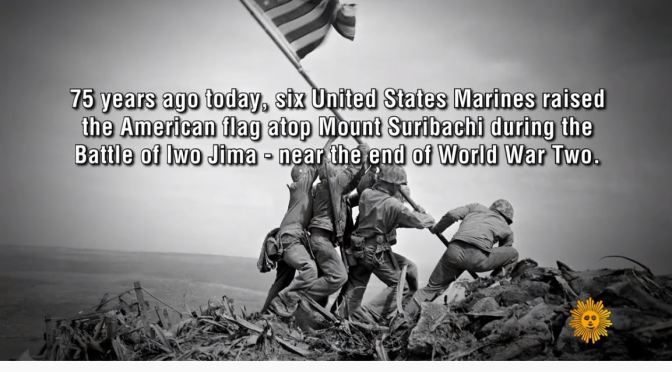
“Sunday Morning” looks to an iconic image of World War II, taken 75 years ago today.
Raising the Flag on Iwo Jima is an iconic photograph of six United States Marines raising the U.S. flag atop Mount Suribachi during the Battle of Iwo Jima in the final stages of the Pacific War. The photograph, taken by Joe Rosenthal of the Associated Press on February 23, 1945, was first published in Sunday newspapers two days later and reprinted in thousands of publications. It was the only photograph to win the Pulitzer Prize for Photography in the same year as its publication, and was later used for the construction of the Marine Corps War Memorial in 1954, which was dedicated to honor all Marines who died for their country since 1775. The memorial, sculpted by Felix de Weldon, is located in Arlington Ridge Park, near the Ord-Weitzel Gate to Arlington National Cemetery and the Netherlands Carillon. The photograph has come to be regarded in the United States as one of the most significant and recognizable images of World War II.

The flag raising occurred in the early afternoon, after the mountaintop was captured and a smaller flag was raised on top that morning. Three of the six Marines in the photograph – Sergeant Michael Strank, Corporal Harlon Block, and Private First Class Franklin Sousley – were killed in action during the battle. The other three Marines in the photograph were Corporals (then Private First Class) Ira Hayes, Harold Schultz, and Harold Keller; Block was identified as Sergeant Hank Hansen (helped raise the first flag and was present at the second flag raising) until January 1947, Schultz (was at both flag raisings) was identified as Sousley who was identified as PhM2c. John Bradley (was at both flag raisings) until June 2016, and Keller was identified as Rene Gagnon (carried the second flag up Mount Suribachi) until October 2019. All of the men served in the 5th Marine Division on Iwo Jima.
The Associated Press has relinquished its copyright to the photograph, placing it in the public domain.
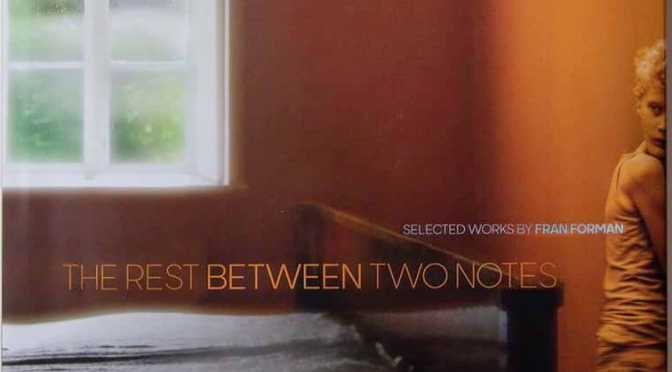
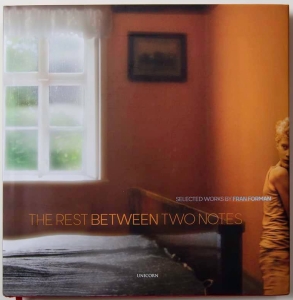 Forman’s photo-paintings explore those liminal and in-between moments – of coming and leaving, innocence and confidence, shadow and light, night and day, absence and connection, loss and longing, and not quite the past and not yet the future. Portals, both real and metaphorical, frequent her layered, complex and often dreamlike images.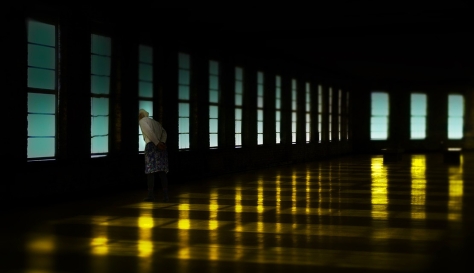
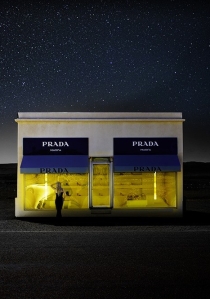 Her work is recognized for imbuing harmonious compositions and for her explosive use of color, light, and shadow.Forman’s images elicit emotions of desire, vulnerability, and a desperate longing for connections.
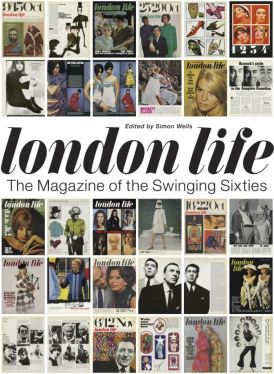 With imagery from the likes of David Bailey, Duffy and Terence Donovan, designs from Peter Blake, David Hockney, Gerald Scarfe and fledgling artist Ian Dury plus words and opinions from those riding high on the city`s cutting-edge, London Life remains the coolest document from the capital’s most exciting period.
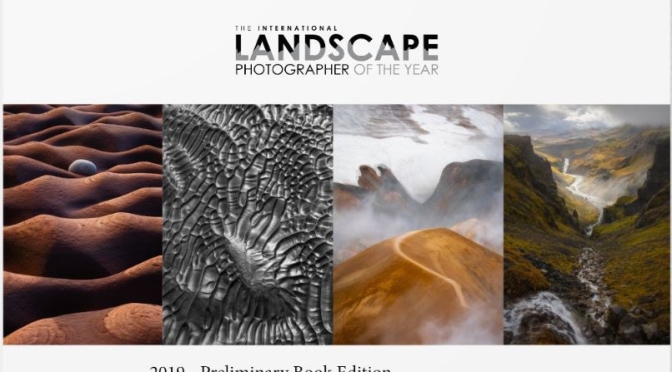
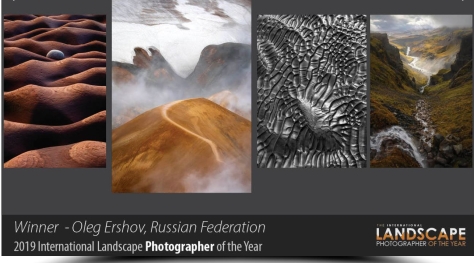
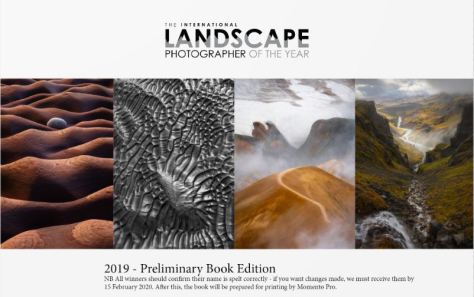
 “Iceland’s glacial rivers are nature’s abstract paintings. It seems obvious that rivers this wild and stunning are protected, yet the harsh reality is that many have been dammed, mainly to provide power for aluminum plants.


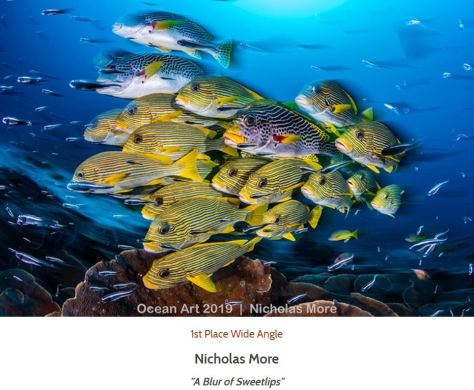
 January 13, 2020 – The prestigious Ocean Art Underwater Photo Competition, organized by the Underwater Photography Guide, has announced its 2019 winners. The 8th annual competition attracted an extremely high caliber of photos from oceans around the world. These photos showcase the best underwater photographs of the year. 2019 was one of the most competitive years to date. Our two new categories, conservation and blackwater diving, had an overwhelming response of incredible photos and were two of the highlights of the competition.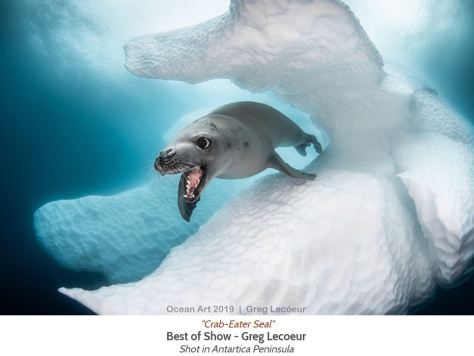
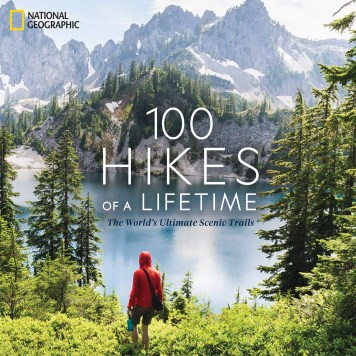 Crossing all continents and climates (from the jungles of Costa Rica to the ice fields in Alaska’s Kenai Fjords National Parks), as well as experiences (a wine route through Switzerland or moose spotting on the Teton Crest Trail in Wyoming,) there is a trail for everyone in these pages. So pack your gear and lace your boots: this comprehensive and innovative guide will lead you to experience the best hikes of your life!
 Boomers Daily