
Filmed, Edited and Directed by: Stéphane Ridard
Camera: Rémy Solomon
Music: Florian Fourlin and Mickael Joseph

Filmed, Edited and Directed by: Stéphane Ridard
Camera: Rémy Solomon
Music: Florian Fourlin and Mickael Joseph
 The podcast team share some of their highlights from the past 12 months: A sole sensation, The make up of the far side of the Moon, Growth Mindset, ‘Manferences’ and Q&A with Nobel Prize winner John Goodenough.
In this episode:
A study of people who do and don’t wear shoes looks into whether calluses make feet less sensitive. Nature Podcast: 26 June 2019; Research article: Holowka et al.; News and Views: Your sensitive sole
Initial observations from the first lander to touch down on the far side of the Moon. Nature Podcast: 15 May 2019; Research article: Li et al.
How a one hour course could improve academic achievement. Nature Podcast: 07 August 2019; Research article: Yeager et al.
Nature investigates the prevalence of conferences where most of the speakers are male. Nature Podcast: 11 September 2019; News Feature: How to banish manels and manferences from scientific meetings
We talk to John Goodenough, who was jointly awarded the 2019 Nobel Prize in Chemistry for his role in the development of the lithium-ion battery. Podcast Extra: 09 October 2019
 In the middle ages, Heidelberg castle was a center of learning, the birthplace of the first university in Germany. Today, it’s a birthplace of a different kind: peregrine falcons.
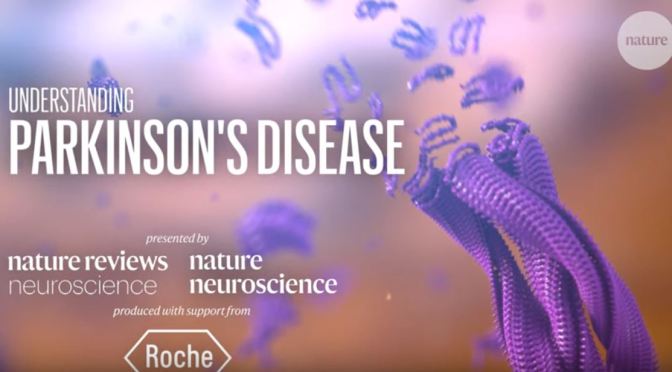
Parkinson’s disease is a neurological condition that affects the brain and other parts of the nervous system. The gradual loss of nerve cells leads to a suite of characteristic motor and non-motor symptoms.
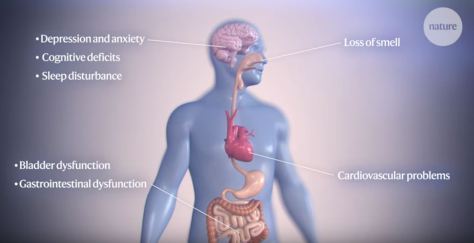
What causes these cells to die and how the pathology develops in the nervous system are not yet clear but multiple lines of investigation are being pursued to answer these questions. In this animation, we explore some of the latest in Parkinson’s disease research.
 Hear the latest science news, brought to you by Benjamin Thompson and Shamini Bundell. This week, exploring two very different issues surrounding genomic sequencing, and the latest results from NASA’s Parker Solar Probe.
In this episode:
Researchers have released the first data from an ambitious project to sequence the genomes of 100,000 people from populations across Asia. Research Article: GenomeAsia100K Consortium
Bare riverbanks make meanders move, and human activity affects picky penguins. Research Highlight: The meandering rivers that speed across barren landscapes; Research Highlight: Climate change splits two penguin species into winners and losers
Concerns are growing around the use of commercial DNA databases for state-level surveillance. Comment: Crack down on genomic surveillance
NASA’s Parker Solar Probe has sent back the most detailed information yet about the birthplace of solar wind. News: Sun-bombing spacecraft uncovers secrets of the solar wind
From a Genetic Engineering & Biotechnology News release:
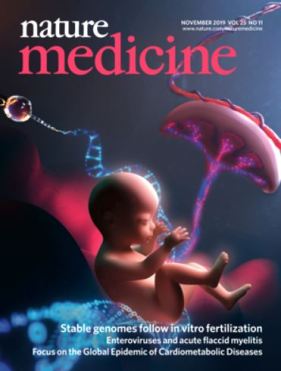 “This proof of concept study demonstrates a new paradigm that measurement of blood proteins can accurately deliver health information that spans across numerous medical specialties and that should be actionable for patients and their healthcare providers,” said Peter Ganz, MD, co-leader of this study and the Maurice Eliaser distinguished professor of medicine at UCSF and director of the Center of Excellence in Vascular Research at Zuckerberg San Francisco General Hospital and Trauma Center.
Specific patterns of protein levels in our blood could be used to provide a comprehensive “liquid health check” that gives a snapshot of health and potentially an indication of the likelihood that we will develop certain diseases or health risk factors in the future, according to research by scientists in the U.S. and U.K. working with SomaLogic. The results of their proof-of-concept study involving more than 16,000 participants, and published in Nature Medicine, showed that while the accuracy of models based on specific protein expression patterns varied, they were all either better predictors than models based on traditional risk factors, or would constitute more convenient and less expensive alternatives to traditional testing.
Study published in Nature Medicine: https://www.nature.com/articles/s41591-019-0665-2
 Listen to the latest science updated, brought to you by Nick Howe and Shamini Bundell. This week, delving into the results of the latest graduate student survey, and assessing ageism in science fiction literature.
In this episode:
The results of Nature’s 2019 PhD survey are in. David Payne, Nature’s Chief Careers Editor, takes us through them. Nature’s PhD survey collection
Giant tortoises are quick learners, and colour-changing magic mushrooms. Research Article: Gutnick et al.; Research Highlights: Why magic mushrooms turn dark blue when picked
Author Sylvia Spruck Wrigley has been looking into the number of older women that appear in sci-fi novels, and the roles they play. Essay: Space ageing: why sci-fi novels shun the badass older woman
A trove of mummified remains causes excitement in Egypt, and Italy plans a new science funding body. News: Rare mummified lions add to Egyptology buzz; News: Italy’s plan to create €300-million research agency draws fire
 Benjamin Thompson brings you the latest science news. This week, an antibiotic that targets difficult to treat bacteria, and a roundup of the latest science news.
In this episode:
Researchers looked inside nematode guts and have identified a new antibiotic with some useful properties. Research Article: Imai et al.
Using urine as a health metric, and sniffing out book decay with an electronic nose. Research Article: Miller et al.; Research Article: Veríssimo et al.
Adding an element of chance to grant funding, a continental butterfly-sequencing project, and tracking endangered animals via traces of their DNA. News: Science funders gamble on grant lotteries; News: Every butterfly in the United States and Canada now has a genome sequence; News: Rare bird’s detection highlights promise of ‘environmental DNA’
To read more: https://www.nature.com/articles/d41586-019-03588-z
Hear this week’s science news, with Nick Howe and Shamini Bundell. This week, a new 3D printer allows quick shifting between many materials, and understanding the link between gut microbes and liver disease.In this episode:
A new nozzle lets a 3D printer switch between materials at a rapid rate, opening the door to a range of applications. Research Article: Skylar-Scott et al.; News and Views: How to print multi-material devices in one go
The slippery secrets of ice, and cells wrapping up their nuclei. Research Highlight: Viscous water holds the secret to an ice skater’s smooth glide; Research Highlight: Super-thin layer of ‘bubble wrap’ cushions a cell’s nucleus
Researchers have isolated a bacterial strain that appears to play an important role in alcoholic liver disease. Research paper: Duan et al.; News and Views: Microbial clues to a liver disease
‘Megaconstellations’ of satellites concern astronomers, and a report on the gender gap in chemistry. News: SpaceX launch highlights threat to astronomy from ‘megaconstellations’; News: Huge study documents gender gap in chemistry publishing




 Boomers Daily