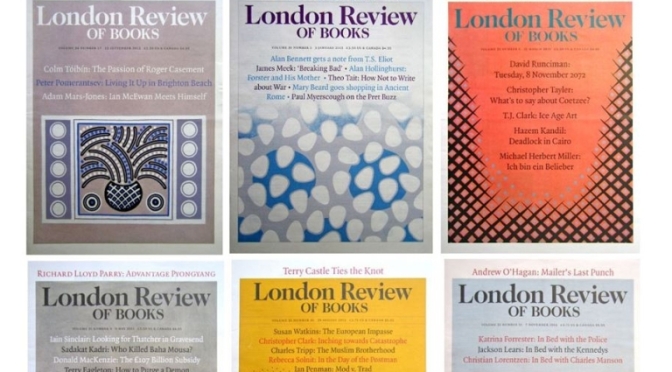
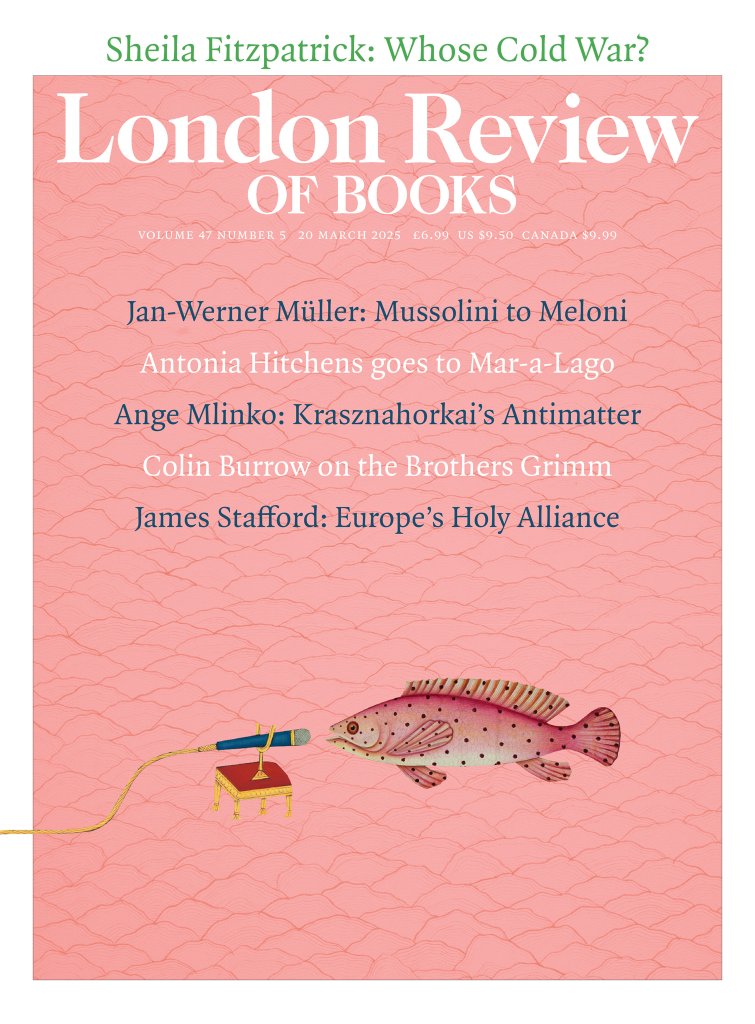
LONDON REVIEW OF BOOKS (March 11, 2025): The latest issue features Mussolini to Meloni; A trip to Mar-a-Lago; The Brothers Grimm and Europe’s Holy Alliance…
Tuberculosis is the world’s most deadly infectious disease, killing more than a million people a year and infecting many millions more, even though treatment in the form of antibiotics has existed for seventy years.
On Sunday, 9 March, at Southbank Centre’s Queen Elizabeth Hall, the City of London Sinfonia and the London Review of Books will be collaborating on an evening of music and readings inspired by Edward Said’s last, posthumous book, On Late Style: Music and Literature Against the Grain.
‘A novelist is condemned to produce a succession of novelties, new names for characters, new incidents for his plots, new scenery,’ reflects the beleaguered hero of The Ordeal of Gilbert Pinfold, Evelyn Waugh’s portrait of the artist as a middle-aged car crash.
London Review of Books (LRB – August 5, 2023) – But really, as Pinfold goes on to say, ‘most men harbour the germs of one or two books only; all else is professional trickery of which the most daemonic of the masters – Dickens and Balzac even – were flagrantly guilty.’ Pinfold is by admission a self-portrait, so Waugh must have expected readers to speculate on how this observation applied to his own career, and whether he was a one or a two-book man himself.
In 1958, a Cambridge don called Frederick J. Stopp produced a study of Waugh – uniquely, Waugh himself gave ‘generous assistance’ – which warmly endorsed the idea that he had basically ‘two books in his armoury’, the first featuring the ‘contrast between sanity and insanity’ and the second ‘sanity venturing out into the surrounding sphere of insanity, and defeating it at its own game’.
Whether this particular dualism had Waugh’s approval is unclear, but either way it doesn’t seem entirely satisfactory since the two alternatives look like variants of the same thing. Less well-disposed readers have thought that Waugh’s books divided on much more rudimentary lines: the good ones, which are funny, and the bad ones, which are pious.
There is the string of brilliant, brittle social comedies in the 1930s, and then there is whatever started happening with the publication in 1945 of Brideshead Revisited. Stopp reported, presumably with his master’s sanction, that ‘Mr Waugh’s reputation among the critics has hardly yet recovered from the blow.’ Brigid Brophy had the best joke: ‘In literary calendars, 1945 is marked as the year Waugh ended.’
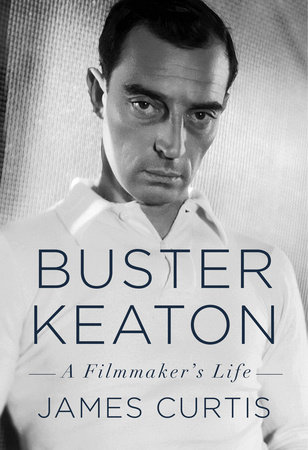
Buster Keaton: A Filmmaker’s Life by James Curtis.
From acclaimed cultural and film historian James Curtis—a major biography, the first in more than two decades, of the legendary comedian and filmmaker who elevated physical comedy to the highest of arts and whose ingenious films remain as startling, innovative, modern—and irresistible—today as they were when they beguiled audiences almost a century ago.
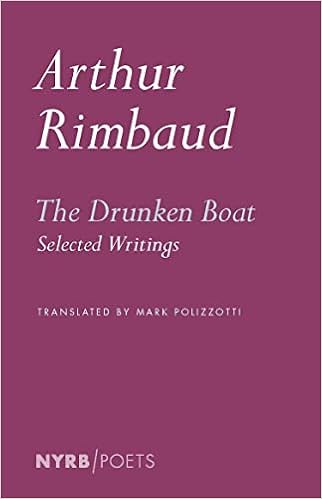
The Drunken Boat: Selected Writings by Arthur Rimbaud, translated by Mark Polizzotti
Poet, prodigy, precursor, punk: the short, precocious, uncompromisingly rebellious career of the poet Arthur Rimbaud is one of the legends of modern literature. By the time he was twenty, Rimbaud had written a series of poems that are not only masterpieces in themselves but that forever transformed the idea of what poetry is. Without him, surrealism is inconceivable, and his influence is palpable in artists as diverse as Henry Miller, John Ashbery, Bob Dylan, and Patti Smith.
London Review of Books (LRB) – December 9, 2022: Among the Ancients, with Emily Wilson and Thomas Jones, which we’ll be re-running from January next year. With a new episode each month, Among the Ancients will consider some of the greatest works of Ancient Greek and Roman literature, from Homer to Horace. In this sample Emily and Tom discuss the Iliad.
A sample from the first episode of the Close Readings series from Emily Wilson and Thomas Jones.
Dating to the ninth century B.C., Homer’s timeless poem still vividly conveys the horror and heroism of men and gods wrestling with towering emotions and battling amidst devastation and destruction, as it moves inexorably to the wrenching, tragic conclusion of the Trojan War. Renowned classicist Bernard Knox observes in his superb introduction that although the violence of the Iliad is grim and relentless, it coexists with both images of civilized life and a poignant yearning for peace.
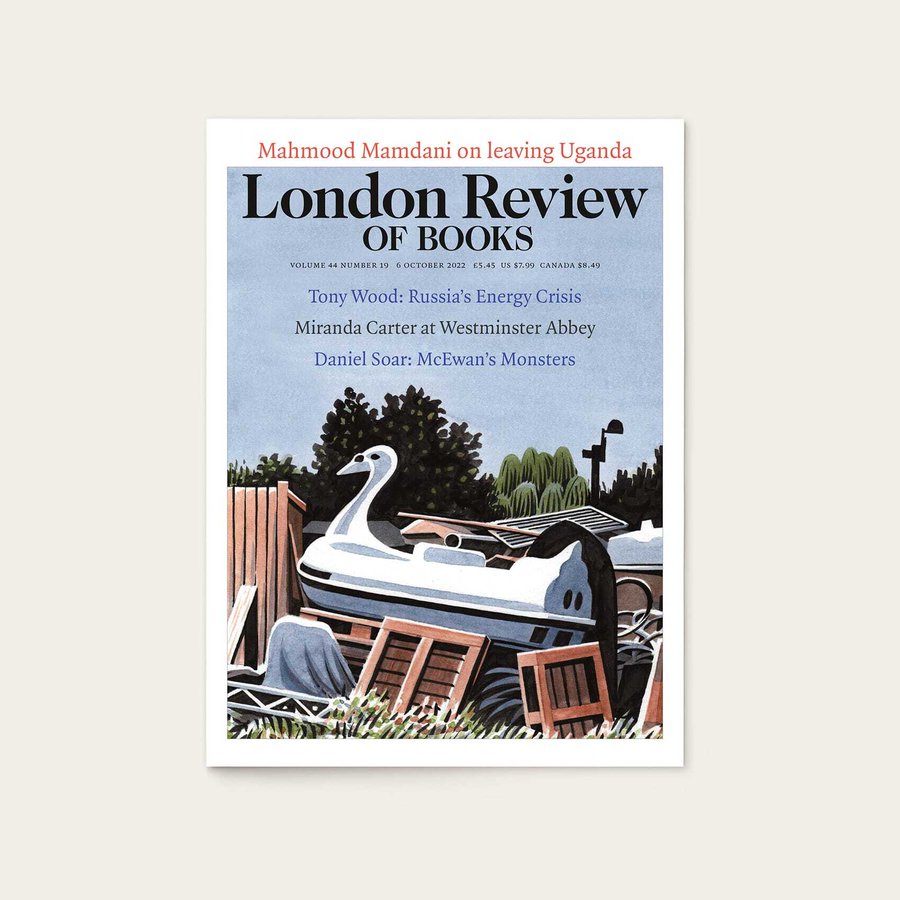
Our new issue is finally online, ft Mahmood Mandani on leaving Uganda, Tony Wood on Russia’s energy crisis, @MJCarter10 at Westminster Abbey, @danielsoar on Ian McEwan, @amiasrinivasan on Andrea Dworkin, T.J. Clark on painting & poetry & a @Jon_McN cover.
Arianne Shahvisi – ‘Sex in the Brain’ Jon Day on Hoardiculture Colin Burrow: Quote Me! Helen Thaventhiran: T.S. Eliot’s Alibis Stefan Collini on the Huxley Inheritance
Our new issue is now online, featuring 29 responses to the overturning of Roe v. Wade, Barbara Newman on medieval sanctuary, @moonjets on Shelley, Mimi Jiang on the end of Shanghai’s lockdown and @mmschwartz on the Bataclan verdict. https://lrb.co.uk
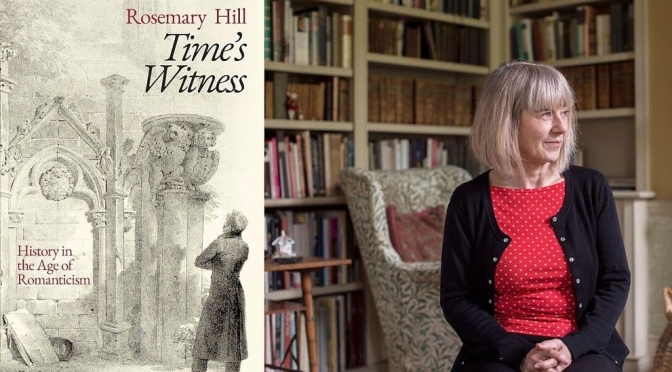
In the 1740s the Scots were invading England and the wearing of tartan was banned. By the 1850s, Queen Victoria had built her Gothic fantasy in Aberdeenshire and tartan was everywhere. What happened in between?
In the second episode of her series on Romantic history, Rosemary Hill talks to Colin Kidd about the myths and traditions of Scottish history created in the 19th century, and the central role of Walter Scott in forging his country’s identity.
In the first episode of a new four-part series looking at the way history was transformed in the Romantic period, Rosemary Hill is joined by Tom Stammers to consider how an argument over the ‘improvement’ of Salisbury Cathedral in 1789 launched a new attitude to the past and its artefacts. Those sentiments were echoed in revolutionary France, where antiquarians risked the guillotine to preserve the monuments of the Ancien Régime.





 Boomers Daily