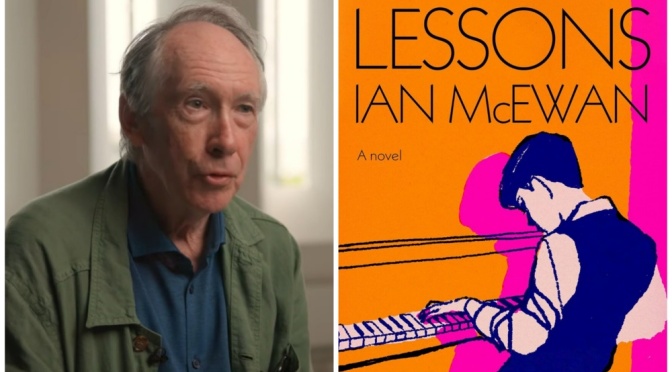
Louisiana Channel (December 8, 2023) – “If I didn’t write, I’d go nuts because I wouldn’t have a single reason to exist. The pleasure of bringing something together is so intense,” says British Ian McEwan, who would love to live forever and discover how we’re doing in 10,000 years.
Ian McEwan is considered one of the most important British novelists alive today. When he writes, characters and plot are difficult to separate because “often characters arise out of plots, often plots drive characters into existence”, he says. What is crucial to McEwan when writing is that “circumstances make the character and the characters generate possibilities. That sense of possibility is always so important. So characters can create their own waves.” The novel Lessons (2022) is McEwan’s most personal novel. It was written in lockdown when he was entering his 70s and beginning to take a look back at his existence. People who know him well can always connect what he is writing with things in his own life, he says.
In Lessons, McEwan wanted to create “the emotional truth of certain rather sad, tragic, disturbing things that happened in my family”, he says. “And the reflective element was also the movement towards trying to understand the circumstances, not only of my life but my generation’s life.” Ian McEwan enjoys reading biographies, but “if you want to know everything it’s possible to know about a great poet, you’ll need to read three or four biographies written over maybe a century or two centuries”, he says. He admits that fiction does not influence him like it did when he was younger.
“We have very little sense of how to generate on the page an open-ended character until the writing of Jane Austen” and he adds that it was the great Russian writers who taught us how to write characters as if they were real people. By the turn of the 19th to the 20th century, there was a great artistic revolution; McEwan points out and emphasizes that it was especially James Joyce who taught us “to understand characters from the flow of consciousness, right from the very inside”.
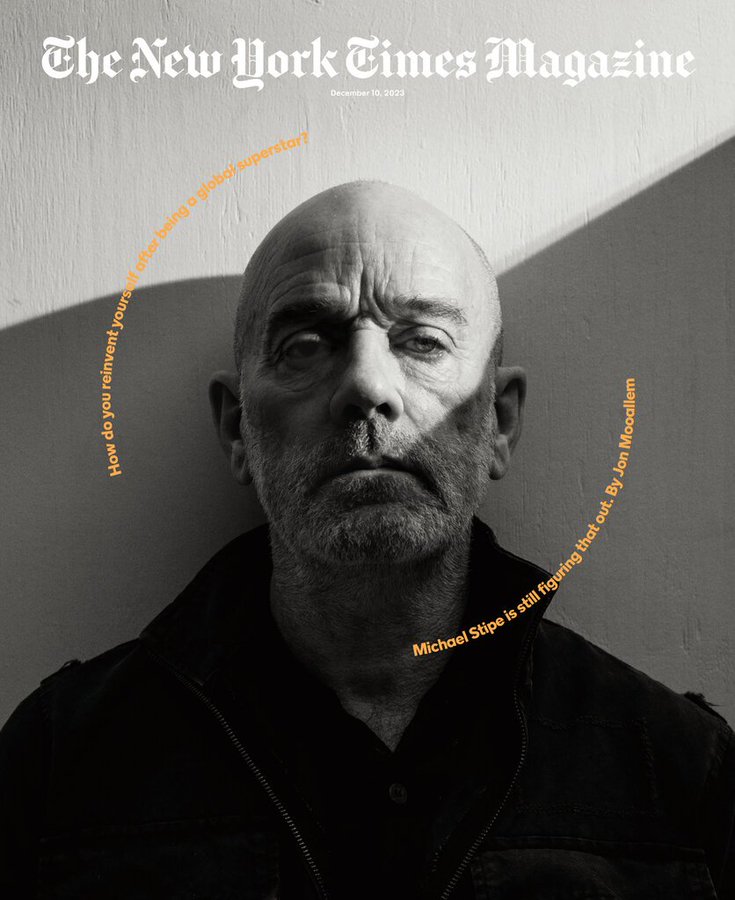
How do you reinvent yourself after being a global superstar? The former R.E.M. frontman is still figuring that out.
By Jon Mooallem
When Michael Stipe was little, his parents called him Mr. Mouse. He was a scurrier. As soon as he could stand, he ran, and when he ran, he ran until he face-planted. His mother would deposit him in a baby walker, but if Stipe scrambled as fast as he could and hit the threshold of a doorway with a running start, he could topple the walker and eject himself onto the floor. Then he’d spring to his feet and run away.
When detained by the U.S. Coast Guard at sea, even children fleeing violence have no right to asylum — and often face an uncertain fate.
By Seth Freed Wessler
Tcherry’s mother could see that her 10-year-old son was not being taken care of. When he appeared on their video calls, his clothes were dirty. She asked who in the house was washing his shirts, the white Nike T-shirt and the yellow one with a handprint that he wore in rotation. He said nobody was, but he had tried his best to wash them by hand in the tub. His hair, which was buzzed short when he lived with his grandmother in Haiti, had now grown long and matted. He had already been thin, but by January, after three months in the smuggler’s house, he was beginning to look gaunt. Tcherry told his mother that there was not enough food. He said he felt “empty inside.”
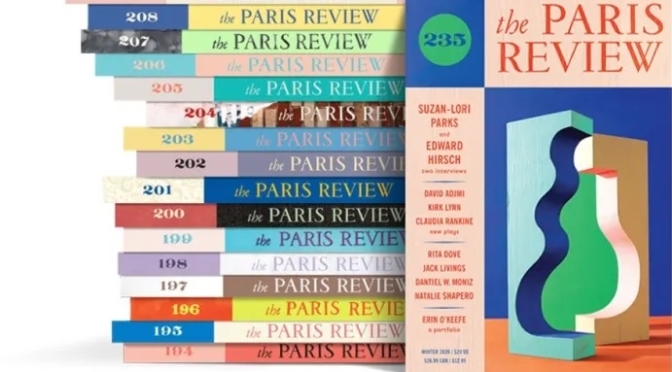
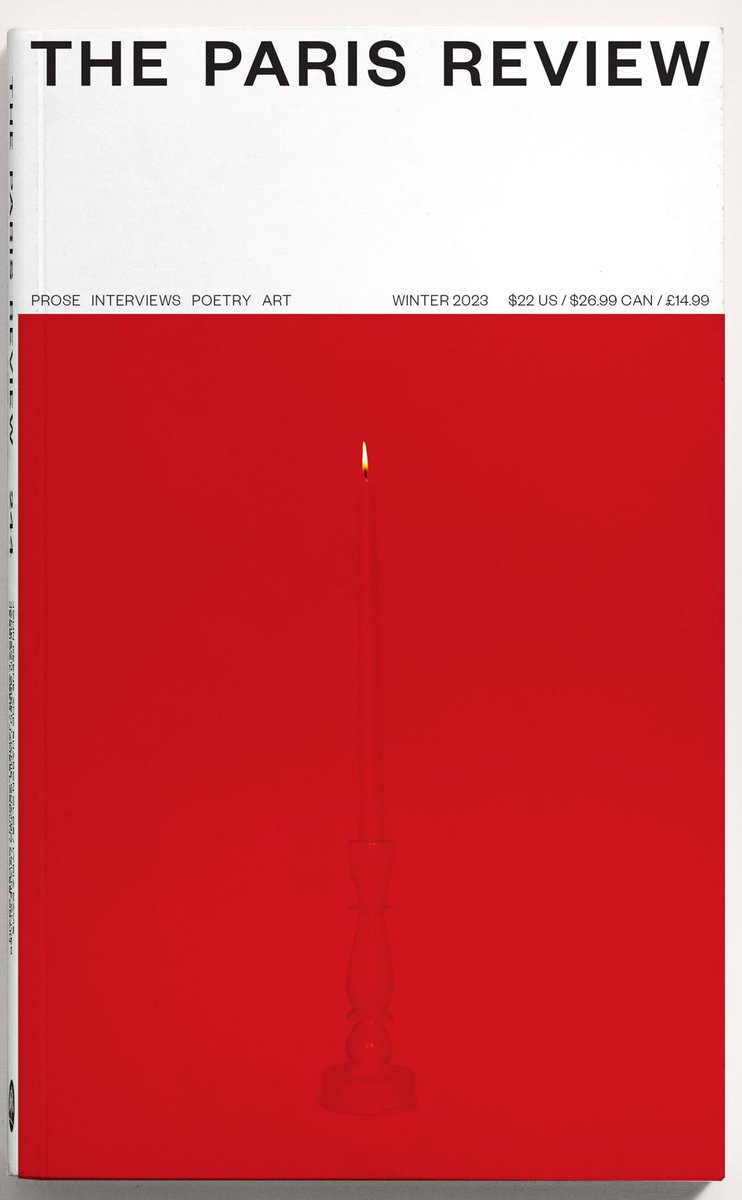
Paris Review Winter 2023 — The new issue features Louise Glück on the Art of Poetry – “You want a poem to register in every mind the way it did in yours. Then you discover this never happens.”; Yu Hua on the Art of Fiction: “If I’d taken another two or three years to start writing, I’d still be a dentist.”; Prose by Ananda Devi, Fiona McFarlane, and Sean Thor Conroe and more…
THE NEW YORK TIMES MAGAZINE (December 2, 2023): The latest issue features Sunday Night Lights – How America’s most spectacular TV show gets made; The Chicken Tycoons vs. the Antitrust Hawks – As part of a broader campaign against anticompetitive practices, the Biden administration has taken on the chicken industry…
Months of preparation, hundreds of staff, convoys of cutting-edge gear: inside the machine that crafts prime time’s most popular entertainment.
By Jody Rosen
Arrowhead Stadium, the home of the Kansas City Chiefs, the N.F.L.’s defending champions, is a very loud place. Players say that when the noise reaches top volume, they can feel vibrations in their bones. During a 2014 game, a sound meter captured a decibel reading equivalent to a jet’s taking off, earning a Guinness World Record for “Loudest crowd roar at a sports stadium.” Chiefs fans know how to weaponize noise, quieting to a churchlike hush when the team’s great quarterback, Patrick Mahomes, calls signals but then, when opponents have the ball, unleashing a howl that can even drown out the sound of the play call crackling through the speaker inside the rival quarterback’s helmet.
As part of a broader campaign against anticompetitive practices, the Biden administration has taken on the chicken industry. Why have the results been so paltry?
By H. Claire Brown
At Kentucky Fried Chicken, sales tend to peak at the same time every year: Mother’s Day. This has been the case since the 1960s, when the chain began to experiment with TV advertising. In a spot from that era, a man in an office answers a phone call from an anonymous male narrator who asks, “Sir, do you have any idea what your wife has to do to run your house?” Cut to a sped-up montage of an impeccably dressed 30-something as she dusts, irons, vacuums and balances the checkbook. Newly enlightened, the husband shows his appreciation by stopping at Kentucky Fried Chicken on his way home. Cut to a close-up of a happy wife biting into a drumstick. “Colonel Sanders fixes Sunday dinner seven days a week, and it’s finger-lickin’ good.”
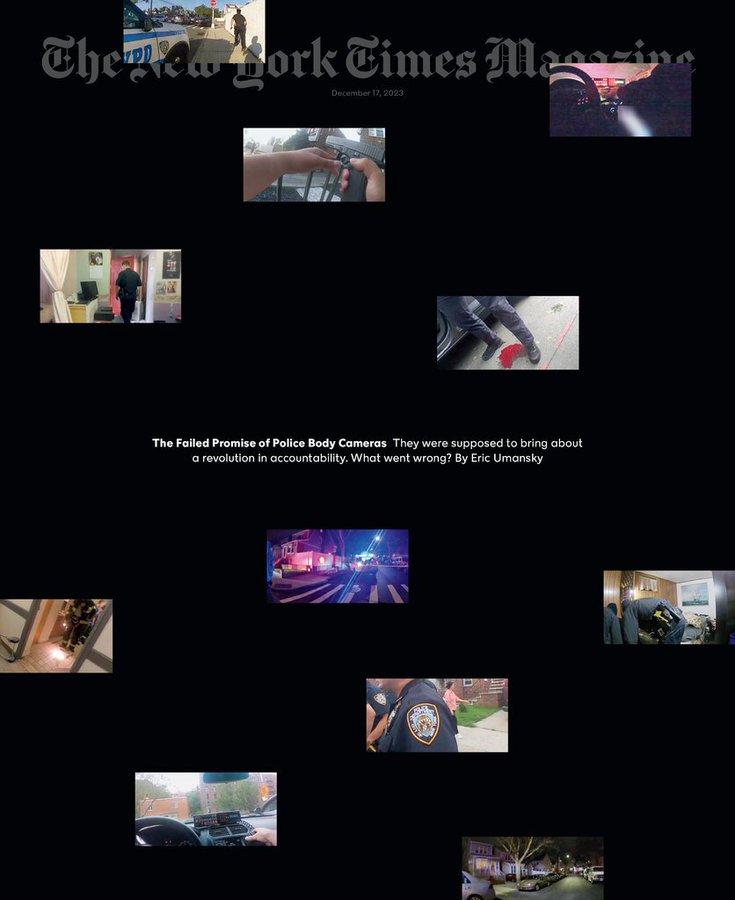
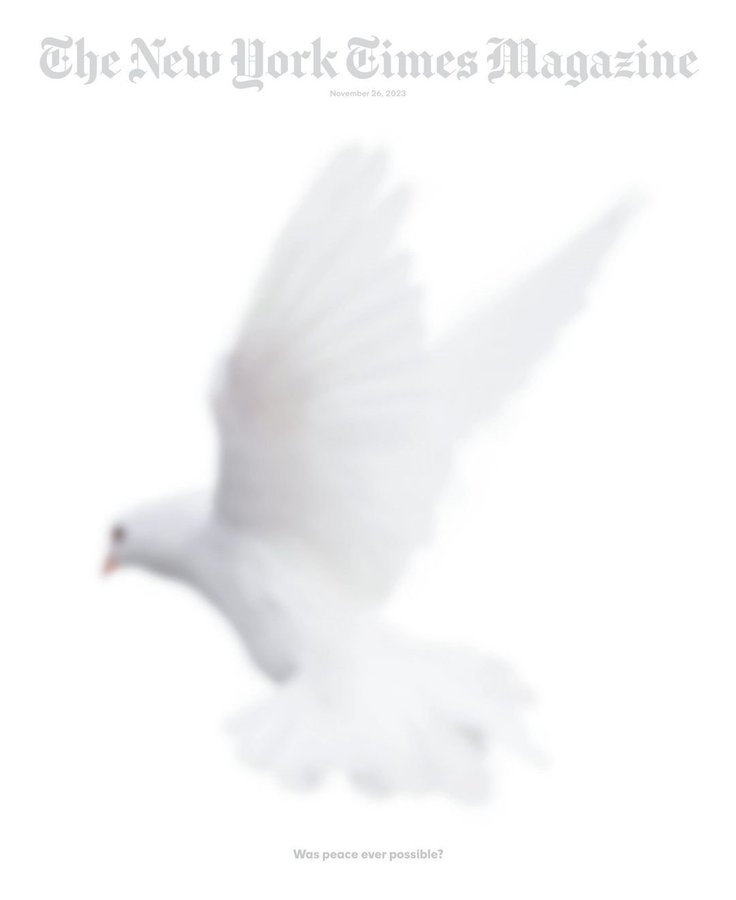
THE NEW YORK TIMES MAGAZINE (November 17, 2023): The latest issue features Was Peace Ever Possible in the Israel-Palestine Conflict?; Finding a Moral Center in This Era of War; The Beatles Are Still Charting the Future of Pop. It Looks Bleak – Their latest song points toward a future where no golden goose need ever stop laying, and more…
Thirty years ago, a negotiated settlement of the Israeli-Palestinian conflict seemed achievable. The story of how it fell apart reveals why the fight remains so intractable today.
Phil Klay, as both a participant and a writer, has been thinking deeply about war for a long time. In his two acclaimed works of fiction, the book of short stories “Redeployment,” which won a 2014 National Book Award, and the novel “Missionaries” (2020), and in the nonfiction collection “Uncertain Ground: Citizenship in an Age of Endless, Invisible War” (2022), Klay has interrogated, to profound effect and with a deeply humane and moral sensibility, what war does to our hearts and minds, individually and collectively, here and abroad. “I’m interested in the kinds of stories that we tell ourselves about war,” says Klay, who is a 40-year-old veteran of the Iraq war.
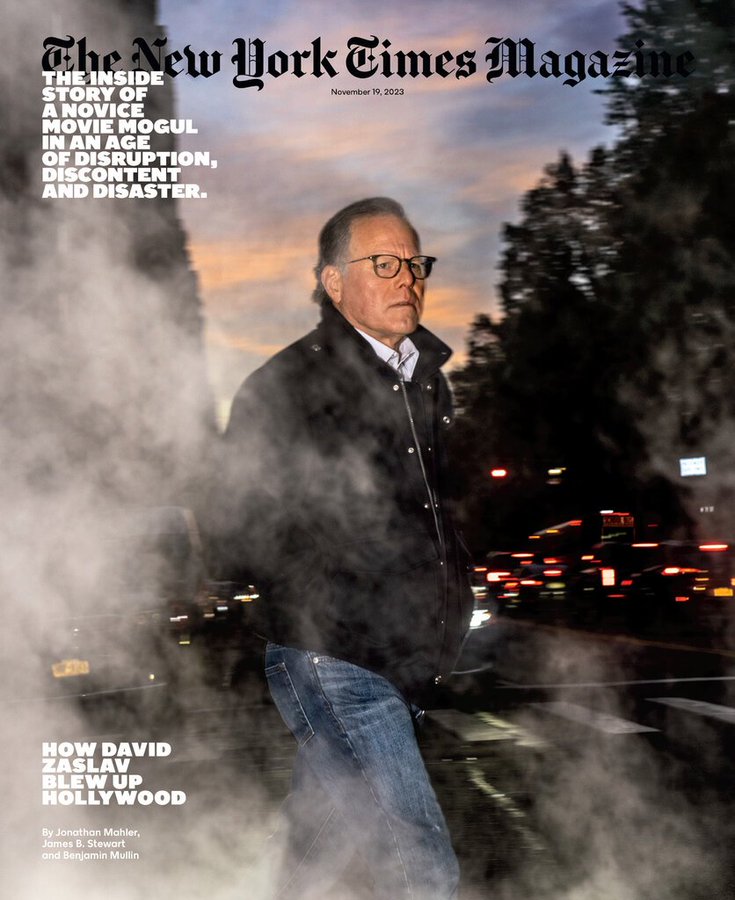
THE NEW YORK TIMES MAGAZINE (November 17, 2023): The latest issue featuresHow David Zaslav blew up Hollywood – The inside story of a novice movie mogul in an age of disruption, discontent and disaster ; Russell Brand’s Alternate Reality – The British entertainer built an army of fans with his conspiracy-minded podcast. Now, amid sex-assault claims against him, they’ve become his whole world; Sofia Coppola’s Subversive Search for Truth in ‘Priscilla’ – Hollywood is addicted to mythologizing biopics. ‘‘Priscilla’’ offers something different…
It was April 2022, and David Zaslav had just closed the deal of a lifetime. From the helm of his relatively small and unglamorous cable company, Discovery, he had taken control of a sprawling entertainment conglomerate that included perhaps the most storied movie studio on the planet, Warner Brothers. The longtime New Yorker had always loved movies, and against the advice of several media peers, he had moved to Hollywood and taken over Jack Warner’s historic office, hauling the old mogul’s desk out of storage and topping it off with an old-time handset telephone. So far things were going great. He had met all the stars and players, was widely feted as the next in line to save the eternally struggling industry and was well into the process of renovating a landmark house in Beverly Hills.
Hollywood is addicted to mythologizing biopics. ‘‘Priscilla’’ offers something different.
By Rafaela Bassili
As with much of her other work, the opening of Sofia Coppola’s latest film, “Priscilla,” is all about textures. A pair of manicured feet sink into a shag carpet; a fingernail is carefully polished in red; we see the back of a prodigious black bouffant, then the dexterous painting of a dramatic cat eye with black liner. Priscilla Presley (Cailee Spaeny) paces around Graceland relentlessly. There’s nothing for her to do, and too much for her to process.
Shakespeare, renowned biographer of Bruce Chatwin, reveals a story worthy of a Bond novel in his life of Ian Fleming. The painstakingly researched yet fast-paced book explores Fleming’s childhood, dramatic war years and complex personal life and reveals how they shaped his hugely successful books.
A follow-up to his 2015 biography of le Carré, who died in 2020, Sisman’s latest book exposes the great spy writer’s duplicitous and deceitful relationships with the women in his life, providing new insights into the secret life of the man behind George Smiley. A fascinating, revelatory appendix to Sisman’s fuller life.
Osip Mandelstam: A Biography
by Ralph Dutli, translated by Ben Fowkes (Verso)
This life of “legendary literary saint”, Osip Mandelstam, provides a timely reminder of both the long history of repression in Russia and the powerful role that literature can play when in the right hands. Dutli’s rounded portrait of the Russian poet unafraid to speak truth to power brings to life the man and his time.
Wifedom: Mrs Orwell’s Invisible Life
by Anna Funder (Viking/Knopf)
Funder, author of Stasiland, her prizewinning account of the East German secret police, takes six letters written by Eileen O’Shaughnessy, George Orwell’s first wife, as the imaginative springboard for a deep dive into their relationship and her impact on his writing and legacy. A haunting, tragic and revealing book.
The Dictionary People: The Unsung Heroes who Created the Oxford English Dictionary
by Sarah Ogilvie (Chatto & Windus)
A former editor of the Oxford English Dictionary herself, Ogilvie has written a “people’s history” of the great literary endeavour. Begun in 1879, the OED is an epic, crowdsourced attempt to pin down slippery, evolving language and this book tells the fascinating story of the eclectic and unsung contributors to this living monument to language.
A Day in the Life of Abed Salama
by Nathan Thrall (Allen Lane/Metropolitan Books)
This quietly heartbreaking work of non-fiction reads like a novel. At its centre is a tragic road accident outside Jerusalem in the West Bank from which Thrall, a Jewish American journalist, carefully traces the labyrinthine lives of those involved and the tangled web of politics, history and culture that ensnare them all.
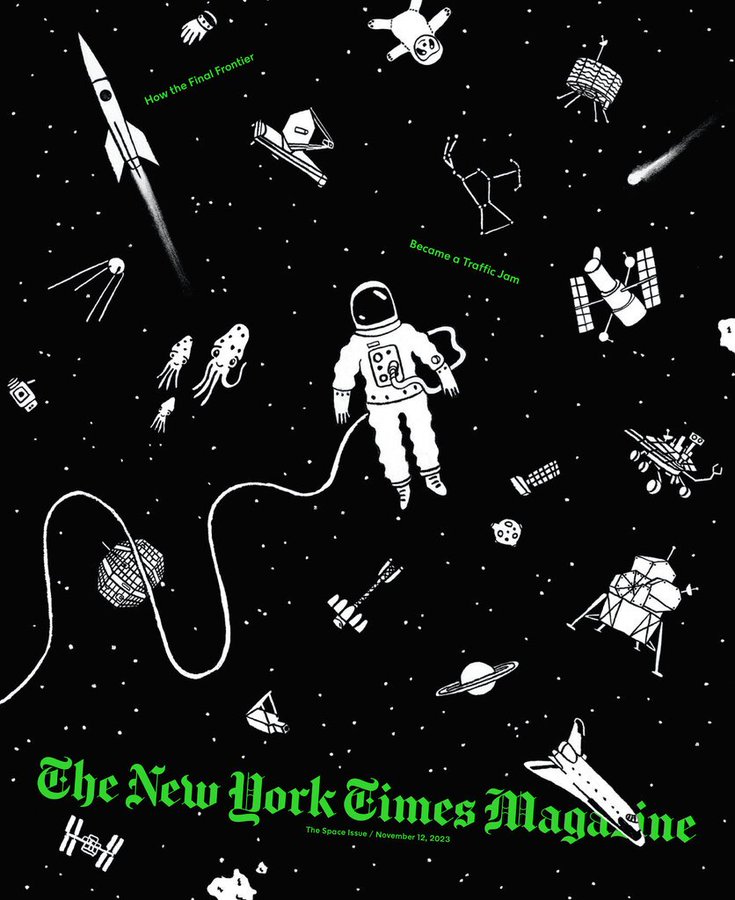
THE NEW YORK TIMES MAGAZINE (November 10, 2023): The latest issue features A Beginner’s Guide to Looking at the Universe; What Does the U.S. Space Force Actually Do? – Inside the highly secretive military branch responsible for protecting American interests in a vulnerable new domain; Their Final Wish? A Burial in Space. – Why some people decide to send their remains into orbit.
A stunning advancement in a long history of stargazing, the James Webb telescope reveals light where once we saw only darkness. Our view of the universe will never be the same.



















 Boomers Daily