This week The World Economic Forum are highlighting 4 top stories:
What is hyperinflation,
the impact of climate change on the Alps,
a record breaking super computer and
the world’s first autonomous ship.
The World Economic Forum is the International Organization for Public-Private Cooperation. The Forum engages the foremost political, business, cultural and other leaders of society to shape global, regional and industry agendas. We believe that progress happens by bringing together people from all walks of life who have the drive and the influence to make positive change.
This week: why is Tate rejecting an archive of material relating to Francis Bacon, 18 years after acquiring it?
Our London correspondent Martin Bailey tells us about his recent scoop that Tate is returning a thousand documents and sketches said to have come from the studio of Francis Bacon to Barry Joule, a close friend of the artist, who donated them to Tate in 2004. We then discuss the material with Martin Harrison, the pre-eminent Bacon scholar and editor of the catalogue raisonné of Francis Bacon’s work published in 2016, and to Sophie Pretorius, the archivist at the Estate of Francis Bacon, who went through the Barry Joule archive item by item. Victoria Munro, the director of the Alice Austen House Museum in New York, discusses this still too-little-known photographer, and her documentation of immigration to the United States and the lives of queer women in the 19th and early 20th centuries. And this episode’s Work of the Week is Weißes Bild (1994), a painting by the late Luxembourg-born artist Michel Majerus, now on view at Art Basel—Aimee Dawson, acting digital editor, is at the fair and talks to Giovanni Carmine, curator of the Unlimited section, in which the painting appears.
Sophie Pretorius’s essay Work on the Barry Joule Archive is in the book Francis Bacon: Shadows published by the Estate of Francis Bacon and Thames and Hudson.
For more on the Alice Austen House Museum, visit aliceausten.org. The podcast My Dear Alice is out in the autumn.
What’s on the agenda of this year’s “Russian Davos”? Plus: we speak with the head of the Latin America desk at Reporters Without Borders and give you the latest art and culture news.
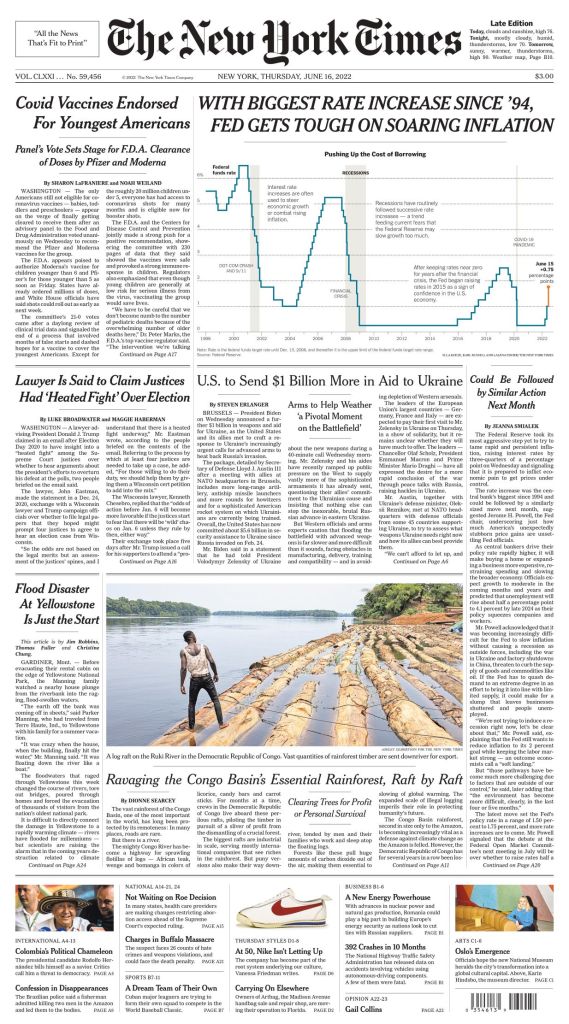
In its third public hearing to lay out its findings, the House committee investigating the Jan. 6 attack showed evidence that the president knew his order to the vice president was unlawful.
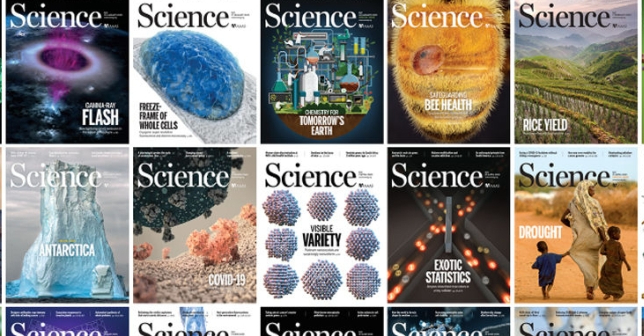
A previously unidentified population of polar bears documented on the southeast coast of Greenland uses glacier ice to survive despite limited access to sea ice.
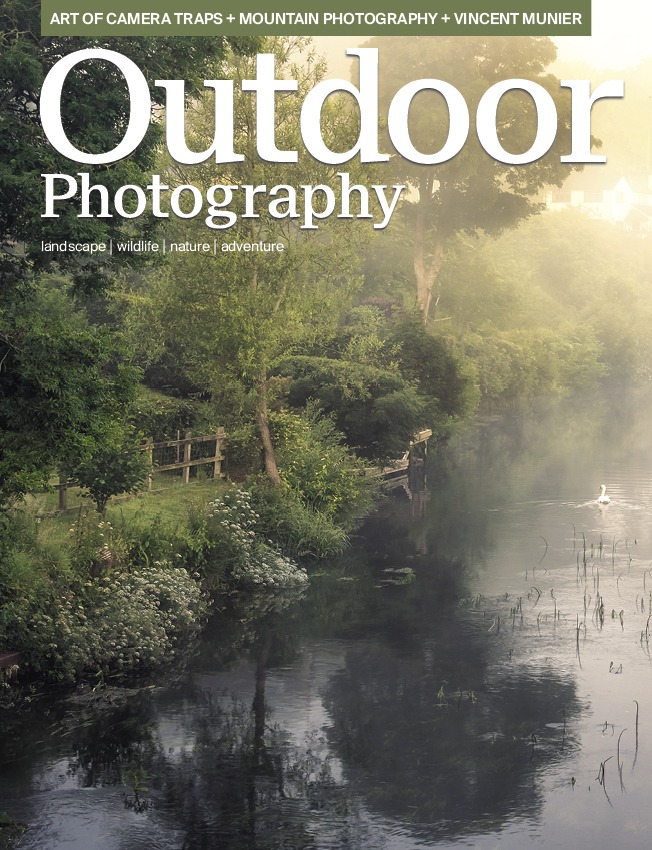
Chris Frost captures the magic of Dorset’s hidden woods Essential tips for successful mountain photography James Roddie introduces the art of camera trapping Vincent Munier discusses his stunning new nature film
A.M. Edition for June 16. The European Union signed a natural-gas deal with Israel and Egypt on Wednesday in a bid to wean itself off Russian supplies by tapping into the gas riches of the eastern Mediterranean.
WSJ correspondent Dov Lieber in Tel Aviv explains the significance of the deal for Israel and Egypt, even if the agreement doesn’t allow the EU to make up for losses of Russian gas. Luke Vargas hosts.
Central bankers raised interest rates by three-quarters of a percentage point, and signaled that they expect rates to be sharply higher by the end of the year.
Our new issue is now online, featuring David Trotter on Sylvia Townsend Warner, @debfriedell on Jane Roe, @kitchenbee on our palm oil dependency, Thomas Meaney on Lea Ypi, Jacqueline Rose and Sam Frears watching ‘EastEnders’ and a cover by Naomi Frears:https://t.co/xaTOjYd3Vrpic.twitter.com/Yb7PUJjfdx




 Boomers Daily