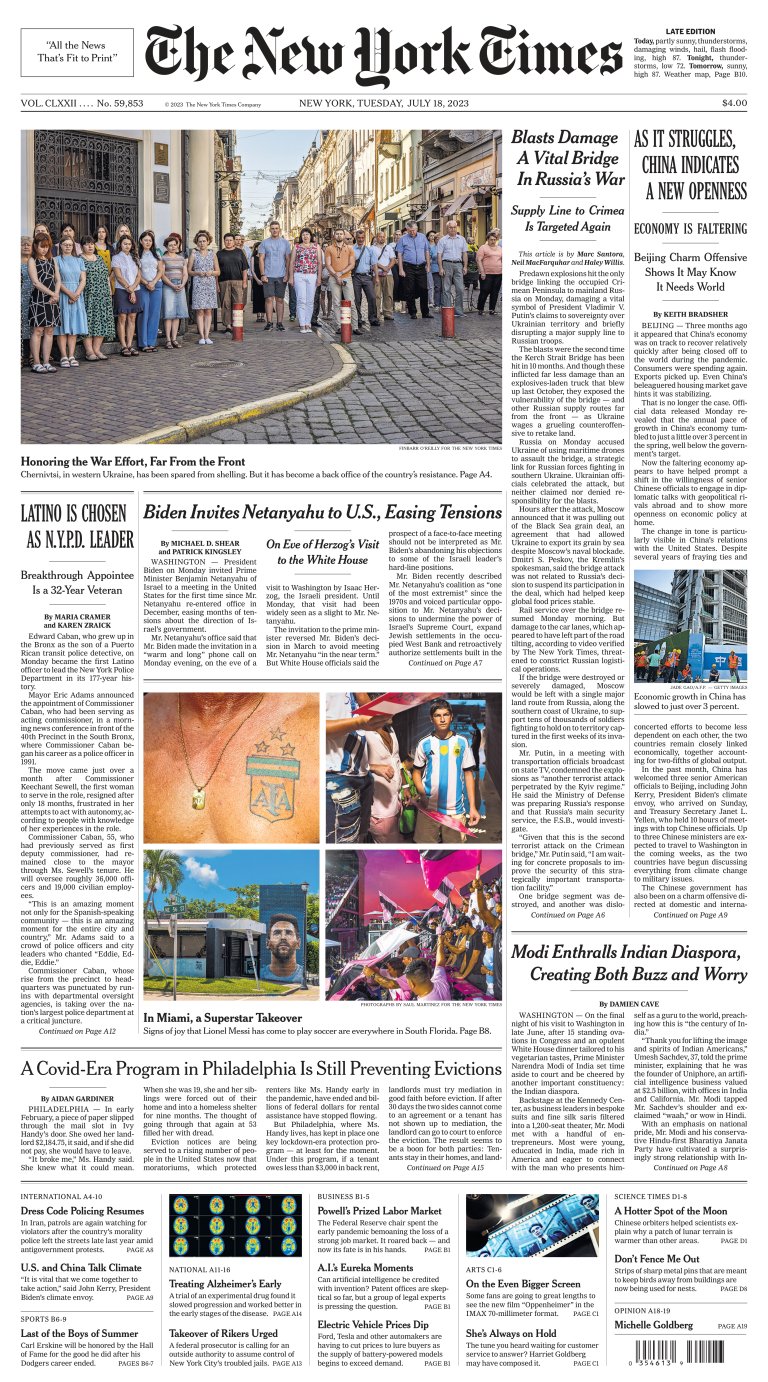
China was on track to recover after closing itself off during the pandemic. Now the country’s growth is staggering, and Beijing is signaling it is open to talking.
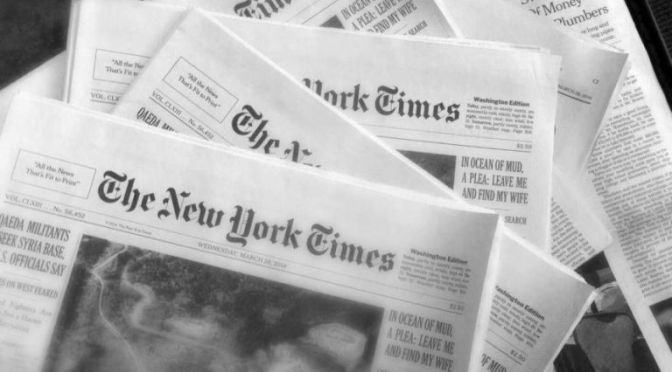
Russia accused Ukraine of hitting the Kerch Strait Bridge for the second time in 10 months, saying that two maritime drones had struck the bridge, an essential supply line for Russian troops.
‘Editor’s Picks’ Podcast (July 17, 2023) – Three essential articles read aloud from the latest issue of The Economist. This week: how populist Republicans plan to make Donald Trump’s second term count, NATO’s promises to Ukraine mark real progress, but there is still much more to do (10:12) and what matters about the human-dominated Anthropocene geological phase is not when it began, but how it might end (14:41).
Tennessee’s government has turned hard red, but a new set of outlaw songwriters is challenging Music City’s conservative ways—and ruling bro-country sound.
On March 20th, at Nashville’s Bridgestone Arena, a block from the honky-tonks of Lower Broadway, Hayley Williams, the lead singer of the pop-punk band Paramore, strummed a country-music rhythm on her guitar. A drag queen in a ketchup-red wig and gold lamé boots bounded onstage. The two began singing in harmony, rehearsing a twangy, raucous cover of Deana Carter’s playful 1995 feminist anthem “Did I Shave My Legs for This?”—a twist on a Nashville classic, remade for the moment.
The Governor’s strategy for revitalizing her state has two parts: to grow, Michigan needs young people; to draw young people, it needs to have the social policies they want.
The Globalist Podcast, Monday, July 17, 2023: Reports from Khartoum as violence in Sudan escalates.
Plus: Japanese prime minister Fumio Kishida tours the Middle East, the latest transport news and a new edition of ‘The Monocle Companion’, celebrating ideas for a better world.
CBS Sunday Morning (July 16, 2023) – Over the last five decades, artist Jaune Quick-to-See Smith has had nearly 100 shows, and in 2020 a painting of hers was the first by a Native American to join the collection of the National Gallery of Art in Washington, D.C.
Now the 83-year-old is the subject of a retrospective at the Whitney Museum of American Art in New York City – the museum’s first retrospective ever of an Indigenous artist. Correspondent Serena Altschul reports on a moment that’s been described as long overdue.
Yurara Sarara Films (July 16, 2023) – Wabi sabi can be defined as “beauty in imperfection” and can incorporate asymmetry, incompleteness, impermanence, and simplicity.
In addition to gardens, wabi sabi influences many other aspects of Japanese art and culture, such as the tea ceremony and pottery making, and it is also seen as a way of life.
A garden based around wabi sabi incorporates natural and manmade elements in a way that allows visitors to appreciate their humble and imperfect forms. This typically involves using not only plants but also stones and weathered manmade objects as design elements.
July 16, 2023– Monocle\’s editorial director, Tyler Brûlé, Alexandra Andrist and Chandra Kurt discuss the major topics of the weekend. Plus: we check in with our friends in London, Barcelona and Bangkok.
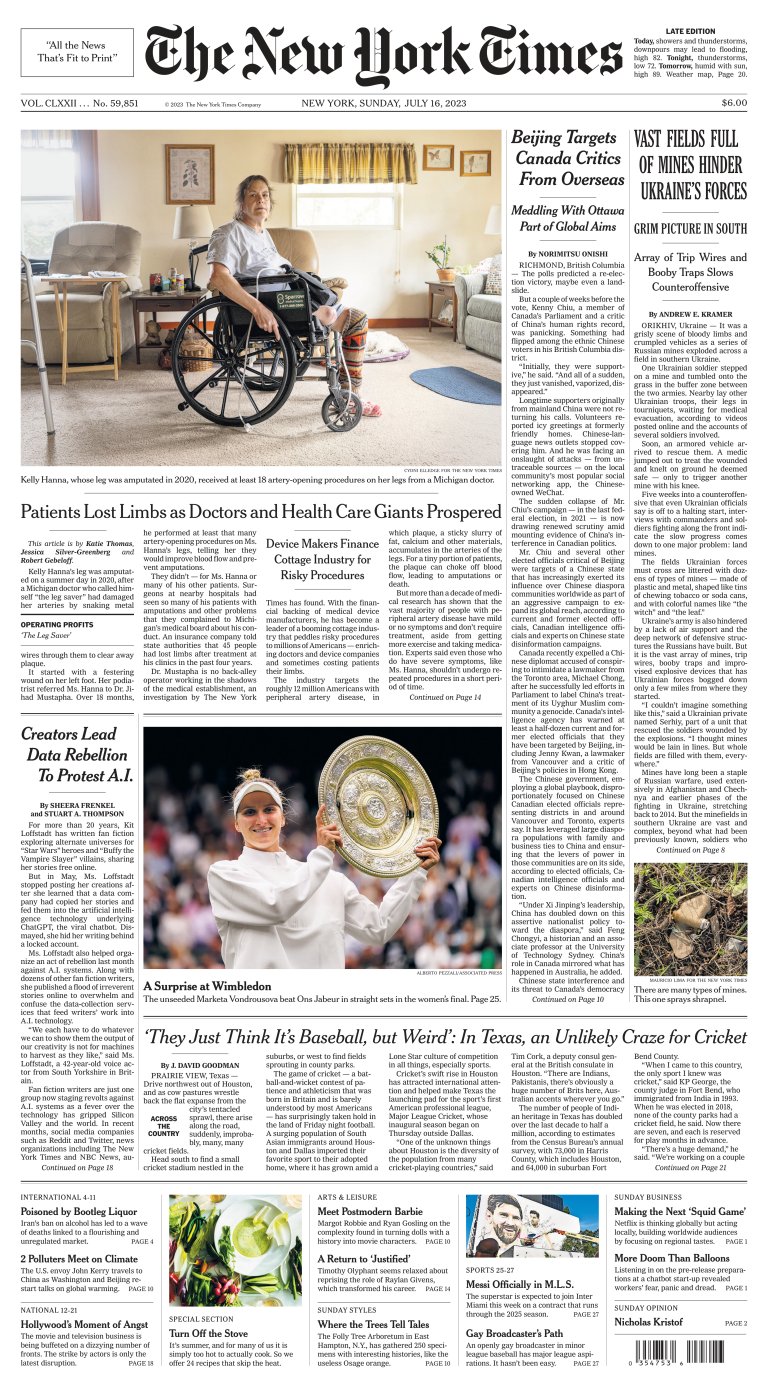
As China increases its reach in diaspora communities, Chinese Canadian politicians in Vancouver are the focus of Chinese state interference in Canadian politics.
They Lost Their Legs. Doctors and Health Care Giants Profited.
Medical device makers have bankrolled a cottage industry of doctors and clinics that perform artery-clearing procedures that can lead to amputations.
‘Not for Machines to Harvest’: Data Revolts Break Out Against A.I.
Fed up with A.I. companies consuming online content without consent, fan fiction writers, actors, social media companies and news organizations are among those rebelling.
World Economic Forum (July 15, 2023) – This week’s top stories of the week include:
0:15UK universities have a plan for AI – The guidelines aim to incorporate AI ethically into education and treat it as ‘an opportunity rather than a threat’. The UK’s 24 Russell Group universities are signing the principles.
2:07This trolley can spot if you’re at risk of stroke – It has electrocardiogram (ECG) sensors embedded in its handles which screen you for heart irregularities as you shop. Researchers at Liverpool John Moores University fitted the sensors into 10 trolleys and rolled them out at 4 supermarkets in Liverpool, UK. Shoppers were invited to hold the handlebar for at least 60 seconds. If the sensor didn’t detect an irregular heartbeat, it lit up green. Over 2 months, the trolleys screened 2,155 people. They detected atrial fibrillation in 39 people who were swiftly able to book a cardiologist appointment.
3:50Paris generates clean energy from Métro passagers – Energy firm IBERDROLA converted 6 turnstiles into mini-turbines at Miromesnil Métro station for 2 days last year. As each passenger passed through the turnstiles the turbines converted their movement into green energy. 27,000 passengers used the turnstiles. Each passenger generated 0.2 watts of energy. If scaled across the entire Métro system, which serves 1.5 billion passengers annually this technology could generate 136MW per year.
5:09These sensors can spot stressed tomatoes – Their inventors say they can make agriculture more sustainable while increasing crop yields at the same time.
_____________________________________________
The World Economic Forum is the International Organization for Public-Private Cooperation. The Forum engages the foremost political, business, cultural and other leaders of society to shape global, regional and industry agendas. We believe that progress happens by bringing together people from all walks of life who have the drive and the influence to make positive change.
News, Views and Reviews For The Intellectually Curious

















 Yurara Sarara




 Boomers Daily