
2021 was a year like no other—but 2022 will likely be entirely different. In this issue: pic.twitter.com/rJfM9a7ozf
— Barron's (@barronsonline) December 18, 2021
Tag Archives: Investing

Investing: The Risks Of Buying Chinese Stocks
Chinese tech stocks popular among U.S. investors have tumbled amid the country’s regulatory crackdown on technology firms. WSJ explains some of the new risks investors face when buying shares of companies like Didi or Tencent. Photo Composite: Michelle Inez Simon

Stock Trading: The Rise Of Robinhood (WSJ Video)
The twists and turns of the online brokerage’s path to a public offering The brokerage app Robinhood has transformed retail trading. WSJ explains its rise amidst a series of legal investigations and regulatory challenges as it looks forward to its IPO. Photo illustration: Jacob Reynolds/WSJ

Cryptocurrencies: ‘What Coinbase’s Listing Means’
The listing of Coinbase, the largest bitcoin exchange in the U.S., introduces a new way to invest in cryptocurrencies. WSJ explains how Coinbase is trying to distance itself from the risks of bitcoin to succeed on Wall Street. Photo illustration: George Downs
Analysis: The Rise Of ‘Robo-Advisors’ To Manage Personal Investments
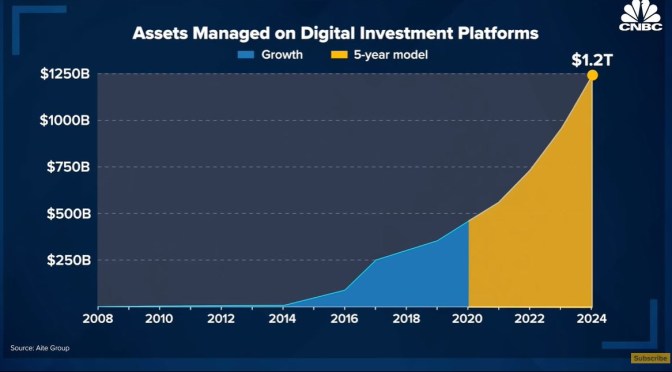
Robo-advisors have had a meteoric rise in popularity since their debut in 2008 thanks to the support from millennials and Gen Z. Today, Robo-advisors manage $460 billion, with some analysts predicting it will become a $1.2 trillion industry by 2024. Watch the video to find out why some investors believe it will never replace traditional human financial.
Since their debut in 2008, robo-advisors have had a meteoric rise in popularity. In 2020, they managed $460 billion, a 30% increase compared with 2019. Some analysts predict robo-advising will become a $1.2 trillion industry by 2024. “Investors historically have had two options when it comes to managing their investments. They could do it themselves through something like an online broker or you can work with a financial advisor,” explained Brian Concannon, head of Digital Advisor at Vanguard.
“Now, with the advent of robo-advisors, there’s a third option, and that’s to merge the benefits of professional money management and advice with the convenience of an all-digital application.” Robo-advisors’ sudden rise to prominence was made possible due to massive interest and support from millennials and Gen Z. According to a recent survey by Vanguard, millennials were twice as likely as young baby boomers to consider using a robo-advisor for investments.
“I believe that there are things that technology or algorithms can do better than humans can,” said Taylor Crane, a robo-advisor customer. “And I have no problem trusting a software to do that.” Skeptics do not expect robo-advisors to replace human advisors entirely in the near future. “Clearly, there’s always going to be a human element that’s missing,” said Jason Snipe, chief investment officer at Odyssey Capital Advisors. “My problem always will be the emotional response. Take a situation like last year when we’re going through Covid-19 and markets are moving a lot, dramatically. …
You can’t talk to the technology, right?” To combat this, many robo-advisor companies including Betterment and Vanguard began providing the option of hybrid services that combine both human and digital advice. “[Some] investors we see crave validation from a financial advisor,” said Concannon. “So for those investors, being able to pick up the phone and have a video conference with a financial advisor, have a discussion about their needs and wants goes an incredibly long way to providing them the peace of mind that they so desperately need.”
Time is on the side of the robo-advisory industry as the technology continues to improve and the younger generations accrue more wealth. “I think some combination of the two probably is where we are headed for in the future,” said Snipe. “I think the robo space has room to grow. I think it will obviously modify and change and become even more sophisticated.”

Retirement: ‘How 401(K) Plans Work’ (Video)
Since 1980, pensions plans have been phased out in favor of 401(k) plans. They now represent nearly one-fifth of the U.S. retirement market. So how did 401(k) plans become such a popular form of retirement savings and how should they be used? Watch the video to find out.

Stock Market: ‘GameStop & Payment For Order Flow’
Following the GameStop trading frenzy, the SEC is expected to take a fresh look at payment for order flow, a decades-old practice that’s at the heart of how commission-free trading works. WSJ explains what it is, and why critics say it’s bad for investors. Illustration: Jacob Reynolds/WSJ

Investments: Why ‘Bitcoin’ Is Soaring In Value (Video)
The price of bitcoin is skyrocketing, driving a rally of momentum trading that’s pushed its value higher than it’s ever been before. WSJ explains how bitcoin trading works, and why the volatile digital currency is reaching all-time highs. Illustration: Jacob Reynolds/WSJ

Investing: “The Volatility In The Gold Market Explained” (WSJ Video)
The price of gold is going haywire, driving a frenzy of investment that’s calling into question the metal’s reputation as a safe-haven during times of economic uncertainty.
WSJ Explains. Illustration: Liz Ornitz/WSJ

Business: “How Tesla Became Most Valuable Auto Company” (WSJ Video)
Tesla’s stock has more than tripled since the start of the year, giving it a market capitalization larger than many behemoths of American industry. But its rise wasn’t necessarily driven by fundamentals. WSJ explains.
Illustration: Jacob Reynolds/WSJ
 Boomers Daily