Tag Archives: Homes

Home Design: ‘Land On Water’ – MAST Studio (2022)

Land on Water by Copenhagen-based Architecture Studio MAST 

Land on Water

The system is based on simple flat pack modules made from recycled reinforced polymer. These are extremely strong and resilient and can be easily transported and assembled on location

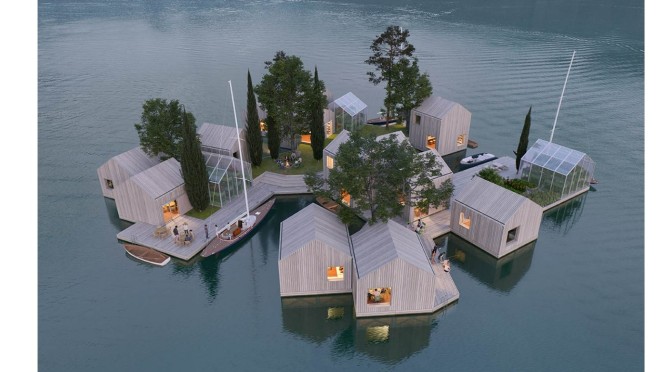
The modules can be assembled in different configurations to provide floating foundations for floating infrastructure, public spaces or housing.

A growing acknowledgement of sea level rise and an increased risk of urban flooding has contributed to a sharp increase in interest in building on water, but current solutions, including polystyrene filled concrete foundations and plastic pontoons are inflexible, difficult to transport and highly unsustainable. 

MAST has envisioned a new system of simple of flat-packed modules made from recycled reinforced plastic, that can be easily transported around the globe and assembled into countless configurations, providing a secure floating foundation. The system offers a sustainable and highly flexible solution for building almost anything on the water; from floating houses in Seattle, to floating campsites on Oslo fjord, to saunas on Hobart’s riverfront.

The system was inspired by gabion construction, an ancient technology which utilises mesh cages filled with rubble to create extremely sturdy, low cost foundations. In this case the concept is inverted; and the modular ‘cages’ are filled with locally sourced, up-cycled floatation supporting the weight of any structure built on top. they are also much more adaptable than existing solutions since floatation can be added or adjusted at any time if weight is added or shifted around above.

Land on water will provide a climate resilient and adaptable solution for the construction of new floating buildings worldwide but could also lead to an entirely new type of dynamic and organic off-grid floating community and an alternative to the large master-planned floating cities currently under development which repeat many of the mistakes made by urban planners in the middle of the 20th century.
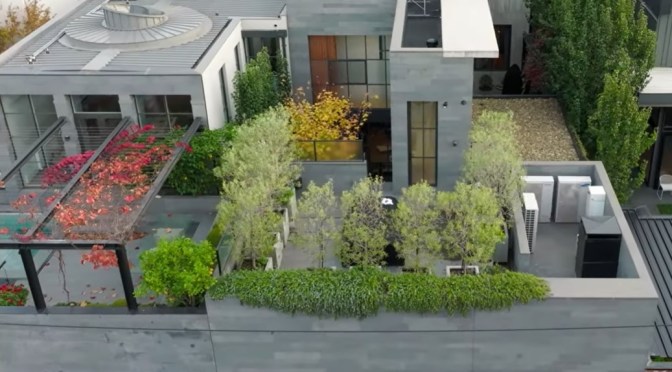
Design: St. Vincent Place In Albert Park, Australia

The Local Project – Following three years of curation, St Vincent’s Place emerges as an award winning home, peppered with art and designed to promote conversation. Crafted by B.E Architecture, the restoration project employs expressive pieces with consistency, enabling the building to be navigated with ease.

Video timeline: 00:00 – Introduction to the Award Winning Home 00:21 – A Restoration Project 3 Years in The Making 00:58 – Building Aspects From the Ground Up 01:31 – Compatibility Within the Home 01:46 – A Walkthrough of the Historic Section of the Home 02:03 – The Modern Section of the Home 02:18 – Reinterpretations of the Historic Aspects 02:46 – Encouraging Conversation Through Building and Design 03:36 – A Range of Surprising Features 04:45 – Peaceful Curation and Arrangement 05:09 – A Journey With the Client

Originally owned by a convent, St Vincent’s Place is comprised of three buildings set side-by-side, situated in the Melbourne precinct of Albert Park. The heritage façade – the only historical element that could be retained in the award winning home – represents a significant contribution to the architecture of the area, presenting a combination of stone and delicate black metalwork. Traversing two design styles in a singular project, B.E Architecture dedicates the front of the home to heritage recreation whilst providing a modern extension.

The front of the award winning home captures a formal entrance and living room and upstairs, a master bedroom and dressing room. A studious approach to restorative design is reflected in the treatment of cornices, skirtings and architraves, as well as doorjambs, doors and flooring. In contrast, the back of the building captures a contemporary interior design including a downstairs pool, onsen and steam room, elevated with tiling and considered lighting.

Several features of St Vincent’s Place indicate the designer’s penchant for aesthetic flair. Inspired by pioneering artist Sigmar Polke, sliced agate doors filter natural light with an array of neutral tones. In addition, a large text piece reading ‘Heaven is a Place Where Nothing Ever Happens’ sparks curiosity from its reference, size and impressive incorporation into the award winning home.

“You do feel the magic of how these elements come together here,” says Broderick Ely, Design Director at B.E Architecture. “We curate, we arrange and manipulate these items so it sits very quietly.” Using the even application of decorative elements, B.E Architecture establishes a coherent and award winning home. St Vincent’s Place is structured to gently guide occupants towards its many hidden gems, enabling the mind to wander in unison with the body.

Preview: Country Life Magazine – Oct 19, 2022

Country Life 19 October 2022 looks at springer spaniels, Manet, the nature writing of ‘BB’ and meets bladesmith Owen Bush.

Masterpiece

Jack Watkins admires Stubbs’s racehorse portrait Gimcrack

With a spring in his step

The Welsh springer is a brainy, loyal dual-purpose spaniel, observes Katy Birchall

Dreams are made of these

Ten field sportsmen and women reveal their perfect days with rod or hawk to Octavia Pollock

Blades of class

Claire Jackson meets imposing bladesmith Owen Bush and dares to swing one of his sharp and gleaming swords

When the heat is on

John Hoyland canvasses gardeners and designers about the plants that best survived the drought

The man that shocked France

Artistic recognition came too late in life for Édouard Manet, regrets Michael Prodger

Tours: Fisherman’s House, Parramatta River, Sydney

Sitting on the edge of Parramatta River, Fisherman’s House is a unique underground home with a sense of the unexpected. Without revealing all at once, the waterfront house is a unique underground home by Studio Prineas that instils moments of awe within every level.

Video Timeline: 00:00 – Introduction to the Underground Home 00:30 – The Waterfront Location of the Home 00:45 – The Original Timber Cottage 01:04 – A Minimalistic View On Arrival 01:35 – A Longstanding Friendship Between Architect and Client 02:05 – Working with an Open Design Brief for the Home 02:33 – The Original Steel Cladding 02:46 – Restoring and Reusing Original Materials from the House 03:28 – Careful Contrast of the New Wing to The Cottage 04:08 – Taking Pride in Preservation and Creation 04:30 – The Swimming Pool

Fisherman’s House is one of the last remaining timber cottages in the area that sits nine metres below the road, hidden from the public eye and offering a serene escape from the city. The client – an engineer and family friend of the architects – delivered an open design brief and sense of freedom for Studio Prineas to organically explore what the unique underground home could become.

The main desire for the client was to have the living spaces facing the water; while there was no desire to keep the original cottage, this was something that Studio Prineas knew they needed to maintain. Throughout the restoration process, removing previous cladding revealed the original weather boards underneath; inside the home, the original timber flooring and lining boards were saved to bring back the lightness of the architecture. With waterfront views from the kitchen, living and dining spaces and entertainment deck, the interior design of the original cottage defers from the new wing.

Additionally, the glazed link is a vertical connection from the original cottage to the private living spaces above. From the lightness of the timber cottage below, the upper levels speak to the rockface behind whilst offering a more grounded appearance with darker timbers. Employing concrete ceilings with rough sawn Oregon formworks that brought a timber look and imprint on the concrete, Studio Prineas established a differentiating space that still feels connected through minute details.

Conserving the history of the cottage whilst creating a contemporary unique underground home for the clients, Studio Prineas were able to embody many design ideas that they have been establishing over many years. As one of the more memorable aspects, the pool acts as one of the last additions of the unique underground home. Unexpected and holding much of the original cottage’s history, the pool offers an enchanting place to sit and watch as the sun sets over the home.

Design: Bunker House In Gerringong, Australia

Representing a built legacy, Bunker House pays homage to the 18 years that Neil Hipwell – Director of Futureflip – has spent in the construction industry. Crafted by Futureflip itself, the oceanfront super house is a proud expression of design capability, created to last over 100 years.

Video timeline: 00:00 – Introduction to Bunker House 00:29 – Introduction To The Owners & Designers 00:40 – The Location of Bunker House 01:09 – Futureflips Concrete Obsession 01:27 – Bringing In The Natural Light 02:00 – Built to Stand for 100 Years 02:20 – A Partially Underground Home 02:46 – Softening The House Through Landscaping 03:12 – The Furniture Selection Process 03:34 – A House Built for Hosting 03:57 – Focusing On The Outdoor Space 04:27 – Building A Legacy

Located in the Syndey surf town of Gerringong, Bunker House celebrates a concrete materiality, the signature base of a Futureflip project. Textural additions of creeping rosemary and Casuarina glauca visually soften the façade of the oceanfront super house whilst adjacent dragon trees, pandanus trees and cacti connect the garden landscape with its masculine character.

With much of its bulk tucked into its site, Bunker House champions the values of endurance and sustainability. Underground, the thermal climate of the oceanfront super house is controlled by the earth temperature, rendering artificial heating and cooling unnecessary. In the outdoor space, durable King furniture is employed to provide comfort whilst withstanding the harsh waterfront conditions.

The interior design of Bunker House presents a welcoming iteration of the raw aesthetic. King furniture pieces complement the built foundation of the oceanfront super house with neutral tones and pleasant tactility. Recycled messmate custom joinery – applied to the kitchens and bedrooms – balances the exposed concrete envelope with a sense of warmth.

Justifying the Futureflip devotion to concrete, Bunker House embodies a sense of timelessness, combining sustainability with compelling architecture. Clearly legible as a work of mindful craft, the oceanfront super house inspires onlookers to reimagine the application of raw materials.

Preview: Country Life Magazine – Oct 12, 2022

Country Life – 12 October 2022

Country Life Magazine 12 October 2022 is an interiors special, but also looks at ancient barrows, Roald Dahl and much more.

Masterpiece

Jack Watkins on Ronald Blythe’s seminal Akenfield

Roald’s medicine

Rural life was a joy to the author, says Matthew Dennison

In praise of decency

Thoughtfulness abounds in the countryside, writes Margaret Casely-Hayford

Splendid isolation

Legendary interior designer Veere Grenney talks to Giles Kime about spending lockdown in a Palladian folly

Australia Interior Design: Wimbledon House Tour

Channelling the sense of warmth that has long-defined the family concept, Wimbledon House befits its purpose as a modern family home. Crafted by Taylor Pressly Architects in collaboration with the clients, Dave and Katie Penfold of Penfold Property Group, the functional home provides a timeless environment for communal living.

Video timeline: 00:00 – Introduction to the Modern Family Home 00:24 – The Site of the Home 00:47 – A Two Level Space 01:27 – The Featuring of a Curved Staircase 01:48 – Bringing Warmth to The Home Through Materials 02:25 – Transparency Through The View Lines 02:50 – Creating a Central Heart to The Home 03:04 – The Key Feature Areas: Kitchen and Staircase 03:25 – Creating the Staircase 04:32 – Building a Functional Family Home

Situated at the junction between Elwood, St Kilda, Balaclava and Elsternwick, Wimbledon House reflects thorough consideration of local design heritage. Recycled red brickwork references the previous iteration of the house as well as the influential art deco movement, wrapping the lower half of the exterior and tracking its fluid curves with a stack bond format.

Occupying a central position in the spatial plan is a landscaped courtyard which opens onto a staircase, executed by S&A Stairs. The spiral staircase connects the levels of the modern family home with a smooth three-dimensional curve, painted white. The handrail, neatly attached to the primary architecture of the modern family home, represents a particular achievement of S&A Stairs. While the company of the past would have taken days or weeks to build the rail, the modern-day S&A Stairs draws upon its 102 years of experience in order to complete the work within hours, using 5-Axis CNC technology.

By accommodating a family with ease, Wimbledon House succeeds in what is considered its core function. Offering a modern family home, Taylor Pressly Architects associates the communal domestic experience with elevated living, during which occupants can enjoy pieces of luxury craftmanship.

Australian Home Design: Mosman House In Sydney

On a steep slope in Mosman, on Sydney’s Lower North Shore, TKD Architects were asked not just to design a six-bedroom family home that took advantage of the views, but also to take charge of the interior architecture and styling – from the furniture and flooring right down to the artwork, bedding and even the cutlery. All their Shanghai-based clients needed to do was unlock the door and walk into their completely finished home.

Read more

Tours: Pepper Tree House In Unanderra, Australia

Creating a sustainable extension for the family home of client and builder Souter Built, Alexander Symes Architects motivates sustainable living through every detail. Featured as part of The Sustainability Series, Pepper Tree Passive House is a personal project crafted between cousins and sees the extension explore a passion for passive house and sustainable living.

Video timeline: 00:00 – Introduction 00:41 – Unanderra Country 01:12 – The Builder and The Owner 01:42 – Building Around The Pepper Tree 02:17 – A Walkthrough Pepper Tree Passive House 02:56 – A Two Fold Concept and Brief 03:22 – Exploring The Concept of A Passive House 03:43 – Using Resources In Respectful Ways 04:00 – Wood Is Good 04:31 -Using Minimal Intervention on The Existing Home 04:59 – The Challenges Faced 05:20 – The Positives of Being The Building & The Client 06:00 – Moments To Celebrate

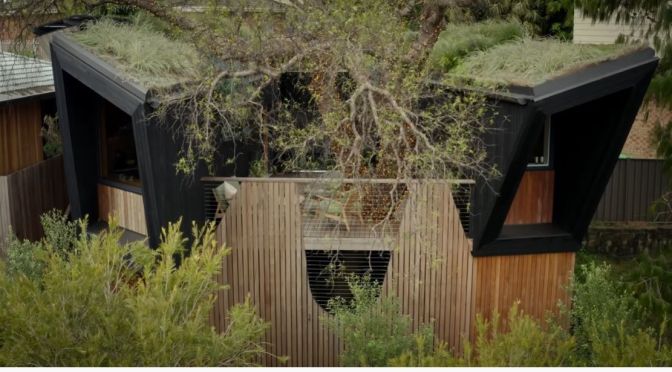
Following a twofold brief, Alexander Symes Architect created an office space, guest house and entertainment area with recycled and renewable materials that echo the ethos of likeminded sustainable buildings. Extending the family home over a slopping landscape and around a tree protection zone, both architect and builder worked cohesively with each other to reflect the positive aspects of sustainable design. What transpired from this effort was an office space, living area, kitchen and guest living space that wrap around the home’s namesake, the pepper tree.

Covered by the canopy of the pepper tree, the garden was transformed, seeing hand-poured pavers lead guests up towards the passive house. Evidence of the passive house concept is also seen at the home’s entrance; wood and convict bricks are used similarly throughout the interior design, seeing sustainable living enhanced through natural thermal heating and cooling. Due to its north-facing position, the convict bricks add a thermal structure throughout, soaking up the natural heat of the sun, whilst the shade of the canopy does the same in the warmer months.

From planning to building to completion, Pepper Tree Passive House passionately showcases the skillset required for sustainable living, alongside Souter Built’s philosophy for sustainable building. Through the architecture and design choices, guests and clients alike can see firsthand how using recycled materials, instead of depleting natural resources, can leave a better footprint for the future of sustainable buildings.

Tour: Scarborough Béton Brut, Christchurch, New Zealand Concrete Design

October Project of the Month | Scarborough Béton Brut | Young Architects.

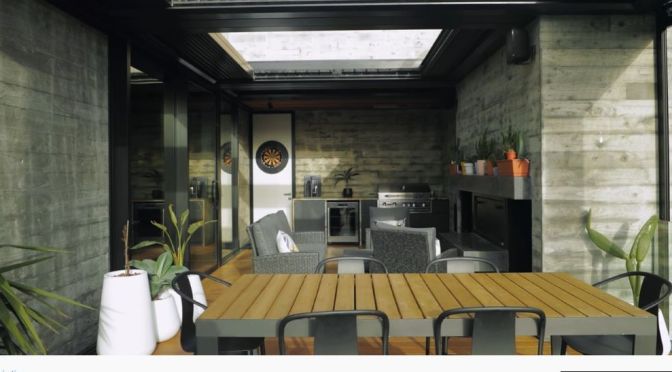
Raw concrete, extensive glazing, and timber accents dominate the design of this home nestled in the hills above Christchurch’s seaside suburb of Sumner. Perched on the edge of a dormant volcano on a 30 degree slope, the form hasn’t been compromised. The structure emerges from the landscape in cubed sections.

To view the full project, click here: https://archipro.co.nz/project/scarbo…