
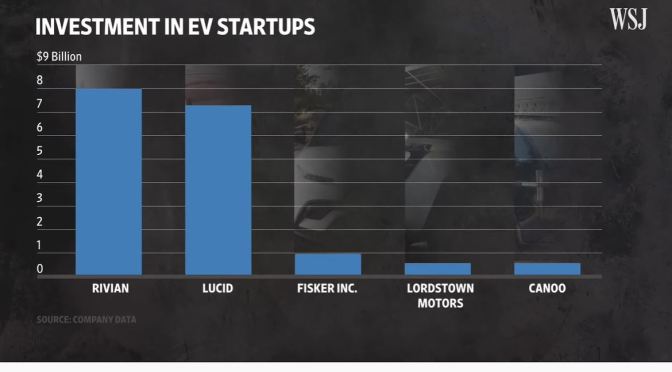
Lucid, Fisker, Rivian and Canoo are among the well-funded startups racing to release new electric vehicles. WSJ asked CEOs and industry insiders how new auto companies plan to challenge Tesla’s market dominance and take on legacy car makers. Photo composite: George Downs
Tag Archives: Electric Vehicles
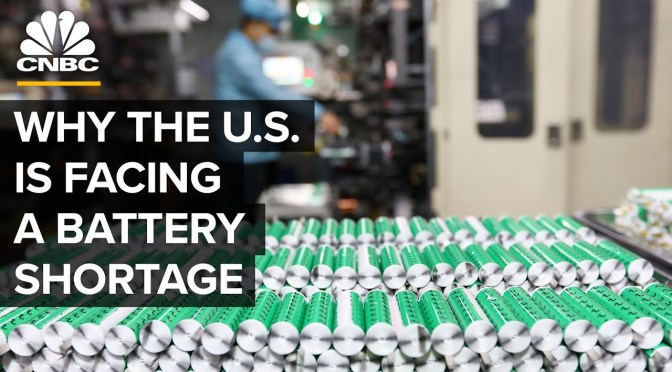
Analysis: The Electric Vehicle Battery Shortage
U.S. automakers are finally making bold commitments to electrify their fleets, but in the short-term, there may not be enough lithium-ion batteries to go around. While China dominates the battery manufacturing supply chain, and Europe is working to catch up, the U.S. still lags far behind.
As batteries become a matter of energy independence and national security, here’s what the U.S. can do to catch up. As automakers continue to grapple with a semiconductor shortage, some experts say the next supply chain crisis for the U.S. could involve lithium-ion batteries. As companies like GM, Ford and a slew of start-ups are ramping up their electric vehicle ambitions, current battery production in the U.S. will not be able to keep up with demand.

World News: Science After Covid, Rwanda & VW Chases Tesla (Podcast)
A selection of three essential articles read aloud from the latest issue of The Economist. This week: science after the pandemic, Rwanda: paragon or prison? (9:10) And Herbie goes electric (33:55)
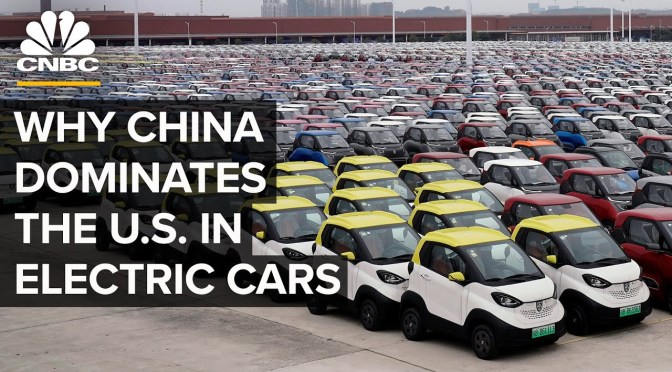
Analysis: Why China Is Dominating The U.S. In Electric Cars (Video)
The global electric vehicle market is heating up and China wants to dominate. The country has invested at least $60 billion to support the EV industry and it’s pushing an ambitious plan to transition to all electric or hybrid cars by 2035. Tesla entered the Chinese market in 2019 and has seen rapid growth.
China sold roughly one million more EVs than the U.S. in 2020. But there are signs the U.S. is getting more serious about going electric. President Joe Biden announced a goal to reach net-zero emissions by 2050 and investments in green infrastructure. Watch the video to find out how China came to dominate the market and whether it’s too late for the U.S. to catch up.
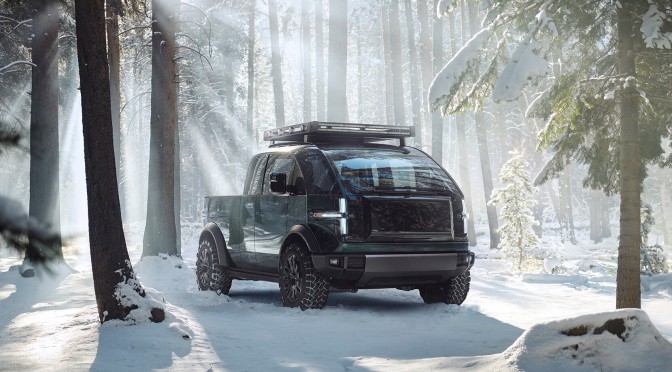
Electric Vehicles: Canoo Debuts 2023 Pickup Truck
Purpose-built pickup truck features powered workbenches, tool storage, a modular expandable bed and more.
Canoo debuted its fully-electric pickup truck during the Motor Press Guild’s Virtual Media Day (VMD) in partnership with Automobility LA. The production version of the pickup truck will open for preorders in Q2 2021, with deliveries beginning as early as 2023.
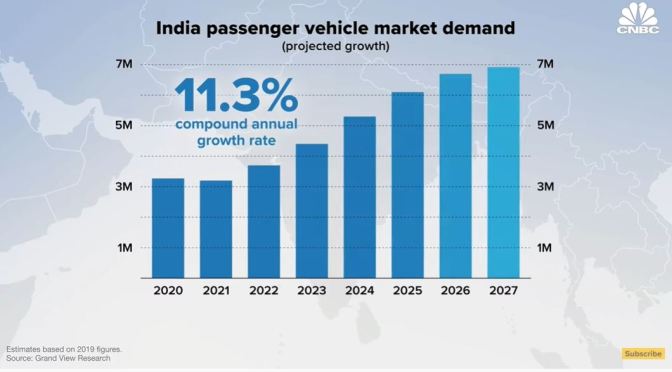
Electric Cars: ‘Can Tesla Succeed In India’ (Video)
As Tesla looks to expand to new markets, rumors are circulating that India could be next. While the 5th largest auto market could be big for the ev manufacturer, it’s filled with challenges and increasing competition.
There is an electric vehicle revolution sweeping the world, but India is lagging behind. Elon Musk has said that Tesla will enter India this year, but it’s not clear if that will actually happen. On January 8th, Tesla took its first step towards launching in the country, registering Tesla Motors India and Energy Private Limited in Bengaluru.
But when Tesla does eventually come to India, it won’t be easy. The electric vehicle industry is in its infant stages there, lacking much of the infrastructure needed for widespread adoption. And the most popular vehicles are motorcycles, rickshaws and budget passenger cars. Watch the video to find out what Tesla will be up against in India.
Electric Vehicles: ‘The EV Charging Problem’ (Video)
A Tesla Supercharger is a 480-volt direct currentfast-charging technology built by American vehicle manufacturer Tesla, Inc. for their all-electric cars. The Supercharger network was introduced on September 24, 2012 with six Supercharger stations.[1] As of December 31, 2020, Tesla operates over 23,277 Superchargers in over 2,564 stations worldwide[2] (an average of 9 chargers per station). There are 1,101 stations in North America, 592 in Europe, and 498 in the Asia/Pacific region.[3] Supercharger stalls have a connector to supply electrical power at maximums of 72 kW, 150 kW or 250 kW.[4]
The original V1 and V2 Tesla supercharging stations charge with up to 150 kW of power distributed between two cars with a maximum of 150[21][22] kW per car, depending on the version.[23][14][24] They take about 20 minutes to charge to 50%, 40 minutes to charge to 80%, and 75 minutes to 100% on the original 85 kWh Model S. The charging stations provide high-power direct-current (DC) charging power directly to the battery, bypassing the internal charging power supply.[25]
In September 2017, Tesla announced the availability of urban Superchargers. The urban Superchargers are more compact than the standard Supercharger stalls, and will be primarily deployed in urban areas such as mall parking lots and garages. Compared to the standard Superchargers, urban Superchargers have a maximum power delivery of 72 kW. Instead of 150 kW distributed between two vehicles at a Supercharger A/B stall pair, each Urban Supercharger stall provides dedicated 72 kW capacity.[26]
A few of the Tesla supercharging stations use solar panels to offset energy use and provide shade.[27] Tesla plans to install additional solar power generation at Superchargers.
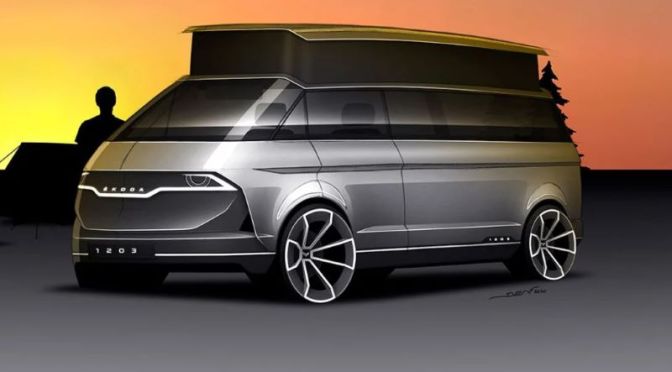
Design: ‘ŠKODA 1203’ Made Over As Electric Camper Van With Pop Top Roof
In his vision the “new” 1203 is a modern camper with a “pop top” roof. “This kind of car has been gaining in popularity recently, so in the end that’s the kind of design I went for. But my first idea was to design a peloton escort vehicle for the Tour de France,” says Daniel, referring to the Czech carmaker’s well-known involvement in the world of cycling.


When designer Daniel Hájek inspects the good-as-new ŠKODA 1203 during the photo shoot, memories come flooding back: “We have a flatbed version like that in the garden of my grandparents’ house, but it’s not roadworthy any more.” And when he adds that “it was kind of my first car, we used it on our farm, and when I was fifteen they let me start the engine now and then and drive it around the field,” it’s clear that it was no accident he chose the legendary ŠKODA utility vehicle for the Icons Get a Makeover series.
Škoda Auto a.s., commonly called Škoda or Skoda, is a Czech automobile manufacturer founded in 1895 as Laurin & Klement and headquartered in Mladá Boleslav, Czech Republic. In 1925 Laurin & Klement was acquired by the industrial conglomerate Škoda Works, which itself became state owned in 1948.

Electric Vehicle: ‘Mobilize EZ-1 Prototype By Renault’
Groupe Renault has revealed a new two-seat urban mobility vehicle designed called the EZ1-Prototype, which recalls the Twizy and will be the first machine offered under its new Mobilize mobility brand.
The Mobilize business venture is intended to help lead Groupe Renault’s efforts to break into new mobility, energy and data-related services, which it anticipates will become increasingly profitable in future years. It will focus on developing both hardware – with a range of purpose-built vehicles – software and services, such as car charging, subscription and finance schemes.
Mobilize is developing four purpose-built machines that will focus on ride-sharing and last-mile delivery services. The first is the EZ-1 Prototype, which “exemplifies the goals of the Mobilize brand” by putting “service at the heart of vehicle design”.
Designed as a shared-use urban mobility vehicle, it takes cues from mobility concepts previously shown by Groupe Renault but has been honed for real-world use. Users will be able to rent by time or distance on a pay-per-use basis.
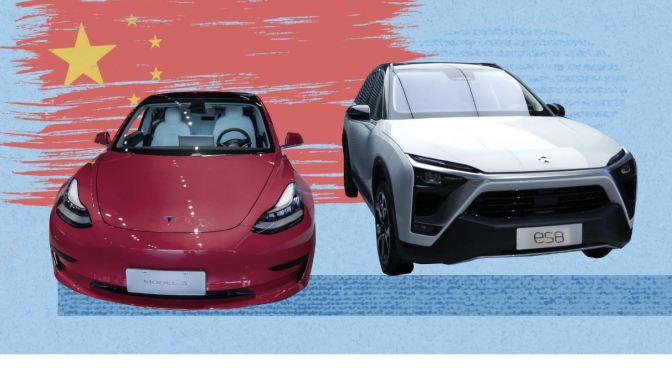
Technology: Tesla Battles Nio In China – Charging Vs Battery Swapping (Video)
Gone are the long waits at charging stations: Chinese electric-vehicle startup NIO is pioneering battery-swap systems, challenging Tesla and other rival car makers. Here’s how NIO and Tesla are racing for the world’s largest EV market in China.
Photo illustration: Sharon Shi
 Boomers Daily