Tag Archives: Diet

Brain Health: “Package Of Lifestyle Changes” (Brisk Exercise, Healthy Diet & Sleep, Cognitive Training) Helps Prevent Dementia

From a Wall Street Journal online article:

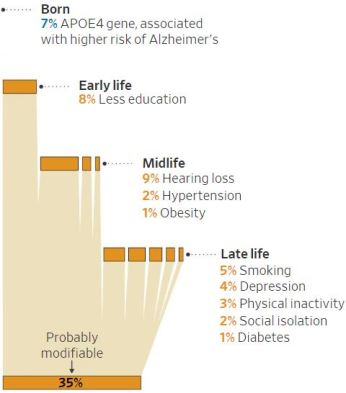
How Likely is Dementia - Source The Lancet, Gill Livingston, et al.
How Likely Is Dementia?

Dementia is a complicated disease that has multiple causes and risk factors, some of which remain unknown. Nevertheless, there is increasing evidence that people—even those who inherit genes that put them at greater risk of developing Alzheimer’s in later life—can improve their chances by adopting lifestyle changes.

“It’s not just about running three times a week,” says Sarah Lenz Lock, executive director of AARP’s Global Council on Brain Health. “Instead, it’s about a package of behaviors, including aerobic exercise, strength training, a healthy diet, sleep and cognitive training.”

When it comes to battling dementia, the unfortunate news is this: Medications have proven ineffective at curing or stopping the disease and its most common form, Alzheimer’s disease. But that isn’t the end of the story. According to a recent wave of scientific studies, we have more control over our cognitive health than is commonly known. We just have to take certain steps—ideally, early and often—to live a healthier lifestyle.

In fact, according to a recent report commissioned by the Lancet, a medical journal, around 35% of dementia cases might be prevented if people do things including exercising and engaging in cognitively stimulating activities. “When people ask me how to prevent dementia, they often want a simple answer, such as vitamins, dietary supplements or the latest hyped idea,” says Eric Larson, a physician at Kaiser Permanente in Seattle and one of a group of scientists who helped prepare the report. “I tell them they can take many common-sense actions that promote health throughout life.”

To read more: https://www.wsj.com/articles/what-science-tells-us-about-preventing-dementia-11574004600

Studies On Eating: Most Adults Prefer “Snacks” Over Meals On Daily Basis

From a Mondelēz International online release:

State of Snacking Report Mondelez InternationalNotably 6 in 10 adults worldwide (59%) say they prefer to eat many small meals throughout the day, as opposed to a few larger ones, with younger consumers especially leaning into snacks over meals as that number rises to 7 in 10 among Millennials (70%).

For consumers around the world, the role food plays in health and wellbeing is increasingly top of mind; people are more commonly considering how smaller bites – snacks – effect their emotional wellbeing, as well as their physical health.

  • For more than 8 in 10 people, convenience (87%) and quality (85%) are among the top factors impacting snack choice.
  • 80% of consumers are looking for healthy, balanced bites.
  • 71% of adults say snacking helps them control their hunger and manage their calories throughout the day.
  • Scking is a key way for people around the world to connect to their culture and share their sense of identity with their communities and families.
    • 71% say snacking is a way to remind themselves of home.
    • 7 in 10 adults make an effort to share their favorite childhood snacks with others (70%).

To read more: https://ir.mondelezinternational.com/news-releases/news-release-details/mondelez-international-releases-first-ever-state-snackingtm

Health Studies: Better Diets Reduce Side Effects Of Sleep Deprivation

From a Stanford Medicine online release:

American Journal of Lifestyle MedicineIn a study published online Sept. 10 in the American Journal of Lifestyle Medicine, Hamidi, along with other Stanford researchers, examined survey results on sleep and nutrition from 245 Stanford physicians and found that a better diet is associated with reduced side effects of sleep deprivation. 

Physicians face significant barriers to eating well at work due to long hours, a heavy workload and limited access to healthy meals, snacks and drinks. The findings of this study suggest that by providing healthy options at work, employers could help reduce the brain fogginess, difficulty concentrating and irritability caused by poor sleep among health care providers. And, as a result, help improve patient care.

“Potential mechanisms for the effect of diet on cognitive performance include regulation of hormones, neurotransmitters, and blood flow as well as reduction of oxidative stress and inflammation. The effects of diet on sleep quality have been attributed to the role of dietary factors in regulation of peripheral circadian clocks and to the synthesis of hormones and neurotransmitters that are involved in sleep regulation.”

To read more: http://med.stanford.edu/news/all-news/2019/10/to-fight-effects-of-sleep-deprivation–reach-for-healthy-snacks-.html

Diet Studies: “Dietary Fructose” In Soft Drinks, Foods Impairs The Body’s Ability To Burn Fat

From a Cell Metabolism online release:

Cell Metabolism Journal CoverIn summary, dietary fructose, but not glucose, supplementation of HFD impairs mitochondrial size, function, and protein acetylation, resulting in decreased fatty acid oxidation and development of metabolic dysregulation.
Dietary sugars, fructose and glucose, promote hepatic de novo lipogenesis and modify the effects of a high-fat diet (HFD) on the development of insulin resistance. Here, we show that fructose and glucose supplementation of an HFD exert divergent effects on hepatic mitochondrial function and fatty acid oxidation. This is mediated via three different nodes of regulation, including differential effects on malonyl-CoA levels, effects on mitochondrial size/protein abundance, and acetylation of mitochondrial proteins. HFD- and HFD plus fructose-fed mice have decreased CTP1a activity, the rate-limiting enzyme of fatty acid oxidation, whereas knockdown of fructose metabolism increases CPT1a and its acylcarnitine products. Furthermore, fructose-supplemented HFD leads to increased acetylation of ACADL and CPT1a, which is associated with decreased fat metabolism.

To read more: https://www.cell.com/cell-metabolism/fulltext/S1550-4131(19)30504-2?_returnURL=https%3A%2F%2Flinkinghub.elsevier.com%2Fretrieve%2Fpii%2FS1550413119305042%3Fshowall%3Dtrue

Nutrional Health Studies: Mediterranean Diet Improves Cognitive Function In Older People

From a Nutritional Neuroscience online release:

Nutritional NeuroscienceOur findings suggest that higher adherence to a Mediterranean diet is associated with better cognitive performance, and therefore less cognitive decline, in older but not middle-aged individuals.


Over a period of five years, higher adherence to a Mediterranean diet was associated with improvements in Global Cognitive Function, Visual-Spatial Organisation and Memory and scanning and tracking in participants ≥70 years.

Adherence to a Mediterranean diet is associated with higher cognitive function and reduced risk of dementia in Mediterranean populations. However, few studies have investigated the association between Mediterranean diet adherence and cognition in populations outside of the Mediterranean basin.

To read more: https://www.tandfonline.com/doi/full/10.1080/1028415X.2019.1655201

Diet Studies: 2-Year Calorie Restriction Diets Lower LDL/Total Cholesterol, C-Reactive Protein & Blood Pressure

From The Lancet Diabetes & Endocrinology:

Calorie Restriction The Lancet Diabetes & Endocrinology Sept 20192 years of moderate calorie restriction significantly reduced multiple cardiometabolic risk factors in young, non-obese adults. These findings suggest the potential for a substantial advantage for cardiovascular health of practicing moderate calorie restriction in young and middle-aged healthy individuals, and they offer promise for pronounced long-term population health benefits.


Calorie restriction caused a persistent and significant reduction from baseline to 2 years of all measured conventional cardiometabolic risk factors, including change scores for LDL-cholesterol (p<0·0001), total cholesterol to HDL-cholesterol ratio (p<0·0001), and systolic (p<0·0011) and diastolic (p<0·0001) blood pressure. In addition, calorie restriction resulted in a significant improvement at 2 years in C-reactive protein (p=0·012), insulin sensitivity index (p<0·0001), and metabolic syndrome score (p<0·0001) relative to control. A sensitivity analysis revealed the responses to be robust after controlling for relative weight loss changes.

To read more click on following link: https://www.thelancet.com/journals/landia/article/PIIS2213-8587(19)30151-2/fulltext?dgcid=raven_jbs_etoc_email

Trends In Food: Erewhon Organic Market Keeps Expanding By Keeping Prices (And Quality) High

From an LAMag.com article:

Erewhon Natural Food Stores Products“In the beginning, the company was so in rapture with health and wellness, that they’d get cashews from some exotic place and you’d end up spending 20-some dollars for a bag of nuts,” Widener says. “But I’d still buy a bag because I wanted to learn about it, and I felt better when I ate ‘em.” The supermarket-as-classroom ethos even influences Erewhon’s physical layout: the grocer builds shelves that are too tall so that customers will be forced to ask for assistance, thus building a relationship with salespeople.
Erewhon, a natural foods grocer based in L.A., has inspired cult-like devotion among those who can afford to pay four dollars for an avocado. On Instagram, a torrent of celebrities can be seen pushing bags of Erewhon produce to their Escalades, while beaming earth mother types with names like “healthjunky” cradle the chain’s green beverages. The store has even inspired a line of merch.

To read more click on the following link: https://www.lamag.com/citythinkblog/erewhon-shopping/?utm_campaign=Daily%20Update&utm_source=hs_email&utm_medium=email&utm_content=75852994&_hsenc=p2ANqtz–GmpdOgZ2NYDU32TTOQ6Gqhus0hNfDfpCleCSES-n_3yZKwHpd-fTuBlp9BycKnouKgvoMgzjQ4d0ayP7fP4dN3E7daQ&_hsmi=75852890

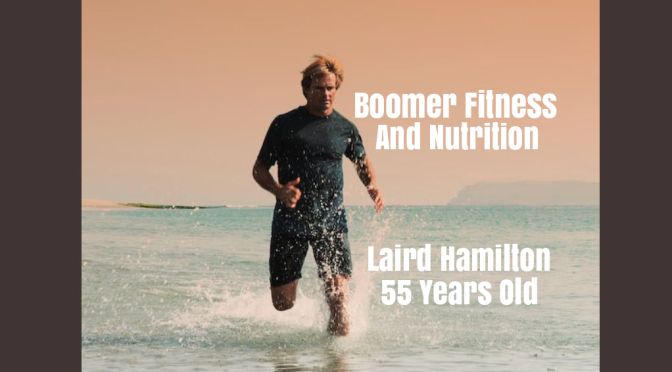
Fitness & Nutrition: Yes, Big Wave Surfer Laird Hamilton Is A Boomer, And This Is What He Eats Daily

From OutsideOnline.com article:

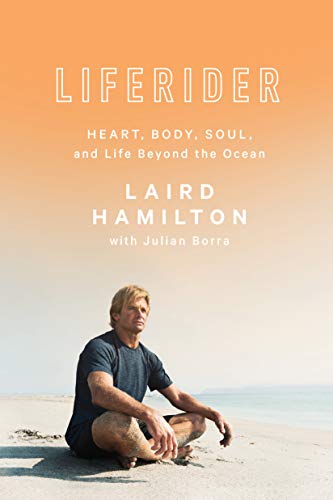
Laird Hamilton Liferider - Heart, Body, Soul, and Life Beyond the OceanBreakfast

I wake up early and start my day by turning my coffee into a meal. I’ll pull three or four shots of dark-roast espresso and add one scoop of my custom-blend coconut-milk creamer, one scoop of turmeric creamer, a teaspoon of ghee or raw butter, a half-teaspoon of fair-trade red palm oil, a teaspoon of raw coconut, and a mushroom blend that includes shiitake, maitake, lion’s mane, and cordyceps. I emulsify the combination until it’s smooth and drink it before I head out to my morning surf or training session.

Lunch

Midday I usually eat enough for two, because I haven’t had solid food since the evening before. I build my lunch around a serving of high-quality animal protein, like sustainable local fish or chicken. I’ll eat it on a bed of lettuce, cabbage, or kale, topped with avocado or crushed macadamia nuts and dressed with olive oil and vinegar. If it’s available, I’ll add raw-milk cheese to the salad. I try to get my carbs mostly from vegetables. When I’m in Hawaii, I’ll indulge in mashed purple sweet potatoes with coconut milk. While traveling, I do my best to enjoy what’s seasonal or indigenous to that particular location.

To read more click on following link: https://www.outsideonline.com/2394872/what-laird-hamilton-eats?utm_medium=email&utm_campaign=Bodywork-08172019&utm_content=Bodywork-08172019+Version+A+CID_91379d10d7358b59a5cfa9bceefb8c01&utm_source=campaignmonitor%20outsidemagazine&utm_term=Laird%20Hamiltons%20Day%20in%20Food


Diet Studies: “Profound Benefits” Of Fasting For Weight Loss, Longevity And Chronic Disease

From a Wall Street Journal article by Andreas Michalsen:

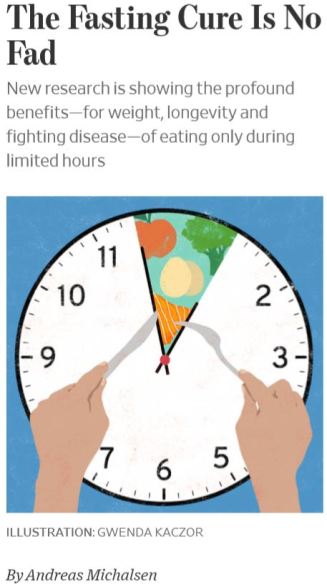
Fasting article Wall Street Journal by Andreas Michalsen Aug 2019At the Charité University Hospital in Berlin, I’ve employed what’s called intermittent fasting, or time-restricted eating, to help patients with an array of chronic conditions. These include diabetes, high blood pressure, rheumatism and bowel diseases, as well as pain syndromes such as migraines and osteoarthritis.

Fasting is one of the biggest weight-losstrends to arise in recent years. Endorsed by A-list celebrities and the subject of a spate ofbest-selling books, it was the eighth most-Googled diet in America in 2018.

There are different ways to go about it, but Iadvise patients to omit either dinner or breakfast, so that they don’t ingest any foodfor at least 14 hours at a stretch.

Healthy Diets: Adults Need 45 Grams Of Protein Per Day From A Balanced Diet

From a Wall Street Journal article by Heidi Mitchell:

How much protein should you eat each day Wall Street JournalUnlike carbohydrates or fats, proteins are the only nutrients that can be used to build new cells that can form tissue, said Dr. Walter, a registered dietitian. 

“These have to be supplied by food, and the best source of them is what we call a complete protein, which includes meat, chicken, fish, milk or eggs,” she said. A total of eight ounces, or about 45 grams of protein, is all an adult needs each day, she said, and the type of complete protein it comes from doesn’t matter in a balanced diet that includes fruits, vegetables and grains.

To read more click on the following link: https://www.wsj.com/articles/how-much-protein-should-you-eat-each-day-11563374327