

Ban Gioc – Detian Falls or Ban Gioc falls is a collective name for two waterfalls on the Quây Sơn River, that straddle the international border between China and Vietnam; more specifically located between the Karst hills of Daxin County, Guangxi, and Trùng Khánh District, Cao Bằng Province.
Tag Archives: China

News: Top 5 Stories For May 24, 2021 (Reuters)
Five stories to know for May 24: Belarus diverts plane, Ronald Greene video, George Floyd, Jan. 6 Capitol riot, and China ultramarathon
1. Western politicians accused Belarus of state piracy amounting to a “warlike act” after Minsk forced a plane to land and arrested a dissident journalist.
2. More video of a fatal 2019 encounter of Ronald Greene with police in Louisiana was released by authorities late Friday.
3. Relatives of George Floyd, the Black man whose death triggered protests against racism and police brutality across the United States and around the world, gathered in a rally to mark the first anniversary of his death.
4. Republicans in Congress clashed over the need for an independent commission to investigate the Jan. 6 Capitol riot.
5. Twenty-one people were killed when extremely cold weather struck during an ultramarathon in rugged Gansu province in northwestern China.

Political Analysis: The U.S.-China Tussle Over Taiwan
Taiwan has long been a U.S.-China flashpoint, but its tech and military capabilities have come into sharper focus under the Biden administration. WSJ travels to three places on the island to explain how both superpowers could determine Taiwan’s future. Photo: Wally Santana/AP

Morning News Podcast: Israel-Hamas Cease Fire, China Communist Party
After 11 days of fierce fighting, Israel and Hamas agreed to a ceasefire beginning in the early hours of Friday morning. But will the quiet last? In July, China’s Communist Party will mark the 100th anniversary of its victory in the revolution that brought it to power.
But it’s not easy for a dictatorship to celebrate a revolt. And, we look back at the life of Asfaw Yemiru, an Ethiopian educator who transformed the lives of more than 120,000 children.

News: Top 5 Stories For May 20, 2021 (Reuters)
May 20, 2021: Israel and Gaza, House approves Capitol probe, Abortion in Texas, U.S travel changes, and South China Sea
1. Diplomatic moves towards a ceasefire in the Israeli-Palestinian conflict gathered pace after President Joe Biden called for a de-escalation.
2. The U.S. House of Representatives voted to create an independent commission to probe the deadly Jan. 6 attack on the Capitol by former President Donald Trump’s supporters. One in six Republicans defied party leaders’ attempts to block it.
3. Republican Texas Governor Greg Abbott signed into law a ‘fetal heartbeat’ abortion bill that bans the procedure after about six weeks of pregnancy and grants citizens the right to sue doctors who perform abortions past that point.
4. The Biden administration weighs changes to sweeping travel restrictions that bar much of the world’s population from coming to the United States.
5. China said a U.S. warship illegally entered its territorial waters in the South China Sea and was expelled by its forces, an assertion the United States denies.

Political Analysis: Is ‘Myanmar’ A Failed State?
Myanmar is on the brink of collapse. Its armed forces are continuing a brutal crackdown—arresting, torturing and killing protesters—as Aung San Suu Kyi, Myanmar’s de-facto leader, is detained. Our experts answer your questions.
Chapters 00:00 – What will happen to Aung San Suu Kyi? 02:15 – What are India and China doing? 03:37 – Should the West intervene? 05:25 – What’s happening to the Rohingya refugees? 07:16 – How will Myanmar’s neighbours be affected? 08:44 – Will civil war break out? 10:36 – Can the protesters win? 12:05 – Will Myanmar become a failed state?

Views: Ancient Mongolian Fishing Technique At Lake Chagan, China (Video)
In the northeast province of Jilin, China, local fishermen rely on an ancient Mongolian technique to fish in the frozen waters of Lake Chagan. And despite temperatures reaching minus 30 degrees Fahrenheit, all they need are a net, two horses, and a spindle.
Morning News Podcast: Israel-Palestinian Clash, Ransomware, China
Tension in the holy city of Jerusalem has been rising for weeks, amid the attempted eviction of Palestinians and a march by Jewish nationalists. Yesterday it erupted into the worst violence in years, as Hamas rockets fired at Israel from Gaza prompted retaliatory air strikes.
A cyber-attack that shut down one of America’s largest fuel pipelines reflects the growing problem of ransomware. And in China, authorities are clamping down on a spurt of grave robbing.
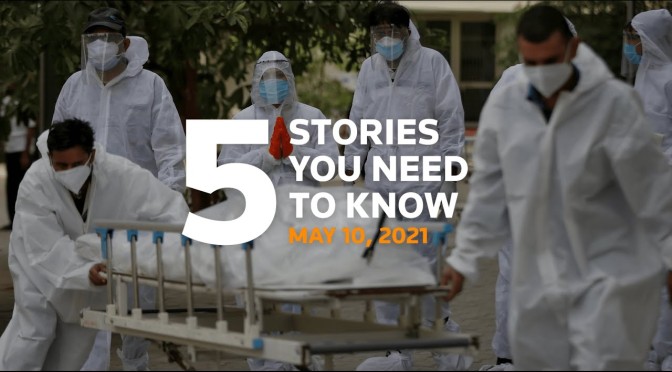
News: Top 5 Stories For May 10, 2021 (Video)
Five stories to know for May 10: Shootings in Colarado and New York’s Times Square, China’s rocket debris, clashes in Israel, and COVID in India.
1. A man fatally shot six people including his girlfriend before turning the gun on himself at a birthday party in Colorado Springs, Colorado.
2. Remnants of China’s biggest rocket landed in the Indian Ocean, with most of its components destroyed upon re-entry into the atmosphere.
3. Three people including a four-year-old girl were shot in New York City’s Times Square after gunfire broke out in a dispute that they were apparently not involved in, the city’s top police official said.
4. Palestinian protesters threw rocks and Israeli police fired stun grenades and rubber bullets in clashes outside al-Aqsa mosque in Jerusalem, as Israel marked the anniversary of its capture of parts of the city in the 1967 Arab-Israeli war.
5. Indian coronavirus infections and deaths held close to record daily highs on Monday, increasing calls for the government of Prime Minister Narendra Modi to lock down the country.
Analysis: Why Demand For Armed-Drones Is Surging
Armed drones are growing in military importance as conflicts around the world have proven the utility of these effective tools of war. Companies in China, Turkey, and Russia, among others, have developed advanced remotely piloted aircraft that can use guided weapons on and off the battlefield.
The widespread use of drones in Iraq and Afghanistan by the United States to target and kill insurgents jump started a new chapter in the history of conflict. These high flying and remotely piloted aircraft could engage targets with impunity while the operators were safely working in a ground control station. Keeping the crews out of danger also made the drones politically cheap to use over dangerous skies.
Now more and more countries are gaining this military capability for their own purposes. “At the moment, we’ve seen over 100 states worldwide using military drones and that number is growing significantly” said Wim Zwijnenburg, Project leader, Humanitarian Disarmament at PAX. “We have over 20 states that are using armed drones in conflicts or outside of armed conflicts.”
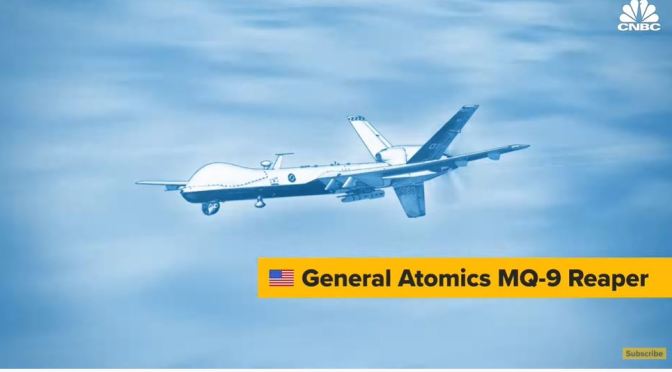
Although larger and more complex drones, like the General Atomics MQ-9 Reaper are not cheap to develop or operate, smaller drones are becoming more ubiquitous in conflict zones. Limiting the proliferation of these smaller drones, and the ability to weaponize them, is a regulatory nightmare for government agencies around the world.
“Drones are just model airplanes with great sensors on them. And all of these are dual use and have been used in the civilian realm” said Ulrike Franke, a Senior Policy Fellow at the European Council on Foreign Relations. “And in fact, drones have risen enormously in the civilian realm over the last five to 10 years. And so controlling their export is really difficult.”
 Boomers Daily