

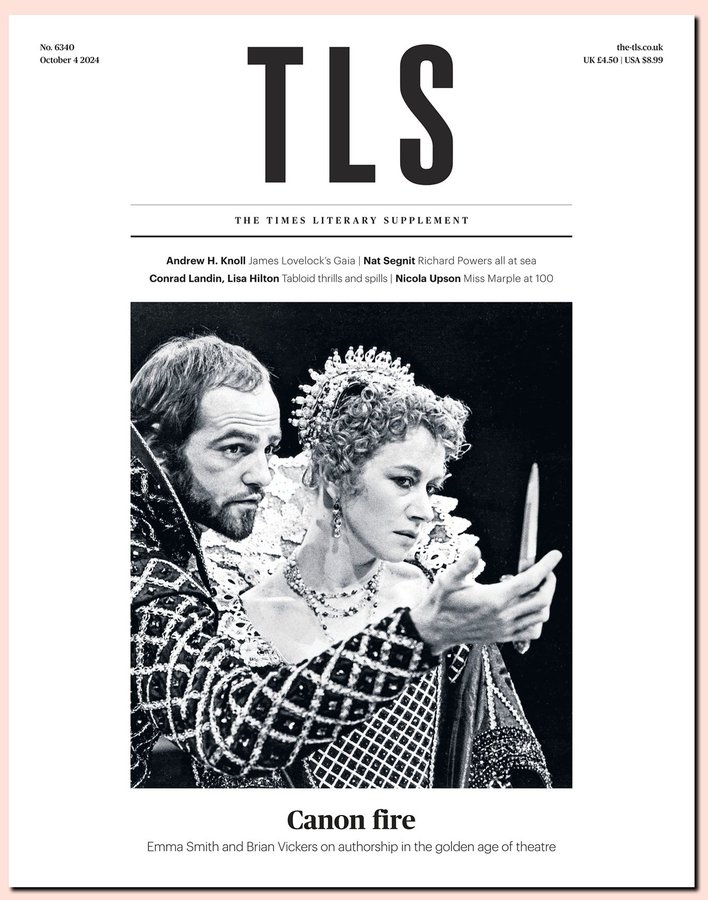
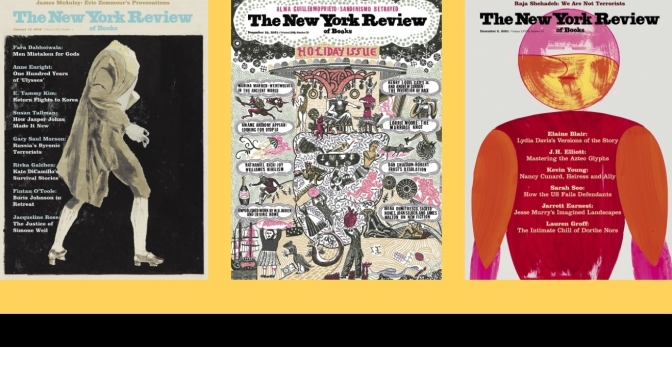
Times Literary Supplement (October 2, 2024): The latest issue features ‘Canon Fire’ – Emma Smith and Brian Vickers on authorship in the golden age of theatre…
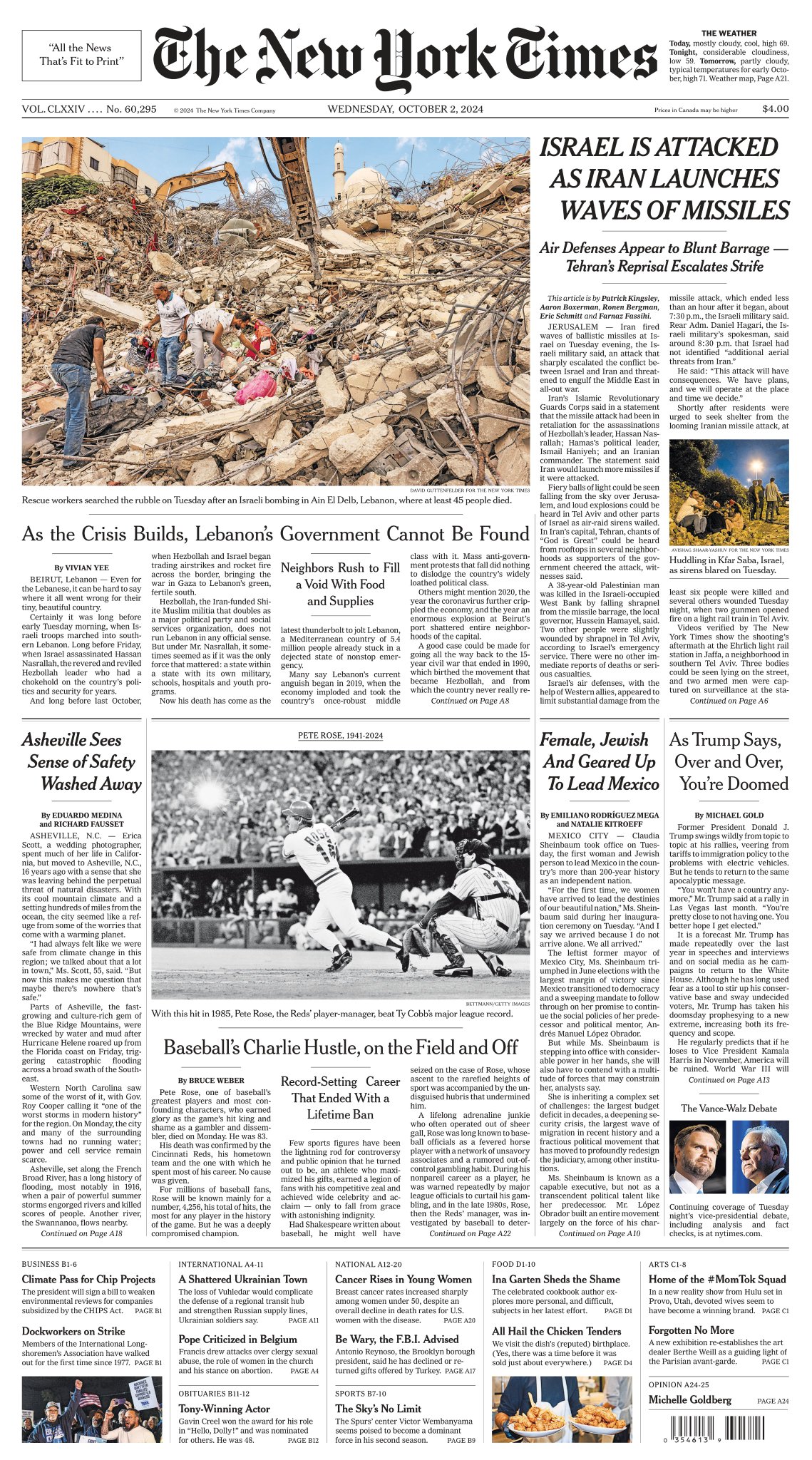
The 180 missiles fired at Israel on Tuesday evening sharply escalated the conflict between the two countries and threatened to engulf the Middle East in all-out war.
Already crippled by years of economic decline, political paralysis and other crises, Lebanon has little but its own citizens’ grit to survive the Israel-Hezbollah conflict.
Worries of flooding had not been top of mind as the mountain-ringed city flourished in recent years as a haven for artists, chefs, brewmasters, entrepreneurs and retirees.
One of the sport’s greatest players, he set a record with 4,256 career hits. But his gambling led to a lifetime ban and kept him out of the Hall of Fame.
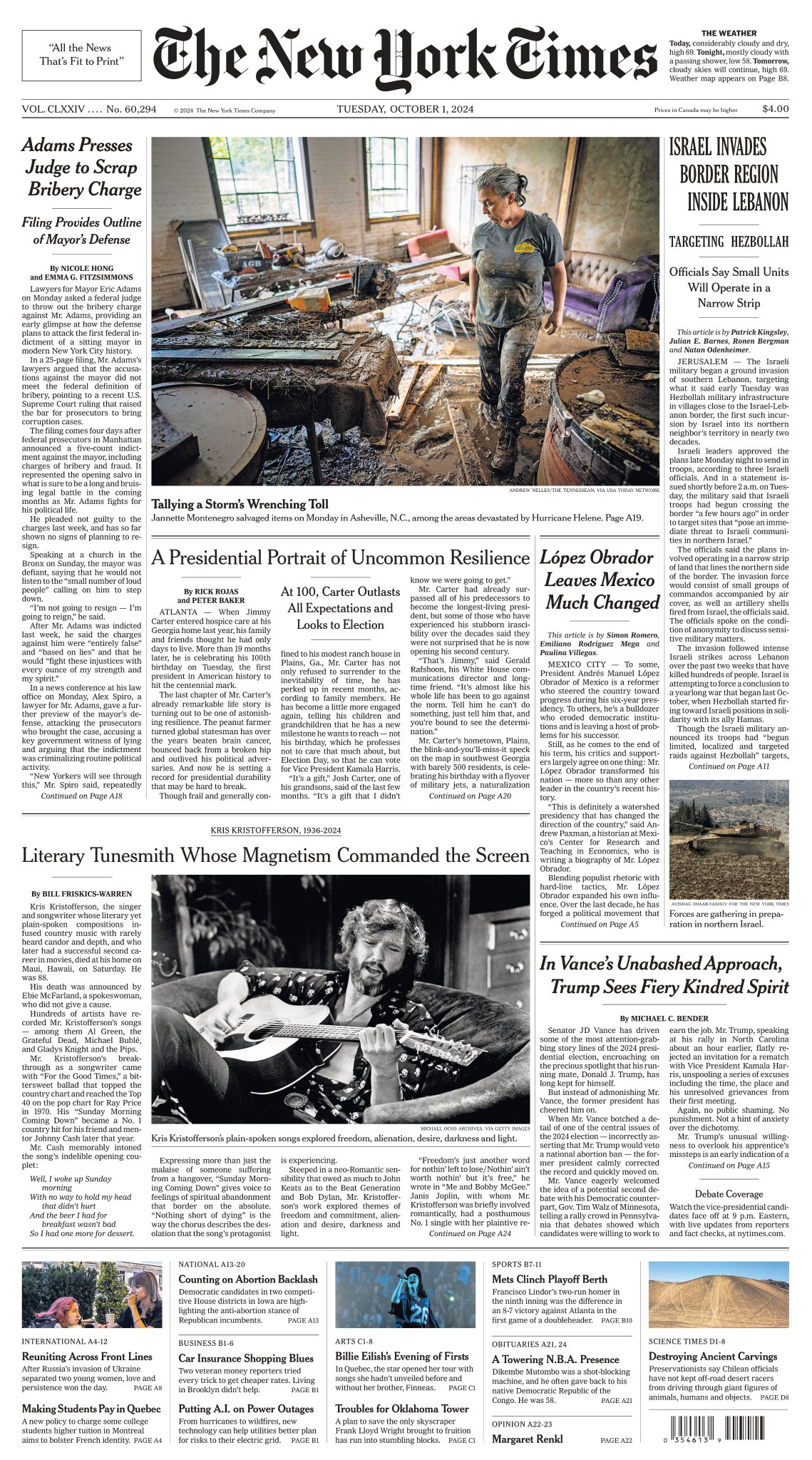
The military said it was targeting Hezbollah infrastructure in villages close to the Israel-Lebanon border.
Lawyers for Mayor Eric Adams of New York filed a 25-page memo arguing that the conduct described in the indictment against him did not meet the definition of bribery.
After the Category 4 hurricane made landfall on Florida’s Gulf Coast and pummeled the Southeast, some victims’ portraits were coming into focus.
Nineteen months after entering hospice care, the 39th president is set to turn 100 on Tuesday. His birthday wish? A chance to vote for his party’s candidate one more time.
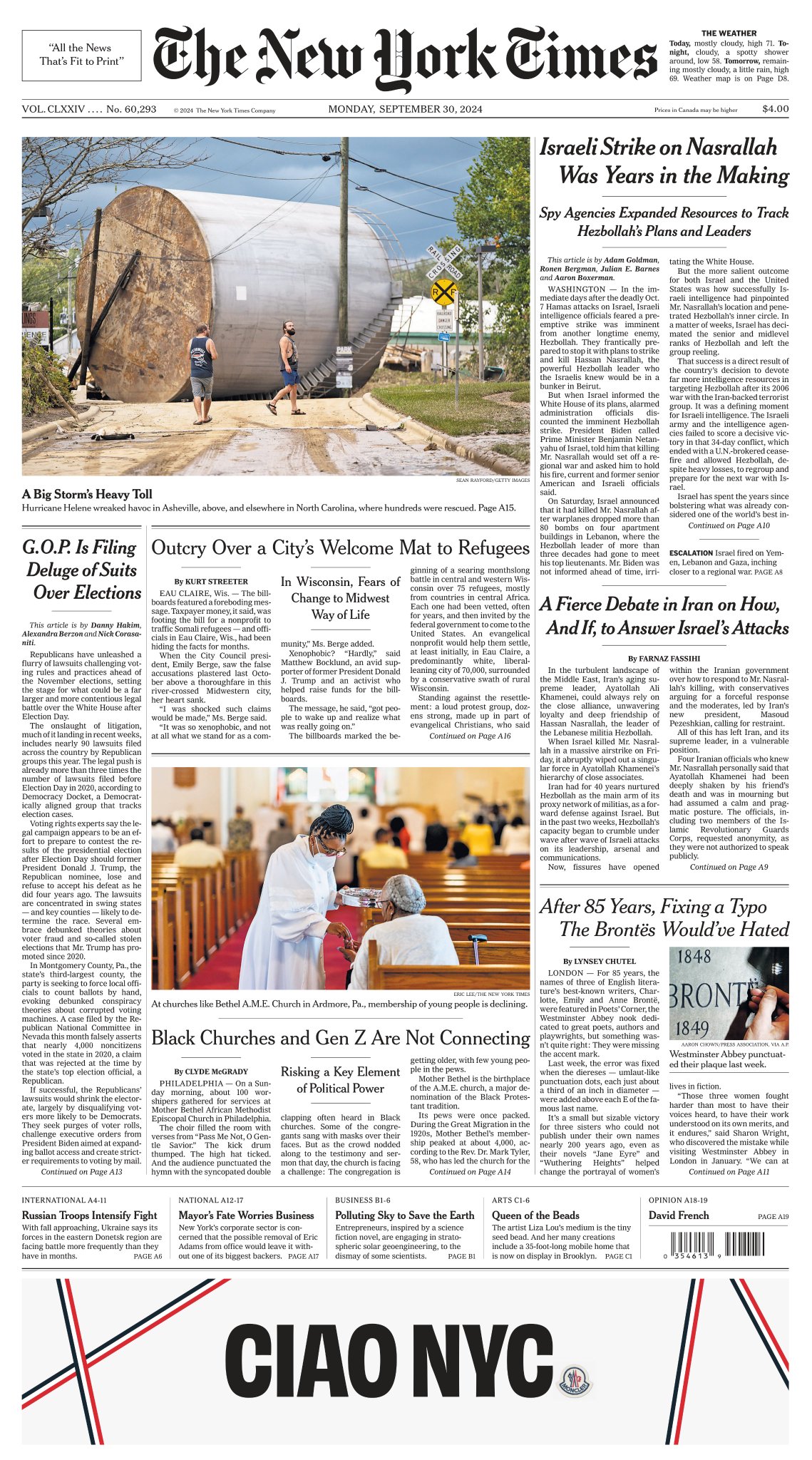
After the 2006 war with Hezbollah, Israel invested heavily to intercept the group’s communications and track its commanders in a shadowy war that ultimately led to the killing of the group’s leader.
The escalation of violence between Israel and Iran-backed proxies across the Middle East threatened to bring the combatants closer to an all-out regional war.
Eau Claire had a plan. But opponents, mostly from rural areas, were convinced that the newcomers would destroy their Midwestern way of life.
Republicans are filing a barrage of election lawsuits in the final weeks of the presidential campaign. The cases may be a road map for a legal battle over the results.
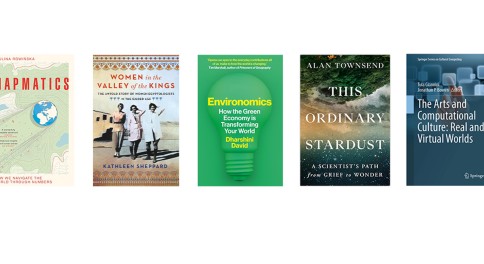

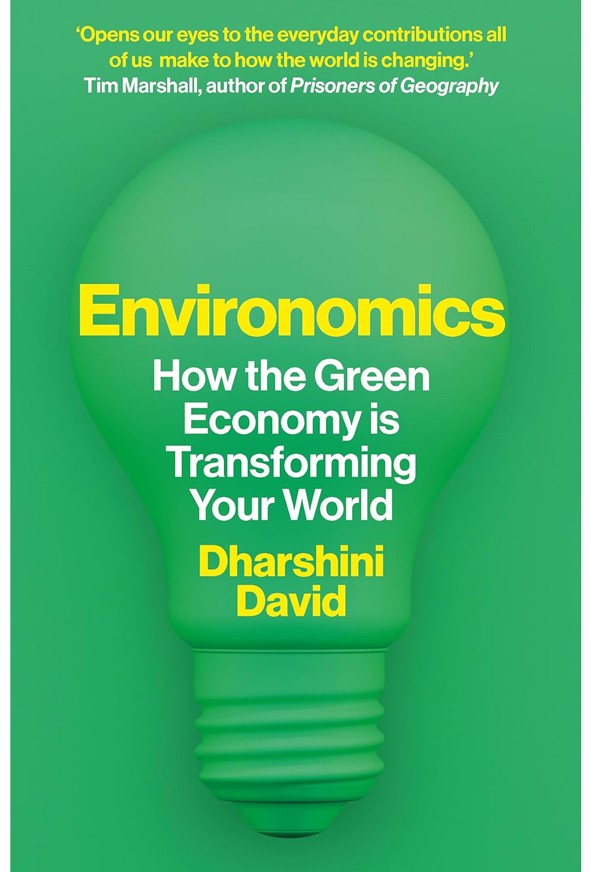
Environomics
By Dharshini David
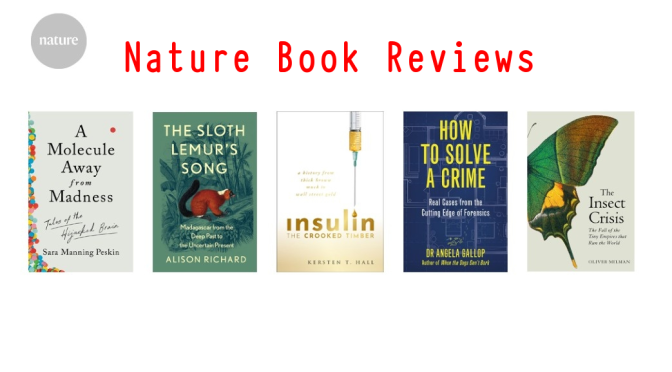
Why should an orangutan care what toothpaste a person uses, asks economist Dharshini David, in her appealing book about how human lifestyle choices affect the planet. Answer: some toothpastes use palm oil to create foam, whereas others don’t, and palm-oil production requires the clearing of tropical forests, eliminating the habitats of creatures such as orangutans. “Nearly every issue that affects the environment comes down, in some way, to what someone, somewhere, is doing to make (or save) money,” she writes.
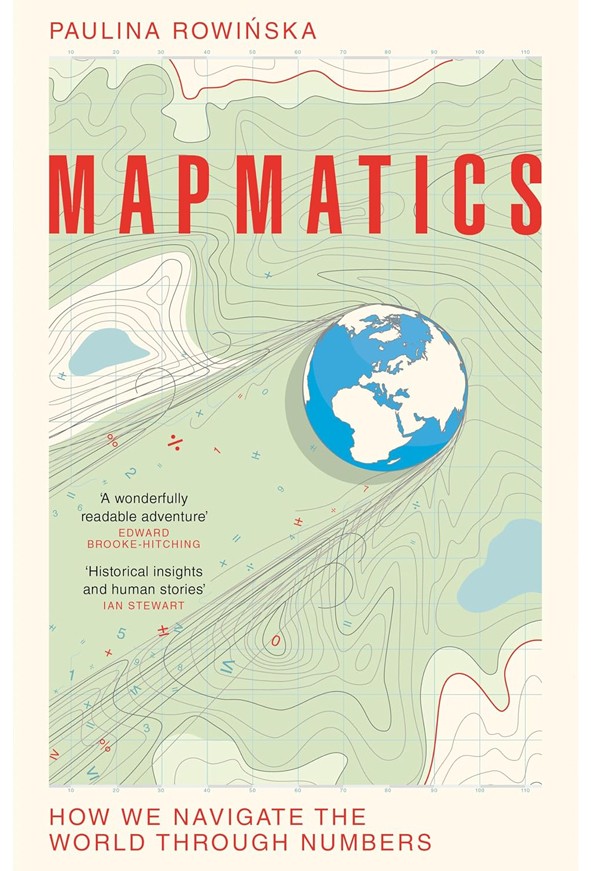
Mapmatics
By Paulina Rowińska
From world maps designed by geographer Gerardus Mercator for marine navigation in the sixteenth century to online maps created by Google for self-driving cars in the twenty-first century, maps rely on mathematics. “While different on the surface, the jobs of a mathematician and a cartographer are surprisingly similar,” writes mathematician Paulina Rowińska in her engaging and original history of ‘mapmatics’. Indeed, maps not only depend on mathematics but have also inspired many mathematical breakthroughs.
The Arts and Computational Culture
By Tula Giannini & Jonathan P. Bowen
This substantial, topical collection on the arts and computing, edited by information scientist Tula Giannini and computer scientist Jonathan Bowen, begins with polymath Leonardo da Vinci’s blending of art and science and ends with a survey of modern art exhibitions that involve computing. As the editors write, “facilitated by computing, artificial intelligence, machine learning, algorithms, and simulated human senses, the arts are expanding their horizons”. Perhaps AI will eventually stand also for Artistic Imagination?
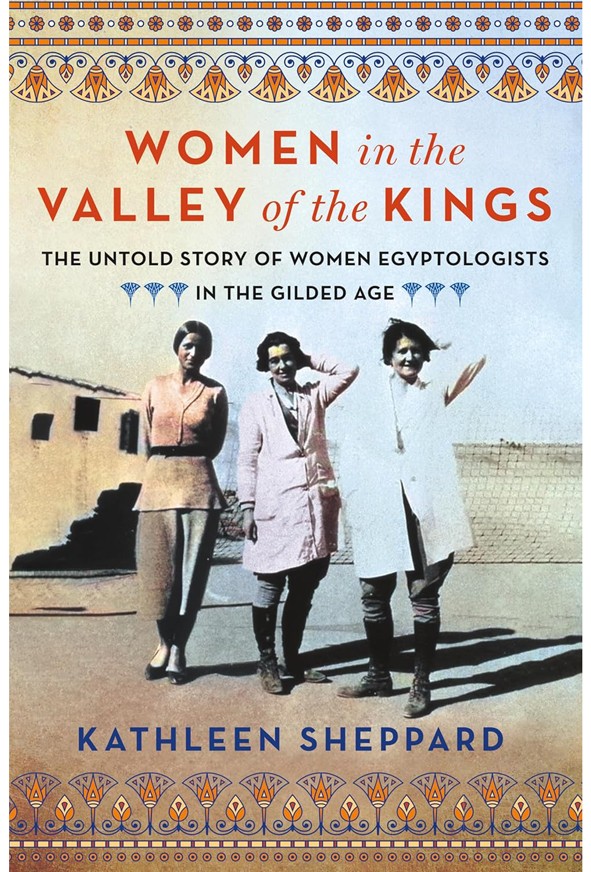
Women in the Valley of the Kings
By Kathleen Sheppard
Discussions of Egyptologists tend to focus on men — for example, Howard Carter, who excavated Tutankhamun’s tomb in 1922. Yet, women played an important part in Egyptology, as historian Kathleen Sheppard describes. She begins in the 1870s with Marianne Brocklehurst and Amelia Edwards’s A Thousand Miles up the Nile, and ends with Caroline Ransom Williams’s death in 1952. Lacking permission to find artefacts, these women “acquired, organized and maintained” the world’s largest collections of Egyptian objects.
This Ordinary Stardust
By Alan Townsend
Alan Townsend, dean of the college of forestry and conservation at the University of Montana in Missoula, calls himself a biogeochemist. This field can teach us, he remarks, about cornfields, fertilizers, lake colours, sea life and even planetary warming. It can also “nurture the soul”. He learnt this truth when both his beloved wife and four-year-old daughter fell ill with brain cancer, and only the child recovered. His moving memoir describes how scientific wonder rescued him from appalling grief and suicidal thoughts.
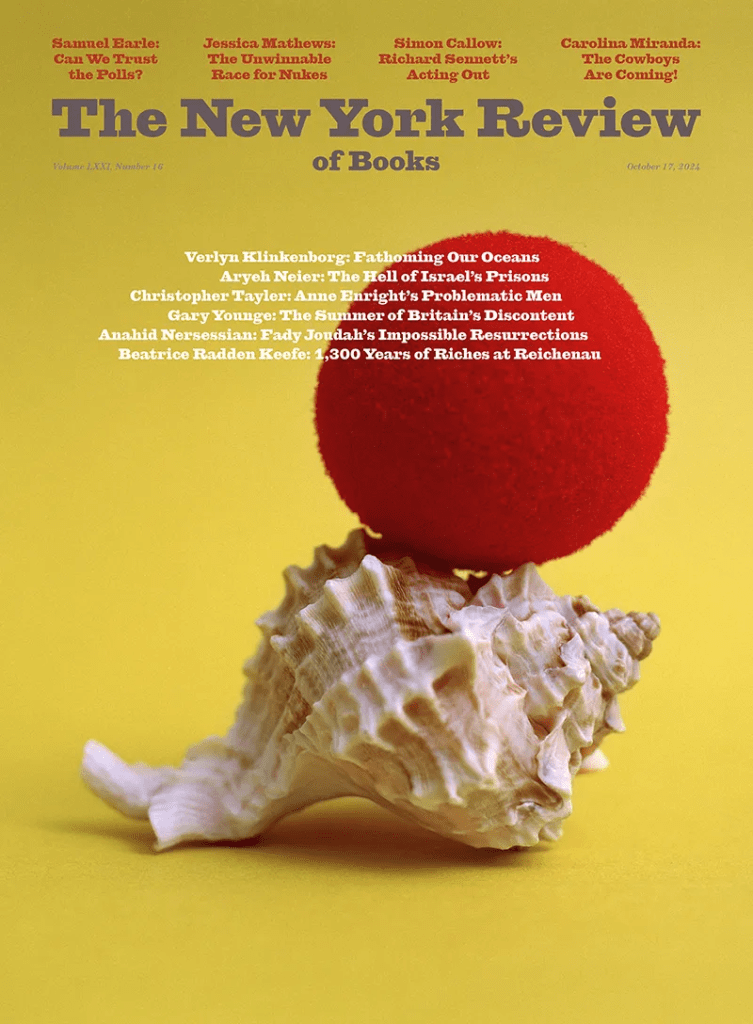

The Irish novelist Anne Enright writes with great prowess and wit about women who make a virtue of getting on with things.
The Wren, the Wren by Anne Enright
At the heart of Daniel Defoe’s fictional world is a feeling for change, of the mutability and shiftiness of modern life and the people who thrive in it.
The Oxford Handbook of Daniel Defoe edited by Nicholas Seager and J.A. Downie
Political polling’s greatest achievement is its complete co-opting of our understanding of public opinion, which we can no longer imagine without it.
Strength in Numbers: How Polls Work and Why We Need Them by G. Elliott Morris

Times Literary Supplement (September 25, 2024): The latest issue features ‘Body and Soul’ – Noel Malcolm on Diamaid MacCulloch’s history of sex and Christianity; Jean Genet’s lost drama; Becoming Lucy Sante; Poor little kids and How the compass got its points…

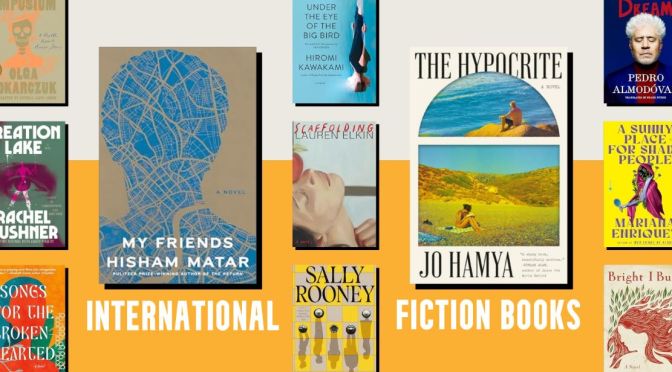
Foreign Policy (September 20, 2024): The Mediterranean was the backdrop for much of FP’s summer reading. For the first installment of our new column about international fiction, we travel to two very different settings along this vast sea: Muammar al-Qaddafi’s Libya and modern Sicily. Plus, we highlight the buzziest releases in international fiction this month.
Hisham Matar (Random House, 416 pp., $28.99, January 2024)
Hisham Matar’s latest novel, recently longlisted for the 2024 Booker Prize, is about friendship and exile. Matar, a Libyan American writer based in London, was raised in a family of anti-Qaddafi dissidents and has made the tyrant’s maniacal rule the subject of most of his work.
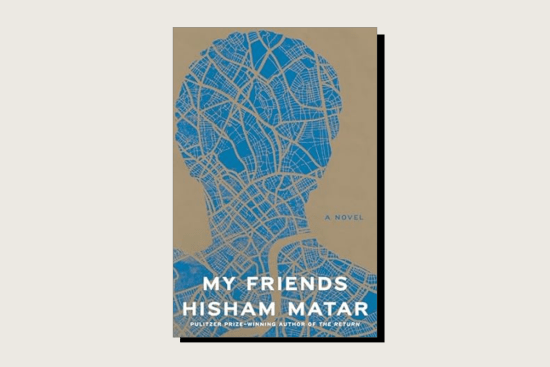
In My Friends, Matar follows protagonist and narrator Khaled from his school days in Benghazi to the period following Qaddafi’s overthrow in 2011. After attending a 1984 anti-Qaddafi demonstration in London and landing on the dictator’s hit list, Khaled is forced to upend his quiet life as a university student in Edinburgh and start over in the British capital. (The real-life protest, where officials at the Libyan Embassy shot several protesters and killed a police officer, led Libya and Britain to sever ties.)
Khaled develops strong friendships with two fellow Libyans in London, Hosam and Mustafa. Unlike Khaled, both are unwavering in their political convictions. Although Khaled is opposed to Qaddafi’s regime, he is also aware of the costs—and futility—of speaking out. That Khaled’s criticism of Qaddafi’s Libya never leaves the private, rhetorical sphere is a point of contention between him and his friends. Ultimately, Hosam and Mustafa return to Libya in 2011 to join the militias fighting Qaddafi; Khaled remains in Britain, deeply insecure about his inaction.
Khaled’s decision to attend the 1984 protest was one he made hesitantly, so it is all the more shocking that his first brush with activism fundamentally altered the course of his life. Khaled’s father, an academic who resigned himself to a mid-level career under Qaddafi to avoid repression, had taught his son that it is “almost always best to leave things be.”
At its core, My Friends is a debate over whether, in the face of repression, such silence is a form of self-preservation or cowardice. This tension exists between the book’s main characters—the friends—as well as within Khaled’s own head. While Khaled’s exile led him to make great friends, his time in London is equally a painful experience of solitude. With Libyan phone lines tapped and mail pilfered by the regime, he has had to uphold a decades-long lie to his family about why he can no longer return home—all because he attended a single protest.
An author with an agenda might have sought to portray Hosam and Mustafa as valiant fighters whose sacrifices are rewarded, opposite Khaled, who prefers comfort to confrontation. But Libyan history does not follow a morally righteous narrative arc. At the end of the book, Libya becomes enveloped in a new crisis, and each friend seeks to find his place within it.—Allison Meakem
Jo Hamya (Pantheon, 240 pp., $26, August 2024)
The Mediterranean is a time-honored stage for the psychosocial dramas of the elite. From British novelist John Fowles’s 1965 masterpiece, The Magus, to the entire Mamma Mia! franchise, fictional foreigners have long flocked to Greek and Italian isles to escape from—and, more often, confront—their heartbreaks and pathologies and familial squabbles. Often left out of these tales are the locals.
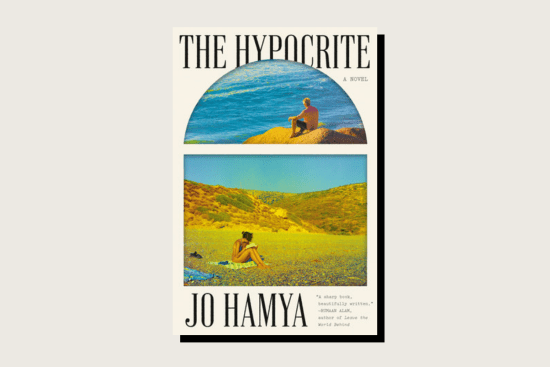
The Hypocrite by British author Jo Hamya at first seems like more of the same. It takes place over the course of one staging of a play about a summer that Sophia, the young playwright, once spent in Sicily’s Aeolian Islands with her father, a famous novelist whose work has aged poorly. It’s a smooth and often witty portrait of the upper-middle-class London art scene, written in the streamlined Rachel Cusk-esque register that defines much contemporary literary fiction.
Yet The Hypocrite also attempts to do something more. Although Sophia’s family dramas make up the bulk of the narrative, Hamya eventually shifts her focus to the family’s housekeeper in Sicily. She recalls that Sophia “was demanding in the worst way an English tourist could be.” Sophia didn’t try to learn even a little Italian. She and her father, the housekeeper thinks, were “lazy, messy people” who never bothered “to make her job easier with the simplest of acts.”
Hamya’s novel is part of the recent trend of examining who, historically, has been omitted in traditional narratives, especially ones set in locales that are under-resourced, exoticized, and deeply reliant on tourism. (Sicilians are European, yes, but they also live in one of Italy’s poorest regions.) In this regard, the novel is closer in spirit to HBO’s The White Lotus, the much-lauded send-up of the rich at a luxury resort chain (first in Hawaii, then in Sicily, and soon in Thailand), than many of its other predecessors.
Hamya does not dwell, however, on this upstairs-downstairs dynamic. Rather than skewering the careless interlopers, she aims for a bit more nuance, attending—if only fleetingly—to both the narrower interests of her protagonists and the invisible hands that helped set the stage for them that summer.—Chloe Hadavas

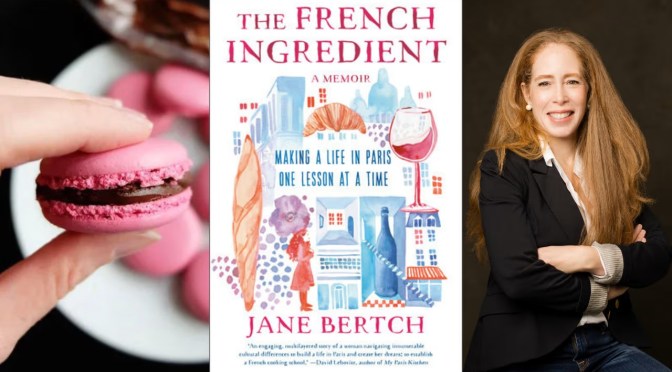
CBS Mornings (September 21, 2024): Jane Bertch was a banker until she quit her job, moved to France and founded a cooking school there. It’s an American dream story set in Paris.
Now, she’s telling her story in the new memoir, “The French Ingredient.” Jeff Glor reports from Paris.

 Boomers Daily