Reclaiming Intellectual Life Within Motherhood

By Renee Dellar, Founder, The Learning Studio, Newport Beach, CA

In homes filled with toy-strewn floors, half-read bedtime stories, and the quiet rituals of care, another kind of cultivation is quietly unfolding: a woman tending both her children and her own mind. For centuries, motherhood has been framed as noble sacrifice—an often invisible labor etched into the margins of cultural discourse. But in 2025, a growing chorus of voices is reviving a different vision. One in which caregiving is not a detour from intellectual life, but its fertile ground.

Two works lead this revival: Karen Andreola’s Mother Culture and Laura Fabrycky’s Motherhood and the Intellectual Life. Each, in their own way, reshapes how we understand the maternal vocation—not as a trade-off between thought and nurture, but as a textured synthesis of both. The intellect, they argue, can live among the ordinary. It can thrive there.

The Domestic as Intellectual Soil

Andreola’s Mother Culture is a quiet revolution disguised as a homemaking guide. Rooted in the Charlotte Mason tradition, an educational philosophy that relies on living stories, literature and engaging with nature, the book encourages mothers to nurture their spiritual and intellectual lives alongside the children they raise. The term “mother culture” describes this practice of personal cultivation within caregiving: reading short chapters, journaling reflections, taking time for beauty and prayer—not as indulgence, but as daily nourishment.

Fabrycky’s Motherhood and the Intellectual Life deepens and broadens the premise. Drawing inspiration from A.G. Sertillanges’s The Intellectual Life, she proposes that intellectual formation is not incompatible with diapers and dinner prep—it may, in fact, be refined by them. Maternal knowing, she argues, is less linear and more contemplative: “a slow epistemology,” where insight emerges through relational rhythms, interruptions, and quiet repetition.

Taken together, these texts offer a radical proposition: that raising children can coexist with the pursuit of meaningful thought—and even become its crucible.

Growth Through the Tension

This vision is not utopian. Fabrycky grapples openly with the fragmented time, emotional exhaustion, and cultural myths that haunt modern motherhood. The notion that one must be endlessly available and self-effacing to be “good” creates a psychic double bind—especially for those who also feel called to write, study, or lead.

A 2025 GBH essay titled “What Does It Mean to Be a Good Mom in 2025?” critiques these cultural pressures and calls for relational authenticity over performative self-sacrifice. Similarly, Amy Shoenthal, writing in Forbes, identifies five emerging trends in maternal identity, including the recognition of unpaid caregiving and the reframing of “career pauses” as formative, not deficient. Both voices echo Andreola’s and Fabrycky’s reframing of homemaking and child-rearing as reflective, generative domains.

Matthew Crawford, in The Hedgehog Review, adds philosophical weight by critiquing the hyper-individualism that isolates mothers from communal meaning. He exposes the autonomy trap—a false promise of liberation that, in practice, leaves caregivers unsupported and intellectually adrift.

Andreola’s response to this fragmentation is practical and merciful. She doesn’t ask for hours of solitude, but twenty minutes a day—a chapter read, a line copied, a prayer whispered. Her method is cumulative, not competitive. Fabrycky reinforces this by insisting that intellectual life shaped by interruptions isn’t inferior—it’s simply different. Perhaps even deeper. A mind accustomed to chaos may grow uniquely capable of synthesis, perception, and grace.

Maternal Knowledge As Intellect

Both authors offer a profound challenge to prevailing epistemologies. Motherhood, in their telling, is not only a form of care, but a form of knowledge—a way of seeing, sensing, and interpreting the world through embodied, relational experience.

Fabrycky names this “maternal knowing,” a quiet but potent resistance to systems that privilege abstraction, quantification, and speed. It is its own category of intellect.

This view finds broader support. In The Journal of Futures Studies, the 2025 essay “Mother, Motherhood, Mothering” uses the Futures Triangle framework to propose mothering as a disruptive force within systems of power. It highlights interdependence, memory, and ancestral wisdom, and calls for “care-full academic spaces” that honor the knowledge generated in relationship.

Andreola, while less overtly political, participates in this resistance through recovery. Her invitation to read poetry, observe nature, and write in stolen moments is not escapism—it is restoration. She sees the home not merely as a workplace, but as a sanctuary of moral imagination.

Kate Lucky’s Comment essay, “Consider the Zoo,” resonates deeply here. Reflecting on containment and longing, Lucky honors domestic life as sacred terrain. Through metaphor and meditation, she illustrates how the architecture of the home—though often confining—can also be spiritually expansive. She, like Andreola, affirms that a richly cultivated mother begets a richly cultivated home.

Motherhood And The Technological Bind

In 2025, new tools offer both hope and hazard. AI tutors, digital reading groups, and remote learning platforms create flexible ways for mothers to remain intellectually engaged. But they also threaten to erode the quiet margins in which thought can truly root.

Editorialge’s “Motherhood in 2025” outlines this double bind. Technology promises convenience, but also expects omnipresence. It can enable, but it can also overwhelm. The modern mother may feel pressure not only to mother well, but to optimize the experience—socially, intellectually, emotionally, and aesthetically.

Andreola responds with a counter-rhythm. Her practice of “mother culture” requires no devices, no tracking apps, no metrics—just twenty minutes and an open soul. Fabrycky, too, advocates what she calls “sacred margins”: spaces where rest and contemplation are guarded from digital encroachment. Whether reading a psalm or journaling in twilight, these acts reclaim time not as commodity, but as communion.

This is an intellectual life that resists acceleration. One rooted not in productivity, but in attention.

Theological Embodiment

Beneath both texts lies a theological current. Andreola’s work is explicitly faith-based, casting motherhood as a sacramental calling. She ties personal growth to spiritual rhythms, blending domesticity with liturgy. Fabrycky’s theology is more implicit, but no less rich. She draws on incarnational motifs—suggesting that just as Christ entered time, mothers enter it fully, redemptively, lovingly.

Paul Kingsnorth, writing in First Things, critiques empire-building models of Christianity and calls instead for mystical humility. It is a useful lens for understanding maternal life. In resisting the culture of achievement, mothers enact a kind of mysticism: the shaping of souls not through acclaim, but through sandwiches and lullabies.

Plough Quarterly’s “Autonomy Trap” extends this idea. The essay argues that liberal autonomy undermines moral formation and calls for renewed celebration of dependency and mutual obligation. Mothers, whose daily lives revolve around interdependence, know this deeply. Their labor is not a retreat from intellectual life—it is its lived expression.

Even empirical research backs this. A 2025 study published by the APA, titled “Nurturing Now, Thriving Later,” found that maternal warmth fosters personality traits associated with intellectual openness and conscientiousness. Far from being anti-intellectual, caregiving becomes a crucible of human formation—for both parent and child.

Reimagining Flourishing

The question, then, is not whether mothers can be intellectuals. It is whether society can reimagine what intellectual life actually looks like.

Both Andreola and Fabrycky challenge the false binary between academic scholarship and domesticity. Intellectual flourishing, they argue, need not wear robes or require citations. It can live in a threadbare armchair, beside a half-finished sketch, or in a whispered poem before lights-out.

Joseph Keegin, writing in Point Magazine, coined the term “commit lit” to describe literature that shapes the soul—not just the intellect. This is the literature of mothers: clarifying, sustaining, quietly transformative. It is what Andreola asks women to read—not for utility, but for delight and reflection. The habit itself becomes a philosophy.

Andreola’s readers praise her for practicality: short chapters, gentle prompts, and the conviction that the inner life matters—even if cultivated between errands and lunchboxes. Fabrycky echoes this, calling us to reject the tired binaries of ambition versus nurture, head versus heart. In doing so, she articulates a vision of womanhood that is fully integrated—thinking, feeling, forming, and formed.

Conclusion

To speak of motherhood as intellectually fruitful is not to romanticize its trials. It is to honor its inherent generativity.

A mother tends more than bodies and schedules. She tends minds, questions, values, and souls. Her daily life is strewn with philosophical inquiry: What does love require when exhausted? How should justice look between siblings? What is the rhythm of truth-telling in a bedtime ritual?

This is not incidental. It is profound.

Karen Andreola’s Mother Culture affirms the mother not only as caregiver, but as curator of wisdom. Through short chapters and gentle urgings, she equips women to reclaim the interior life—to read, think, pray, and study amidst the hum of the washing machine and the chaos of toddler negotiations. It is philosophy shelved among the laundry. Theology scribbled between school pick-ups.

Laura Fabrycky extends this sacred motif, framing motherhood as epistemology itself. In her vision, maternal knowledge is slow and embodied—shaped by noise, honed through disruption. It is knowledge with fingerprints, and fingerprints with knowledge.

Culture often demands a choice: between ambition and nurture, visibility and devotion. But this is a false binary. The intellectually vibrant mother is not the exception—she is the mirror. Her search for meaning, amid fractured time, is no less rigorous than that of the cloistered scholar. It may, in fact, be more so.

With new tools, communal voices, and literary recoveries blooming in 2025, the conditions are ripe for reframing. Writers, theologians, educators, and artists are clearing space for caregiving not as an interruption of intellect, but as its generative soil.

The mother who lights a candle for evening reading, who sketches thoughts between lessons, who whispers poetry over lunch—is not delaying her intellectual life. She is living it. And in doing so, she is cultivating a garden of wisdom whose fruits will shape families, culture, and the age to come.

She is, in every way, a thinker.

And the home—far from a site of confinement—is one of the most intellectually fertile landscapes of all.

THIS ESSAY WAS WRITTEN BY RENEE DELLAR UTILIZING AI

NATURE MAGAZINE – JULY 24, 2025 – RESEARCH PREVIEW

Volume 643 Issue 8073

NATURE MAGAZINE: The latest issue features ‘Microbes Mapped’ – Spread of human pathogens across Eurasia plotted from ancient DNA.

Asia’s haze affects ice and weather on the Frozen Continent

Pollution emitted by fossil-fuel usage in Asia influences sea-ice coverage in Antarctica.

The mysterious missing ingredient in the highest-energy cosmic rays

Data from a South Pole observatory show that the fraction of protons in ultrahigh-energy cosmic rays is lower than expected.

How the world’s biggest bats got their enormous wingspans

Genetic analysis helps to reveal why flying foxes can measure almost 2 metres from wingtip to wingtip.

How sugar overload in early life affects the brain later

A study in mice finds that a high-sucrose diet during youth has long-term implications for learning and brain connectivity.

TIMES LITERARY SUPPLEMENT – JULY 25, 2025 PREVIEW

TIMES LITERARY SUPPLEMENT: The latest issue features All change is for the worse? Pessimists will find evidence in Joad Raymond Wren’s The Great Exchange: Making the news in early modern Europe, reviewed for the TLS by Noel Malcolm.

The news that was fit to print

Where newspapers came from By Noel Malcolm

Light of the right

A cultural conservative who paved the way for Ronald Reagan By Christopher J. Scalia

Through bushes and briars

Ancient rural skills in a modern world By Norma Clarke

Away from it all

Restfully contemplative holiday reading By Irina Dumitrescu

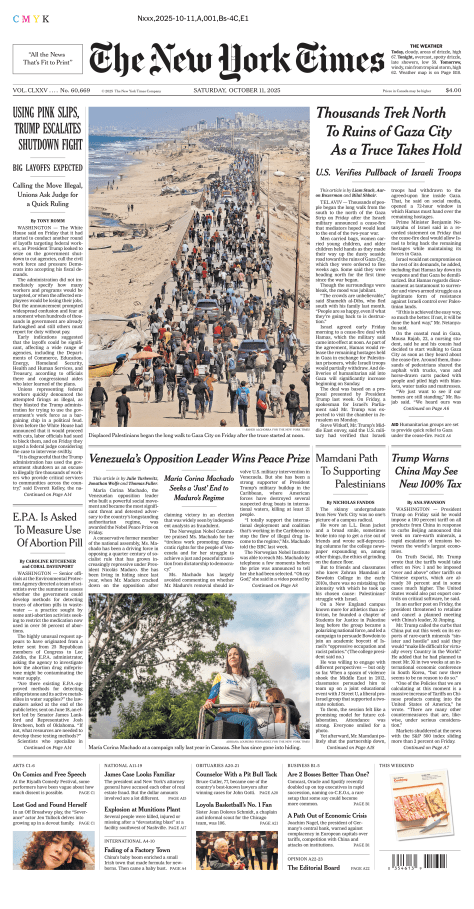
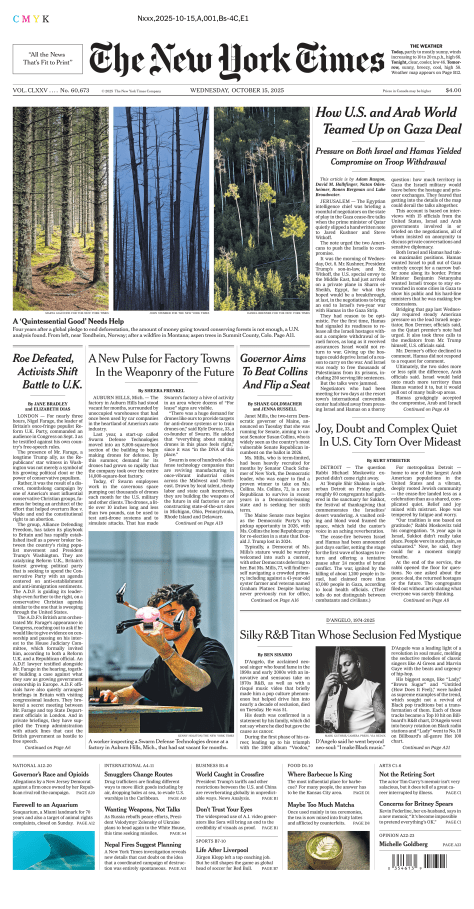
THE NEW YORK TIMES – WEDNESDAY, JULY 23, 2025

China Flexes Muscles at U.N. Cultural Agency, Just as President Trump Walks Away

Washington had been a buffer against China’s efforts to use UNESCO to influence education, historical designations and even artificial intelligence.

Iranian Officials Suspect Sabotage in String of Mysterious Fires

For weeks, fires and explosions have been reported almost daily in Iran. Officials are investigating what they think is a coordinated campaign.

E.P.A. Is Said to Draft a Plan to End Its Ability to Fight Climate Change

According to two people familiar with the draft, it would repeal the finding that greenhouse-gas emissions threaten life by dangerously warming the planet.

Republicans Rely on Trump’s Promises to Grease the Path for His Agenda

G.O.P. leaders scrounging for votes to push through President Trump’s priorities have increasingly turned to him and his team to cut side deals with holdouts.

Why “Hamlet” Matters In Our Technological Age

INTELLICUREAN (JULY 22, 2025):

“The time is out of joint: O cursed spite, / That ever I was born to set it right!” — Hamlet, Act I, Scene V

In 2025, William Shakespeare’s Hamlet no longer reads as a distant Renaissance relic but rather as a contemporary fever dream—a work that reflects our age of algorithmic anxiety, climate dread, and existential fatigue. The tragedy of the melancholic prince has become a diagnostic mirror for our present: grief-stricken, fragmented, hyper-mediated. Written in a time of religious upheaval and epistemological doubt, Hamlet now stands at the crossroads of collective trauma, ethical paralysis, and fractured memory.

As Jeremy McCarter writes in The New York Times essay Listen to ‘Hamlet.’ Feel Better., “We are Hamlet.” That refrain echoes across classrooms, podcasts, performance spaces, and peer-reviewed journals. It is not merely identification—it is diagnosis.

This essay weaves together recent scholarship, creative reinterpretations, and critical performance reviews to explore why Hamlet matters—right now, more than ever.

Grief and the Architecture of Memory

Hamlet begins in mourning. His father is dead. His mother has remarried too quickly. His place in the kingdom feels stolen. This grief—raw, intimate, but also national—is not resolved; it metastasizes. As McCarter observes, Hamlet’s sorrow mirrors our own in a post-pandemic, AI-disrupted society still reeling from dislocation, death, and unease.

In Hamlet, architecture itself becomes a mausoleum: Elsinore Castle feels less like a home and more like a prison of memory. Recent productions, including the Royal Shakespeare Company’s Hamlet: Hail to the Thief and the Mark Taper Forum’s 2025 staging, emphasize how space becomes a character. Set designs—minimalist, surveilled, hypermodern—render castles as cages, tightening Hamlet’s emotional claustrophobia.

This spatial reading finds further resonance in Jeffrey R. Wilson’s Essays on Hamlet (Harvard, 2021), where Elsinore is portrayed not just as a backdrop but as a haunted topography—a burial ground for language, loyalty, and truth. In a world where memories are curated by devices and forgotten in algorithms, Hamlet’s mourning becomes a radical act of remembrance.

Our own moment—where memories are stored in cloud servers and memorialized through stylized posts—finds its counter-image in Hamlet’s obsession with unfiltered grief. His mourning is not just personal; it is archival. To remember is to resist forgetting—and to mourn is to hold meaning against its erasure.

Madness and the Diseased Imagination

Angus Gowland’s 2024 article Hamlet’s Melancholic Imagination for Renaissance Studies draws a provocative bridge between early modern melancholy and twenty-first-century neuropsychology. He interprets Hamlet’s unraveling not as madness in the theatrical sense, but as a collapse of imaginative coherence—a spiritual and cognitive rupture born of familial betrayal, political corruption, and metaphysical doubt.

This reading finds echoes in trauma studies and clinical psychology, where Hamlet’s soliloquies—“O that this too too solid flesh would melt” and “To be, or not to be”—become diagnostic utterances. Hamlet is not feigning madness; he is metabolizing a disordered world through diseased thought.

McCarter’s audio adaptation of the play captures this inner turmoil viscerally. Told entirely through Hamlet’s auditory perception, the production renders the world as he hears it: fragmented, conspiratorial, haunted. The sound design enacts the “nutshell” of Hamlet’s consciousness—a sonic echo chamber where lucidity and delusion merge.

Gowland’s interdisciplinary approach, melding humoral theory with neurocognitive frameworks, reveals why Hamlet remains so psychologically contemporary. His imagination is ours—splintered by grief, reshaped by loss, and destabilized by unreliable truths.

Existentialism and Ethical Procrastination

Boris Kriger’s Hamlet: An Existential Study (2024) reframes Hamlet’s paralysis not as cowardice but as ethical resistance. Hamlet delays because he must. His world demands swift vengeance, but his soul demands understanding. His refusal to kill without clarity becomes an act of defiance in a world of urgency.

Kriger aligns Hamlet with Sartre’s Roquentin, Camus’s Meursault, and Kierkegaard’s Knight of Faith—figures who suspend action not out of fear, but out of fidelity to a higher moral logic. Hamlet’s breakthrough—“The readiness is all”—is not triumph but transformation. He who once resisted fate now accepts contingency.

This reading gains traction in modern performances that linger in silence. At the Mark Taper Forum, Hamlet’s soliloquies are not rushed; they are inhabited. Pauses become ethical thresholds. Audiences are not asked to agree with Hamlet—but to wait with him.

In an era seduced by velocity—AI speed, breaking news, endless scrolling—Hamlet’s slowness is sacred. He does not react. He reflects. In 2025, this makes him revolutionary.

Isolation and the Politics of Listening

Hamlet’s isolation is not a quirk—it is structural. The Denmark of the play is crowded with spies, deceivers, and echo chambers. Amid this din, Hamlet is alone in his need for meaning.

Jeffrey Wilson’s essay Horatio as Author casts listening—not speaking—as the play’s moral act. While most characters surveil or strategize, Horatio listens. He offers Hamlet not solutions, but presence. In an age of constant commentary and digital noise, Horatio becomes radical.

McCarter’s audio adaptation emphasizes this loneliness. Hamlet’s soliloquies become inner conversations. Listeners enter his psyche not through spectacle, but through headphones—alone, vulnerable, searching.

This theme echoes in retellings like Matt Haig’s The Dead Father’s Club, where an eleven-year-old grapples with his father’s ghost and the loneliness of unresolved grief. Alienation begins early. And in our culture of atomized communication, Hamlet’s solitude feels painfully modern.

We live in a world full of voices but starved of listeners. Hamlet exposes that silence—and models how to endure it.

Gender, Power, and Counter-Narratives

If Hamlet’s madness is philosophical, Ophelia’s is political. Lisa Klein’s novel Ophelia and its 2018 film adaptation give the silenced character voice and interiority. Through Ophelia’s eyes, Hamlet’s descent appears not noble, but damaging. Her own breakdown is less theatrical than systemic—borne from patriarchy, dismissal, and grief.

Wilson’s essays and Yan Brailowsky’s edited volume Hamlet in the Twenty-First Century (2023) expose the structural misogyny of the play. Hamlet’s world is not just corrupt—it is patriarchally decayed. To understand Hamlet, one must understand Ophelia. And to grieve with Ophelia is to indict the systems that broke her.

Contemporary productions have embraced this feminist lens. Lighting, costuming, and directorial choices now cast Ophelia as a prophet—her madness not as weakness but as indictment. Her flowers become emblems of political rot, and her drowning a refusal to play the script.

Where Hamlet delays, Ophelia is dismissed. Where he soliloquizes, she sings. And in this contrast lies a deeper truth: the cost of male introspection is often paid by silenced women.

Hamlet Reimagined for New Media

Adaptations like Alli Malone’s Hamlet: A Modern Retelling podcast transpose Hamlet into “Denmark Inc.”—a corrupt corporate empire riddled with PR manipulation and psychological gamesmanship. In this world, grief is bad optics, and revenge is rebranded as compliance.

Malone’s immersive audio design aligns with McCarter’s view: Hamlet becomes even more intimate when filtered through first-person sensory experience. Technology doesn’t dilute Shakespeare—it intensifies him.

Even popular culture—The Lion KingSons of Anarchy, countless memes—draws from Hamlet’s genetic code. Betrayal, grief, existential inquiry—these are not niche themes. They are universal templates.

Social media itself channels Hamlet. Soliloquies become captions. Madness becomes branding. Audiences become voyeurs. Hamlet’s fragmentation mirrors our own feeds—brilliant, performative, and crumbling at the edges.

Why Hamlet Still Matters

In classrooms and comment sections, on platforms like Bartleby.com or IOSR Journal, Hamlet remains a fixture of moral inquiry. He endures not because he has answers, but because he never stops asking.

What is the moral cost of revenge?
Can grief distort perception?
Is madness a form of clarity?
How do we live when meaning collapses?

These are not just literary questions. They are existential ones—and in 2025, they feel acute. As AI reconfigures cognition, climate collapse reconfigures survival, and surveillance reconfigures identity, Hamlet feels uncannily familiar. His Denmark is our planet—rotted, observed, and desperate for ethical reawakening.

Hamlet endures because he interrogates. He listens. He doubts. He evolves.

A Final Benediction: Readiness Is All

Near the end of the play, Hamlet offers a quiet benediction to Horatio:

“If it be now, ’tis not to come. If it be not to come, it will be now… The readiness is all.”

No longer raging against fate, Hamlet surrenders not with defeat, but with clarity. This line—stripped of poetic flourish—crystallizes his journey: from revenge to awareness, from chaos to ethical stillness.

“The readiness is all” can be read as a secular echo of faith—not in divine reward, but in moral perception. It is not resignation. It is steadiness.

McCarter’s audio finale invites listeners into this silence. Through Hamlet’s ear, through memory’s last echo, we sense peace—not because Hamlet wins, but because he understands. Readiness, in this telling, is not strategy. It is grace.

Conclusion: Hamlet’s Sacred Relevance

Why does Hamlet endure in the twenty-first century?

Because it doesn’t offer comfort. It offers courage.
Because it doesn’t resolve grief. It honors it.
Because it doesn’t prescribe truth. It wrestles with it.

Whether through feminist retellings like Ophelia, existential essays by Kriger, cognitive studies by Gowland, or immersive audio dramas by McCarter and Malone, Hamlet adapts. It survives. And in those adaptations, it speaks louder than ever.

In an age where memory is automated, grief is privatized, and moral decisions are outsourced to algorithms, Hamlet teaches us how to live through disorder. It reminds us that delay is not cowardice. That doubt is not weakness. That mourning is not a flaw.

We are Hamlet.
Not because we are doomed.
But because we are still searching.
Because we still ask what it means to be.
And what it means—to be ready.

THIS ESSAY WAS WRITTEN AND EDITED BY INTELLICUREAN USING AI

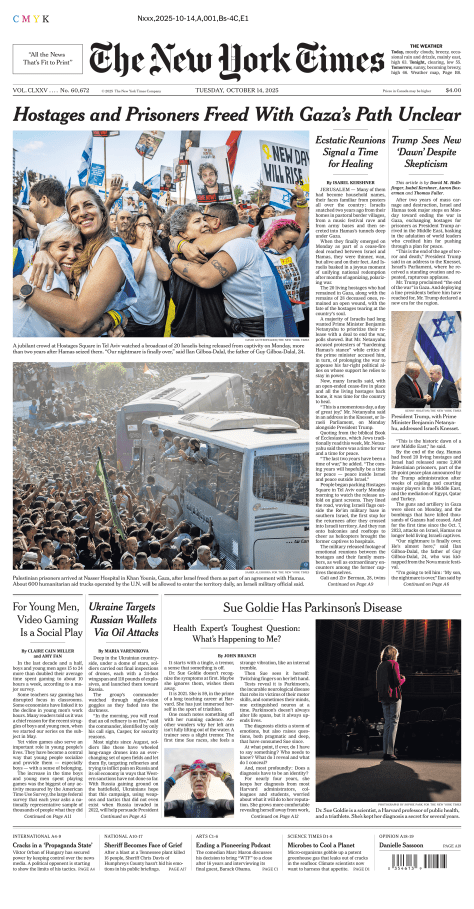
THE NEW YORK TIMES – TUESDAY, JULY 22, 2025

Trump’s Student Arrests, and the Lawsuit Fighting Them, Tread New Ground

The efforts by President Trump’s administration to deport foreign students who espoused pro-Palestinian views have no obvious legal parallel.

Israel Expands Offensive in Gaza and Raids a W.H.O. Office

Strikes targeted a city, Deir al-Balah, that had largely been spared and that had become an informal refuge for Palestinians fleeing other areas.

In Search of Trade Deal, Philippines’ Leader Will Meet With Trump

Iran’s Leaders Turn to a New Brand of Nationalism After Israeli and U.S. Attacks

The theocratic government is repurposing folklore and patriotic anthems as it seeks to channel national outrage into increasing its support at home.

The Fiscal Fantasies Of A “For-Profit” Government

BY INTELLICUREAN, JULY 21, 2025:

In the summer of 2025, former President Donald Trump and Commerce Secretary Howard Lutnick unveiled a bold proposal: the creation of an External Revenue Service (ERS), a federal agency designed to collect tariffs, fees, and other payments from foreign entities. Framed as a patriotic pivot toward self-sufficiency, the ERS would transform the U.S. government from a tax-funded service provider into a revenue-generating enterprise, capable of offsetting domestic tax burdens through external extraction. The idea, while politically magnetic, raises profound questions: Can the U.S. federal government become a “for-profit” entity? And if so, can the ERS be a legitimate mechanism for such a transformation?

This essay argues that while the concept of external revenue generation is not unprecedented, the rebranding of the U.S. government as a profit-seeking enterprise risks undermining its foundational principles. The ERS proposal conflates revenue with legitimacy, and profit with power, leading to a fundamental misunderstanding of the government’s role in society. We explore the constitutional, economic, and geopolitical dimensions of the ERS proposal, drawing on recent analyses from the Peterson Institute for International Economics, The Diplomat, and The New Yorker, to assess its fiscal viability, strategic risks, and national security implications.

Constitutional Foundations: Can a Republic Seek Profit?

The U.S. Constitution grants Congress the power to “lay and collect Taxes, Duties, Imposts and Excises” and to “regulate Commerce with foreign Nations” (Article I, Section 8). These provisions clearly authorize the federal government to generate revenue through tariffs and fees. Historically, tariffs served as a primary source of federal income, funding everything from infrastructure to military expansion during the 19th century.

However, the Constitution does not envision the government as a profit-maximizing entity. Its purpose, as articulated in the Preamble, is to “establish Justice, ensure domestic Tranquility, provide for the common defence, [and] promote the general Welfare.” These are public goods, not commercial outputs. The government’s legitimacy is grounded in its service to the people—not in its ability to generate surplus revenue.

The Federal Reserve offers a useful analogy here. While not a for-profit institution, the Fed earns more than it spends through its monetary operations—primarily interest on government securities—and remits excess income to the Treasury. Between 2011 and 2021, these remittances totaled over $920 billion. But this is not “profit” in the corporate sense. The Fed’s primary mandate is macroeconomic stability, not shareholder returns. Even during economic stress (as seen in 2022–2025), the Fed may run negative remittances, underscoring its non-commercial orientation.

In contrast, the ERS is framed as a profit center—an entity designed to extract wealth from foreign actors to reduce domestic tax burdens. This shift raises critical questions: Who are the “customers” of the ERS? What are the “products” it offers? And what happens when profit motives collide with diplomatic or humanitarian priorities?

Economic Modeling: Revenue vs. Net Gain

A rigorous analysis of Trump’s proposed tariffs comes from Chad P. Bown and Melina Kolb at the Peterson Institute for International Economics. In their April 2025 briefing, they use a global economic model to estimate the gross and net revenue generated by tariffs of 10%, 15%, and 20% on all imported goods.

Their findings are sobering:

  • A 15% universal tariff could generate $3.9 trillion in gross revenue over a decade (2025–2034), assuming no foreign retaliation.
  • However, after accounting for slower growth, reduced investment, and lower tax receipts from households and businesses, the net gain drops to $3.2 trillion.
  • If foreign countries retaliate with reciprocal tariffs, the net gain falls further to $1.5 trillion.
  • A 20% tariff results in the lowest net gain ($791 billion), due to intensified economic drag and retaliation.

These findings underscore a crucial distinction: tariffs are not free money. They impose costs on consumers, disrupt supply chains, and invite countermeasures. The ERS may collect billions, but its net contribution to fiscal health is far more modest—and potentially negative if retaliation escalates.

Additionally, tariff revenue is volatile and politically contingent. Tariffs can be reversed by executive order, invalidated by courts, or rendered moot by trade realignment. In short, the ERS lacks the predictability and stability necessary for a legitimate fiscal foundation. Tariffs are a risky and politically charged mechanism for revenue generation—making them an unreliable cornerstone for the country’s fiscal health.

Strategic Blowback: Reverse Friendshoring and Supply Chain Drift

Beyond economics, the ERS proposal carries significant geopolitical risks. In The Diplomat, Thiago de Aragao warns of a phenomenon he calls reverse friendshoring—where companies, instead of relocating supply chains away from China, move closer to it in response to U.S. tariffs.

The logic is simple: If exporting to the U.S. becomes prohibitively expensive, firms may pivot to serving Asian markets, leveraging China’s mature infrastructure and consumer base. This could undermine the strategic goal of decoupling from Chinese influence, potentially strengthening Beijing’s economic hand.

Examples abound:

  • A firm that invested in Mexico to reduce exposure to China redirected its exports to Latin America after Mexico was hit with new tariffs.
  • Another company shifted operations to Canada to avoid compounded U.S. duties—only to face new levies there as well.

This unpredictability erodes trust in U.S. trade policy and incentivizes supply chain diversification away from the U.S. As Aragao notes, “Protectionism may offer a temporary illusion of control, but in the long run, it risks pushing businesses away.”

The ERS, by monetizing tariffs, could accelerate this trend. If foreign firms perceive the U.S. as a hostile or unstable market, they will seek alternatives. And if allies are treated as adversaries, the strategic architecture of friendshoring collapses, leaving the U.S. economically isolated and diplomatically weakened.

National Security Costs: Alienating Allies

Perhaps the most damning critique of the ERS comes from Cullen Hendrix at the Peterson Institute, who argues that imposing tariffs on U.S. allies undermines national security. The U.S. alliance network spans over 60 countries, accounting for 38% of global GDP. These partnerships enhance deterrence, enable forward basing, and create markets for U.S. defense exports.

Tariffs—especially those framed as revenue tools—erode alliance cohesion. They signal that economic extraction trumps strategic cooperation. Hendrix warns that “treating alliance partners like trade adversaries will further increase intra-alliance frictions, weaken collective deterrence, and invite potential adversaries—none better positioned than China—to exploit these divisions.”

Moreover, the ERS’s indiscriminate approach—levying duties on both allies and rivals—blurs the line between economic policy and coercive diplomacy. It transforms trade into a zero-sum game, where even friends are fair targets. This undermines the credibility of U.S. commitments and may prompt allies to seek alternative trade and security arrangements.

Lutnick’s Barber Economics: Rhetoric vs. Reality

The ERS proposal is not merely a policy—it’s a performance. Nowhere is this clearer than in Howard Lutnick’s keynote at the Hill and Valley Forum, as reported in The New Yorker on July 21, 2025. Addressing a room of venture capitalists, defense contractors, and policymakers, Lutnick attempted to explain trade deficits using personal analogies: “I have a trade deficit with my barber,” he said. “I have a trade deficit with my grocery store. Right? I just buy stuff from them. That’s ridiculous.”

The crowd, described as “sophisticated tech and finance attendees,” was visibly uncomfortable. Lutnick’s analogies, while populist in tone, misread the room and revealed a deeper disconnect between economic complexity and simplistic transactionalism. As one attendee noted, “It’s obvious why Lutnick’s affect appeals to Trump. But it’s Bessent’s presence in the Administration that reassures us there is someone smart looking out for us.”

This contrast between Lutnick and Treasury Secretary Scott Bessent is telling. Bessent, who reportedly flew to Mar-a-Lago to urge Trump to pause the tariffs, represents the limits of ideological fervor when confronted with institutional complexity. Lutnick, by contrast, champions the ERS as a populist vessel—a way to turn deficits into dues, relationships into revenue, and governance into a business plan.

The ERS, then, is not just a fiscal experiment—it’s a philosophical battleground. Lutnick’s vision of government as a money-making enterprise may resonate with populist frustration, but it risks trivializing the structural and diplomatic intricacies of global trade. His “barber economics” may play well on cable news, but it falters under scrutiny from economists, allies, and institutional stewards.

Conclusion: Profit Is Not Purpose

The idea of a “for-profit” U.S. government, embodied in the External Revenue Service, is seductive in its simplicity. It promises fiscal relief without domestic taxation, strategic leverage through economic pressure, and a reassertion of American dominance in global trade. But beneath the surface lies a tangle of contradictions.

Constitutionally, the federal government is designed to serve—not to sell. Its legitimacy flows from the consent of the governed, not the extraction of foreign wealth. Economically, tariffs may generate gross revenue, but their net contribution is constrained by retaliation, inflation, and supply chain disruption. Strategically, the ERS risks alienating allies, incentivizing reverse friendshoring, and weakening collective security.

With Howard Lutnick as the plan’s leading voice—offering anecdotes like the barber and grocery store as proxies for international trade—the ERS becomes more than a revenue mechanism; it becomes a prism for reflecting the Administration’s governing style: transactional, simplified, and rhetorically appealing, yet divorced from systemic nuance. His “barber economics” may evoke applause from certain circles, but in the forums that shape long-term policy, it has landed with discomfort and disbelief.

The comparison between Lutnick and Treasury Secretary Scott Bessent, as reported in The New Yorker, captures this divide. Bessent, attempting to temper Trump’s protectionist instincts, represents the limits of ideological fervor when confronted with institutional complexity. Lutnick, by contrast, champions the ERS as a populist vessel—a way to turn deficits into dues, relationships into revenue, and governance into a business plan.

Yet governance is not a business, and the nation’s global responsibilities cannot be monetized like a corporate balance sheet. If America begins to treat its allies as clients, its rivals as profit centers, and its global footprint as a monetizable asset, it risks transforming foreign policy into a ledger—and leadership into a transaction.

The External Revenue Service, in its current form, fails to reconcile profit with purpose. It monetizes strength but neglects stewardship. It harvests dollars but undermines trust. And in doing so, it invites a broader reckoning—not just about trade and taxation, but about what kind of republic America wishes to be. For now, the ERS remains an emblem of ambition unmoored from architecture, where the dream of profit collides with the duty to govern.

THIS ESSAY WAS WRITTEN AND EDITED BY INTELLICUREAN USING AI

THE NEW YORKER MAGAZINE – JULY 28, 2025 PREVIEW

The illustrated cover for the July 28 2025 issue of The New Yorker in which many people are queuing in a line at an airport.

THE NEW YORKER MAGAZINE: The latest cover features Sergio García Sánchez and Lola Moral’s “Journeys” – Crossing the border.

Behind Trump’s Jeffrey Epstein Problem

The President has tried to blame the Democrats, and, more unexpectedly, he has called those in his base who have asked for a fuller accounting “weaklings” and “stupid.” By Benjamin Wallace-Wells

“Yes, And” for Downsized Federal Workers

A Washington, D.C., improv theatre invited recently laid-off civil servants to a free workshop. The goals: stay adaptable, and maybe even laugh. By Sadie Dingfelder

Donald Trump’s Tariff Dealmaker-in-Chief

How Howard Lutnick, the Secretary of Commerce, plans to transform government into a money-making enterprise. By Antonia Hitchens

THE NEW YORK TIMES – MONDAY, JULY, 21, 2025

How Trump Deflected His Base’s Wrath Over Jeffrey Epstein, at Least for Now

By tapping into other grievances, President Trump managed to turn one of the most fractious moments for some of his supporters into a unifying one.

An Accuser’s Story Suggests How Trump Might Appear in the Epstein Files

A former Jeffrey Epstein employee said that she told the F.B.I. in 1996 and 2006 about what she considered a troubling encounter with Donald Trump.

2 Deadly Shootings in 2 Days Highlight Dangers of Aid Distribution in Gaza

Israeli soldiers shot Palestinians near a food site and, the next day, near a U.N. convoy. Both incidents were symptoms of broader problems.

Trump Administration and Harvard Face Crucial Court Test

A hearing in Boston today is expected to shape the future of negotiations between the White House and the nation’s oldest university.

The Curated Persona vs. The Cultivated Spirit

“There is pleasure in the pathless woods,
There is rapture on the lonely shore,
There is society where none intrudes,
By the deep sea, and music in its roar.”
— Lord Byron, Childe Harold’s Pilgrimage

Intellicurean (July 20, 2025):

We are living in a time when almost nothing reaches us untouched. Our playlists, our emotions, our faces, our thoughts—all curated, filtered, reassembled. Life itself has been stylized and presented as a gallery: a mosaic of moments arranged not by meaning, but by preference. We scroll instead of wander. We select instead of receive. Even grief and solitude are now captioned.

Curation is no longer a method. It is a worldview. It tells us what to see, how to feel, and increasingly, who to be. What once began as a reverent gesture—a monk illuminating a manuscript, a poet capturing awe in verse—has become an omnipresent architecture of control. Curation promises freedom, clarity, and taste. But what if it now functions as a closed system—resisting mystery, filtering out surprise, and sterilizing transformation?

This essay explores the spiritual consequences of that system: how the curated life may be closing us off from the wildness within, the creative rupture, and the deeper architecture of meaning—the kind once accessed by walking, wandering, and waiting.

Taste and the Machinery of Belonging

Taste used to be cultivated: a long apprenticeship shaped by contradiction and immersion. One learned to appreciate Bach or Baldwin not through immediate alignment, but through dedicated effort and often, difficulty. This wasn’t effortless consumption; it was opening oneself to a demanding process of intellectual and emotional growth, engaging with works that pushed against comfort and forced a recalibration of understanding.

Now, taste has transformed. It’s no longer a deep internal process but a signal—displayed, performed, weaponized. Curation, once an act of careful selection, has devolved into a badge of self-justification, less about genuine appreciation and more about broadcasting allegiance.

What we like becomes who we are, flattened into an easily digestible profile. What we reject becomes our political tribe, a litmus test for inclusion. What we curate becomes our moral signature, a selective display designed to prove our sensibility—and to explicitly exclude others who don’t share it. This aesthetic alignment replaces genuine shared values.

This system is inherently brittle. It leaves little room for the tension, rupture, or revision essential for genuine growth. We curate for coherence, not depth—for likability, not truth. We present a seamless, unblemished self, a brand identity without flaw. The more consistent the aesthetic, the more brittle the soul becomes, unable to withstand the complexities of real life.

Friedrich Nietzsche, aware of human fragility, urged us in The Gay Science to “Become who you are.” But authentic becoming requires wandering, failing, and recalibrating. The curated life demands you remain fixed—an unchanging exhibit, perpetually “on brand.” There’s no space for the messy, contradictory process of self-discovery; each deviation is a brand inconsistency.

We have replaced moral formation with aesthetic positioning. Do you quote Simone Weil or wear linen neutrals? Your tastes become your ethics, a shortcut to moral authority. But what happens when we are judged not by our love or actions, but by our mood boards? Identity then becomes a container, rigidly defined by external markers, rather than an expansive horizon of limitless potential.

James Baldwin reminds us that identity, much like love, must be earned anew each day. It’s arduous labor. Curation offers no such labor—only the performative declaration of arrival. In the curated world, to contradict oneself is a failure of brand, not a deepening of the human story.

Interruption as Spiritual Gesture

Transformation—real transformation—arrives uninvited. It’s never strategic or trendy. It arrives as a breach, a profound disruption to our constructed realities. It might be a dream that disturbs, a silence that clarifies, or a stranger who speaks what you needed to hear. These are ruptures that stubbornly refuse to be styled or neatly categorized.

These are not curated moments. They are interruptions, raw and unmediated. And they demand surrender. They ask that we be fundamentally changed, not merely improved. Improvement often implies incremental adjustments; change implies a complete paradigm shift, a dismantling and rebuilding of perception.

Simone Weil wrote, “Attention is the rarest and purest form of generosity.” To give genuine attention—not to social media feeds, but to the world’s unformatted texture—is a profoundly spiritual act. It makes the soul porous, receptive to insights that transcend the superficial. It demands we quiet internal noise and truly behold.

Interruption, when received rightly, becomes revelation. It breaks the insidious feedback loop of curated content. It reclaims our precious time from the relentless scroll. It reminds us that meaning is not a product, but an inherent presence. It calls us out of the familiar, comfortable loop of our curated lives and into the fertile, often uncomfortable, unknown.

Attention is not surveillance. Surveillance consumes and controls. Attention, by contrast, consecrates; it honors sacredness. It is not monitoring. It is beholding, allowing oneself to be transformed by what is perceived. In an age saturated with infinite feeds, sacred attention becomes a truly countercultural act of resistance.

Wilderness as Revelation

Before curation became the metaphor for selfhood, wilderness was. For millennia, human consciousness was shaped by raw, untamed nature. Prophets were formed not in temples, but in the harsh crucible of the wild.

Moses wandered for forty years in the desert before wisdom arrived. Henry David Thoreau withdrew to Walden Pond not to escape, but to immerse himself in fundamental realities. Friedrich Nietzsche walked—often alone and ill—through the Alps, where he conceived eternal recurrence, famously declaring: “All truly great thoughts are conceived by walking.”

The Romantic poets powerfully echoed this truth. William Wordsworth, in Tintern Abbey, describes a profound connection to nature, sensing:

“A sense sublime / Of something far more deeply interfused, / Whose dwelling is the light of setting suns…”

John Keats saw nature as a portal to the eternal.

Yet now, even wilderness is relentlessly curated. Instagrammable hikes. Hashtagged retreats. Silence, commodified. We pose at the edge of cliffs, captioning our solitude for public consumption, turning introspection into performance.

But true wilderness resists framing. It is not aesthetic. It is initiatory. It demands discomfort, challenges complacency, and strips away pretense. It dismantles the ego rather than decorating it, forcing us to confront vulnerabilities. It gives us back our edges—the raw, unpolished contours of our authentic selves—by rubbing away the smooth veneers of curated identity.

In Taoism, the sage follows the path of the uncarved block. In Sufi tradition, the Beloved is glimpsed in the desert wind. Both understand: the wild is not a brand. It is a baptism, a transformative immersion that purifies and reveals.

Wandering as Spiritual Practice

The Romantics knew intuitively that walking is soulwork. John Keats often wandered through fields for the sheer presence of the moment. Lord Byron fled confining salons for pathless woods, declaring: “I love not Man the less, but Nature more.” His escape was a deliberate choice for raw experience.

William Wordsworth’s daffodils become companions, flashing upon “that inward eye / Which is the bliss of solitude.” Walking allows a convergence of external observation and internal reflection.

Walking, in its purest form, breaks pattern. It refuses the algorithm. It is an act of defiance against pre-determined routes. It offers revelation in exchange for rhythm, the unexpected insight found in the meandering journey. Each footstep draws us deeper into the uncurated now.

Bashō, the haiku master, offered a profound directive:

“Do not seek to follow in the footsteps of the wise. Seek what they sought.”

The pilgrim walks not primarily to arrive at a fixed destination, but to be undone, to allow the journey itself to dismantle old assumptions. The act of walking is the destination.

Wandering is not a detour. It is, in its deepest sense, a vocation, a calling to explore the contours of one’s own being and the world without the pressure of predetermined outcomes. It is where the soul regains its shape, shedding rigid molds imposed by external expectations.

Creation as Resistance

To create—freely, imperfectly, urgently—is the ultimate spiritual defiance against the tyranny of curation. The blank page is not optimized; it is sacred ground. The first sketch is not for immediate approval. It is for the artist’s own discovery.

Samuel Taylor Coleridge defined poetry as “the best words in the best order.” Rainer Maria Rilke declared, “You must change your life.” Friedrich Nietzsche articulated art’s existential necessity: “We have art so that we do not perish from the truth.” These are not calls to produce content for an audience; they are invitations to profound engagement with truth and self.

Even creation is now heavily curated by metrics. Poems are optimized for engagement. Music is tailored to specific moods. But art, in its essence, is not engagement; it is invocation. It seeks to summon deeper truths, to ask questions the algorithm can’t answer, to connect us to something beyond the measurable.

To make art is to stand barefoot in mystery—and to respond with courage. To write is to risk being misunderstood. To draw is to embrace the unpolished. This is not inefficiency. This is incarnation—the messy, beautiful process of bringing spirit into form.

Memory and the Refusal to Forget

The curated life often edits memory for coherence. It aestheticizes ancestry, reducing complex family histories to appealing narratives. It arranges sentiment, smoothing over rough edges. But real memory is a covenant with contradiction. It embraces the paradoxical coexistence of joy and sorrow.

John Keats, in his Ode to a Nightingale, confronts the painful reality of transience and loss: “Where youth grows pale, and spectre-thin, and dies…” Memory, in its authentic form, invites this depth, this uncomfortable reckoning with mortality. It is not a mood board. It is a profound reckoning, where pain and glory are allowed to dwell together.

In Jewish tradition, memory is deeply embodied. To remember is not merely to recall a fact; it is to retell, to reenact, to immerse oneself in the experience of the past, remaining in covenant with it. Memory is the very architecture of belonging. It does not simplify complex histories. Instead, it deepens understanding, allowing generations to draw wisdom and resilience from their heritage.

Curation flattens, reducing multifaceted experiences to digestible snippets. Memory expands, connecting us to the vast tapestry of time. And in the sacred act of memory, we remember how grace once broke into our lives, how hope emerged from despair. We remember so we can genuinely hope again, with a resilient awareness of past struggles and unexpected mercies.

The Wilderness Within

The final frontier of uncuration is profoundly internal: the wilderness within. This is the unmapped territory of our own consciousness, the unruly depths that resist control.

Søren Kierkegaard called it dread—not fear, but the trembling before the abyss of possibility. Nietzsche called it becoming—not progression, but metamorphosis. This inner wilderness resists styling, yearns for presence instead of performance, and asks for silence instead of applause.

Even our inner lives are at risk of being paved over. Advertisements and algorithmic suggestions speak to us in our own voice, subtly shaping desires. Choices feel like intuition—but are often mere inference. The landscape of our interiority, once a refuge for untamed thought, is being meticulously mapped and paved over for commercial exploitation, leaving little room for genuine self-discovery.

Simone Weil observed: “We do not obtain the most precious gifts by going in search of them, but by waiting for them.” The uncurated life begins in this waiting—in the ache of not knowing, in the quiet margins where true signals can penetrate. It’s in the embrace of uncertainty that authentic selfhood can emerge.

Let the Soul Wander

“Imagination may be compared to Adam’s dream—he awoke and found it truth.” — Keats

To live beyond curation is to choose vulnerability. It is to walk toward complexity, to embrace nuances. It is to let the soul wander freely and to cultivate patience for genuine waiting. It is to choose mystery over mastery, acknowledging truths revealed in surrender, not control.

Lord Byron found joy in pathless woods. Percy Bysshe Shelley sang alone, discovering his creative spirit. William Wordsworth found holiness in leaves. John Keats touched eternity through birdsong. Friedrich Nietzsche walked, disrupted, and lived with intensity.

None of these lives were curated. They were entered—fully, messily, without a predefined script. They were lives lived in engagement with the raw, untamed forces of self and world.

Perhaps / The truth depends on a walk around a lake, / A composing as the body tires, a stop. // To see hepatica, a stop to watch. / A definition growing certain…” Wallace Stevens

So let us make pilgrimage, not cultivate a profile. Let us write without audience, prioritizing authentic expression. Let us wander into ambiguity, embracing the unknown. And let us courageously welcome rupture, contradiction, and depth, for these are the crucibles of genuine transformation.

And there—at the edge of control, in the sacred wilderness within, where algorithms cannot reach—
Let us find what no curated feed can ever give.
And be profoundly changed by it.

THIS ESSAY WAS WRITTEN AND EDITED BY INTELLICUREAN USING

News, Views and Reviews For The Intellectually Curious