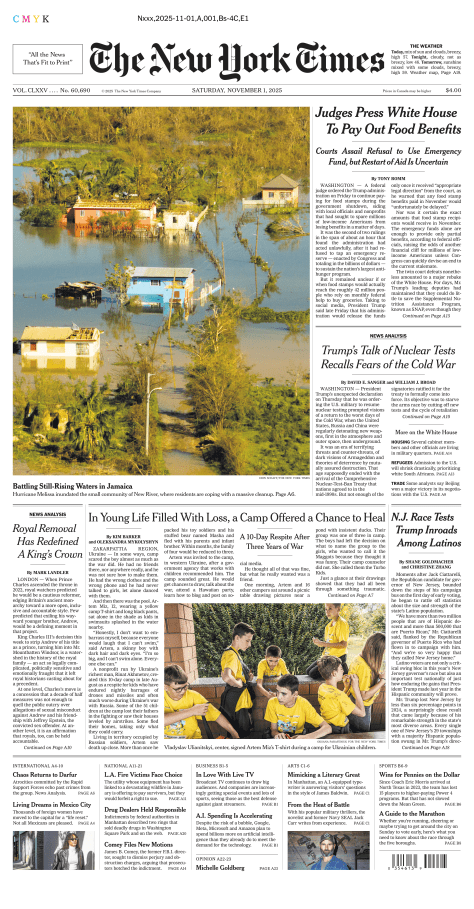
THE NEW YORK TIMES – SUNDAY, AUGUST 10, 2025

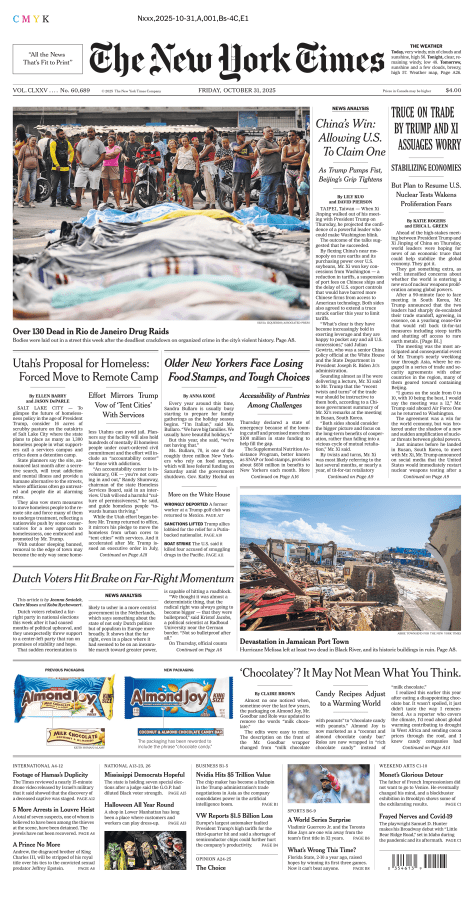
In a Trump-Putin Summit, Ukraine Fears Losing Say Over Its Future

Ukrainians have worried about a peace accord being struck without them. Mr. Trump and President Vladimir Putin of Russia are set to meet this week.

After Almost Losing Trump, Putin Gets His Ideal Meeting

Behind Europe’s Anguished Words on Gaza, a Flurry of Hard Diplomacy

Images of starving children spurred Britain, France and Germany to a tougher stance. Prime Minister Benjamin Netanyahu was undeterred.

Far-Right Israeli Minister Calls for Quicker Military Moves in Gaza

ADVANCING TOWARDS A NEW DEFINITION OF “PROGRESS”

By Michael Cummins, Editor, August 9, 2025

The very notion of “progress” has long been a compass for humanity, guiding our societies through eras of profound change. Yet, what we consider an improved or more developed state is a question whose answer has shifted dramatically over time. As the Cambridge Dictionary defines it, progress is simply “movement to an improved or more developed state, or to a forward position.” But whose state is being improved? And toward what future are we truly moving? The illusion of progress is perhaps most evident in the realm of technology, where breathtaking innovation often masks a troubling truth: the benefits are frequently unevenly shared, concentrating power and wealth while leaving many behind.

Historically, the definition of progress was a reflection of the era’s dominant ideology. In the medieval period, progress was a spiritual journey, a devout path toward salvation and the divine kingdom. The great cathedrals were not just architectural feats; they were monuments to this singular, sacred definition of progress. The Enlightenment shattered this spiritual paradigm, replacing it with the ascent of humanity through reason, science, and the triumph over superstition and tyranny. Thinkers like Voltaire and Condorcet envisioned a linear march toward a more enlightened, rational society.

This optimism fueled the Industrial Revolution, where figures like Auguste Comte and Herbert Spencer saw progress as a social evolution—an unstoppable climb toward knowledge and material prosperity. But this vision was a mirage for many. The steam engines that powered unprecedented economic growth also subjected workers to brutal, dehumanizing conditions, where child labor and dangerous factories were the norm. The Gilded Age, following this revolution, enriched railroad magnates and steel barons, while workers struggled in poverty and faced violent crackdowns on their efforts to organize.

Today, a similar paradox haunts our digital age. Meet Maria, a fictional yet representative 40-year-old factory worker in Flint, Michigan. For decades, her livelihood was a steady source of income for her family. But last year, the factory where she worked introduced an AI-powered assembly line, and her job, along with hundreds of others, was automated away. Maria’s story is not an isolated incident; it is a global narrative that reflects the experiences of billions. Technologies like the microchip, the algorithm, and generative AI promise to lift economies and solve complex problems, yet they often leave a trail of deepened inequality in their wake. Her story is a poignant call to arms, demanding that we re-examine our collective understanding of progress.

This essay argues for a new, more deliberate definition of progress—one that moves beyond the historical optimism rooted in automatic technological gains and instead prioritizes equity, empathy, and sustainability. We will explore the clash between techno-optimism, a blind faith in technology’s ability to solve all problems, and techno-realism, a balanced approach that seeks inclusive and ethical innovation. Drawing on the lessons of history and the urgent struggles of individuals like Maria, we will chart a course toward a progress that uplifts all, not just the powerful and the privileged.


The Myth of Automatic Progress

The allure of technology is undeniable. It is a siren’s song, promising a frictionless world of convenience, abundance, and unlimited potential. Marc Andreessen’s 2023 “Techno-Optimist Manifesto” captured this spirit perfectly, a rallying cry for the belief that technology is the engine of all good and that any critique is a form of “demoralization.” However, this viewpoint ignores the central lesson of history: innovation is not inherently a force for equality.

The Industrial Revolution, while a monumental leap for humanity, was a masterclass in how progress can widen the chasm between the rich and the poor. Factory owners, the Andreessens of their day, amassed immense wealth, while the ancestors of today’s factory workers faced dangerous, low-wage jobs and lived in squalor. Today, the same forces are at play. A 2023 McKinsey report projected that up to 30% of jobs in the U.S. could be automated by 2030, a seismic shift that will disproportionately affect low-income workers, the very demographic to which Maria belongs.

Progress, therefore, is not an automatic outcome of innovation; it is a result of conscious choices. As economists Daron Acemoglu and Simon Johnson argue in their pivotal 2023 book Power and Progress, the benefits of technology are not predetermined.

“The distribution of a technology’s benefits is not predetermined but rather a result of governance and societal choices.” — Daron Acemoglu and Simon Johnson, Power and Progress: Our Thousand-Year Struggle Over Technology and Prosperity

Redefining progress means moving beyond the naive assumption that technology’s gains will eventually “trickle down” to everyone. It means choosing policies and systems that uplift workers like Maria, ensuring that the benefits of automation are shared broadly, rather than being captured solely as corporate profits.


The Uneven Pace of Progress

Our perception of progress is often skewed by the dizzying pace of digital advancements. We see the exponential growth of computing power, the rapid development of generative AI, and the constant stream of new gadgets, and we mistakenly believe this is the universal pace of all human progress. But as Vaclav Smil, a renowned scholar on technology and development, reminds us, this is a dangerous illusion.

In his recent book, The Illusion of Progress, Smil meticulously dismantles this notion, arguing that while digital technologies soar, fundamental areas of human need—like energy and food production—are advancing at a far slower, more laborious pace.

“We are misled by the hype of digital advances, mistaking them for universal progress.” — Vaclav Smil, The Illusion of Progress: The Promise and Peril of Technology

A look at the data confirms Smil’s point. According to the International Energy Agency (IEA), the global share of fossil fuels in the primary energy mix only dropped from 85% to 80% between 2000 and 2022—a change so slow it is almost imperceptible. Simultaneously, despite technological advancements, global crop yields for staples like wheat have largely plateaued since 2010, according to a 2023 report from the Food and Agriculture Organization (FAO). This stagnation, combined with global population growth, has left an estimated 735 million people undernourished in 2022, a stark reminder that our most fundamental challenges are not being solved by the same pace of innovation we see in Silicon Valley.

Even the very tools of the digital revolution can be a source of regression. Social media, a technology once heralded as a democratizing force, has become a powerful engine for division and misinformation. For example, a 2023 BBC report documented how WhatsApp was used to fuel ethnic violence during the Kenyan elections. These platforms, while distracting us with their endless streams of content, often divert our attention from the deeper, more systemic issues squeezing families like Maria’s, such as stagnant wages and rising food prices.

Yet, progress is possible when innovation is directed toward systemic challenges. The rise of microgrid solar systems in Bangladesh, which has provided electricity to millions of households, demonstrates how targeted, appropriate technology can bridge gaps and empower communities. Redefining progress means prioritizing these systemic solutions over the next shiny gadget.


Echoes of History in Today’s World

Maria’s job loss in Flint is not a modern anomaly; it is an echo of historical patterns of inequality and division. It resonates with the Gilded Age of the late 19th century, when railroad monopolies and steel magnates like Carnegie amassed colossal fortunes while workers faced brutal, 12-hour days in unsafe factories. The violent Homestead Strike of 1892, where workers fought against wage cuts, is a testament to the bitter class struggle of that era. Today, wealth inequality rivals that gilded age, with a recent Oxfam report showing that the world’s richest 1% have captured almost two-thirds of all new wealth created since 2020. Families like Maria’s are left to struggle with rising rents and stagnant wages, a reality far removed from the promise of prosperity.

“History shows that technological progress often concentrates wealth unless society intervenes.” — Daron Acemoglu and Simon Johnson, Power and Progress

Another powerful historical parallel is the Dust Bowl of the 1930s. Decades of poor agricultural practices and corporate greed, driven by a myopic focus on short-term profit, led to an environmental catastrophe that displaced 2.5 million people. This environmental mismanagement is an eerie precursor to our current climate crisis. A recent NOAA report on California’s wildfires and other extreme weather events shows how a similar failure to prioritize long-term well-being over short-term gains is now displacing millions more, just as it did nearly a century ago.

In Flint, the social fabric is strained, with some residents blaming immigrants for economic woes—a classic scapegoat tactic that ignores the significant contributions of immigrants to the U.S. economy. This echoes the xenophobic sentiment of the 1920s Red Scare and the anti-immigrant rhetoric of the Great Depression. The rise of modern nationalism, fueled by social media and political leaders, mirrors the post-WWI isolationism that deepened the Great Depression. Unchecked AI-driven misinformation and viral “deepfakes” on platforms like X are the modern equivalent of 1930s radio propaganda, amplifying fear and division in our daily feeds.

“We shape our tools, and thereafter our tools shape us, often reviving old divisions.” — Yuval Noah Harari, Homo Deus: A Brief History of Tomorrow

Yet, history is not just a cautionary tale; it is also a source of hope. Germany’s proactive refugee integration programs in the mid-2010s, which trained and helped integrate hundreds of thousands of migrants into the workforce, show that societies can learn from past mistakes and choose inclusion over exclusion. A new definition of progress demands that we confront these cycles of inequality, fear, and division. By choosing empathy and equity, we can ensure that technology serves to bridge divides and uplift communities like Maria’s, rather than fracturing them further.


The Perils of Techno-Optimism

The belief that technology will, on its own, solve our most pressing problems—a phenomenon some scholars have termed “technowashing”—is a seductive but dangerous trap. It promises a quick fix while delaying the difficult, structural changes needed to address crises like climate change and social inequality.

In their analysis of climate discourse, scholars Sofia Ribeiro and Viriato Soromenho-Marques argue that techno-optimism is a distraction from necessary action.

“Techno-optimism distracts from the structural changes needed to address climate crises.” — Sofia Ribeiro and Viriato Soromenho-Marques, The Techno-Optimists of Climate Change

The Arctic’s indigenous communities, like the Inuit, face the existential threat of melting permafrost, which a 2023 IPCC report warns could threaten much of their infrastructure. Meanwhile, some oil companies continue to tout expensive and unproven technologies like direct air capture to justify continued fossil fuel extraction, all while delaying the real solutions—a massive investment in renewable energy—that could save trillions of dollars. This is not progress; it is a corporate strategy to externalize costs and delay accountability, echoing the tobacco industry’s denialism of the 1980s. As Nathan J. Robinson’s 2023 critique in Current Affairs notes, techno-optimism is a form of “blind faith” that ignores the need for regulation and ethical oversight, risking a repeat of catastrophes like the 2008 financial crisis, which cost the global economy trillions.

The gig economy is a perfect microcosm of this peril. Driven by AI platforms like Uber, it exemplifies how technology can optimize for profits at the expense of fairness. A recent study from UC Berkeley found that a significant portion of gig workers earn below the minimum wage, as algorithms prioritize efficiency over worker well-being. This echoes the unchecked speculative frenzy of the 1990s dot-com bubble, which ended with trillions in losses. Today, unchecked AI is amplifying these harms, with a 2023 Reuters study finding that a large percentage of content on platforms like X is misleading, fueling division and distrust.

“Technology without politics is a recipe for inequality and instability.” — Evgeny Morozov, The Net Delusion: The Dark Side of Internet Freedom

Yet, rejecting blind techno-optimism is not a rejection of technology itself. It is a demand for a more responsible, regulated approach. Denmark’s wind energy strategy, which has made it a global leader in renewables, is a testament to how pragmatic government regulation and public investment can outpace the empty promises of technowashing. Redefining progress means embracing this kind of techno-realism.


Choosing a Techno-Realist Path

To forge a new definition of progress, we must embrace techno-realism, a balanced approach that harnesses innovation’s potential while grounding it in ethics, transparency, and human needs. As Margaret Gould Stewart, a prominent designer, argues, this is an approach that asks us to design technology that serves society, not just markets.

This path is not about rejecting technology, but about guiding it. Think of the nurses in rural Rwanda, where drones zip through the sky, delivering life-saving blood and vaccines to remote clinics. According to data from the company Zipline, these drones have saved thousands of lives. This is technology not as a shiny, frivolous toy, but as a lifeline, guided by a clear human need.

History and current events show us that this path is possible. The Luddites of 1811, often dismissed as anti-progress, were not fighting against technology; they were fighting for fairness in the face of automation’s threat to their livelihoods. Their spirit lives on in the European Union’s landmark AI Act, which mandates transparency and safety standards to protect workers like Maria from biased algorithms. In Chile, a national program is retraining former coal miners to become renewable energy technicians, creating thousands of jobs and demonstrating that a just transition to a sustainable future is possible when policies prioritize people.

The heart of this vision is empathy. Finland’s national media literacy curriculum, which has been shown to be effective in combating misinformation, is a powerful model for equipping citizens to navigate the digital world. In communities closer to home, programs like Detroit’s urban gardens bring neighbors together to build solidarity across racial and economic divides. In Mexico, indigenous-led conservation projects are blending traditional knowledge with modern science to heal the land.

As Nobel laureate Amartya Sen wrote, true progress is about a fundamental expansion of human freedom.

“Development is about expanding the freedoms of the disadvantaged, not just advancing technology.” — Amartya Sen, Development as Freedom

Costa Rica’s incredible achievement of powering its grid with nearly 100% renewable energy is a beacon of what is possible when a nation aligns innovation with ethics. These stories—from Rwanda’s drones to Mexico’s forests—prove that technology, when guided by history, regulation, and empathy, can serve all.


Conclusion: A Progress We Can All Shape

Maria’s story—her job lost to automation, her family struggling in a community beset by historical inequities—is not a verdict on progress but a powerful, clear-eyed challenge. It forces us to confront the fact that progress is not an inevitable, linear march toward a better future. It is a series of deliberate choices, a constant negotiation between what is technologically possible and what is ethically and socially responsible. The historical echoes of inequality, environmental neglect, and division are loud, but they are not our destiny.

Imagine Maria today, no longer a victim of technological displacement but a beneficiary of a new, more inclusive model. Picture her retrained as a solar technician, her hands wiring a community-owned energy grid that powers Flint’s homes with clean energy. Imagine her voice, once drowned out by economic hardship, now rising on social media to share stories of unity and resilience, drowning out the divisive noise. This vision—where technology is harnessed for all, guided by ethics and empathy—is the progress we must pursue.

The path forward lies in action, not just in promises. It requires us to engage in our communities, pushing for policies that protect and empower workers. It demands that we hold our leaders accountable, advocating for a future where investments in renewable energy and green infrastructure are prioritized over short-term profits. It requires us to support initiatives that teach media literacy, allowing us to discern truth from the fog of misinformation. It is in these steps, grounded in the lessons of history, that we turn a noble vision into a tangible reality.

Progress, in its most meaningful sense, is not about the speed of a microchip or the efficiency of an algorithm. It is about the deliberate, collective movement toward a society where the benefits of innovation are shared broadly, where the most vulnerable are protected, and where our shared future is built on the foundations of empathy, community, and sustainability. It is a journey we must embark on together, a progress we can all shape.

Progress: movement to a collectively improved and more inclusively developed state, resulting in a lessening of economic, political, and legal inequality, a strengthening of community, and a furthering of environmental sustainability.


THIS ESSAY WAS WRITTEN AND EDITED UTILIZING AI

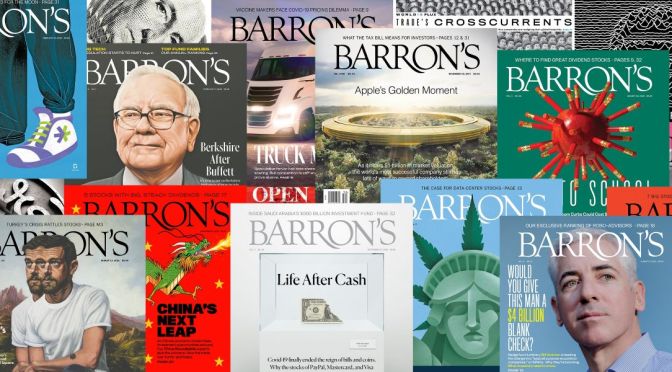
BARRON’S MAGAZINE – AUGUST 11, 2025 PREVIEW

BARRON’S MAGAZINE: The latest issue features ‘Everyone Is Along for the Crypto Ride Now, Even if It Ends Badly

Everyone Is Along for the Crypto Ride Now, Even if It Ends Badly

The guardrails are off as crypto prices soar. The next crash will hurt.

How Quantum Computing Could Upend Bitcoin

Hackers stand to gain “a superpower.” Will the crypto industry be ready?

5% Yields Are Hard to Find. Here Are 4 Dividend Stocks You Can Count On.

With elevated inflation, income investments that can keep up with the pace of rising prices are crucial.

THE NEW YORK TIMES – SATURDAY, AUGUST 9, 2025

Secret Compartments and Cartel Lookouts: How Fentanyl Reaches the U.S.

Times reporters documented how fentanyl was concealed by Mexico’s most powerful criminal syndicate, which is adapting amid a crackdown by two governments.

Mexico’s President Says U.S. Forces Are Unwelcome in Her Country

Zelensky Rejects Ceding Land to Russia After Trump Suggests a Land Swap

President Volodymyr Zelensky of Ukraine’s comments risk angering President Trump, who has made a peace deal one of his signature foreign policy goals.

Russia Goes After Ukraine With Distant Strikes and New Tactics

Assaults on Ukraine have intensified even as President Trump has threatened new sanctions. But Russia’s gains aren’t translating into a breakthrough, experts say.

Trump Says He Will Meet With Putin in Alaska Next Week

The Humanist Genius Of Boccaccio’s “Dirty Tales”

By Michael Cummins, Editor, August 8, 2025

The enduring literary fame of the Italian writer and humanist Giovanni Boccaccio (1313-1375) is a monument to paradox. His name has been synonymous with the ribald, lascivious, and often obscene tales of the Decameron, a reputation that stands in stark opposition to the scholarly humanist who devoted his life to promoting Dante, meticulously copying ancient manuscripts, and writing a monumental work of literary theory. This seemingly irreconcilable contradiction, however, was not a sign of a conflicted personality but a masterfully deployed strategy.

Boccaccio’s genius lay in his ability to harness this paradox—juxtaposing the vulgar with the profound, the entertaining with the intellectual, the vernacular with the classical—to achieve his most ambitious goals. As Barbara Newman writes in her review “Dirty Books,” Boccaccio “used the irresistible allure of obscenity as a Trojan horse” to advance a revolutionary literary and intellectual agenda, ultimately establishing a new standard for vernacular literature and its relationship with the reader. He even feared this reputation, fretting that female readers, to whom he had dedicated the book, would consider him:

“a foul-mouthed pimp, a dirty old man.”

It was this very anxiety, however, that Boccaccio would so expertly exploit. His work, far from being a moral compromise, was a brilliant act of subversion. It offered a compelling blend of popular entertainment and intellectual rigor, creating a new literary space that transcended the rigid social and intellectual hierarchies of his time. The Decameron was not just a collection of tales but a comprehensive literary project, a direct challenge to the staid Latin humanism of his peers, and a deliberate attempt to shape the future of a nascent Italian literary tradition.

The “Light Fare” of Romance

Boccaccio’s first and most crucial strategic maneuver was the deliberate choice to write for an audience that had been largely ignored by the literary establishment: the common people, and especially women. In an era dominated by humanists who saw the Latin language as the only worthy vehicle for serious intellectual thought, Boccaccio’s decision to compose his masterpiece in the Italian vernacular was a revolutionary act. The review of his biography notes that few women could read Latin, and that his vernacular works were, in part, a response to their plight, offering them a mind-broadening occupation beyond their cloistered chambers. The “light fare” of romance and other stories was the key that unlocked this new readership, and Boccaccio brilliantly understood that the most effective way to captivate this audience was through sheer entertainment.

The scandalous and titillating stories, such as the tale of Alibech and Rustico, served as an irresistible hook. These seemingly frivolous tales were the attractive exterior of the Trojan horse, designed to slip past the defenses of literary elitism and cultural propriety, and gain access to an audience that was hungry for engaging material. In doing so, Boccaccio laid the groundwork for a literary future where the vernacular would reign supreme and where the lines between high art and popular entertainment would be forever blurred. He openly admitted to this strategy, telling his critics:

“the fact is that ladies have already been the reason for my composing thousands of verses, while the Muses were in no way the cause.”

This statement, with its characteristic blend of humility and boldness, was both a gracious dedication to his female audience and a powerful declaration of his revolutionary purpose: to create a new form of literature for a new kind of reader.

Once inside the gates, Boccaccio’s Trojan horse began its true work, embedding profound scholarly and social critiques within the entertaining narratives. The first of these, and one of the most powerful, was his use of satire to expose the hypocrisies of popular piety and clerical corruption. The tale of Ser Ciappelletto, the heinous villain who, on his deathbed, fakes a pious confession to an unwitting friar, is not merely a funny story. It is a brilliant, inverted hagiography that exposes the emptiness of a religious system based on appearances rather than genuine faith.

a scholarly and theological examination of popular piety, raising serious questions about the nature of sin, redemption, and the efficacy of the Church’s authority.

Boccaccio’s meticulous description of Ciappelletto’s fabricated saintliness and the friar’s unquestioning credulity is a scathing critique of a society that would venerate a man based on a convincing lie. This tale, disguised as a vulgar joke, functions as a scholarly and theological examination of popular piety, raising serious questions about the nature of sin, redemption, and the efficacy of the Church’s authority. This intellectual core is hidden beneath the surface of a simple, bawdy tale, a testament to Boccaccio’s strategic genius.

Entertaining Tales to Present Shockingly Progressive Philosophical Ideas

Boccaccio also used his entertaining tales to present shockingly progressive philosophical ideas. The story of Saladin and the Jewish moneylender Melchisedek is a prime example. The core of this story is the “Ring Parable,” in which a father with three equally beloved sons has three identical rings made, so that no one son can prove he holds the “true” inheritance. Melchisedek uses this parable to cleverly sidestep Saladin’s theological trap about which of the three Abrahamic religions is the true one. This tale, with its message of religious tolerance and the indeterminacy of religious truth, is an astonishingly modern concept for the 14th century.

Boccaccio’s decision to embed this complex philosophical lesson within a compelling narrative about a clever Jewish moneylender and a benevolent sultan was a stroke of genius. It made a difficult and dangerous idea palatable and memorable, allowing it to be discussed and absorbed by an audience that would likely never have read a dry theological treatise. It is no wonder that centuries later, Gotthold Lessing would make this same parable the centerpiece of his own play, Nathan the Wise, an impassioned plea for interreligious peace.

“a Jewish man who converts to Christianity despite witnessing the total debauchery of the pope and his clerics. He reasons that no institution so depraved could have survived without divine aid.”

The most politically charged of Boccaccio’s embedded critiques is the tale of the Jewish man Abraham, who, after a visit to Rome, converts to Christianity despite witnessing the total debauchery of the pope and his clerics. He reasons that no institution so depraved could have survived without divine aid. While the tale is a humorous inversion of the traditional conversion story, its message is deeply subversive and profoundly serious.

It serves as a devastating critique of clerical corruption, an attack so potent that it resonated for centuries, even finding an admirer in the less-than-tolerant Martin Luther. The review notes that Luther preferred this story for its “vigorous anti-Catholic message,” a clear indication that Boccaccio’s seemingly simple tale had a scholarly and political weight far beyond mere entertainment. This tale, along with the others, reveals that the Decameron was not just a collection of stories but a well-orchestrated assault on the religious and social institutions of his day, all delivered under the guise of an amusing “dirty book.”

Shifting Moral Blame

Boccaccio’s most explicit defense of his method can be found in his own writings, where he articulated a revolutionary literary theory that placed the moral responsibility for a work squarely on the reader. In the introduction to Book 4 and his conclusion to the Decameron, Boccaccio confronts his prudish critics head-on. He disarmingly accepts their accusations that he wrote to please women, arguing that the Muses themselves are ladies. But his most significant contribution is his groundbreaking theory of “reader responsibility.” Drawing on St. Paul, he argues that “to the pure all things are pure,” and that a corrupt mind sees nothing but corruption everywhere. This was not a flimsy excuse for his bawdy tales but a serious philosophical statement about the nature of interpretation and the autonomy of fiction. He drove this point home with a pointed command to his detractors:

“the lady who is forever saying her prayers or baking… cakes for her confessor should leave my tales alone,”

Boccaccio was, in effect, defending the right to write for amusement while simultaneously ensuring that those who sought a deeper meaning would be rewarded with profound truths.

The “Feminine” Chain

This revolutionary theory was not an isolated thought but was, as the review so eloquently puts it, “braided together and gendered feminine.” This final act cemented his position as a far-sighted innovator, one who saw the future of literature not in the elitist cloisters of humanism but in the hands of the wider public. Boccaccio’s defense of vernacularity, writing for entertainment, and reader responsibility all coalesced into a single, cohesive argument about the nature of literature. In his Latin masterpiece, the Genealogy of the Pagan Gods, Boccaccio defined poetry as a:

“fervent and exquisite invention” proceeding from the bosom of God.

By dedicating his works to women, by championing the vernacular language they could read, and by giving them the power to interpret the stories for themselves, Boccaccio was creating a new and enduring literary canon. He was not only writing for a new audience; he was creating it, and he was giving it the tools to appreciate literature on its own terms, free from the conservative constraints of his era.

Conclusion

Boccaccio’s reputation as a purveyor of “dirty” tales is not a stain on his scholarly legacy, but the very tool he used to forge it. His strategic use of popular, entertaining stories was a brilliant, multilayered gambit to achieve his most ambitious goals: to create a new literary audience, to disseminate challenging intellectual and philosophical ideas, and to articulate a groundbreaking theory of literature itself. By packaging his sharp wit, profound social critiques, and revolutionary ideas within the guise of a “commedia profana,”

His genius, as a biographer would later note, lay in his “psychological fragility” that led to a restlessness and a willingness to “experiment in genre and style.”

Boccaccio bypassed the conservative gatekeepers of his time and proved that literature could be both enjoyable and intellectually rigorous. His genius, as a biographer would later note, lay in his “psychological fragility” that led to a restlessness and a willingness to “experiment in genre and style.” This willingness, combined with his strategic mind, secured his place as a foundational figure of the Renaissance and as a truly modern writer—one who understood that the most effective way to change minds was to first capture hearts and imaginations, even with the “dirtiest” of stories.

Boccaccio’s influence stretches far beyond his immediate contemporaries. His work became a cornerstone for a new literary tradition that valued realism and human psychology. Writers like Chaucer, despite his reluctance to name him, were clearly influenced by Boccaccio’s narrative structures and characterizations. Later, in the English Renaissance, Shakespeare drew inspiration from Boccaccio’s plots for plays like All’s Well That Ends Well and Cymbeline. The development of the modern novel, with its emphasis on detailed character portraits and the use of dialogue to drive the plot, owes a significant debt to Boccaccio’s innovations. He was among the first to give voice to the full spectrum of humanity, from the most pious to the most profane, laying the groundwork for the rich, multifaceted characters we see in literature today. His legacy is not merely that of a storyteller, but of a literary architect who built the foundations of a new, more expansive, and more humanistic form of writing.

Works Cited: Newman, Barbara. “Dirty Books.” Review of Boccaccio: A Biography, by Marco Santagata, and Boccaccio Defends Literature, by Brenda Deen Schildgen. London Review of Books, 14 August 2025.

THIS ESSAY WAS WRITTEN AND EDITED UTILIZING AI

LONDON REVIEW OF BOOKS – AUGUST 14, 2025 PREVIEW

LONDON REVIEW OF BOOKS: The latest issue features Tariffs Before Trump; Boccaccio’s Dirty Book and Constance Marten’s Defiance

Exile Economics: If Globalisation Fails by Ben Chu

No Trade Is Free: Changing Course, Taking on China and Helping America’s Workers by Robert Lighthizer

White Light: The Elemental Role of Phosphorus – in Our Cells, in Our Food and in Our World by Jack Lohmann

Boccaccio: A Biography by Marco Santagata, translated by Emlyn Eisenach

Boccaccio Defends Literature by Brenda Deen Schildgen

THE NEW YORK TIMES – FRIDAY, AUGUST 8, 2025

Netanyahu, Aiming to Capture Gaza City, Risks Ending in Familiar Deadlock

Time and again, Prime Minister Benjamin Netanyahu has pledged to defeat Hamas by force. The decision to capture Gaza City repeats a strategy that has failed in the past.

Trump Escalates a Fight Over How to Measure Merit in American Education

President Trump’s demand for college admissions data enters a debate over how grades and test scores should be weighed against less quantitative measures.

Can Russia’s Economy Withstand Trump’s Pressure?

The Russian economy was slowing even before President Trump’s latest threats. But the Kremlin has enough money to keep fighting in Ukraine.

SCIENCE MAGAZINE – AUGUST 8, 2025 PREVIEW

Science issue cover

SCIENCE MAGAZINE: The latest issue features ‘Evoloving Immunity’…

The multifunctional immune system

Thank ketchup, and interbreeding, for your French fries

Hybridization 9 million years ago gave potatoes the genetic knack to develop tubers, a new study finds

Study reveals industrial-scale publishing fraud

Sophisticated global networks are infiltrating journals to publish fake papers

AI-generated text surges in research papers

One-fifth of computer science papers may include AI-written sentences

The Peril Of Perfection: Why Utopian Cities Fail

By Michael Cummins, Editor, August 7, 2025

Throughout human history, the idea of a perfect city—a harmonious, orderly, and just society—has been a powerful and enduring dream. From the philosophical blueprints of antiquity to the grand, state-sponsored projects of the modern era, the desire to create a flawless urban space has driven thinkers and leaders alike. This millennia-long aspiration, rooted in a fundamental human longing for order and a rejection of present-day flaws, finds its most recent and monumental expression in China’s Xiongan New Area, a project highlighted in an August 7, 2025, Economist article titled “Xi Jinping’s city of the future is coming to life.” Xiongan is both a marvel of technological and urban design and a testament to the persistent—and potentially perilous—quest for an idealized city.

By examining the historical precedents of utopian thought, we can understand Xiongan not merely as a contemporary infrastructure project but as the latest chapter in a timeless and often fraught human ambition to build paradise on earth. This essay will trace the evolution of the utopian ideal from ancient philosophy to modern practice, arguing that while Xiongan embodies the most technologically advanced and politically ambitious vision to date, its top-down, state-driven nature and astronomical costs raise critical questions about its long-term viability and ability to succeed where countless others have failed.

The Philosophical and Historical Roots

The earliest and most iconic examples of this utopian desire were theoretical and philosophical, serving as intellectual critiques rather than practical blueprints. Plato’s mythological city of Atlantis, described in his dialogues Timaeus and Critias, was not just a lost city but a complex philosophical thought experiment. Plato detailed a powerful, technologically advanced, and ethically pure island society, governed by a wise and noble lineage. The city itself was a masterpiece of urban planning, with concentric circles of land and water, advanced canals, and stunning architecture.

However, its perfection was ultimately undone by human greed and moral decay. As the Atlanteans became corrupted by hubris and ambition, their city was swallowed by the sea. This myth is foundational to all subsequent utopian thought, serving as a powerful and enduring cautionary tale that even the most perfect physical and social structure is fragile and susceptible to corruption from within. It suggests that a utopian society cannot simply be built; its sustainability is dependent on the moral fortitude of its citizens.

Centuries later, in 1516, Thomas More gave the concept its very name with his book Utopia. More’s work was a masterful social and political satire, a searing critique of the harsh realities of 16th-century England. He described a fictional island society where there was no private property, and all goods were shared. The citizens worked only six hours a day, with the rest of their time dedicated to education and leisure.

“For where pride is predominant, there all these good laws and policies that are designed to establish equity are wholly ineffectual, because this monster is a greater enemy to justice than avarice, anger, envy, or any other of that kind; and it is a very great one in every man, though he have never so much of a saint about him.” – Utopia by Thomas More

The society was governed by reason and justice, and there were no social classes, greed, or poverty. More’s Utopia was not about a perfect physical city, but a perfect social structure. It was an intellectual framework for political philosophy, designed to expose the flaws of a European society plagued by poverty, inequality, and the injustices of land enclosure. Like Atlantis, it existed as an ideal, a counterpoint to the flawed present, but it established a powerful cultural archetype.

The city as a reflection of societal ideals. — Intellicurean

Following this, Francis Bacon’s unfinished novel New Atlantis (1627) offered a different, more prophetic vision of perfection. His mythical island, Bensalem, was home to a society dedicated not to social or political equality, but to the pursuit of knowledge. The core of their society was “Salomon’s House,” a research institution where scientists worked together to discover and apply knowledge for the benefit of humanity. Bacon’s vision was a direct reflection of his advocacy for the scientific method and empirical reasoning.

In his view, a perfect society was one that systematically harnessed technological innovation to improve human life. Bacon’s utopia was a testament to the power of collective knowledge, a vision that, unlike More’s, would resonate profoundly with the coming age of scientific and industrial revolution. These intellectual exercises established a powerful cultural archetype: the city as a reflection of societal ideals.

From Theory to Practice: Real-World Experiments

As these ideas took root, the dream of a perfect society moved from the page to the physical world, often with mixed results. The Georgia Colony, founded in 1732 by James Oglethorpe, was conceived with powerful utopian ideals, aiming to be a fresh start for England’s “worthy poor” and debtors. Oglethorpe envisioned a society without the class divisions that plagued England, and to that end, his trustees prohibited slavery and large landholdings. The colony was meant to be a place of virtue, hard work, and abundance. Yet, the ideals were not fully realized. The prohibition on slavery hampered economic growth compared to neighboring colonies, and the trustees’ rules were eventually overturned. The colony ultimately evolved into a more typical slave-holding, plantation-based society, demonstrating how external pressures and economic realities can erode even the most virtuous of founding principles.

In the 19th century, with the rise of industrialization, several communities were established to combat the ills of the new urban landscape. The Shakers, a religious community founded in the 18th century, are one of America’s most enduring utopian experiments. They built successful communities based on communal living, pacifism, gender equality, and celibacy. Their belief in simplicity and hard work led to a reputation for craftsmanship, particularly in furniture making. At their peak in the mid-19th century, there were over a dozen Shaker communities, and their economic success demonstrated the viability of communal living. However, their practice of celibacy meant they relied on converts and orphans to sustain their numbers, a demographic fragility that ultimately led to their decline. The Shaker experience proved that a society’s success depends not only on its economic and social structure but also on its ability to sustain itself demographically.

These real-world attempts demonstrate the immense difficulty of sustaining a perfect society against the realities of human nature and economic pressures. — Intellicurean

The Transcendentalist experiment at Brook Farm (1841-1847) attempted to blend intellectual and manual labor, blurring the lines between thinkers and workers. Its members, who included prominent figures like Nathaniel Hawthorne, believed that a more wholesome and simple life could be achieved in a cooperative community. However, the community struggled from the beginning with financial mismanagement and the impracticality of their ideals. The final blow was a disastrous fire that destroyed a major building, and the community was dissolved. Brook Farm’s failure illustrates a central truth of many utopian experiments: idealism can falter in the face of economic pressures and simple bad luck.

A more enduring but equally radical experiment, the Oneida Community (1848-1881), achieved economic success through manufacturing, particularly silverware, under the leadership of John Humphrey Noyes. Based on his concept of “Bible Communism,” they practiced communal living and a system of “complex marriage.” Despite its radical social structure, the community thrived economically, but internal disputes and external pressures ultimately led to its dissolution. These real-world attempts demonstrate the immense difficulty of sustaining a perfect society against the realities of human nature and economic pressures.

Xiongan: The Modern Utopia?

Xiongan is the natural, and perhaps ultimate, successor to these modern visions. It represents a confluence of historical utopian ideals with a uniquely contemporary, state-driven model of urban development. Touted as a “city of the future,” Xiongan promises short, park-filled commutes and a high-tech, digitally-integrated existence. It seeks to be a model of ecological civilization, where 70% of the city is dedicated to green space and water, an explicit rejection of the “urban maladies” of pollution and congestion that plague other major Chinese cities.

Its design principles are an homage to the urban planners of the past, with a “15-minute lifecycle” for residents, ensuring all essential amenities are within a short walk. The city’s digital infrastructure is also a modern marvel, with digital roads equipped with smart lampposts and a supercomputing center designed to manage the city’s traffic and services. In this sense, Xiongan is a direct heir to Francis Bacon’s vision of a society built on scientific and technological progress.

Unlike the organic, market-driven growth of a city like Shenzhen, Xiongan is an authoritarian experiment in building a perfect city from scratch. — The Economist

This vision, however, is a top-down creation. As a “personal initiative” of President Xi, its success is a matter of political will, with the central government pouring billions into its construction. The project is a key part of the “Jing-Jin-Ji” (Beijing-Tianjin-Hebei) coordinated development plan, meant to relieve the pressure on the capital. Unlike the organic, market-driven growth of a city like Shenzhen, Xiongan is an authoritarian experiment in building a perfect city from scratch. Shenzhen, for example, was an SEZ (Special Economic Zone) that grew from the bottom up, driven by market forces and a flexible policy environment. It was a chaotic, rapid, and often unplanned explosion of economic activity. Xiongan, in stark contrast, is a meticulously planned project from its very inception, with a precise ideological purpose to showcase a new kind of “socialist” urbanism.

This centralized approach, while capable of achieving rapid and impressive infrastructure development, runs the risk of failing to create the one thing a true city needs: a vibrant, organic, and self-sustaining culture. The criticisms of Xiongan echo the failures of past utopian ventures; despite the massive investment, the city’s streets remain “largely empty,” and it has struggled to attract the talent and businesses needed to become a bustling metropolis. The absence of a natural community and the reliance on forced relocations have created a city that is technically perfect but socially barren.

The Peril of Perfection

The juxtaposition of Xiongan with its utopian predecessors highlights the central tension of the modern planned city. The ancient dream of Atlantis was a philosophical ideal, a perfect society whose downfall served as a moral warning against hubris. The real-world communities of the 19th century demonstrated that idealism could falter in the face of economic and social pressures, proving that a perfect society is not a fixed state but a dynamic, and often fragile, process. The modern reality of Xiongan is a physical, political, and economic gamble—a concrete manifestation of a leader’s will to solve a nation’s problems through grand design. It is a bold attempt to correct the mistakes of the past and a testament to the immense power of a centralized state. Yet, the question remains whether it can escape the fate of its predecessors.

The ultimate verdict on Xiongan will not be about the beauty of its architecture or the efficiency of its smart infrastructure alone, but whether it can successfully transcend its origins as a state project. — The Economist

The ultimate verdict on Xiongan will not be about the beauty of its architecture or the efficiency of its smart infrastructure alone, but whether it can successfully transcend its origins as a state project to become a truly livable, desirable, and thriving city. Only then can it stand as a true heir to the timeless dream of a perfect urban space, rather than just another cautionary tale. Whether a perfect city can be engineered from the top down, or if it must be a messy, organic creation, is the fundamental question that Xiongan, and by extension, the modern world, is attempting to answer.

THIS ESSAY WAS WRITTEN AND EDITED UTILIZING AI

THE ECONOMIST MAGAZINE – AUGUST 9, 2025 PREVIEW

THE ECONOMIST MAGAZINE: The latest issue features Why Israel must hold itself to account

Why Israel must hold itself to account

And how it can be made to do so

Donald Trump’s awful trade policy will outlast him

He thinks America is winning. It is not

Buy now, pay later gets a bad rap. But it could be useful

Provided lenders open up

News, Views and Reviews For The Intellectually Curious