

Holidays in New York City are quite an experience. Winter Village at Bryant Park is one of the best locations to experience holidays in New York City. Bryant Park is a ~10 acre public park located between 5th and 6th Avenues and 40th and 42nd streets in Midtown Manhattan. Every winter, the park turns into a winter village consisting of an ice rink, cafes and small shops selling gift items. Winter Village at Bryant Park is one of the place you must visit while spending holidays in New York City.

Walking Tours: Christmas Season In Paris, France
Filmed on November 28th, 2020 in Paris, France.
【Locations】 00:00 Preview 00:24 Starting Point 00:32 1st arrondissement of Paris / 1er arrondissement de Paris 01:55 Avenue de l’Opéra 11:11 Place de l’Opéra 12:13 Palais Garnier / Opéra Garnier 14:17 Rue de la Paix 17:51 Colonne Vendôme 18:12 Place Vendôme 21:20 Rue de Castiglione 23:53 Rue de Rivoli 28:19 Place des Pyramides 32:49 Place du Carrousel 33:40 Louvre Pyramid / Pyramide du Louvre
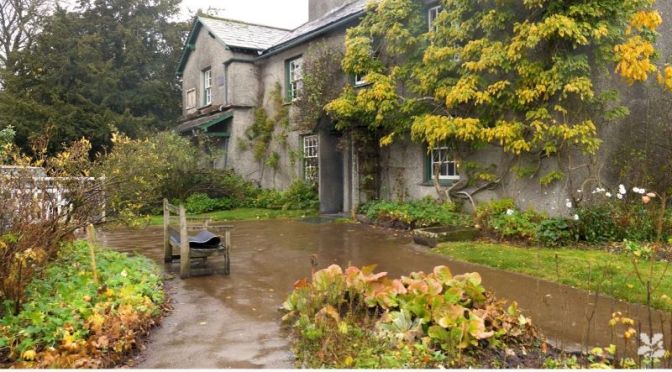
Literary Travel: ‘Hill Top’ – Cumbria, England Home Of Beatrix Potter (Video)
Hill Top, the much-loved Cumbrian home of author Beatrix Potter, creator of the character Peter Rabbit™. Although the farm is closed at the moment you can still explore the writer’s paintings, drawings, treasured objects, as well as the surrounding countryside that inspired her. Look out for your favourite characters along the way.
Hill Top is a 17th-century house in Near Sawrey near Hawkshead, in the English county of Cumbria. It is an example of Lakeland vernacular architecture with random stone walls and slate roof. The house was once the home of children’s author and illustrator Beatrix Potter who left it to the National Trust.
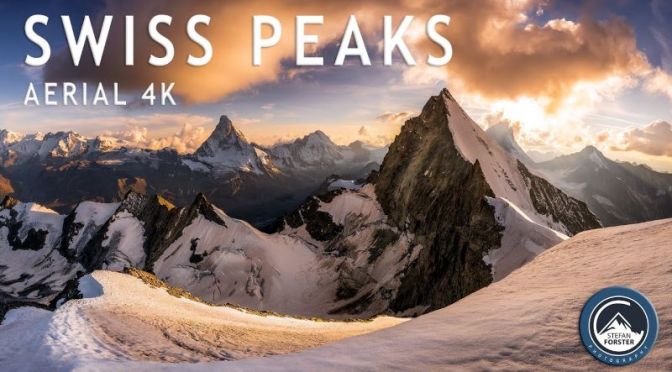
Aerial Travel Video: ‘Alpine Peaks In Switzerland’
Filmed and Edited by: Stefan Forster
The Alpine region of Switzerland, conventionally referred to as the Swiss Alps, represents a major natural feature of the country and is, along with the Swiss Plateau and the Swiss portion of the Jura Mountains, one of its three main physiographic regions.

TRAVEL IN THE COTSWOLDS: ‘HISTORY OF MALMESBURY’
Malmesbury is another classic Cotswold destination – located in Wiltshire, England, famous for its large abbey and beautiful surrounding countryside.

Building Industry: ‘The Rise Of Autonomous Construction Robots’
There’s a lot of buzz around self-driving cars, but autonomous-driving technology could revolutionize a different industry first — construction. That industry hasn’t changed much over the last several decades, according to some experts, making it an ideal candidate for automation.
“The way we build today is largely unchanged from the way we used to build 50 years ago,” said Gaurav Kikani, vice president of Built Robotics. “Within two years, I think we’re really going to turn the corner, and you’re going to see an explosion of robotics being used on construction sites.”
The industry is also faced with a labor shortage that the Covid-19 pandemic has further complicated. “Covid is making people step back and say, ‘hey, the way we’ve been doing things for a long time is just not sustainable,’” said Kevin Albert, founder and CEO of Canvas. “It is just a wake-up call for the industry.”
Canvas is one of several companies working on autonomous construction technology. Big players like Caterpillar and Komatsu, and start-ups like SafeAI and Built Robotics, see value in using autonomous machines to accelerate construction projects. The mining industry was one of the first to employ the use of self-driving tech.
Caterpillar began its first autonomy program more than 30 years ago. The company now has the largest fleet of autonomous haul trucks. Caterpillar says it’s hauled 2 billion metric tons in just over six years. Built Robotics is a San Francisco-based start-up founded by an ex-Google engineer that already has machinery out in the field. It’s automated several pieces of equipment, such as bulldozers and excavators.
“You can now collapse your construction timeline so you can knock out work overnight so that it’s ready for your human workers in the morning to speed them along,” Kikani said. SafeAI is another Silicon Valley start-up. It recently teamed up with Obayashi for a pilot program. It’s been retrofitting equipment like dump trucks, bulldozers and loaders. Robots are also helping inside.
San Francisco-based Canvas created an autonomous machine for finishing drywall and has worked on projects like the San Francisco International Airport and Chase Arena. Humans work alongside its robotic system. “Drywall is very hard work on the body,” Albert said. “And we’ve seen that 1 out of every 4 workers has to end their career early because of injuries. This will create longer careers for people and also enable people to join the trades that haven’t had access before.”
The construction industry is one of the largest sectors in the global economy, with about $10 trillion spent each year. That spending accounts for 13% of the world’s GDP, even though the sector’s annual productivity growth has only increased 1% over the past 20 years. According to McKinsey & Co., $1.6 trillion of additional value could be created through higher productivity, and autonomy would help the industry achieve that.

Technology Trends: India Quickly Becoming A Major Smartphone Producer
India is positioning itself as a smartphone-production hub amid a U.S.-China trade war that has disrupted global supply chains and left tech firms such as Apple and Samsung looking for alternatives to China to manufacture their products. Photo: Olivier Le Hellard for The Wall Street Journal

Travel: The ‘Lofoten Islands’ Of Norway (Video)
A visit to the Norwegian Lofoten Islands in the northern region. Beautiful scenery.
Lofoten is an archipelago and a traditional district in the county of Nordland, Norway. Lofoten is known for a distinctive scenery with dramatic mountains and peaks, open sea and sheltered bays, beaches and untouched lands. Its largest town, Leknes, is approximately 169 km (105 mi) inside the Arctic Circle and approximately 2,420 km (1,500 mi) away from the North Pole, making Lofoten one of the world’s northernmost populated regions. Though lying within the Arctic Circle, the archipelago experiences one of the world’s largest elevated temperature anomalies relative to its highlatitude.Lofoten (Norwegian pronunciation: [ˈlùːfuːtn̩]) is an archipelago and a traditional district in the county of Nordland, Norway. Lofoten is known for a distinctive scenery with dramatic mountains and peaks, open sea and sheltered bays, beaches and untouched lands. Its largest town, Leknes, is approximately 169 km (105 mi) inside the Arctic Circle and approximately 2,420 km (1,500 mi) away from the North Pole, making Lofoten one of the world’s northernmost populated regions. Though lying within the Arctic Circle, the archipelago experiences one of the world’s largest elevated temperature anomalies relative to its high latitude.

History: Planning And Building ‘The Pentagon’
The Pentagon is the headquarters building of the United States Department of Defense. As a symbol of the U.S. military, the phrase The Pentagon is also often used as a metonym for the Department of Defense and its leadership.
Located in Arlington County, Virginia, across the Potomac River from Washington, D.C., the building was designed by American architect George Bergstrom and built by contractor John McShain. Ground was broken on 11 September 1941, and the building was dedicated on 15 January 1943. General Brehon Somervell provided the major motivating power behind the project;[6] Colonel Leslie Groves was responsible for overseeing the project for the U.S. Army.
The Pentagon is the world’s largest office building, with about 6,500,000 square feet (150 acres; 0.60 km2) of floor space, of which 3,700,000 sq ft (85 acres; 0.34 km2) are used as offices.[7][8] Some 23,000 military and civilian employees,[8] and another 3,000 non-defense support personnel, work in the Pentagon. It has five sides, five floors above ground, two basement levels, and five ring corridors per floor with a total of 17.5 miles (28.2 km)[8] of corridors. The central five-acre (2.0 ha) pentagonal plaza is nicknamed “ground zero” on the presumption that it would be a prime target in a nuclear war.

History Of Satellites: NASA’s ‘Landsat’ Program – “Getting Off The Ground”
Every legacy has a compelling origin. The soon-to-be-launched Landsat 9 is the intellectual and technical product of eight generations of Landsat missions, spanning nearly 50 years.
Episode One answers the question “why?” Why did the specific years between 1962 and 1972 call for a such a mission? Why did leadership across agencies commit to its fruition? Why was the knowledge it could reveal important to the advancing study of earth science?
In this episode, we’re introduced to William Pecora and Stewart Udall, two men who propelled the project into reality, as well as Virginia Norwood who breathed life into new technology. Like any worthwhile endeavor, Landsat encountered its fair share of resistance. Episode one explores how those challenges were overcome with the launch of Landsat 1, signifying a bold step into a new paradigm.
Additional footage courtesy of Gordon Wilkinson/Texas Archive of the Moving Image and the US Geological Survey. The Landsat Program is a series of Earth-observing satellite missions jointly managed by NASA and the U.S. Geological Survey (USGS). Landsat satellites have been consistently gathering data about our planet since 1972. They continue to improve and expand this unparalleled record of Earth’s changing landscapes for the benefit of all.
Music: “The Missing Star,” “Brazenly Bashful,” “Light Tense Weight,” “It’s Decision Time,” “Patisserie Pressure,” from Universal Production Music Credit: NASA’s Goddard Space Flight Center Matthew R. Radcliff (USRA): Lead Producer Ryan Fitzgibbons (USRA): Lead Producer Kate Ramsayer (USRA): Lead Producer LK Ward (USRA): Lead Writer Ryan Fitzgibbons (USRA): Lead Editor Jeffrey Masek (NASA/GSFC): Lead Scientist Marc Evan Jackson: Narrator Terry Arvidson (Lockheed Martin): Interviewee Aaron E. Lepsch (ADNET): Technical Support
 Boomers Daily