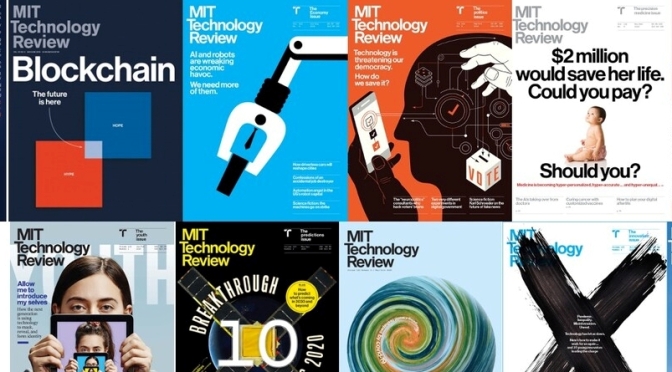
MIT TECHNOLOGY REVIEW (April 23, 2025): The Creativity Issue features Defining creativity in the Age of AI: Meet the artists, musicians, composers, and architects exploring productive ways to collaborate with the now ubiquitous technology. Plus: Debunking the myth of creativity, asteroid-deflecting nukes, bitcoin-powered hot tubs, and a new way to detect bird flu.
Forget one-click creativity. These artists and musicians are finding new ways to make art using AI, by injecting friction, challenge, and serendipity into the process.
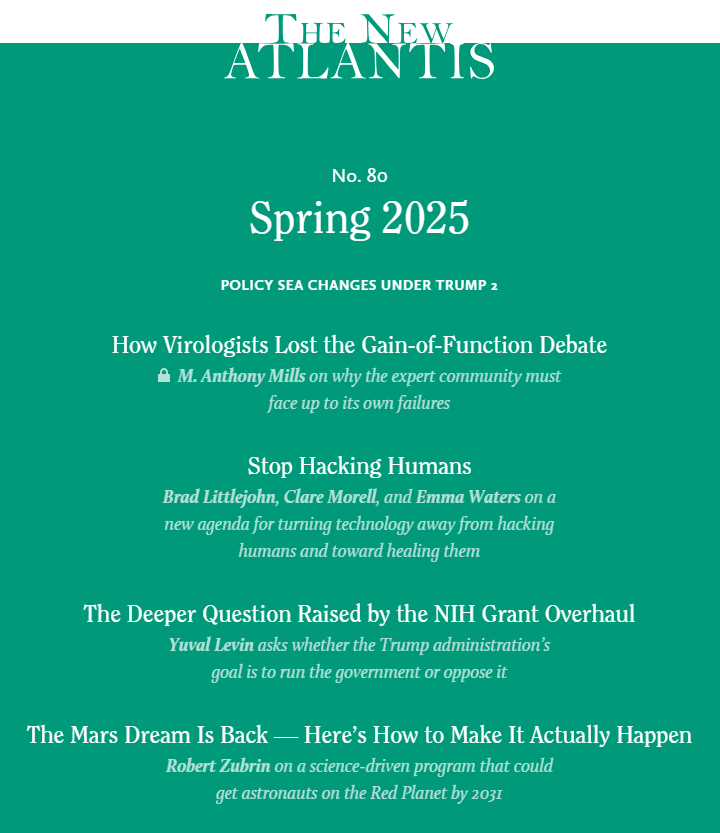
For years, scientists kept the debate about risky virus research among themselves. Then Covid happened. As President Trump prepares to crack down on virology research, the expert community must face up to its own failures.
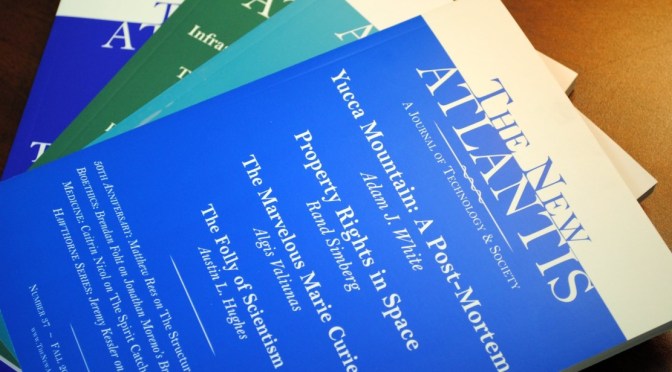
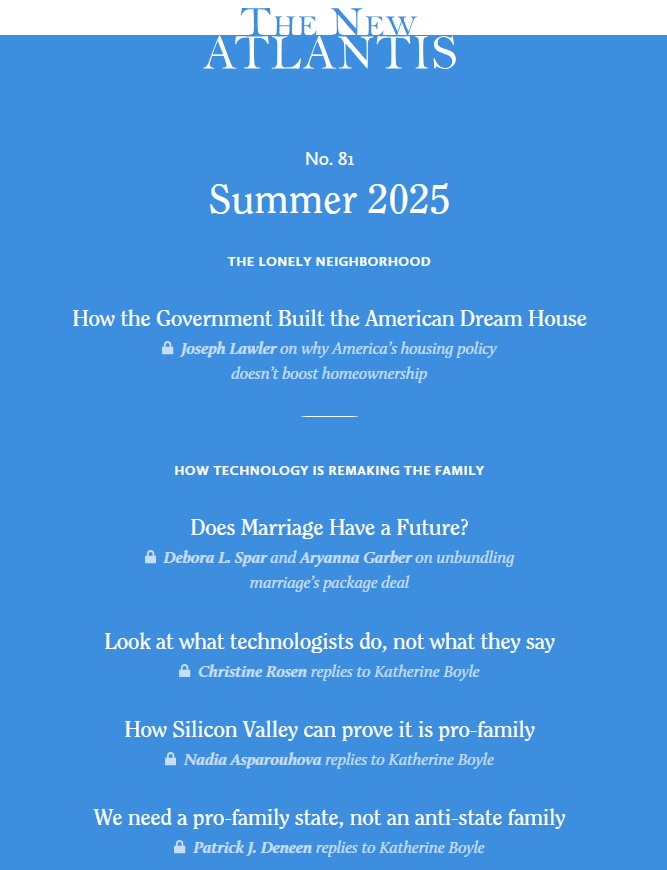
From cradle to grave, surrogacy to smartphones to gender surgery to euthanasia, Americans are using technology to shortcut human nature — and shortchange ourselves. Here is a new agenda for turning technology away from hacking humans and toward healing them.
Between SpaceX’s breakthroughs and Trump’s inaugural promise, we have a once-in-a-generation opportunity. But it can’t be realized as an eccentric’s project or a pork banquet. Here’s a science-driven program that could get astronauts on the Red Planet by 2031.
MIT TECHNOLOGY REVIEW (February 26, 2025): The ‘Relationships Issue’ features AI, Automation, and Surveillance will improve productivity. Or else.
This issue explores the many ways technology is transforming our relationships, from the AI chatbot revolution that’s changing how we connect with one another to the increasing power imbalance in the workplace that’s happening as monitoring increases and protections fall far behind. Plus animating ancient animals, lab-grown spandex, and adventures in the genetic time machine.
Introducing “How the System Works,” a series on the hidden mechanisms that support modern life
The Tyranny of Now
There’s no time like the present to revisit the warning of forgotten media theorist Harold Innis: “Enormous improvements in communication have made understanding more difficult.”
Foreign Affairs Magazine (January 12, 2025): How the Next Computing Revolution Will Transform the Global Economy and Upend National Security
Over the last several years, as rapid advances in artificial intelligence have gained enormous public attention and critical scrutiny, another crucial technology has been evolving largely out of public view. Once confined to the province of abstract theory, quantum computing seeks to use operations based on quantum mechanics to crack computational problems that were previously considered unsolvable. Although the technology is still in its infancy, it is already clear that quantum computing could have profound implications for national security and the global economy in the decades to come.
World Economic Forum (January 11, 2025): This week’s top stories of the week include:
0:15 What do the jobs of the future look like? – The world of work is changing fast. While 92 million jobs may disappear over the next 5 years, nearly 170 million new ones will emerge, driven by new technology and the energy transition. What are these new jobs and which sectors will see the greatest changes? Find out in the 2025 Future of Jobs Report.
1:40 Here’s how factories are changing – Chindarat Ninnama tells us the story of how data and digital tools transformed her factory job into a career brimming with new opportunities. A shortage of workforce talent is a major barrier to the digital transformation of manufacturing. Western Digital is part of the World Economic Forum’s Frontline Talent of the Future initiative, which has built a playbook of solutions to address this
5:28 Global cooperation has flatlined – The world is facing a perfect storm of challenges, with global security at a crisis point and competition escalating. The climate crisis has intensified, with 2024 recorded as the hottest year ever. Economic growth remains sluggish, with the IMF projecting global growth of just 3.2% in 2025—and only 1.8% in developed economies.
7:47 These are the most essential skills for work – The jobs of tomorrow will require a new set of skills. The latest Future of Jobs report surveyed company executives on the most in-demand skills of the workplace – both today and in 2030. Find out what the ‘hirers’ of the future are looking for.
MIT Technology Review (January 8, 2025): The latest issue features ’10 Breakthrough Technologies’ – Fast-learning robots, next-gen jet fuel, new HIV protection meds, the largest camera ever built to document the cosmos, and more. Plus: digital twins, high-tech fisheries, and the AI Hype Index.











 Boomers Daily