Category Archives: Technology

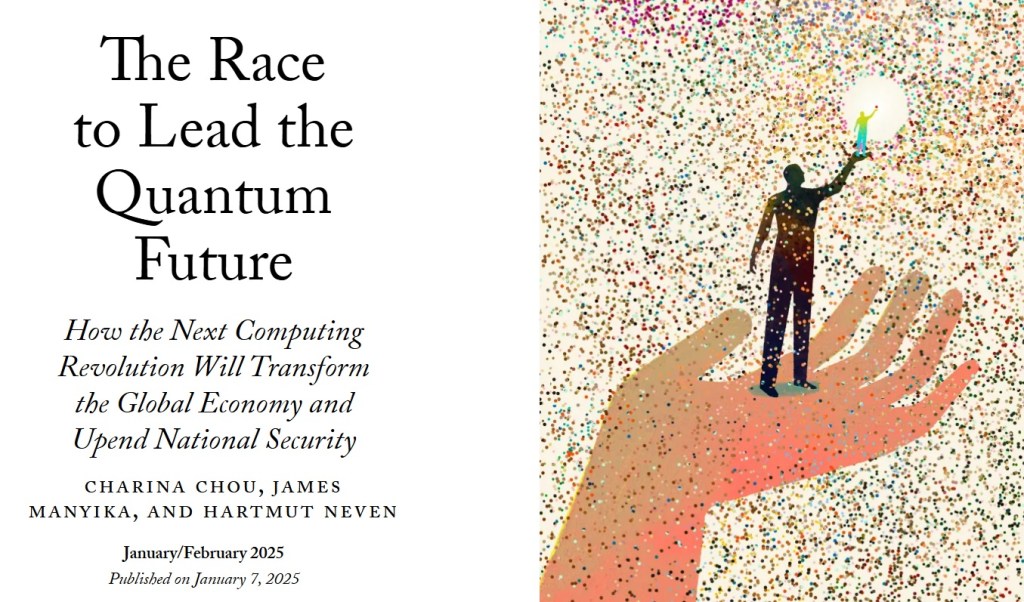
Foreign Affairs: A Race To Lead The Quantum Future

Foreign Affairs Magazine (January 12, 2025): How the Next Computing Revolution Will Transform the Global Economy and Upend National Security

Over the last several years, as rapid advances in artificial intelligence have gained enormous public attention and critical scrutiny, another crucial technology has been evolving largely out of public view. Once confined to the province of abstract theory, quantum computing seeks to use operations based on quantum mechanics to crack computational problems that were previously considered unsolvable. Although the technology is still in its infancy, it is already clear that quantum computing could have profound implications for national security and the global economy in the decades to come.

Read full article

World Economic Forum: Top Stories Of The Week

World Economic Forum (January 11, 2025): This week’s top stories of the week include:

0:15 What do the jobs of the future look like? – The world of work is changing fast. While 92 million jobs may disappear over the next 5 years, nearly 170 million new ones will emerge, driven by new technology and the energy transition. What are these new jobs and which sectors will see the greatest changes? Find out in the 2025 Future of Jobs Report.

1:40 Here’s how factories are changing – Chindarat Ninnama tells us the story of how data and digital tools transformed her factory job into a career brimming with new opportunities. A shortage of workforce talent is a major barrier to the digital transformation of manufacturing. Western Digital is part of the World Economic Forum’s Frontline Talent of the Future initiative, which has built a playbook of solutions to address this

5:28 Global cooperation has flatlined – The world is facing a perfect storm of challenges, with global security at a crisis point and competition escalating. The climate crisis has intensified, with 2024 recorded as the hottest year ever. Economic growth remains sluggish, with the IMF projecting global growth of just 3.2% in 2025—and only 1.8% in developed economies.

7:47 These are the most essential skills for work – The jobs of tomorrow will require a new set of skills. The latest Future of Jobs report surveyed company executives on the most in-demand skills of the workplace – both today and in 2030. Find out what the ‘hirers’ of the future are looking for.

#WorldEconomicForum

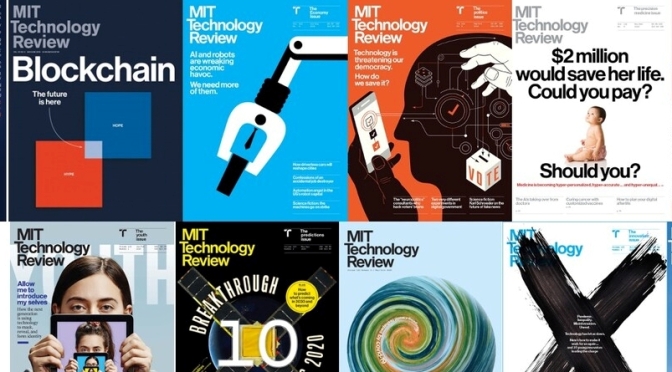
MIT Technology Review – January/February 2025

MIT Technology Review (January 8, 2025): The latest issue features ’10 Breakthrough Technologies’ – Fast-learning robots, next-gen jet fuel, new HIV protection meds, the largest camera ever built to document the cosmos, and more. Plus: digital twins, high-tech fisheries, and the AI Hype Index.

10 Breakthrough Technologies 2025

What will really matter in the long run? That’s the question we tackle each year as we compile this annual list.

AI means the end of internet search as we’ve known it

Despite fewer clicks, copyright fights, and sometimes iffy answers, AI could unlock new ways to summon all the world’s knowledge.

AI is changing how we study bird migration

After decades of frustration, machine-learning tools are unlocking a treasure trove of acoustic data for ecologists.

Will we ever trust robots?

If most robots still need remote human operators to be safe and effective, why should we welcome them into our homes?

Future Technology: Can AI Build Cities In Space?

The Economist (December 12, 2024): The EconomistFast forward into the future, when building in space is normal, from huge satellites and spacecraft in orbit, to entire cities on the Moon and Mars. Could robots guided by AI make it happen?

Video timeiine: 00:00 – Future of building in space 00:43 – Machina Labs 02:15 – Could we 3D print in space? 02:44 – Infrastructure on the Moon 03:25 – AI & robotics on Mars 04:41 – History of AI in space 05:41 – Challenges to space technology

Video supported by @mishcon_de_reya

MIT Technology Review – The Top Stories (11.24.24)

a person with luggage walks through and airport setting

MIT Technology Review (Novemer 24, 2024): This week’s round up includes Google DeepMind has a new way to look inside an AI’s “mind”. Inside Clear’s ambitions to manage your identity beyond the airport. Who’s to blame for climate change? And more.

Inside Clear’s ambitions to manage your identity beyond the airport
The company that has helped millions of people cut security lines wants to give you a frictionless future—in exchange for your face.

Read more →

Google DeepMind has a new way to look inside an AI’s “mind”
Autoencoders are letting us peer into the black box of artificial intelligence. They could help us create AI that is better understood, and more easily controlled.

Read more →

How this grassroots effort could make AI voices more diverse
A massive volunteer-led effort to collect training data in more languages, from people of more ages and genders, could help make the next generation of voice AI more inclusive and less exploitative.

Read more →

Who’s to blame for climate change? It’s surprisingly complicated.The world’s biggest polluters, by the numbers.

Read more →

The rise of Bluesky, and the splintering of social
You may have read that it was a big week for Bluesky. If you’re not familiar, Bluesky is, essentially, a Twitter clone that publishes short-form status updates.

Read more →

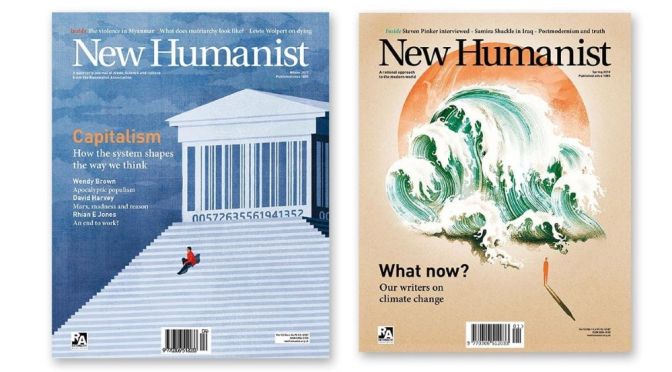
Culture: New Humanist Magazine – Winter 2024-25

New Humanist's winter 2024 cover shows a futuristic blue face with the words: 'Our cyborg future?'

NEW HUMANIST MAGAZINE – WINTER 2024/2025 ISSUE: The new issue features ‘Our Cyborg Future?’

The new age of the cyborg?

Neurobiologist and journalist Moheb Costandi explores the rapidly-developing world of brain-computer interfaces. For some people, these devices are already transforming lives – but the technology is quickly overtaking the ethics.

A dangerous calculation

Peter Ward unpicks the dark philosophy of the tech billionaires and how it is infiltrating some of our most powerful organisations.

There’s a product for that

A recent film, The Substance, explored the growing pressure on all of us – particularly women – to modify our bodies, not only through make-up and cosmetic procedures but also through digital filters. Clare Chambers, professor of political philosophy at the University of Cambridge, talks to us about the power of resistance and allowing our bodies to be “good enough”.

New life in the veins

Peter Salmon recounts the bizarre history of blood transfusion – and why the super-rich remain fascinated by its possibilities.

How AI Is Revolutionising Science (The Economist)

The Economist (November 21, 2024): AI is driving a transformation across all fields of science, from developing drugs for incurable diseases and improving the understanding of animal communication to self-driving labs.

Video timeline: 00:00 – How AI is revolutionising science 02:53 – Drug discovery 04:31 – AlphaFold 05:30 – Adoption of AI in science 07:08 – Animal communication 09:26 – Scientific fraud 11:03 – Self-driving labs 14:36 – Future of AI in science

Could this prompt a new golden age of discovery? Video supported by @mishcon_de_reya

MIT Technology Review – The Top Stories (11.17.24)

Ai gaping maw with teeth and two clawed hands swallows artworks which tiny artists have put poison symbols on the reverse side. One carries a flag with Ben Zhao's face
Ben Zhao remembers well the moment he officially jumped into the fight between artists and generative AI: when one artist asked for AI bananas. 

MIT Technology Review (Novemer 17, 2024): This week’s round up includes Generative AI taught a robot dog to scramble around a new environment; The AI lab waging a guerrilla war over exploitative AI; Life-seeking, ice-melting robots could punch through and Europa’s icy shell.

The AI lab waging a guerrilla war over exploitative AI

The tools Glaze and Nightshade are giving artists hope that they can fight back against AI that hoovers internet data to train. Are they enough?

Generative AI taught a robot dog to scramble around a new environment

A new system could help train robots entirely in generated worlds.

Why AI could eat quantum computing’s lunch

Rapid advances in applying artificial intelligence to simulations in physics and chemistry have some people questioning whether we will even need quantum computers at all.

AI search could break the web

Life-seeking, ice-melting robots could punch through Europa’s icy shell

Researchers are working on technology that could follow NASA’s Europa Clipper mission and hunt for life in the ocean of Jupiter’s moon.

World Economic Forum: Top Stories – Nov 16, 2024

World Economic Forum (November 16, 2024) – The top stories of the week include:

0:15 AI robot zaps weeds while saving crops – It’s called Concentrated Light Autonomous Weeding and Scouting or CLAWS for short. CLAWS uses AI-powered image processing to identify the crops, then targets weeds around the crop with blasts of concentrated light. This gets rid of unwanted intruders without damaging either crops or soil.

1:52 5 ways bioeconomy affects daily living – The bioeconomy uses renewable resources from land or sea to produce food, energy, and other resources. It focuses on leveraging nature’s processes and products to create sustainable economic outputs. The bioeconomy is already a part of our daily lives, influencing various sectors and industries.

6:08 Iceland sees benefit of a 4-day work week – The Nordic nation of 380,000 is rolling out a new way of working. Between 2020 and 2022, 51% of Iceland’s workers accepted an offer of shorter hours, such as a 4-day week for no loss of pay. The shift has had a positive impact on work-life balance and personal stress, new research shows.

8:17 Restored Amazon ecosystems beat logging – Amazon Sacred Headwaters Alliance is fighting to safeguard 35 million hectares of rainforest through a collaboration between 30 Indigenous nations of the Amazon basin. There’s an economic case for protecting the Amazon, says Atossa Soltani, Director of Global Strategy, Amazon Sacred Headwaters Alliance.

#WorldEconomicForum

World Economic Forum: Top Stories – Nov 9, 2024

World Economic Forum (November 9, 2024) – The top stories of the week include:

0:15 Finfluencer financial advice revolution – A finfluencer is a content creator on social media who shares information on budgeting, saving and financial investments, among other topics. Finfluencers use blogs, podcasts or videos to get their message out. They help widen financial access to groups who didn’t have it before.

3:49 These vegetables grow in-store without soil – Instead of soil, they use plugs of rockwool, irrigated with nutrient-rich water in a method called hydroponics. They come in different sizes producing from 2,000 to 15,000 plants monthly. These farms have a tiny environmental footprint. The largest models can grow as much as a 3-hectare farm.

5:44 Telehealth platform empowers millions – Altibbi offers 24/7 access to online doctors along with accessible, up-to-date medical information. It offers a cheaper, more accessible alternative to in-person consultations but it also aims to ‘change the narrative’ around the patient-doctor relationship.

8:43 ‘Underwater tractors’ replant seagrass – They were created by Reefgen, an UpLink Top Innovator. The robot scoots over the seabed, steadily and carefully restoring the ecosystem. Reefgen’s technology aims to aid conservation efforts by augmenting the efforts of human restorers.

#WorldEconomicForum