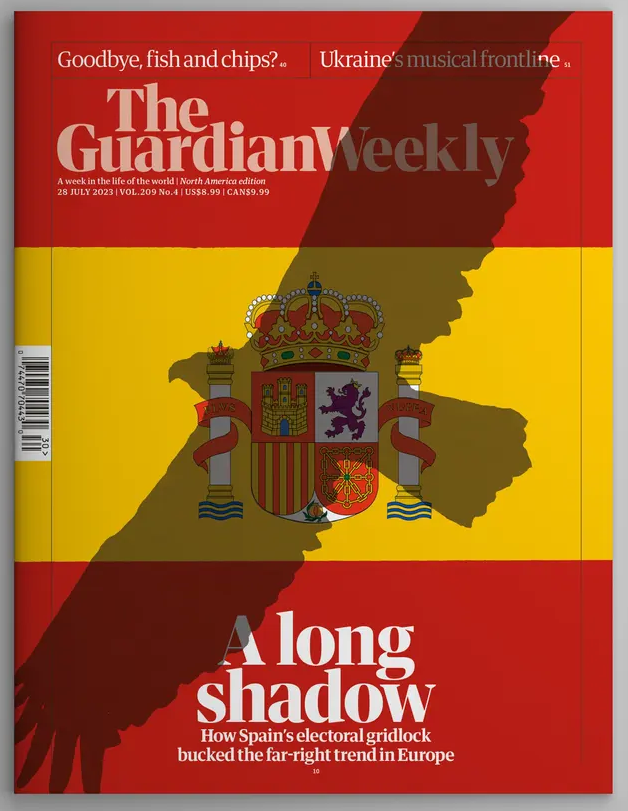
The Guardian Weekly (August 4, 2023)– Israel in turmoil: Netanyahu’s judicial coup; Stormzy’s scholarship graduates; International fiction found in translation, and more…
‘Editor’s Picks’ Podcast (July 31, 2023) – Three essential articles read aloud from the latest issue of The Economist. This week:what to do about overstretched CEOs, how to better predict the weather (9:00) and we meet Myanmar’s Gen Z guerrillas (15:00).
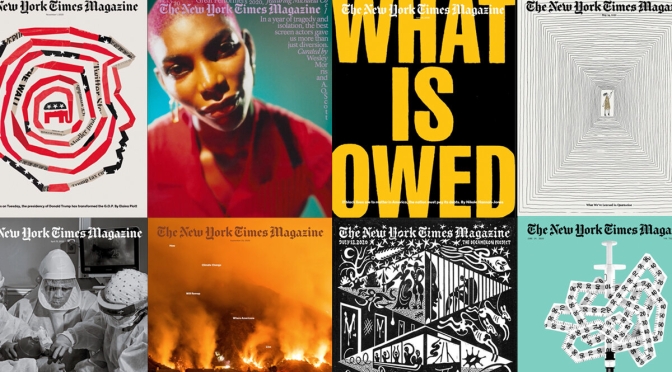
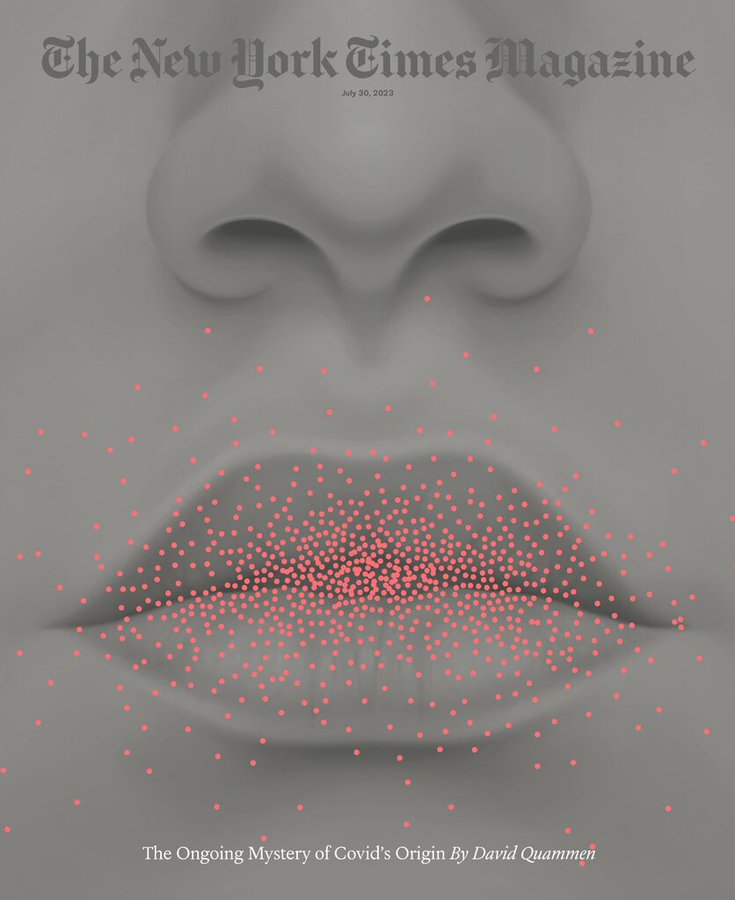
THE NEW YORK TIMES MAGAZINE (July 30, 2023) – In this week’s cover story, David Quammen reports on the ongoing mystery of Covid’s origin, what we do know — and why it matters. Plus, a profile of a poet who was kidnapped from his Black father by his white grandparents and a look at a group of English activists’ fight for the right to access public lands.
We still don’t know how the pandemic started. Here’s what we do know — and why it matters.
By David Quammen
Where did it come from? More than three years into the pandemic and untold millions of people dead, that question about the Covid-19 coronavirus remains controversial and fraught, with facts sparkling amid a tangle of analyses and hypotheticals like Christmas lights strung on a dark, thorny tree. One school of thought holds that the virus, known to science as SARS-CoV-2, spilled into humans from a nonhuman animal, probably in the Huanan Seafood Wholesale Market, a messy emporium in Wuhan, China, brimming with fish, meats and wildlife on sale as food. Another school argues that the virus was laboratory-engineered to infect humans and cause them harm — a bioweapon — and was possibly devised in a “shadow project” sponsored by the People’s Liberation Army of China.
A group of English activists want to legally enshrine the “right to roam” — and spread the idea that nature is a common good.
By Brooke Jarvis
The signs on the gateat the entrance to the path and along the edge of the reservoir were clear. “No swimming,” they warned, white letters on a red background.
On a chill mid-April day in northwest England, with low, gray clouds and rain in the forecast, the signs hardly seemed necessary. But then people began arriving, by the dozens and then the hundreds. Some walked only from nearby Hayfield, while others came by train or bus or foot from many hours away. In a long, trailing line, they tramped up the hill beside the dam and around the shore of the reservoir, slipping in mud and jumping over puddles. Above them rose a long, curving hill of open moorland, its heather still winter brown. When they came to a gap between a stone wall and a metal fence, they squeezed through it, one by one, slipping under strings of barbed wire toward the water below.
Socialist leader assures party ‘democracy can find a formula for government’ as left and right blocs try to form viable coalitions
The Spanish Socialist leader, Pedro Sánchez, has ruled out a return to the polls following Sunday’s inconclusive snap general election, insisting a new government can be formed after his ruling coalition was narrowly beaten by the opposition conservative People’s party (PP).
Plenty of people will tell you the East Neuk of Fife in Scotland is the best place in the world to eat fish and chips. So what happens when its chippies – and chippies across the UK – start to close?
‘Editor’s Picks’ Podcast (July 24, 2023) – Three essential articles read aloud from the latest issue of The Economist. This week:a report on the technology behind babymaking, why optimism about the world economy might be premature (10:30), and what the hype over Barbenheimer says about the movie industry (16:17).
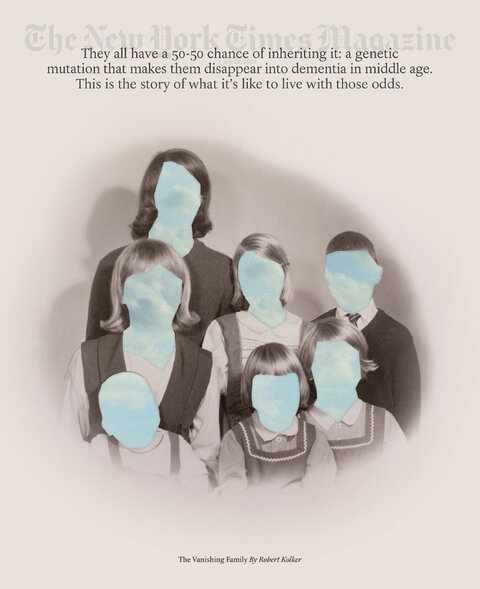
THE NEW YORK TIMES MAGAZINE (July 23, 2023) – In this issue, Robert Kolker on a family’s struggle with a genetic mutation that leads to dementia in middle age; Caity Weaver tries to track down Tom Cruise; Jon Gertner on the future of Wikipedia as A.I. feeds off its human input; and more.
They all have a 50-50 chance of inheriting a cruel genetic mutation — which means disappearing into dementia in middle age. This is the story of what it’s like to live with those odds.
By Robert Kolker
Barb was the youngest in her large Irish Catholic family — a surprise baby, the ninth child, born 10 years after the eighth. Living in the suburbs of Pittsburgh, her family followed the football schedule: high school games on Friday night, college games on Saturday, the Steelers on Sunday. Dad was an engineer, mom was a homemaker and Barb was the family mascot, blond and adorable, watching her brothers and sisters finish school and go on to their careers.
Can the online encyclopedia help teach A.I. chatbots to get their facts right — without destroying itself in the process?
By JON GERTNER
In early 2021, a Wikipedia editor peered into the future and saw what looked like a funnel cloud on the horizon: the rise of GPT-3, a precursor to the new chatbots from OpenAI. When this editor — a prolific Wikipedian who goes by the handle Barkeep49 on the site — gave the new technology a try, he could see that it was untrustworthy. The bot would readily mix fictional elements (a false name, a false academic citation) into otherwise factual and coherent answers.
The action star has gone to great lengths to avoid the press for more than a decade. But maybe our writer could track him down anyway?
By CAITY WEAVER
In an interview with Playboy in 2012, Tom Cruise described Katie Holmes as “an extraordinary person” with a “wonderful” clothing line, and someone for whom he was fond of “doing things like creating romantic dinners” — behavior that, he confided, “she enjoys.” It would prove to be his last major interview with a reporter to date. Despite what may be recalled through the penumbra of memory, this sudden silence was not directly preceded by either of Cruise’s infamous appearances on television: not by his NBC’s “Today” show interview (in which he labeled host Matt Lauer both “glib” and “Matt — MattMattMattMatt”), nor even by his appearance on “The Oprah Winfrey Show” (in which he reverse-catapulted himself onto Winfrey’s fawn-colored couch multiple times in a demonstration of his enthusiasm for Holmes).
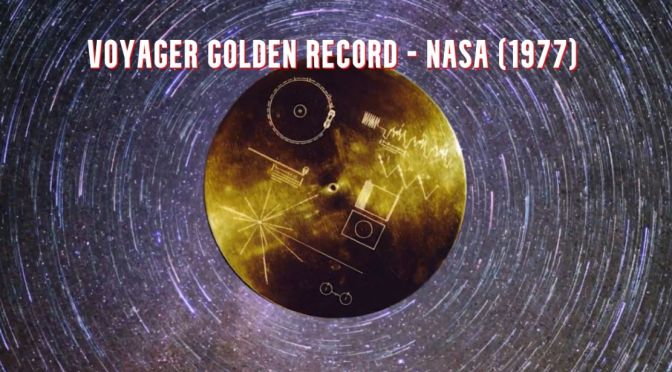
Sotheby’s (July 20, 2023) – The Voyager Golden Record is a unique audio-visual time capsule developed by NASA and affixed to the Voyager 1 and 2 spacecrafts.
Designed to communicate to possible space-faring civilizations something of the diversity of life and culture on our world, the Golden Record consisted of greetings in 59 human languages and those of the humpback whales, 115 images of life here, the sounds of Earth, and 27 pieces from the world’s musical traditions. It has been called the beginning of the concept of “world music.”
It was Voyager 1 that looked homeward from high above Neptune to take, at Carl Sagan’s behest, the iconic Pale Blue Dot photograph. Upon flawlessly completing the first phase of their mission, the NASA Voyagers 1 and 2 made for the open sea of interstellar space, teaching us the actual shape of our solar system as it moves through the galaxy. The Golden Record is an unparalleled document in the history of space exploration and our civilization.
When the result of the Hollywood actors’ strike ballot was announced last Thursday, the big-name stars of Oppenheimer left the film’s London premiere.
This show of solidarity by Matt Damon, Emily Blunt, Cillian Murphy and Florence Pugh was a demonstration of the far-reaching effects of creatives taking to the picket lines. For our big story, arts reporter Vanessa Thorpe looks at what the historic joint walkout by writers and actors means for all of us as movie-goers and TV viewers as well as the stars, lesser-known actors and technicians struggling to make a living.
And we look at what lies behind the dispute with our film editors Catherine Shoard and Andrew Pulver while Los Angeles reporter Lois Beckett hears from actors finding it ever harder to make a living in the age of streaming and the use of AI in the entertainment industry.
‘Editor’s Picks’ Podcast (July 17, 2023) – Three essential articles read aloud from the latest issue of The Economist. This week: how populist Republicans plan to make Donald Trump’s second term count, NATO’s promises to Ukraine mark real progress, but there is still much more to do (10:12) and what matters about the human-dominated Anthropocene geological phase is not when it began, but how it might end (14:41).
News, Views and Reviews For The Intellectually Curious













 Sotheby’s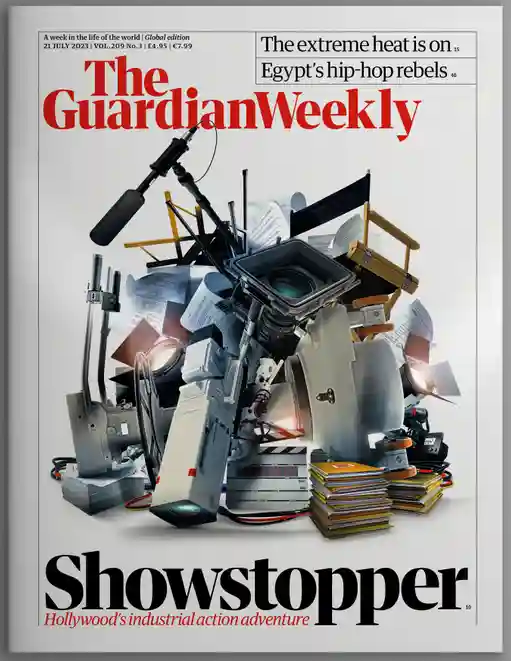
 Boomers Daily