Peer through the lens of flourishing 17th-century Dutch technological innovation to witness wondrous advancements in science, including astronomy and medicine.
Harold J. Cook, John F. Nickoll Professor of History, Brown University
Peer through the lens of flourishing 17th-century Dutch technological innovation to witness wondrous advancements in science, including astronomy and medicine.
Harold J. Cook, John F. Nickoll Professor of History, Brown University

It’s a leap year which means there’s an extra day in the calendar – 29 February 2020. But why do we need it? The answer is a little more complicated than you may think.
Excerpts from a New York Times article (Feb 28, 2020):
“Life begins at 55, the age at which I published my first book,” he wrote in “From Eros to Gaia,” one of the collections of his writings that appeared while he was a professor of physics at the Institute for Advanced Study — an august position for someone who finished school without a Ph.D. The lack of a doctorate was a badge of honor, he said. With his slew of honorary degrees and a fellowship in the Royal Society, people called him Dr. Dyson anyway.
Freeman J. Dyson, a mathematical prodigy who left his mark on subatomic physics before turning to messier subjects like Earth’s environmental future and the morality of war, died on Friday at a hospital near Princeton, N.J. He was 96.
As a young graduate student at Cornell University in 1949, Dr. Dyson wrote a landmark paper — worthy, some colleagues thought, of a Nobel Prize — that deepened the understanding of how light interacts with matter to produce the palpable world. The theory the paper advanced, called quantum electrodynamics, or QED, ranks among the great achievements of modern science.
In this edition of Backchat we take a deep dive into Nature’s coverage of coronavirus. As cases climb, what are some of the challenges involved in reporting on the virus?But was this new ruler of a Maya city really from a separate culture? New techniques being used at the Tikal and Teotihuacan sites have revealed conflicting evidence as to whether Teotihuacan really held sway over a much larger region than previously estimated.
Sarah also talks with Rashid Sumaila, professor and Canada research chair in interdisciplinary ocean and fisheries economics at the University of British Columbia, Vancouver’s Institute for the Oceans and Fisheries. You may have heard of illegal fishing being bad for the environment or bad for maintaining fisheries—but as Sumaila and colleagues report this week in Science Advances, the illegal fishing trade is also incredibly costly—with gross revenues of between $8.9 billion and $17.2 billion each year.
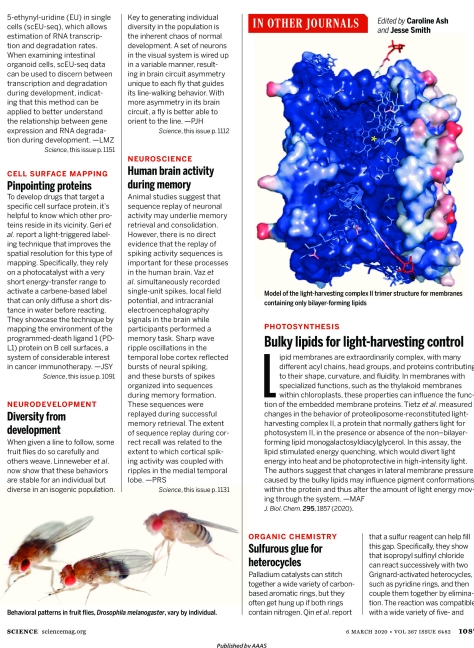
This week, the brain pathways of egg laying in fruit flies, preventing fractures in metallic glass, moth’s fuzz as superior acoustic camouflage and a coronavirus update.In this episode:
00:46 Working out the wiring behind fruit fly behaviour
Researchers have identified a neural circuit linking mating and egg laying in female fruit flies. Research Article: Wang et al.
06:01 Research Highlights
Ancient, cave-dwelling cockroaches, and hairy moths dampen sound. Research Highlight: Cockroaches preserved in amber are the world’s oldest cave dwellers; Research Highlight: Stealth flyers: moths’ fuzz is superior acoustic camouflage
07:57 Making better metallic glass
Metallic glasses have many desirable properties, but these materials are prone to fracturing. Now, a new manufacturing process may have overcome this issue. Research article: Pan et al.; News and Views: Metallic glasses rejuvenated to harden under strain
13:47 News Chat
Coronavirus outbreak updates, a survey shows Indian bird numbers are in decline, and the genomes of New York rats. News: Coronavirus: latest news on spreading infection; News: Hundreds of bird species in India are declining; News: Genomes reveal how New York City’s rats thrive in the urban jungle
Watch a Q&A with Steven Chu, who’s devoted a large part of his scientific career to searching for solutions to our climate challenges.
Steven Chu born February 28, 1948) is an American physicist and a former government official. He is known for his research at the University of California at Berkeley and his research at Bell Labs and Stanford University regarding the cooling and trapping of atoms with laser light, for which he won the Nobel Prize in Physics in 1997, along with his scientific colleagues Claude Cohen-Tannoudji and William Daniel Phillips.
Chu served as the 12th United States Secretary of Energy from 2009 to 2013. At the time of his appointment as Energy Secretary, Chu was a professor of physics and molecular and cellular biology at the University of California, Berkeley, and the director of the Lawrence Berkeley National Laboratory, where his research was concerned primarily with the study of biological systems at the single molecule level. Chu resigned as energy secretary on April 22, 2013. He returned to Stanford as Professor of Physics and Professor of Molecular & Cellular Physiology.
Chu is a vocal advocate for more research into renewable energy and nuclear power, arguing that a shift away from fossil fuels is essential to combating climate change. He has conceived of a global “glucose economy”, a form of a low-carbon economy, in which glucose from tropical plants is shipped around like oil is today. On February 22, 2019, Chu began a one-year term as president of the American Association for the Advancement of Science.
Bio from Wikipedia
On this week’s show, Staff Writer Robert F. Service talks with host Sarah Crespi about manipulating microbes to make them produce building materials like bricks—and walls that can take toxins out of the air.
Sarah also talks with Paul Davids, principal member of the technical staff in applied photonics & microsystems at Sandia National Laboratories, about an innovation in converting waste heat to electricity that uses similar materials to solar cells but depends on quantum tunneling. And in a bonus segment, producer Meagan Cantwell talks with Online News Editor David Grimm on stage at the AAAS annual meeting in Seattle.
They discuss how wildfires can harm your lungs, crime rates in so-called sanctuary states, and how factors such as your gender and country of origin influence how much trust you put in science.