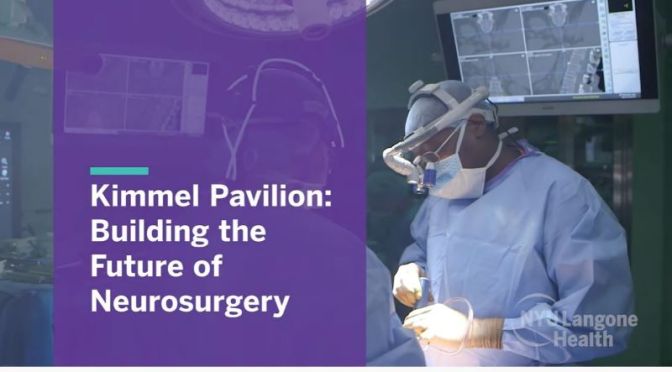
NYU Langone’s Kimmel Pavilion is home to the region’s newest and most technologically sophisticated neurosurgery suite. Designed to optimize patient care, our facilities are just one reason U.S. News & World Report’s “Best Hospitals” ranks NYU Langone among the top 10 hospitals in the country for neurology and neurosurgery.
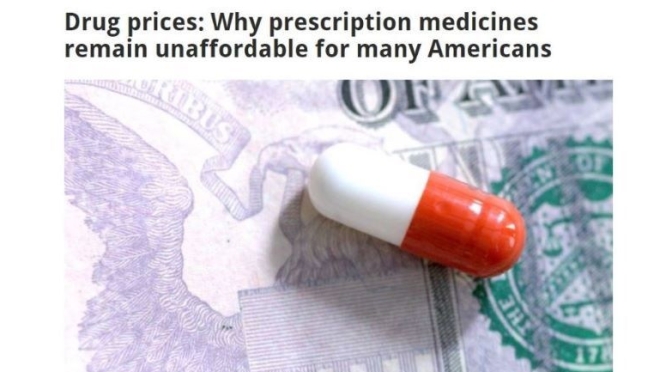
There may be few issues that unite Americans ahead of the 2020 election as do their concerns about the cost of prescription drugs.
A clear majority — 75% — of respondents to a July survey said the cost of prescription medicines would be among the factors likely to influence their votes this year, according to a report from Gallup and the nonprofit West Health. Gallup reported on results from 1,007 interviews conducted with adults between July 1 and July 24.
1. What are the 2020 presidential candidates saying they will do to lower drug prices?
Both President Donald Trump, a Republican, and former Vice President Joe Biden, a Democrat, have highlighted insulin costs in their discussions of the need to lower drug prices.
In a January interview with the New York Times editorial board, Biden noted the widespread discontent among Americans about sticker shock often experienced at pharmacies. He spoke of a need for the federal government to act to make medicines more affordable.
“This is a place where I find, whether you’re Republican or Democrat, you think you’re getting screwed on drug prices. And you are, in terms of everything from insulin to inhalers and a whole range of other things,” Biden said. “So, again, can I guarantee that it gets done? No, but I can tell you what, if anybody can get it done, I can, and I think there’s a consensus for it.”
2. Why doesn’t Medicare, the biggest U.S. purchaser of drugs, directly negotiate on drug prices?
Congress has taken different approaches in designing the terms under which the two largest federal health programs, Medicaid and Medicare, buy drugs.
Medicaid is a program run by states with federal contributions and oversight. It covers people with low incomes and disabilities. Almost 67 million people were enrolled in Medicaid as of May 2020, including about 29 million children. In 1990 Congress decided that drugmakers who want to have their products covered by Medicaid must give rebates to the government. The initial rebate is equal to 23.1% of the average manufacturer price (AMP) for most drugs, or the AMP minus the best price provided to most other private-sector payers, whichever is greater. An additional rebate kicks in when prices rise faster than general inflation.
3. What’s the deal with rebates and discounts?
There’s widespread frustration among lawmakers and policy analysts about the lack of clarity about the role of middlemen in the supply chain for medicines. Known as pharmacy benefit managers (PBMs), these businesses describe the aim of their business as making drugs more affordable for consumers. Insurers like Cigna and UnitedHealth operate some of the nation’s largest PBMs, as does pharmacy giant CVS Health, which also owns insurer Aetna.
“They will tell you their mission is to lower drug costs,” said Rep. Earl L. “Buddy” Carter, a Georgia Republican, a pharmacist and a critic of PBMs, in a speech on the House floor last year. “My question to you would be: How is that working out?”
4. What is the “distinctly American” phenomenon of specialty drugs?
Kesselheim also has written on what he terms “Specialty Drugs — A Distinctly American Phenomenon.” That’s the title of a 2020 paper in the New England Journal of Medicine Kesselheim authored with Huseyin Naci, an associate professor of health policy at the London School of Economics.
In this Perspective article, Kesselheim and Naci look at how the “specialty” designation morphed from its origin in the 1970s. It then referred to a need for extra steps for preparation and delivery of new injectable and infusion products.
5. How much does it cost to bring a new drug to market anyway?
The median cost for a medicine developed in recent years was $985 million, according to a study published in JAMA in March 2020, “Estimated Research and Development Investment Needed to Bring a New Medicine to Market, 2009-2018.”
“Rising drug prices have attracted public debate in the United States and abroad on fairness of drug pricing and revenues,” write the study’s authors: Olivier J. Wouters of the London School of Economics; Martin McKee of the London School of Hygiene and Tropical Medicine; and Jeroen Luyten of Leuven Institute for Healthcare Policy, KU Leuven, Belgium. “Central to this debate is the scale of research and development investment by companies that is required to bring new medicines to market.”
Nature reports on: Coaxing tiny colloid particles into a diamond structure, rapid antigen tests and manipulating cell death and homeostasis in neurodegenerative disease.
In this episode:
00:45 Creating colloidal crystals
For decades, researchers have attempted to create crystals with a diamond-like structure using tiny colloid particles. Now, a team thinks they’ve cracked it, which could open the door for new optical technologies. Research Article: He et al.
In neurodegenerative disease, cell death can be prevented, however this can lead to the accumulation of incorrectly folded proteins. Now researchers have found targets that can be used to both stop cell death and protein aggregation. Research Article: Xu et al.
The Great Books presents: John J. Miller is joined by Missy Andrews of the Center for Literary Education to discuss Ernest Hemingway’s The Old Man and the Sea.
The Old Man and the Sea is a short novel written by the American author Ernest Hemingway in 1951 in Cuba, and published in 1952. It was the last major work of fiction written by Hemingway that was published during his lifetime. One of his most famous works, it tells the story of Santiago, an aging Cuban fisherman who struggles with a giant marlin far out in the Gulf Stream off the coast of Cuba.
Nature podcast discusses: Mapping the migration of the Vikings, a leading Covid-19 vaccine trial was abruptly halted and the world’s smallest ultrasound device.
In this episode:
00:45 Following the Viking footprint across Europe
To better understand who the Vikings were, and where they went, researchers have mapped genomes from hundreds of archaeological artifacts. Research Article: Margaryan et al.
Scientists have developed an ultrasound detector which is smaller than the wavelength of sound it detects, providing highly detailed imaging at a cellular level; Research Article: ; Research Article: Shnaiderman et al.
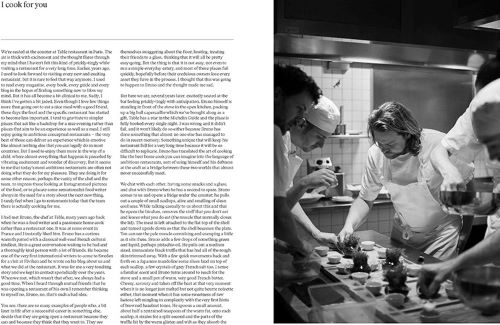
Fäviken: 4015 Days, Beginning to End is a vital commentary on food culture today and includes illuminating essays on subjects as wide ranging as creativity; balancing familial responsibilities while running a restaurant; the hypocrisy of sustainability in restaurants; the search for lagom; social media; imitation vs. plagiarism; haute cuisine; the art of hospitality; and the importance of craft over innovation.
In 2019, Magnus Nilsson closed Fäviken, his one-of-a-kind restaurant in remote Sweden – a difficult decision, as it was close to his heart and at the height of its success. Here is the Fäviken story: how it became a world-class destination, how the industry it was a part of has changed, and why Magnus eventually elected to pursue new projects.
The book also includes a chronological list of every dish ever served at the restaurant and highlights 100 memorable recipes. The book’s stunning photography includes a mixture of archival photographs and newly shot images of the food, the restaurant, the staff, and the surrounding setting of Northern Sweden.
A textural cover made of blue cloth and red paper with a wood-grain effect references the shape and color of the Fäviken building.
Magnus Nilsson is the author of Fäviken (2012), The Nordic Cookbook (2015), Nordic: A Photographic Essay of Landscapes (2016), and The Nordic Baking Book (2018), all published with Phaidon.















 Boomers Daily