

Category Archives: Reviews

Political Analysis: Taliban In Afghanistan, Climate Change, Vaccinations
Washington Post columnists Jonathan Capehart and Michael Gerson join William Brangham to discuss the politics of the week including the Taliban’s march across Afghanistan, the latest startling report on climate change and how to convince all Americans to get vaccinated.
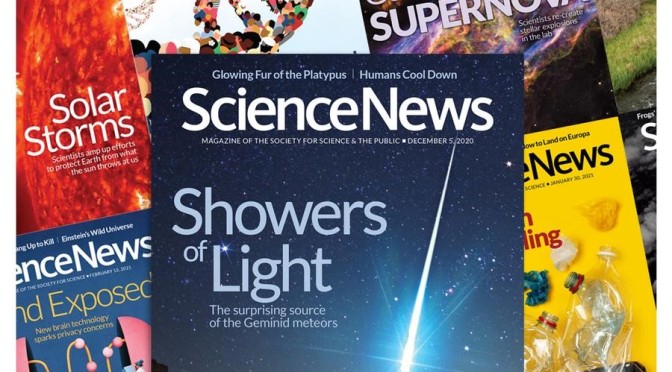
Magazine Views: Science News – August 14, 2021


Science: Wooly Mammoth Tusks & Ice Age Extinction
A woolly mammoth that roamed Alaska 17,000 years ago covered enough ground in its 28-year lifetime to nearly circle the globe twice, an analysis of one of its tusks suggests.

Art Books: ‘Caravaggio – The Complete Works’
Caravaggio, or more accurately Michelangelo Merisi da Caravaggio (1571–1610), was always a name to be reckoned with. Notorious bad boy of Italian painting, the artist was at once celebrated and controversial: violent in temper, precise in technique, a creative master, and a man on the run. Today, he is considered one of the greatest influences in all art history.


This edition offers a neat and comprehensive Caravaggio catalogue raisonné. Each of his paintings is reproduced from recent top-quality photography, allowing for a vivid encounter with the artist’s ingenious repertoire of looks and gestures, as well as numerous detail shots of his boundary-breaking naturalism. Five accompanying chapters trace the complete arc of Caravaggio’s career from his first public commissions in Rome through to his growing celebrity status and trace his tempestuous personal life, in which drama loomed as prominently as in his canvases.
The author
Sebastian Schütze was a longtime research fellow at the Bibliotheca Hertziana (Max Planck Institute for Art History) in Rome. He is a member of the academic board of the Istituto Italiano per gli Studi Filosofici in Naples, and a member of the Österreichische Akademie der Wissenschaften. From 2003 to 2009 he held the Bader Chair in Southern Baroque Art at Queen’s University in Kingston. In 2009 he was appointed professor of early modern art history at Vienna University.

Science: Vitamin D Trial In Asthmatic Children, Risks to Machine Learning
Charles Piller, an investigative journalist for Science, talks with host Sarah Crespi about a risky trial of vitamin D in asthmatic children that has caused a lot of concern among ethicists.
They also discuss how the vitamin D trial connects with a possibly dangerous push to compare new treatments with placebos instead of standard-of-care treatments in clinical trials.
Next, Birhanu Eshete, professor of computer and information science at the University of Michigan, Dearborn, talks with producer Joel Goldberg about the risks of exposing machine learning algorithms online—risks such as the reverse engineering of training data to access proprietary information or even patient data.
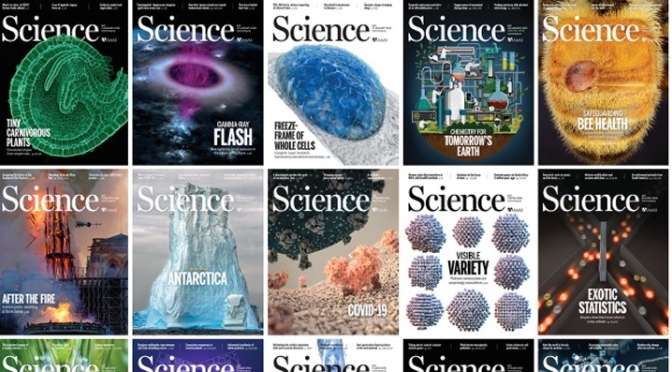
Front Covers: Science Magazine – August 13
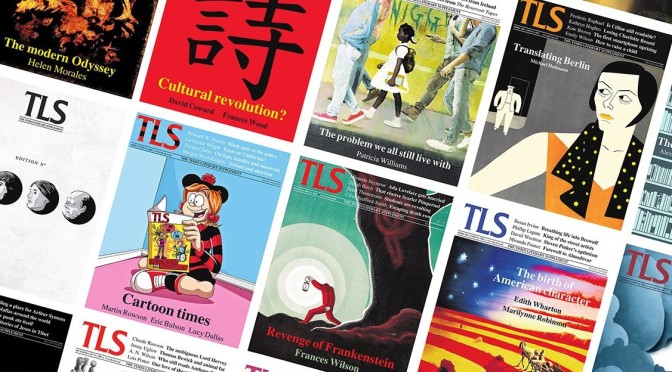
Previews: Times Literary Supplement – August 13
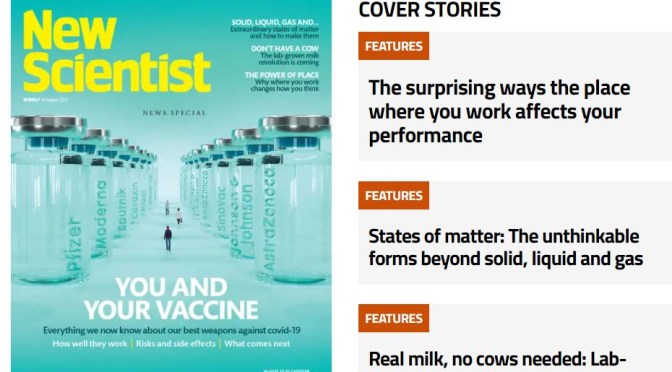
Previews: New Scientist Magazine – August 14

Science: Mapping A Bat’s Navigation Neurons In 3D, Poison Dart Frogs, Fabrics
Researchers uncover how grid cells fire in a 3D space to help bats navigate, and a fabric that switches between being stiff and flexible.
In this episode:
00:47 Mapping a bat’s navigation neurons in 3D
Grid cells are neurons that regularly fire as an animal moves through space, creating a pattern of activity that aids navigation. But much of our understanding of how grid cells work has involved rats moving in a 2D plane. To figure out how the system works in a 3D space, researchers have mapped the brain activity of bats flying freely around a room.
Research Article: Ginosar et al.
07:44 Research Highlights
How a ‘toxin sponge’ may protect poison dart frogs from themselves, and the world’s oldest known coin foundry has been found.
Research Highlight: An absorbing tale: poison dart frogs might have a ‘toxin sponge’
Research Highlight: Found: the world’s oldest known mint and its jumbo product
09:59 A flexible fabric that transforms from soft to rigid (and back again)
Researchers have created a ‘tunable’ fabric, inspired by medieval chainmail, that when compressed changes from flexible to rigid. The stiffened structure can hold 30 times its own weight, and the team behind it suggest this material could be used to build temporary shelters or have medical applications.
Research article: Wang et al.
16:33 Stark warning from the IPCC’s latest report
This week the UN’s Intergovernmental Panel on Climate Change released its long awaited report detailing compiling the latest climate science data. Nature’s Jeff Tollefson joins us to discuss the report and the warnings it contains for our warming world.
News: IPCC climate report: Earth is warmer than it’s been in 125,000 years
 Boomers Daily