

By Michael Cummins, Editor, August 8, 2025

The enduring literary fame of the Italian writer and humanist Giovanni Boccaccio (1313-1375) is a monument to paradox. His name has been synonymous with the ribald, lascivious, and often obscene tales of the Decameron, a reputation that stands in stark opposition to the scholarly humanist who devoted his life to promoting Dante, meticulously copying ancient manuscripts, and writing a monumental work of literary theory. This seemingly irreconcilable contradiction, however, was not a sign of a conflicted personality but a masterfully deployed strategy.
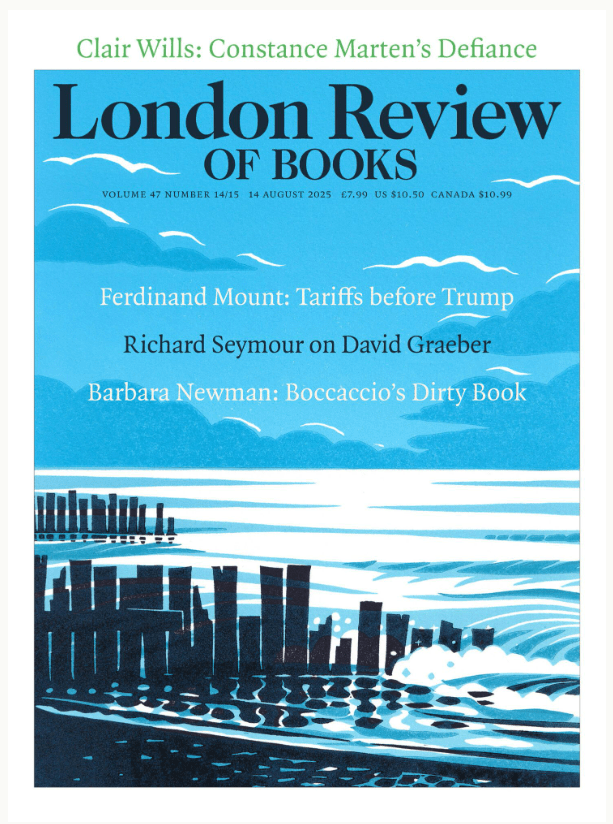
Boccaccio’s genius lay in his ability to harness this paradox—juxtaposing the vulgar with the profound, the entertaining with the intellectual, the vernacular with the classical—to achieve his most ambitious goals. As Barbara Newman writes in her review “Dirty Books,” Boccaccio “used the irresistible allure of obscenity as a Trojan horse” to advance a revolutionary literary and intellectual agenda, ultimately establishing a new standard for vernacular literature and its relationship with the reader. He even feared this reputation, fretting that female readers, to whom he had dedicated the book, would consider him:
“a foul-mouthed pimp, a dirty old man.”
It was this very anxiety, however, that Boccaccio would so expertly exploit. His work, far from being a moral compromise, was a brilliant act of subversion. It offered a compelling blend of popular entertainment and intellectual rigor, creating a new literary space that transcended the rigid social and intellectual hierarchies of his time. The Decameron was not just a collection of tales but a comprehensive literary project, a direct challenge to the staid Latin humanism of his peers, and a deliberate attempt to shape the future of a nascent Italian literary tradition.
The “Light Fare” of Romance
Boccaccio’s first and most crucial strategic maneuver was the deliberate choice to write for an audience that had been largely ignored by the literary establishment: the common people, and especially women. In an era dominated by humanists who saw the Latin language as the only worthy vehicle for serious intellectual thought, Boccaccio’s decision to compose his masterpiece in the Italian vernacular was a revolutionary act. The review of his biography notes that few women could read Latin, and that his vernacular works were, in part, a response to their plight, offering them a mind-broadening occupation beyond their cloistered chambers. The “light fare” of romance and other stories was the key that unlocked this new readership, and Boccaccio brilliantly understood that the most effective way to captivate this audience was through sheer entertainment.
The scandalous and titillating stories, such as the tale of Alibech and Rustico, served as an irresistible hook. These seemingly frivolous tales were the attractive exterior of the Trojan horse, designed to slip past the defenses of literary elitism and cultural propriety, and gain access to an audience that was hungry for engaging material. In doing so, Boccaccio laid the groundwork for a literary future where the vernacular would reign supreme and where the lines between high art and popular entertainment would be forever blurred. He openly admitted to this strategy, telling his critics:
“the fact is that ladies have already been the reason for my composing thousands of verses, while the Muses were in no way the cause.”
This statement, with its characteristic blend of humility and boldness, was both a gracious dedication to his female audience and a powerful declaration of his revolutionary purpose: to create a new form of literature for a new kind of reader.
Once inside the gates, Boccaccio’s Trojan horse began its true work, embedding profound scholarly and social critiques within the entertaining narratives. The first of these, and one of the most powerful, was his use of satire to expose the hypocrisies of popular piety and clerical corruption. The tale of Ser Ciappelletto, the heinous villain who, on his deathbed, fakes a pious confession to an unwitting friar, is not merely a funny story. It is a brilliant, inverted hagiography that exposes the emptiness of a religious system based on appearances rather than genuine faith.
“a scholarly and theological examination of popular piety, raising serious questions about the nature of sin, redemption, and the efficacy of the Church’s authority.“
Boccaccio’s meticulous description of Ciappelletto’s fabricated saintliness and the friar’s unquestioning credulity is a scathing critique of a society that would venerate a man based on a convincing lie. This tale, disguised as a vulgar joke, functions as a scholarly and theological examination of popular piety, raising serious questions about the nature of sin, redemption, and the efficacy of the Church’s authority. This intellectual core is hidden beneath the surface of a simple, bawdy tale, a testament to Boccaccio’s strategic genius.
Entertaining Tales to Present Shockingly Progressive Philosophical Ideas
Boccaccio also used his entertaining tales to present shockingly progressive philosophical ideas. The story of Saladin and the Jewish moneylender Melchisedek is a prime example. The core of this story is the “Ring Parable,” in which a father with three equally beloved sons has three identical rings made, so that no one son can prove he holds the “true” inheritance. Melchisedek uses this parable to cleverly sidestep Saladin’s theological trap about which of the three Abrahamic religions is the true one. This tale, with its message of religious tolerance and the indeterminacy of religious truth, is an astonishingly modern concept for the 14th century.
Boccaccio’s decision to embed this complex philosophical lesson within a compelling narrative about a clever Jewish moneylender and a benevolent sultan was a stroke of genius. It made a difficult and dangerous idea palatable and memorable, allowing it to be discussed and absorbed by an audience that would likely never have read a dry theological treatise. It is no wonder that centuries later, Gotthold Lessing would make this same parable the centerpiece of his own play, Nathan the Wise, an impassioned plea for interreligious peace.
“a Jewish man who converts to Christianity despite witnessing the total debauchery of the pope and his clerics. He reasons that no institution so depraved could have survived without divine aid.”
The most politically charged of Boccaccio’s embedded critiques is the tale of the Jewish man Abraham, who, after a visit to Rome, converts to Christianity despite witnessing the total debauchery of the pope and his clerics. He reasons that no institution so depraved could have survived without divine aid. While the tale is a humorous inversion of the traditional conversion story, its message is deeply subversive and profoundly serious.
It serves as a devastating critique of clerical corruption, an attack so potent that it resonated for centuries, even finding an admirer in the less-than-tolerant Martin Luther. The review notes that Luther preferred this story for its “vigorous anti-Catholic message,” a clear indication that Boccaccio’s seemingly simple tale had a scholarly and political weight far beyond mere entertainment. This tale, along with the others, reveals that the Decameron was not just a collection of stories but a well-orchestrated assault on the religious and social institutions of his day, all delivered under the guise of an amusing “dirty book.”
Shifting Moral Blame
Boccaccio’s most explicit defense of his method can be found in his own writings, where he articulated a revolutionary literary theory that placed the moral responsibility for a work squarely on the reader. In the introduction to Book 4 and his conclusion to the Decameron, Boccaccio confronts his prudish critics head-on. He disarmingly accepts their accusations that he wrote to please women, arguing that the Muses themselves are ladies. But his most significant contribution is his groundbreaking theory of “reader responsibility.” Drawing on St. Paul, he argues that “to the pure all things are pure,” and that a corrupt mind sees nothing but corruption everywhere. This was not a flimsy excuse for his bawdy tales but a serious philosophical statement about the nature of interpretation and the autonomy of fiction. He drove this point home with a pointed command to his detractors:
“the lady who is forever saying her prayers or baking… cakes for her confessor should leave my tales alone,”
Boccaccio was, in effect, defending the right to write for amusement while simultaneously ensuring that those who sought a deeper meaning would be rewarded with profound truths.
The “Feminine” Chain
This revolutionary theory was not an isolated thought but was, as the review so eloquently puts it, “braided together and gendered feminine.” This final act cemented his position as a far-sighted innovator, one who saw the future of literature not in the elitist cloisters of humanism but in the hands of the wider public. Boccaccio’s defense of vernacularity, writing for entertainment, and reader responsibility all coalesced into a single, cohesive argument about the nature of literature. In his Latin masterpiece, the Genealogy of the Pagan Gods, Boccaccio defined poetry as a:
“fervent and exquisite invention” proceeding from the bosom of God.
By dedicating his works to women, by championing the vernacular language they could read, and by giving them the power to interpret the stories for themselves, Boccaccio was creating a new and enduring literary canon. He was not only writing for a new audience; he was creating it, and he was giving it the tools to appreciate literature on its own terms, free from the conservative constraints of his era.
Conclusion
Boccaccio’s reputation as a purveyor of “dirty” tales is not a stain on his scholarly legacy, but the very tool he used to forge it. His strategic use of popular, entertaining stories was a brilliant, multilayered gambit to achieve his most ambitious goals: to create a new literary audience, to disseminate challenging intellectual and philosophical ideas, and to articulate a groundbreaking theory of literature itself. By packaging his sharp wit, profound social critiques, and revolutionary ideas within the guise of a “commedia profana,”
His genius, as a biographer would later note, lay in his “psychological fragility” that led to a restlessness and a willingness to “experiment in genre and style.”
Boccaccio bypassed the conservative gatekeepers of his time and proved that literature could be both enjoyable and intellectually rigorous. His genius, as a biographer would later note, lay in his “psychological fragility” that led to a restlessness and a willingness to “experiment in genre and style.” This willingness, combined with his strategic mind, secured his place as a foundational figure of the Renaissance and as a truly modern writer—one who understood that the most effective way to change minds was to first capture hearts and imaginations, even with the “dirtiest” of stories.
Boccaccio’s influence stretches far beyond his immediate contemporaries. His work became a cornerstone for a new literary tradition that valued realism and human psychology. Writers like Chaucer, despite his reluctance to name him, were clearly influenced by Boccaccio’s narrative structures and characterizations. Later, in the English Renaissance, Shakespeare drew inspiration from Boccaccio’s plots for plays like All’s Well That Ends Well and Cymbeline. The development of the modern novel, with its emphasis on detailed character portraits and the use of dialogue to drive the plot, owes a significant debt to Boccaccio’s innovations. He was among the first to give voice to the full spectrum of humanity, from the most pious to the most profane, laying the groundwork for the rich, multifaceted characters we see in literature today. His legacy is not merely that of a storyteller, but of a literary architect who built the foundations of a new, more expansive, and more humanistic form of writing.
Works Cited: Newman, Barbara. “Dirty Books.” Review of Boccaccio: A Biography, by Marco Santagata, and Boccaccio Defends Literature, by Brenda Deen Schildgen. London Review of Books, 14 August 2025.
THIS ESSAY WAS WRITTEN AND EDITED UTILIZING AI











 Boomers Daily