
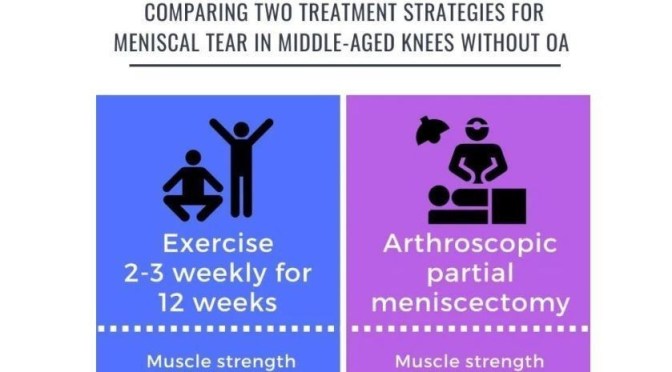
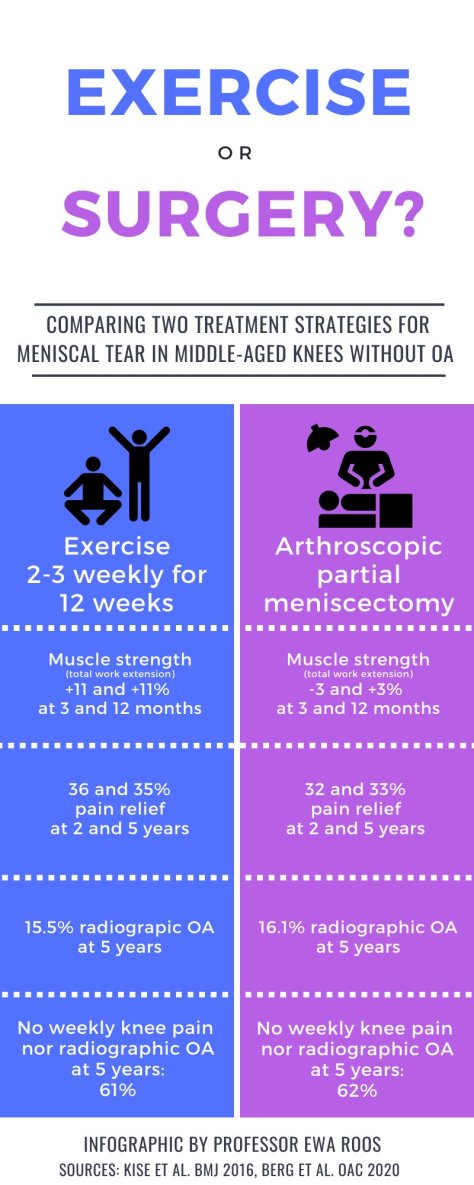
Conclusion: The study was inconclusive with respect to potential differences in progression of individual radiographic features after surgical and non-surgical treatment for degenerative meniscal tear. Further, we found no strong evidence in support of differences in development of incident radiographic knee osteoarthritis or patient-reported outcomes between exercise therapy and arthroscopic partial meniscectomy.
Objective: To evaluate progression of individual radiographic features 5 years following exercise therapy or arthroscopic partial meniscectomy as treatment for degenerative meniscal tear.
Design: Randomized controlled trial including 140 adults, aged 35-60 years, with a magnetic resonance image verified degenerative meniscal tear, and 96% without definite radiographic knee osteoarthritis. Participants were randomized to either 12-weeks of supervised exercise therapy or arthroscopic partial meniscectomy. The primary outcome was between-group difference in progression of tibiofemoral joint space narrowing and marginal osteophytes at 5 years, assessed semi-quantitatively by the OARSI atlas. Secondary outcomes included incidence of radiographic knee osteoarthritis and symptomatic knee osteoarthritis, medial tibiofemoral fixed joint space width (quantitatively assessed), and patient-reported outcome measures. Statistical analyses were performed using a full analysis set. Per protocol and as treated analysis were also performed.
Results: The risk ratios (95% CI) for progression of semi-quantitatively assessed joint space narrowing and medial and lateral osteophytes for the surgery group were 0.89 (0.55-1.44), 1.15 (0.79-1.68) and 0.77 (0.42-1.42), respectively, compared to the exercise therapy group. In secondary outcomes (full-set analysis) no statistically significant between-group differences were found.


 Food and medicine shopping is essential during the COVID-19 pandemic, but requires getting out and standing close to strangers at a time when social distancing and sheltering-in-place are recommended to slow spread of disease.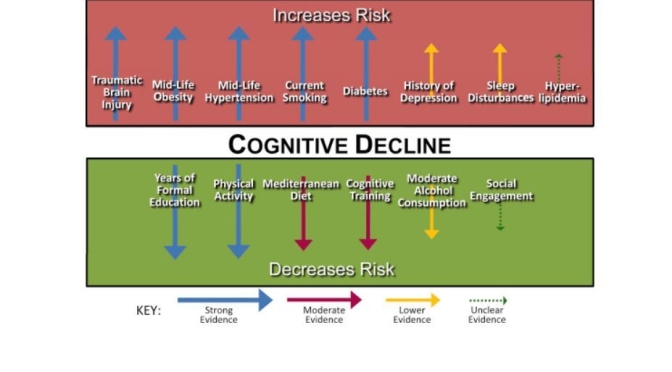
 This relationship between higher glucose levels and poorer cognitive functioning extended beyond just CASI z-score, as well, Cukierman-Yaffe noted. Higher HbA1c levels were also tied to significantly poorer performance in other psychological tests, including the clock making test of executive functioning, test of discriminative ability, and for the test of verbal fluency.

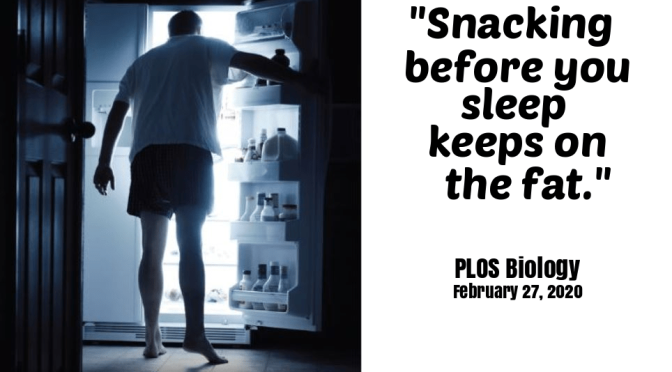
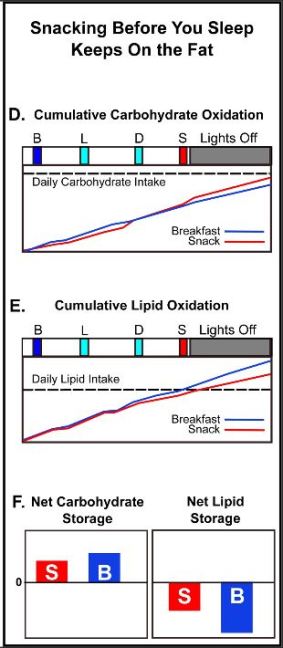
 These daily oscillations are controlled by the circadian clock, which is composed of an autoregulatory biochemical mechanism that is expressed in tissues throughout the body and is coordinated by a master pacemaker located in the suprachiasmatic nuclei of the brain (aka the SCN [
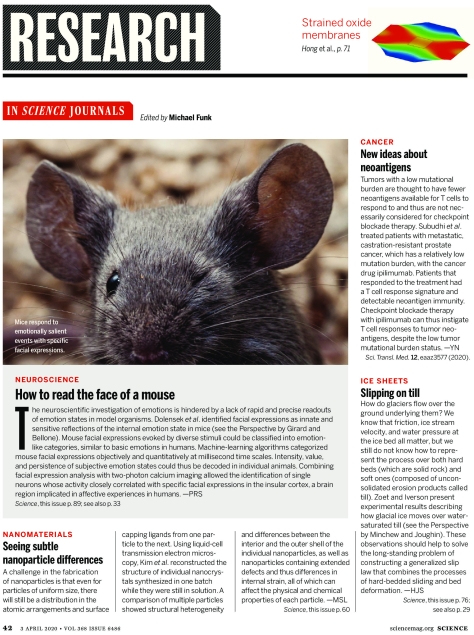
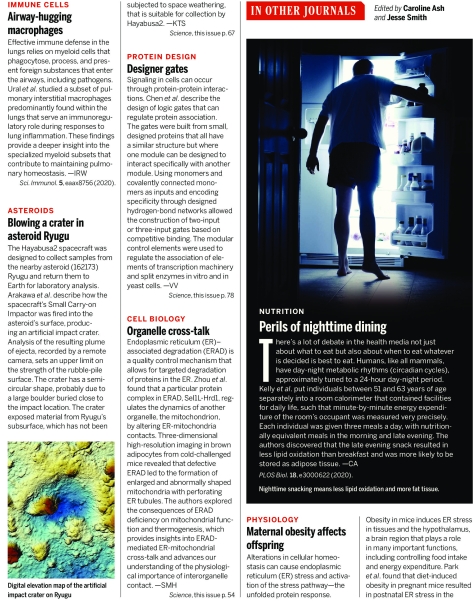

 On this week’s show, Contributing Correspondent Kai Kupferschmidt talks with host Sarah Crespi about modeling coronavirus spread and the role of forecasts in national lockdowns and other pandemic policies. They also talk about the launch of a global trial of promising treatments.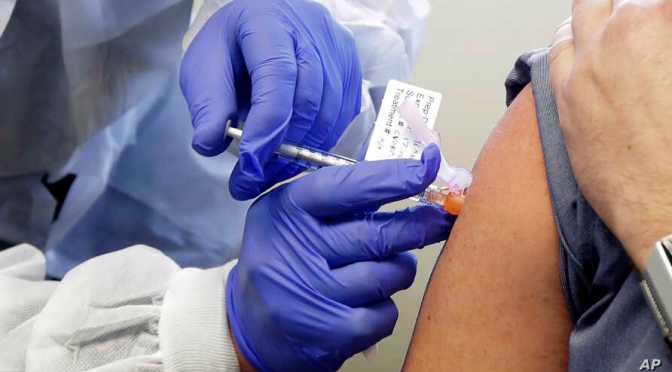
 Scientists around the world are racing to develop a vaccine for COVID-19. But experts have said it could take a year to 18 months for one to hit the market. The process for testing and approving a vaccine is long and complicated.
 Boomers Daily