

 Gertrude Stein. James Joyce. Ernest Hemingway. Aimé Césaire. Simone de Beauvoir. Jacques Lacan. Walter Benjamin.
What do these writers have in common? They were all members of the Shakespeare and Company lending library.
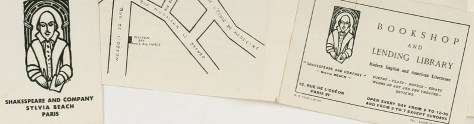
In 1919, an American woman named Sylvia Beach opened Shakespeare and Company, an English-language bookshop and lending library in Paris. Almost immediately, it became the home away from home for a community of expatriate writers and artists now known as the Lost Generation. In 1922, she published James Joyce’s Ulysses under the Shakespeare and Company imprint, a feat that made her—and her bookshop and lending library—famous around the world. In the 1930s, she increasingly catered to French intellectuals, supplying English-language publications from the recently rediscovered Moby Dick to the latest issues of The New Yorker. In 1941, she preemptively closed Shakespeare and Company after refusing to sell her last copy of Joyce’s Finnegans Wake to a Nazi officer.
The Shakespeare and Company Project uses sources from the Beach Papers at Princeton University to reveal what the lending library members read and where they lived. The Project is a work-in-progress, but you can begin to explore now. Search and browse the lending library members and books. Read about joining the lending library. Download a preliminary export of Project data. In the coming months, check back for new features and essays.
 This week, perfecting catalysts that split water using light, the mystery of missing matter in the Universe and how working memory ‘works’ in children.
 A selection of three essential articles read aloud from the latest issue of The Economist. This week, the chance to flatten the

 The first results from vaccine trials are in and they are encouraging, but scientists are still urging caution. We hear the lowdown on the types of vaccines being developed and what hope there is of rolling them out any time soon.
 Interview with Dr. Nicole Lurie on rapid vaccine development, including new tools to facilitate vaccine testing and manufacturing and persistent challenges.
 Online News Editor David Grimm talks with producer Joel Goldberg about the unique challenges of reopening labs amid the coronavirus pandemic. Though the chance to resume research may instill a sense of hope, new policies around physical distancing and access to facilities threaten to derail studies—and even careers.
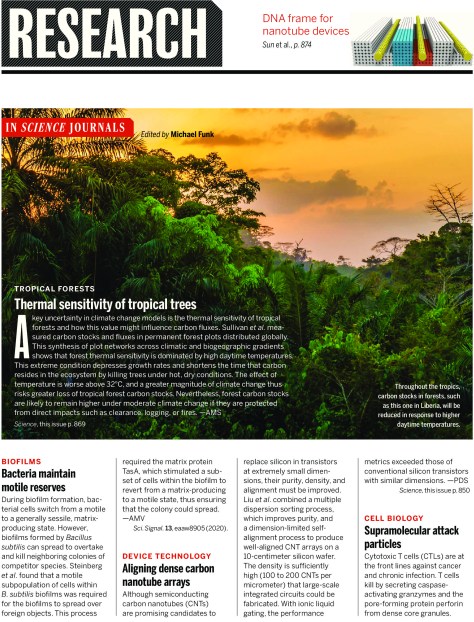

 This week, crafting an artificial eye with the benefits of a human’s, and understanding how disk-galaxies formed by peering back in time.
 Boomers Daily