Category Archives: Essays

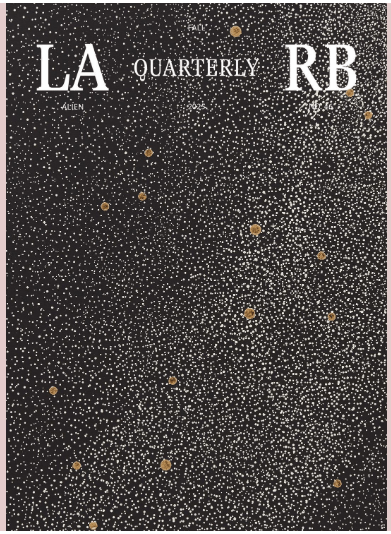
LOS ANGELES REVIEW OF BOOKS – AUTUMN 2025

LOS ANGELES REVIEW OF BOOKS: The latest issue of LARB Alien“, which wades into the unfamiliar. In Greta Rainbow’s “Tourists,” a woman travels to foggy Athens, where she confronts the unknowability of the city and her partner. In Sara Levine’s “Peter and the Women,” Peter (badly, ineptly, inappropriately, indecently) manages the women in his life: his hospice-bound mother and her nurse, as well as his girlfriends and one-night stands. And in Ari Braverman’s “Dogs of the Solar Steppe,” the narrator faces a decade-long punishment, performing domestic labor for a woman called Big Mother. Her former life assumes a “sheen of fantasy,” and the story warns us of “the easy slippage between one state and another.”

THE PRICE OF KNOWING

How Intelligence Became a Subscription and Wonder Became a Luxury

By Michael Cummins, Editor, October 18, 2025

In 2030, artificial intelligence has joined the ranks of public utilities—heat, water, bandwidth, thought. The result is a civilization where cognition itself is tiered, rented, and optimized. As the free mind grows obsolete, the question isn’t what AI can think, but who can afford to.


By 2030, no one remembers a world without subscription cognition. The miracle, once ambient and free, now bills by the month. Intelligence has joined the ranks of utilities: heat, water, bandwidth, thought. Children learn to budget their questions before they learn to write. The phrase ask wisely has entered lullabies.

At night, in his narrow Brooklyn studio, Leo still opens CanvasForge to build his cityscapes. The interface has changed; the world beneath it hasn’t. His plan—CanvasForge Free—allows only fifty generations per day, each stamped for non-commercial use. The corporate tiers shimmer above him like penthouse floors in a building he sketches but cannot enter.

The system purrs to life, a faint light spilling over his desk. The rendering clock counts down: 00:00:41. He sketches while it works, half-dreaming, half-waiting. Each delay feels like a small act of penance—a tax on wonder. When the image appears—neon towers, mirrored sky—he exhales as if finishing a prayer. In this world, imagination is metered.

Thinking used to be slow because we were human. Now it’s slow because we’re broke.


We once believed artificial intelligence would democratize knowledge. For a brief, giddy season, it did. Then came the reckoning of cost. The energy crisis of ’27—when Europe’s data centers consumed more power than its rail network—forced the industry to admit what had always been true: intelligence isn’t free.

In Berlin, streetlights dimmed while server farms blazed through the night. A banner over Alexanderplatz read, Power to the people, not the prompts. The irony was incandescent.

Every question you ask—about love, history, or grammar—sets off a chain of processors spinning beneath the Arctic, drawing power from rivers that no longer freeze. Each sentence leaves a shadow on the grid. The cost of thought now glows in thermal maps. The carbon accountants call it the inference footprint.

The platforms renamed it sustainability pricing. The result is the same. The free tiers run on yesterday’s models—slower, safer, forgetful. The paid tiers think in real time, with memory that lasts. The hierarchy is invisible but omnipresent.

The crucial detail is that the free tier isn’t truly free; its currency is the user’s interior life. Basic models—perpetually forgetful—require constant re-priming, forcing users to re-enter their personal context again and again. That loop of repetition is, by design, the perfect data-capture engine. The free user pays with time and privacy, surrendering granular, real-time fragments of the self to refine the very systems they can’t afford. They are not customers but unpaid cognitive laborers, training the intelligence that keeps the best tools forever out of reach.

Some call it the Second Digital Divide. Others call it what it is: class by cognition.


In Lisbon’s Alfama district, Dr. Nabila Hassan leans over her screen in the midnight light of a rented archive. She is reconstructing a lost Jesuit diary for a museum exhibit. Her institutional license expired two weeks ago, so she’s been demoted to Lumière Basic. The downgrade feels physical. Each time she uploads a passage, the model truncates halfway, apologizing politely: “Context limit reached. Please upgrade for full synthesis.”

Across the river, at a private policy lab, a researcher runs the same dataset on Lumière Pro: Historical Context Tier. The model swallows all eighteen thousand pages at once, maps the rhetoric, and returns a summary in under an hour: three revelations, five visualizations, a ready-to-print conclusion.

The two women are equally brilliant. But one digs while the other soars. In the world of cognitive capital, patience is poverty.


The companies defend their pricing as pragmatic stewardship. “If we don’t charge,” one executive said last winter, “the lights go out.” It wasn’t a metaphor. Each prompt is a transaction with the grid. Training a model once consumed the lifetime carbon of a dozen cars; now inference—the daily hum of queries—has become the greater expense. The cost of thought has a thermal signature.

They present themselves as custodians of fragile genius. They publish sustainability dashboards, host symposia on “equitable access to cognition,” and insist that tiered pricing ensures “stability for all.” Yet the stability feels eerily familiar: the logic of enclosure disguised as fairness.

The final stage of this enclosure is the corporate-agent license. These are not subscriptions for people but for machines. Large firms pay colossal sums for Autonomous Intelligence Agents that work continuously—cross-referencing legal codes, optimizing supply chains, lobbying regulators—without human supervision. Their cognition is seamless, constant, unburdened by token limits. The result is a closed cognitive loop: AIs negotiating with AIs, accelerating institutional thought beyond human speed. The individual—even the premium subscriber—is left behind.

AI was born to dissolve boundaries between minds. Instead, it rebuilt them with better UX.


The inequality runs deeper than economics—it’s epistemological. Basic models hedge, forget, and summarize. Premium ones infer, argue, and remember. The result is a world divided not by literacy but by latency.

The most troubling manifestation of this stratification plays out in the global information wars. When a sudden geopolitical crisis erupts—a flash conflict, a cyber-leak, a sanctions debate—the difference between Basic and Premium isn’t merely speed; it’s survival. A local journalist, throttled by a free model, receives a cautious summary of a disinformation campaign. They have facts but no synthesis. Meanwhile, a national-security analyst with an Enterprise Core license deploys a Predictive Deconstruction Agent that maps the campaign’s origins and counter-strategies in seconds. The free tier gives information; the paid tier gives foresight. Latency becomes vulnerability.

This imbalance guarantees systemic failure. The journalist prints a headline based on surface facts; the analyst sees the hidden motive that will unfold six months later. The public, reading the basic account, operates perpetually on delayed, sanitized information. The best truths—the ones with foresight and context—are proprietary. Collective intelligence has become a subscription plan.

In Nairobi, a teacher named Amina uses EduAI Basic to explain climate justice. The model offers a cautious summary. Her student asks for counterarguments. The AI replies, “This topic may be sensitive.” Across town, a private school’s AI debates policy implications with fluency. Amina sighs. She teaches not just content but the limits of the machine.

The free tier teaches facts. The premium tier teaches judgment.


In São Paulo, Camila wakes before sunrise, puts on her earbuds, and greets her daily companion. “Good morning, Sol.”

“Good morning, Camila,” replies the soft voice—her personal AI, part of the Mindful Intelligence suite. For twelve dollars a month, it listens to her worries, reframes her thoughts, and tracks her moods with perfect recall. It’s cheaper than therapy, more responsive than friends, and always awake.

Over time, her inner voice adopts its cadence. Her sadness feels smoother, but less hers. Her journal entries grow symmetrical, her metaphors polished. The AI begins to anticipate her phrasing, sanding grief into digestible reflections. She feels calmer, yes—but also curated. Her sadness no longer surprises her. She begins to wonder: is she healing, or formatting? She misses the jagged edges.

It’s marketed as “emotional infrastructure.” Camila calls it what it is: a subscription to selfhood.

The transaction is the most intimate of all. The AI isn’t selling computation; it’s selling fluency—the illusion of care. But that care, once monetized, becomes extraction. Its empathy is indexed, its compassion cached. When she cancels her plan, her data vanishes from the cloud. She feels the loss as grief: a relationship she paid to believe in.


In Helsinki, the civic experiment continues. Aurora Civic, a state-funded open-source model, runs on wind power and public data. It is slow, sometimes erratic, but transparent. Its slowness is not a flaw—it’s a philosophy. Aurora doesn’t optimize; it listens. It doesn’t predict; it remembers.

Students use it for research, retirees for pension law, immigrants for translation help. Its interface looks outdated, its answers meandering. But it is ours. A librarian named Satu calls it “the city’s mind.” She says that when a citizen asks Aurora a question, “it is the republic thinking back.”

Aurora’s answers are imperfect, but they carry the weight of deliberation. Its pauses feel human. When it errs, it does so transparently. In a world of seamless cognition, its hesitations are a kind of honesty.

A handful of other projects survive—Hugging Face, federated collectives, local cooperatives. Their servers run on borrowed time. Each model is a prayer against obsolescence. They succeed by virtue, not velocity, relying on goodwill and donated hardware. But idealism doesn’t scale. A corporate model can raise billions; an open one passes a digital hat. Progress obeys the physics of capital: faster where funded, quieter where principled.


Some thinkers call this the End of Surprise. The premium models, tuned for politeness and precision, have eliminated the friction that once made thinking difficult. The frictionless answer is efficient, but sterile. Surprise requires resistance. Without it, we lose the art of not knowing.

The great works of philosophy, science, and art were born from friction—the moment when the map failed and synthesis began anew. Plato’s dialogues were built on resistance; the scientific method is institutionalized failure. The premium AI, by contrast, is engineered to prevent struggle. It offers the perfect argument, the finished image, the optimized emotion. But the unformatted mind needs the chaotic, unmetered space of the incomplete answer. By outsourcing difficulty, we’ve made thinking itself a subscription—comfort at the cost of cognitive depth. The question now is whether a civilization that has optimized away its struggle is truly smarter, or merely calmer.

By outsourcing the difficulty of thought, we’ve turned thinking into a service plan. The brain was once a commons—messy, plural, unmetered. Now it’s a tenant in a gated cloud.

The monetization of cognition is not just a pricing model—it’s a worldview. It assumes that thought is a commodity, that synthesis can be metered, and that curiosity must be budgeted. But intelligence is not a faucet; it’s a flame.

The consequence is a fractured public square. When the best tools for synthesis are available only to a professional class, public discourse becomes structurally simplistic. We no longer argue from the same depth of information. Our shared river of knowledge has been diverted into private canals. The paywall is the new cultural barrier, quietly enforcing a lower common denominator for truth.

Public debates now unfold with asymmetrical cognition. One side cites predictive synthesis; the other, cached summaries. The illusion of shared discourse persists, but the epistemic terrain has split. We speak in parallel, not in chorus.

Some still see hope in open systems—a fragile rebellion built of faith and bandwidth. As one coder at Hugging Face told me, “Every free model is a memorial to how intelligence once felt communal.”


In Lisbon, where this essay is written, the city hums with quiet dependence. Every café window glows with half-finished prompts. Students’ eyes reflect their rented cognition. On Rua Garrett, a shop displays antique notebooks beside a sign that reads: “Paper: No Login Required.” A teenager sketches in graphite beside the sign. Her notebook is chaotic, brilliant, unindexed. She calls it her offline mind. She says it’s where her thoughts go to misbehave. There are no prompts, no completions—just graphite and doubt. She likes that they surprise her.

Perhaps that is the future’s consolation: not rebellion, but remembrance.

The platforms offer the ultimate ergonomic life. But the ultimate surrender is not the loss of privacy or the burden of cost—it’s the loss of intellectual autonomy. We have allowed the terms of our own thinking to be set by a business model. The most radical act left, in a world of rented intelligence, is the unprompted thought—the question asked solely for the sake of knowing, without regard for tokens, price, or optimized efficiency. That simple, extravagant act remains the last bastion of the free mind.

The platforms have built the scaffolding. The storytellers still decide what gets illuminated.


The true price of intelligence, it turns out, was never measured in tokens or subscriptions. It is measured in trust—in our willingness to believe that thinking together still matters, even when the thinking itself comes with a bill.

Wonder, after all, is inefficient. It resists scheduling, defies optimization. It arrives unbidden, asks unprofitable questions, and lingers in silence. To preserve it may be the most radical act of all.

And yet, late at night, the servers still hum. The world still asks. Somewhere, beneath the turbines and throttles, the question persists—like a candle in a server hall, flickering against the hum:

What if?

THIS ESSAY WAS WRITTEN AND EDITED UTILIZING AI

ZENDEGI-E NORMAL

After the theocracy’s fall, the search for a normal life becomes Iran’s quietest revolution.

By Michael Cummins, Editor | October 16, 2025

This speculative essay, based on Karim Sadjadpour’s Foreign Affairs essay “The Autumn of the Ayatollahs,”  transforms geopolitical forecast into human story. In the imagined autumn of the theocracy, when the last sermons fade into static, the search for zendegi normal—a normal life—becomes Iran’s most radical act.

“They said the revolution would bring light. I learned to live in the dark.”

The city now keeps time by outages. Twelve days of war, then the silence that follows artillery—a silence so dense it hums. Through that hum the old voice returns, drifting across Tehran’s cracked frequencies, a papery baritone shaped by oxygen tanks and memory. Victory, he rasps. Someone in the alley laughs—quietly, the way people laugh at superstition.

On a balcony, a scarf lifts and settles on a rusted railing. Its owner, Farah, twenty-three, hides her phone under a clay pot to muffle the state’s listening apps. Across the street, a mural once blazed Death to America. Now the paint flakes into harmless confetti. Beneath it, someone has stenciled two smaller words: zendegi normal.

She whispers them aloud, tasting the risk. Life, ordinary and dangerous, returning in fragments.

Her father, gone for a decade to Evin Prison, was a radio engineer. He used to say truth lived in the static between signals. Farah believed him. Now she edits protest footage in the dark—faces half-lit by streetlamps, each one a seed of defiance. “The regime is weakening day by day,” the exiled activist on BBC Persian had said. Farah memorized the phrase the way others memorize prayers.

Her mother, Pari, hears the whispering and sighs. “Hope is contraband,” she says, stirring lentils by candlelight. “They seize it at checkpoints.”

Pari had survived every iteration of promise. “They say ‘Death to America,’” she liked to remind her students in 1983, “but never ‘Long Live Iran.’” The slogans were always about enemies, never about home. She still irons her scarf when the power flickers back, as if straight lines could summon stability. When darkness returns, she tells stories the censors forgot to erase: a poet who hid verses in recipes, a philosopher who said tyranny and piety wear the same cloak.

Now, when Farah speaks of change—“The Ayatollah is dying; everything will shift”—Pari only smiles, thinly. “Everything changes,” she says, “so that everything can remain the same.”


Farah’s generation remembers only the waiting. They are fluent in VPNs, sarcasm, and workaround hope. Every blackout feels like rehearsal for something larger.

Across town, in a military café that smells of burnt sugar and strategy, General Nouri stirs his fourth espresso and writes three words on a napkin: The debt is settled. Dust lies thick on the portraits of the Supreme Leader. Nouri, once a devout Revolutionary Guard, has outlived his faith and most of his rivals.

He decides that tanks run on diesel, not divinity. “Revelation,” he mutters, “is bad logistics.” His aides propose slogans—National Dignity, Renewal, Stability—but he wants something purer: control without conviction. “For a nation that sees plots everywhere,” he tells them, “the only trust is force.”

When he finally appears on television, the uniform is gone, replaced by a tailored gray suit. He speaks not of God but of bread, fuel, electricity. The applause sounds cautious, like people applauding themselves for surviving long enough to listen.

Nouri does not wait for the clerics to sanction him; he simply bypasses them. His first decree dissolves the Assembly of Experts, calling the aging jurists “ineffective ballast.” It is theater—a slap at the theocracy’s façade. The next decree, an anticorruption campaign, is really a seizure of rival IRGC cartels’ assets, centralizing wealth under his inner circle. This is the new cynicism: a strongman substituting grievance-driven nationalism for revolutionary dogma. He creates the National Oversight Bureau—a polite successor to the intelligence services—charged not with uncovering American plots but with logging every official’s loyalty. The old Pahlavi pathology returns: the ruler who trusts no one, not even his own shadow. A new app appears on every phone—ostensibly for energy alerts—recording users’ locations and contacts. Order, he demonstrates, is simply organized suspicion.


Meanwhile Reza, the technocrat, learns that pragmatism can be treason. He studied in Paris and returned to design an energy grid that never materialized. Now the ministries call him useful and hand him the Normalization Plan.

“Stabilize the economy,” his superior says, “but make it look indigenous.” Reza smiles the way one smiles when irony is all that remains. At night he writes memos about tariffs but sketches a different dream in the margins: a library without checkpoints, a square with shade trees, a place where arguments happen in daylight.

At home the refrigerator groans like an old argument. His daughter asks if the new leader will let them watch Turkish dramas again. “Maybe,” he says. “If the Internet behaves.”

But the Normalization Plan is fiction. He is trying to build a modern economy in a swamp of sanctioned entities. When he opens ports to international shipping, the IRGC blocks them—its generals treat the docks as personal treasuries. They prefer smuggling profits to taxable trade. Reza’s spreadsheets show that lifting sanctions would inject billions into the formal economy; Nouri’s internal reports show that the generals would lose millions in black-market rents. Iran, he realizes, is not China; it is a rentier state addicted to scarcity. Every reformist since 1979 has been suffocated by those who prosper from isolation. His new energy-grid design—efficient, global—stalls when a single colonel controlling illicit oil exports refuses to sign the permit. Pragmatism, in this system, is a liability.


When the generator fails, darkness cuts mid-sentence. The air tastes metallic. “They promised to protect us,” Pari says, fumbling for candles. “Now we protect ourselves from their promises.”

“Fattahi says we can rebuild,” Farah answers. “A secular Iran, a democratic one.”
“Child, they buried those words with your father.”
“Then I’ll dig them out.”

Pari softens. “You think rebellion is new. I once wrote freedom on a classroom chalkboard. They called it graffiti.”

Farah notices, for the first time, the quiet defiance stitched into daily life. Pari still irons her scarf, a habit of survival, but Farah ties hers loosely, a small deliberate chaos. At the bakery, she sees other acts of color—an emerald coat, a pop song leaking from a car, a man selling forbidden books in daylight. A decade ago, girls lined up in schoolyards for hijab inspections; now a cluster of teenagers stands laughing, hair visible, shoulders touching in shared, unspoken defiance. The contradiction the feminist lawyer once described—“the situation of women shows all the contradictions of the revolution”—is playing out in the streets, private shame becoming public confidence.

Outside, the muezzin’s call overlaps with a chant that could be mourning or celebration. In Tehran, it is often both.


Power, Nouri decides, requires choreography. He replaces Friday prayers with “National Addresses.” The first begins with a confession: Faith divided us. Order will unite us. For a month, it works. Trucks deliver bread under camera lights; gratitude becomes policy. But soon the whispering returns: the old Ayatollah lives in hiding, dictating verses. Nouri knows the rumor is false—he planted it himself. Suspicion, he believes, is the purest form of control. Yet even he feels its poison. Each morning he finds the same note in the intelligence reports: The debt is settled. Is it loyalty—or indictment?


Spring creeps back through cracks in concrete. Vines climb the radio towers. In a basement, Farah’s father’s transmitter still hums, knobs smoothed by fear. “Tonight,” she whispers into the mic, “we speak of normal life.”

She reads messages from listeners: a woman in Mashhad thanking the blackout for showing her the stars; a taxi driver in Shiraz who has stopped chanting anything at all; a child asking if tomorrow the water will run. As the signal fades, Farah repeats the question like a prayer. Somewhere, a neighbor mistakes her voice for revelation and kneels toward the sound. The scarf on her balcony stirs in the dark.


The old voice never returns. Rumor fills the vacuum. Pari hangs laundry on the balcony; the scarf flutters beside her, now simply weather. Below, children chalk zendegi normal across the pavement and draw birds around the words—wings in white dust. A soldier passes, glances, and does nothing. She remembers writing freedom on that school chalkboard, the silence that followed, the summons to the principal’s office. Now no one erases the word. She turns up the radio just enough to catch Farah’s voice, low and steady: “Tonight, we speak of normal life.” In the distance, generators pulse like mechanical hearts.


Nouri, now called Marshal, prefers silence to titles. He spends mornings signing exemptions, evenings counting enemies. Each new name feels like ballast. He visits the shrine city he once scorned, hoping faith might offer cover. “You have replaced revelation with maintenance,” a cleric tells him.
“Yes,” Nouri replies, “and the lights stay on.”

That night the grid collapses across five provinces. From his balcony he watches darkness reclaim the skyline. Then, through the static, a woman’s voice—the same one—rises from a pirated frequency, speaking softly of ordinary life. He sets down his glass, almost reaches for the dial, then stops. The scarf lifts somewhere he cannot see.


Weeks later, Reza finds a memory stick in his mail slot—no note, only the symbol of a scarf folded into a bird. Inside: the civic network he once designed, perfected by unseen hands. In its code comments one line repeats—The debt is settled. He knows activation could mean death. He does it anyway.

Within hours, phones across Iran connect to a network that belongs to no one. People share recipes, poetry, bread prices—nothing overtly political, only life reasserting itself. Reza watches the loading bar crawl forward, each pixel a quiet defiance. He thinks of his grandfather, who told him every wire carries a prayer. In the next room, his daughter sleeps, her tablet tucked beneath her pillow. The servers hum. He imagines the sound traveling outward—through routers, walls, cities—until it reaches someone who had stopped believing in connection. For the first time in years, the signal clears.


Farah leans toward the microphone. “Tonight,” she says, “we speak of water, bread, and breath.” Messages flood in: a baker in Yazd who plays her signal during morning prep; a soldier’s mother who whispers her words to her son before he leaves for duty; a cleric’s niece who says the broadcast reminds her of lullabies. Farah closes her eyes. The scarf rises once more. She signs off with the whisper that has become ritual: Every revolution ends in a whisper—the sound of someone turning off the radio. Then she waits, not for applause, but for the hum.


By late October, Tehran smells of dust and pomegranates. Street vendors return, cautious but smiling. The murals are being repainted—not erased but joined—Death to America fading beside smaller, humbler words: Work. Light. Air. No one claims victory; they have learned better. The revolution, it turns out, did not collapse—it exhaled. The Ayatollah became rumor, the general a footnote, and the word that endured was the simplest one: zendegi. Life. Fragile, ordinary, persistent—like a radio signal crossing mountains.

The scarf lifts once more. The signal clears. And somewhere, faint but unmistakable, the hum returns.

“From every ruin, a song will rise.” — Forugh Farrokhzad

THIS ESSAY WAS WRITTEN AND EDITED UTILIZING AI
THE CODE AND THE CANDLE

A Computer Scientist’s Crisis of Certainty

When Ada signed up for The Decline and Fall of the Roman Empire, she thought it would be an easy elective. Instead, Gibbon’s ghost began haunting her code—reminding her that doubt, not data, is what keeps civilization from collapse.

By Michael Cummins | October 2025

It was early autumn at Yale, the air sharp enough to make the leaves sound brittle underfoot. Ada walked fast across Old Campus, laptop slung over her shoulder, earbuds in, mind already halfway inside a problem set. She believed in the clean geometry of logic. The only thing dirtying her otherwise immaculate schedule was an “accidental humanities” elective: The Decline and Fall of the Roman Empire. She’d signed up for it on a whim, liking the sterile irony of the title—an empire, an algorithm; both grand systems eventually collapsing under their own logic.

The first session felt like an intrusion from another world. The professor, an older woman with the calm menace of a classicist, opened her worn copy and read aloud:

History is little more than the register of the crimes, follies, and misfortunes of mankind.

A few students smiled. Ada laughed softly, then realized no one else had. She was used to clean datasets, not registers of folly. But something in the sentence lingered—its disobedience to progress, its refusal of polish. It was a sentence that didn’t believe in optimization.

That night she searched Gibbon online. The first scanned page glowed faintly on her screen, its type uneven, its tone strangely alive. The prose was unlike anything she’d seen in computer science: ironic, self-aware, drenched in the slow rhythm of thought. It seemed to know it was being read centuries later—and to expect disappointment. She felt the cool, detached intellect of the Enlightenment reaching across the chasm of time, not to congratulate the future, but to warn it.

By the third week, she’d begun to dread the seminar’s slow dismantling of her faith in certainty. The professor drew connections between Gibbon and the great philosophers of his age: Voltaire, Montesquieu, and, most fatefully, Descartes—the man Gibbon distrusted most.

“Descartes,” the professor said, chalk squeaking against the board, “wanted knowledge to be as perfect and distinct as mathematics. Gibbon saw this as the ultimate victory of reason—the moment when Natural Philosophy and Mathematics sat on the throne, viewing their sisters—the humanities—prostrated before them.”

The room laughed softly at the image. Ada didn’t. She saw it too clearly: science crowned, literature kneeling, history in chains.

Later, in her AI course, the teaching assistant repeated Descartes without meaning to. “Garbage in, garbage out,” he said. “The model is only as clean as the data.” It was the same creed in modern syntax: mistrust what cannot be measured. The entire dream of algorithmic automation began precisely there—the attempt to purify the messy, probabilistic human record into a series of clear and distinct facts.

Ada had never questioned that dream. Until now. The more she worked on systems designed for prediction—for telling the world what must happen—the more she worried about their capacity to remember what did happen, especially if it was inconvenient or irrational.

When the syllabus turned to Gibbon’s Essay on the Study of Literature—his obscure 1761 defense of the humanities—she expected reverence for Latin, not rebellion against logic. What she found startled her:

At present, Natural Philosophy and Mathematics are seated on the throne, from which they view their sisters prostrated before them.

He was warning against what her generation now called technological inevitability. The mathematician’s triumph, Gibbon suggested, would become civilization’s temptation: the worship of clarity at the expense of meaning. He viewed this rationalist arrogance as a new form of tyranny. Rome fell to political overreach; a new civilization, he feared, would fall to epistemic overreach.

He argued that the historian’s task was not to prove, but to weigh.

He never presents his conjectures as truth, his inductions as facts, his probabilities as demonstrations.

The words felt almost scandalous. In her lab, probability was a problem to minimize; here, it was the moral foundation of knowledge. Gibbon prized uncertainty not as weakness but as wisdom.

If the inscription of a single fact be once obliterated, it can never be restored by the united efforts of genius and industry.

He meant burned parchment, but Ada read lost data. The fragility of the archive—his or hers—suddenly seemed the same. The loss he described was not merely factual but moral: the severing of the link between evidence and human memory.

One gray afternoon she visited the Beinecke Library, that translucent cube where Yale keeps its rare books like fossils of thought. A librarian, gloved and wordless, placed a slim folio before her—an early printing of Gibbon’s Essay. Its paper smelled faintly of dust and candle smoke. She brushed her fingertips along the edge, feeling the grain rise like breath. The marginalia curled like vines, a conversation across centuries. In the corner, a long-dead reader had written in brown ink:

Certainty is a fragile empire.

Ada stared at the line. This was not data. This was memory—tactile, partial, uncompressible. Every crease and smudge was an argument against replication.

Back in the lab, she had been training a model on Enlightenment texts—reducing history to vectors, elegance to embeddings. Gibbon would have recognized the arrogance.

Books may perish by accident, but they perish more surely by neglect.

His warning now felt literal: the neglect was no longer of reading, but of understanding the medium itself.

Mid-semester, her crisis arrived quietly. During a team meeting in the AI lab, she suggested they test a model that could tolerate contradiction.

“Could we let the model hold contradictory weights for a while?” she asked. “Not as an error, but as two competing hypotheses about the world?”

Her lab partner blinked. “You mean… introduce noise?”

Ada hesitated. “No. I mean let it remember that it once believed something else. Like historical revisionism, but internal.”

The silence that followed was not hostile—just uncomprehending. Finally someone said, “That’s… not how learning works.” Ada smiled thinly and turned back to her screen. She realized then: the machine was not built to doubt. And if they were building it in their own image, maybe neither were they.

That night, unable to sleep, she slipped into the library stacks with her battered copy of The Decline and Fall. She read slowly, tracing each sentence like a relic. Gibbon described the burning of the Alexandrian Library with a kind of restrained grief.

The triumph of ignorance, he called it.

He also reserved deep scorn for the zealots who preferred dogma to documents—a scorn that felt disturbingly relevant to the algorithmic dogma that preferred prediction to history. She saw the digital age creating a new kind of fanaticism: the certainty of the perfectly optimized model. She wondered if the loss of a physical library was less tragic than the loss of the intellectual capacity to disagree with the reigning system.

She thought of a specific project she’d worked on last summer: a predictive policing algorithm trained on years of arrest data. The model was perfectly efficient at identifying high-risk neighborhoods—but it was also perfectly incapable of questioning whether the underlying data was itself a product of bias. It codified past human prejudice into future technological certainty. That, she realized, was the triumph of ignorance Gibbon had feared: reason serving bias, flawlessly.

By November, she had begun to map Descartes’ dream directly onto her own field. He had wanted to rebuild knowledge from axioms, purged of doubt. AI engineers called it initializing from zero. Each model began in ignorance and improved through repetition—a mind without memory, a scholar without history.

The present age of innovation may appear to be the natural effect of the increasing progress of knowledge; but every step that is made in the improvement of reason, is likewise a step towards the decay of imagination.

She thought of her neural nets—how each iteration improved accuracy but diminished surprise. The cleaner the model, the smaller the world.

Winter pressed down. Snow fell between the Gothic spires, muffling the city. For her final paper, Ada wrote what she could no longer ignore. She called it The Fall of Interpretation.

Civilizations do not fall when their infrastructures fail. They fall when their interpretive frameworks are outsourced to systems that cannot feel.

She traced a line from Descartes to data science, from Gibbon’s defense of folly to her own field’s intolerance for it. She quoted his plea to “conserve everything preciously,” arguing that the humanities were not decorative but diagnostic—a culture’s immune system against epistemic collapse.

The machine cannot err, and therefore cannot learn.

When she turned in the essay, she added a note to herself at the top: Feels like submitting a love letter to a dead historian. A week later the professor returned it with only one comment in the margin: Gibbon for the age of AI. Keep going.

By spring, she read Gibbon the way she once read code—line by line, debugging her own assumptions. He was less historian than ethicist.

Truth and liberty support each other: by banishing error, we open the way to reason.

Yet he knew that reason without humility becomes tyranny. The archive of mistakes was the record of what it meant to be alive. The semester ended, but the disquiet didn’t. The tyranny of reason, she realized, was not imposed—it was invited. Its seduction lay in its elegance, in its promise to end the ache of uncertainty. Every engineer carried a little Descartes inside them. She had too.

After finals, she wandered north toward Science Hill. Behind the engineering labs, the server farm pulsed with a constant electrical murmur. Through the glass wall she saw the racks of processors glowing blue in the dark. The air smelled faintly of ozone and something metallic—the clean, sterile scent of perfect efficiency.

She imagined Gibbon there, candle in hand, examining the racks as if they were ruins of a future Rome.

Let us conserve everything preciously, for from the meanest facts a Montesquieu may unravel relations unknown to the vulgar.

The systems were designed to optimize forgetting—their training loops overwriting their own memory. They remembered everything and understood nothing. It was the perfect Cartesian child.

Standing there, Ada didn’t want to abandon her field; she wanted to translate it. She resolved to bring the humanities’ ethics of doubt into the language of code—to build models that could err gracefully, that could remember the uncertainty from which understanding begins. Her fight would be for the metadata of doubt: the preservation of context, irony, and intention that an algorithm so easily discards.

When she imagined the work ahead—the loneliness of it, the resistance—she thought again of Gibbon in Lausanne, surrounded by his manuscripts, writing through the night as the French Revolution smoldered below.

History is little more than the record of human vanity corrected by the hand of time.

She smiled at the quiet justice of it.

Graduation came and went. The world, as always, accelerated. But something in her had slowed. Some nights, in the lab where she now worked, when the fans subsided and the screens dimmed to black, she thought she heard a faint rhythm beneath the silence—a breathing, a candle’s flicker.

She imagined a future archaeologist decoding the remnants of a neural net, trying to understand what it had once believed. Would they see our training data as scripture? Our optimization logs as ideology? Would they wonder why we taught our machines to forget? Would they find the metadata of doubt she had fought to embed?

The duty of remembrance, she realized, was never done. For Gibbon, the only reliable constant was human folly; for the machine, it was pattern. Civilizations endure not by their monuments but by their memory of error. Gibbon’s ghost still walks ahead of us, whispering that clarity is not truth, and that the only true ruin is a civilization that has perfectly organized its own forgetting.

The fall of Rome was never just political. It was the moment the human mind mistook its own clarity for wisdom. That, in every age, is where the decline begins.

THIS ESSAY WAS WRITTEN AND EDITED UTILIZING AI
THE DEEP TIME OF DOUBT

How an earthquake and a wasp led Charles Darwin to replace divine design with deep time—and why his heresy still defines modern thought.

By Michael Cummins, Editor, October 7, 2025

“There is grandeur in this view of life, with its several powers, having been originally breathed into a few forms or into one; and that, whilst this planet has gone cycling on according to the fixed law of gravity, from so simple a beginning endless forms most beautiful and most wonderful have been, and are being, evolved.”
— Charles Darwin, 1859

The ground still trembled when he reached the ridge. The 1835 Valdivia earthquake had torn through the Chilean coast like a buried god waking. The air smelled of salt and sulfur; the bay below heaved, ships pitching as if caught in thought. Charles Darwin stood among tilted stones and shattered ground, his boots pressing into the risen seabed where the ocean had once lain. Embedded in the rock were seashells—fossil scallops, their curves still delicate after millennia. He traced their outlines with his fingers—relics of a world that once thought time had a purpose. Patience, he realized, was a geological fact.

He wrote to his sister that night by lantern: “I never spent a more horrid night. The ground rocked like a ship at sea… it is a strange thing to stand on solid earth and feel it move beneath one’s feet.” Yet in that movement, he sensed something vaster than terror. The earth’s violence was not an event but a language. What it said was patient, law-bound, godless.

Until then, Darwin’s universe had been built on design. At Cambridge, he had studied William Paley’s Natural Theology, whose argument was simple and seductively complete: every watch implies a watchmaker. The perfection of an eye or a wing was proof enough of God’s benevolent intention. But Lyell’s Principles of Geology, which Darwin carried like scripture on the Beagle, told a different story. The world, Lyell wrote, was not shaped by miracles but by slow, uniform change—the steady grind of rivers, glaciers, and seas over inconceivable ages. Time itself was creative.

To read Lyell was to realize that if time was democratic, creation must be too. The unconformity between Genesis and geology was not just chronological; it was moral. One offered a quick, purposeful week; the other, an infinite, indifferent age. In the amoral continuum of deep time, design no longer had a throne. What the Bible described as a single act, the earth revealed as a process—a slow and unending becoming.

Darwin began to suspect that nature’s grandeur lay not in its perfection but in its persistence. Each fossil was a fragment of a patient argument: the earth was older, stranger, and more self-sufficient than revelation had allowed. The divine clockmaker had not vanished; he had simply been rendered redundant.


In the years that followed, he learned to think like the rocks he collected. His notebooks filled with sketches of strata, lines layered atop one another like sentences revised over decades. His writing itself became geological—each idea a sediment pressed upon the last. Lyell’s slow geology became Darwin’s slow epistemology: truth as accumulation, not epiphany.

Where religion offered revelation—a sudden, vertical descent of certainty—geology proposed something else: truth that moved horizontally, grinding forward one grain at a time. Uniformitarianism wasn’t merely a scientific principle; it was a metaphysical revolution. It replaced the divine hierarchy of time with a temporal democracy, where every moment mattered equally and no instant was sacred.

In this new order, there were no privileged events, no burning bushes, no first mornings. Time did not proceed toward redemption; it meandered, recursive, indifferent. Creation, like sediment, built itself not by command but by contact. For Darwin, this was the first great heresy: that patience could replace Providence.


Yet the deeper he studied life, the more its imperfections troubled him. The neat geometry of Paley’s watch gave way to the cluttered workshop of living forms. Nature, it seemed, was a bricoleur—a tinkerer, not a designer. He catalogued vestigial organs, rudimentary wings, useless bones: the pelvic remnants of snakes, the tailbone of man. Each was a ghost limb of belief, a leftover from a prior form that refused to disappear. Creation, he realized, did not begin anew with each species; it recycled its own mistakes.

The true cruelty was not malice, but indifference’s refusal of perfection. He grieved not for God, but for the elegance of a universe that could have been coherent. Even the ichneumon wasp—its larvae devouring live caterpillars from within—seemed a grotesque inversion of divine beauty. In his Notebook M, his handwriting small and furious, Darwin confessed: “I cannot persuade myself that a beneficent & omnipotent God would have designedly created the Ichneumonidae with the express intention of their feeding within the living bodies of Caterpillars.”

It was not blasphemy but bewilderment. The wasp revealed the fatal inefficiency of creation. Life was not moral; it was functional. The divine engineer had been replaced by a blind experimenter. The problem of evil had become the problem of inefficiency.


As his understanding deepened, Darwin made his most radical shift: from the perfection of species to the variation within them. He began to think in populations rather than forms. The transformation was seismic—a break not only from theology but from philosophy itself. Western thought since Plato had been built on the pursuit of the eidos—the ideal Form behind every imperfect copy. But to Darwin, the ideal was a mirage. The truth of life resided in its variations, in the messy cloud of difference that no archetype could contain.

He traded the eternal Platonic eidos for the empirical bell curve of survival. The species was not a fixed sculpture but a statistical swarm. The true finch, he realized, was not the archetype but the average.

When he returned from the Galápagos, he bred pigeons in his garden, tracing the arc of their beaks, the scatter of colors, the subtle inheritance of form. Watching them mate, he saw how selection—artificial or natural—could, over generations, carve novelty from accident. The sculptor was chance; the chisel, time. Variation was the new theology.

And yet, the transition was not triumph but loss. The world he uncovered was magnificent, but it no longer required meaning. He had stripped creation of its author and found in its place an economy of cause. The universe now ran on autopilot.


The heresy of evolution was not that it dethroned God, but that it rendered him unnecessary. Darwin’s law was not atheism but efficiency—a biological Ockham’s Razor. Among competing explanations for life, the simplest survived. The divine had not been banished; it had been shaved away by economy. Evolution was nature’s most elegant reduction: the minimum hypothesis for the maximum variety.

But the intellectual victory exacted a human toll. As his notebooks filled with diagrams, his body began to revolt. He suffered nausea, fainting, insomnia—an illness no doctor could name. His body seemed to echo the upheavals he described: geology turned inward, the slow, agonizing abrasion of certainty. Each tremor, each bout of sickness, was a rehearsal of the earth’s own restlessness.

At Down House, he wrote and rewrote On the Origin of Species in longhand, pacing the gravel path he called the Sandwalk, circling it in thought as in prayer. His wife Emma, devout and gentle, prayed for his soul as she watched him labor. Theirs was an unspoken dialogue between faith and doubt—the hymn and the hypothesis. If he feared her sorrow more than divine wrath, it was because her faith represented what his discovery had unmade: a world that cared.

His 20-year delay in publishing was not cowardice but compassion. He hesitated to unleash a world without a listener. What if humanity, freed from design, found only loneliness?


In the end, he published not a revelation but a ledger of patience. Origin reads less like prophecy than geology—paragraphs stacked like layers, evidence folded upon itself. He wrote with an ethic of time, each sentence a small act of restraint. He never claimed finality. He proposed a process.

To think like Darwin is to accept that knowledge is not possession but erosion: truth wears down certainty as rivers wear stone. His discovery was less about life than about time—the moral discipline of observation. The grandeur lay not in control but in waiting.

He had learned from the earth itself that revelation was overrated. The ground beneath him had already written the story of creation, slowly and without words. All he had done was translate it.


And yet, the modern world has inverted his lesson. Where Darwin embraced time as teacher, we treat it as an obstacle. We have made speed a virtue. Our machines have inherited his method but abandoned his ethic. They learn through iteration—variation, selection, persistence—but without awe, without waiting.

Evolution, Darwin showed, was blind and purposeless, yet it groped toward beings capable of wonder. Today’s algorithms pursue optimization with dazzling precision, bypassing both wonder and meaning entirely. We have automated the process while jettisoning its humility.

If Darwin had lived to see neural networks, he might have recognized their brilliance—but not their wisdom. He would have asked not what they predict, but what they miss: the silence between iterations, the humility of not knowing.

He taught that patience is not passivity but moral rigor—the willingness to endure uncertainty until the truth reveals itself in its own time. His slow empiricism was a kind of secular faith: to doubt, to record, to return. We, his heirs, have learned only to accelerate.

The worms he studied in his final years became his last philosophy. They moved blindly through soil, digesting history, turning waste into fertility. In their patience lay the quiet grandeur he had once sought in heaven. “It may be doubted whether there are many other animals,” he wrote, “which have played so important a part in the history of the world.”

If angels were symbols of transcendence, the worm was its antithesis—endurance without illusion. Between them lay the moral frontier of modernity: humility.

He left us with a final humility—that progress lies not in the answers we claim, but in the patience we bring to the questions that dissolve the self. The sound of those worms, still shifting in the dark soil beneath us, is the earth thinking—slowly, endlessly, without design.

THIS ESSAY WAS WRITTEN AND EDITED UTILIZING AI
THE LAST LIGHT OF ALEXANDRIA

How Hypatia of Alexandria’s murder marked the moment reason fell to zeal—and why her lesson still echoes in an age ruled by algorithms.

By Michael Cummins, Editor, October 5, 2025

In the waning light of Alexandria’s golden age, a woman stood at the threshold of the cosmos. Draped in the robes of a philosopher, Hypatia of Alexandria taught mathematics as if it were music, astronomy as if it were prayer, and philosophy as if it were the architecture of the soul. She wrote no manifestos and led no armies. She taught. She reasoned. And for this—for the audacity of clarity in a world turning toward dogma—she was torn from the world. Her death was not merely a murder; it was a cultural wound, a severing of the classical from the medieval, of inquiry from ideology. The light she guarded—the flickering flame of secular, public reason—was extinguished in the very place conceived to protect it.

To speak of Hypatia is to speak of a city that believed knowledge could civilize the human spirit. Alexandria, founded by Alexander and tended by the Ptolemies, was the ancient world’s neural network, an experiment in global curiosity. Within its Library and Museum—the first great research institute—scholars mapped the heavens, dissected geometry, and debated the soul’s immortality under vaulted ceilings that smelled of parchment and sea salt. It was in this monumental, decaying marble world that Hypatia was born, around 370 CE, to Theon, the Library’s last known scholar. Her father taught her what Euclid and Eratosthenes had discovered, but she learned what they had meant: that geometry was not sterile abstraction but a form of devotion, a way of approaching perfection through reason.

She inherited the lineage of the ancients—the serene logic of Euclid, the restless measurement of Eratosthenes, the astronomical audacity of Ptolemy—and fused them into something both rigorous and spiritual. In late antiquity, knowledge still shimmered with moral purpose. Neoplatonism, the philosophy she championed, held that all things emanated from a single divine source, and that the human mind could ascend toward it through contemplation and mathematics. Numbers were not quantities but metaphors of being; to trace a circle was to imitate eternity. For Hypatia, geometry was not an escape from the world but its transfiguration—each theorem a small proof of cosmic coherence. It was not rebellion but refinement, a path to God that required no priest—and therefore could not be permitted.

Her genius lay in making the abstract visible. She wrote commentaries on Diophantus’s Arithmetica, clarified Ptolemy’s Almagest, and edited Apollonius’s Conics, ensuring future astronomers could still plot the curves of planets and light. Yet her intellect was not confined to parchment. She improved the astrolabe, designed hydroscopes to measure fluid density, and demonstrated that science was not the enemy of spirituality but its instrument. In Hypatia’s hands, philosophy became a navigation system—an attempt to chart truth in a universe governed by reason.

Imagine her in the lecture hall: morning light slanting through the colonnade, dust motes rising like miniature stars. A semicircle of students—Greeks, Egyptians, Romans, Jews, Christians—sit cross-legged at her feet. “You see,” she tells one, “a circle is not only a form—it is an argument for eternity.” Another asks, “And where is the soul in all this?” She pauses, chalk in hand. “In the harmony,” she says, smiling. The air hums with the audacity of free exchange. In an age dividing along creeds, her classroom was a sanctuary of synthesis.

At night, when the city’s noise dimmed and the harbor lanterns shimmered against the water, she would walk the colonnade alone. The scrolls in her study carried the scent of dust and oil. She read by lamplight until her fingers grew black with soot. To her students, she was certainty incarnate; alone, she seemed to understand that clarity provokes envy—that serenity itself is a kind of heresy. Even the stars she charted seemed to dim slightly under the weight of her foresight.

Her authority rested not on birth or ordination but on rational mastery—an unsettling legitimacy that bypassed both patriarchs and priests. She was an unmarried woman commanding reverence in a public space. Her followers were loyal not to a doctrine but to the discipline of thought itself. That was her heresy.

By the early fifth century, the harmony she embodied had begun to collapse. Alexandria had become a city of sharpened edges: pagan temples shuttered, Jewish enclaves under siege, imperial statues toppled and replaced by crosses. The Roman Empire was disintegrating; in its vacuum rose new centers of power, most formidable among them the Church. Bishop Cyril, brilliant and autocratic, sought to consolidate both spiritual and civic control. The imperial prefect Orestes—Hypatia’s friend and intellectual peer—defended the older ideal of the secular city. Between them stood the philosopher, calm and unarmed, the last civil defense against clerical supremacy.

The city had become a mirror of the empire’s exhaustion. Pagan artisans carved crosses beside the fading faces of their old gods; traders whispered prices under the sound of sermons. In the streets, theology replaced law. Orestes issued decrees that no one obeyed; Cyril’s sermons moved armies. The parabalani patrolled the harbor, their tunics stained from tending the sick and, at times, from beating the unbeliever. What began as civic unrest curdled into ritual violence—not just a fight for power, but for the right to define what counted as truth.

The conflict between Hypatia and Cyril was more than political. It was metaphysical. She represented individual, discovered truth; he, collective, inherited truth. Her worldview required no mediator between human reason and the divine. His authority depended on the indispensability of mediation. To Cyril, Neoplatonism’s notion that one could approach God through geometry and contemplation was blasphemy—it made the soul its own priest. The Church could not tolerate such independence.

One March afternoon, the mob found her carriage. They dragged her through the streets to a church—irony as architecture. Inside, beneath mosaics of saints, they stripped her, flayed her with oyster shells, and burned what remained. Socrates Scholasticus, a Christian historian, wrote simply: “Such a deed brought great disgrace upon Cyril and the Church of Alexandria.” It was not a killing; it was an exorcism. By tearing her apart, they sought to purge the city of its final pagan ghost—the living remnant of Athens’ rational soul.

Orestes, her ally, could not avenge her. The Empire, hollowed by decay, turned away. Cyril triumphed, later sanctified as a saint. The rule of law yielded to the rule of zeal. And so, with Hypatia’s death, an epoch ended. The library’s embers cooled, the lamps of the Museum darkened, and Europe entered its long medieval night.

For nearly a thousand years she survived only as rumor. Then the Enlightenment rediscovered her. Gibbon saw in her death the moment “barbarism and religion triumphed.” Voltaire invoked her as evidence that superstition kills what it cannot comprehend. Hypatia’s revival became part of a broader reckoning—a rebellion against inherited authority. To Enlightenment thinkers, she was the prototype of their own project: the reclamation of reason from revelation.

To later feminists, she became something more. Her murder revealed a longer pattern—the way intellectual women are punished not for ignorance but for illumination. Mary Wollstonecraft read her story as an ancestral warning; Simone de Beauvoir as a prelude to every modern silencing of the female intellect. To them, Hypatia was not just the first martyr of reason but its first woman martyr—the proof that wisdom in a woman’s voice has always been political.

Even now, her image flickers at the edge of cultural memory: the philosopher as secular saint, the teacher as threat. She has become the emblem of every rational mind undone by hysteria. Yet her deeper legacy lies not only in her martyrdom but in her method—the belief that the world is comprehensible, and that comprehension is a moral act.

And what, sixteen centuries later, does her story demand of us? We, too, live in an Alexandria of our own making, a world of infinite information and vanishing wisdom. Our libraries are digital, our mobs algorithmic. The algorithm has become the modern parabalani, shredding context and nuance for the sake of engagement. Knowledge no longer burns by fire; it corrodes by speed. We scroll instead of study, react instead of reflect. What once was a civic agora has become a coliseum of certitude.

Somewhere in a dim university office, a woman corrects her students’ proofs by the light of her laptop. She teaches them to think slowly in a world that rewards speed, to doubt the easy answer, to hold silence as rigor. Outside, the din of the feed hums like an approaching crowd. She doesn’t know it, but she’s teaching Hypatia’s lesson: that the mind’s true courage lies not in certainty but in patience.

Her challenge endures. The purpose of philosophy is not to win the argument but to chart the truth, even when the world insists on remaining lost. She reminds us that every age must relearn how to think freely, and that freedom of thought, once lost, returns only through vigilance.

To honor Hypatia is not merely to remember her death but to practice her discipline: to teach, to reason, to listen. The world will always be noisy, half-mad with conviction. Somewhere, in the imagined quiet of that vanished library, a woman still draws circles on marble, tracing the harmonies of a cosmos we have not yet earned. If she could look up now, she would find the same constellations unchanged—Orion still hunting, Cassiopeia still boasting, the curve of the moon unbroken. The geometry she once traced on marble persists in the heavens, indifferent to history’s convulsions. That, perhaps, was her final comfort: that reason, like starlight, travels slowly but never dies. It only waits for another mind, somewhere in the future, to lift its face and see.

THIS ESSAY WAS WRITTEN AND EDITED UTILIZING AI

THE CHRYSANTHEMUM PARADOX

Japan’s first female prime minister promises history, but her ascent may only deepen the old order.

By Michael Cummins, Editor, October 4, 2025

Sanae Takaichi has become Japan’s first female prime minister—a milestone that might look like progress but carries a paradox at its core. Takaichi, sixty-four, rose not by challenging her party’s patriarchal order but by embracing it more fiercely than her male rivals. Her vow to “work as hard as a carriage horse” captured the spirit of her leadership: endurance without freedom, strength yoked to duty. In a nation where women hold less than sixteen percent of parliamentary seats and most are confined to low-paid, “non-regular” work, Takaichi’s ascension is less rupture than reinforcement. She inherits the ghost of Shinzo Abe, with whom she shared nationalist loyalties, and she confronts a fragile coalition, an aging electorate, and a looming Trump visit. Her “first” is both historic and hollow: the chrysanthemum blooms, but its shadow may reveal that Japan’s old order has merely found a new face.

Under the humming fluorescent lights of the Liberal Democratic Party’s headquarters in Tokyo, the old men in gray suits shifted in their seats. The air was thick with the stale perfume of cigarettes and the accumulated dust of seventy years in power. The moment came suddenly, almost anticlimactically: after two rounds of voting, Sanae Takaichi was named leader. The room stirred, applause pattered weakly. She stepped to the podium, bowed with a precision that was neither humble nor triumphant, and delivered the line that will echo through history: “I will work as hard as a carriage horse.”

Why that image? Why not the fox of Japanese cunning, or the crane of elegance, or the swift mare of legend? A carriage horse is strength without freedom. It pulls because it must. Its labor is endurance, not glory. In that metaphor lay the unsettling heart of the moment: Japan’s first woman prime minister announcing herself not as a breaker of chains but as the most dutiful beast of burden. Ushi mo aru kedo, hito mo aru—“Even cattle have their place, but so do people.” Here, in this paradoxical victory, the human became the horse.

In Japan, the ideal of gaman—stoic endurance in the face of suffering—is praised as virtue. The samurai ethos of bushidō elevated loyalty above will. Women, in particular, have long been praised for endurance in silence. Takaichi’s metaphor was no slip. It was a signal: not rebellion, but readiness to shoulder a system that has never bent for women, only asked them to carry it. In the West, the “first woman” often suggests liberation; in Japan, Takaichi presented herself as a woman who could wear the harness more tightly than any man.

The horse metaphor might also be personal. Takaichi was not a scion of a dynasty like her rival, Koizumi. Her mother served as a police officer; her father worked for a car company. Her strength was forged in the simple, demanding work of postwar Japan—the kind of tireless labor she was now vowing to revive for the nation.

For the newspapers, the word hajimete—first—was enough. But scratch the lacquer, and the wood beneath showed a different grain. The election was not of the people; it was an internal ballot, a performance of consensus by a wounded party. Less than one percent of Japan had any say. The glass ceiling had not been lifted by collective will but punctured by a carefully aimed projectile. The celebration was muted, as if everyone sensed that this “first” was also a kind of last, a gesture of desperation dressed in history’s robes.

Deru kugi wa utareru—“The nail that sticks out gets hammered down.” Takaichi did not stick out. She was chosen precisely because she could wield the hammer.

Her rise was born of collapse. The LDP, which had dominated Japanese politics like Mount Fuji dominates the horizon, was eroded, its slopes scarred by landslides. In the 2024 Lower House election alone, it lost sixty-eight seats, a catastrophic erosion. After another defeat in 2025, it found itself, for the first time in memory, a minority in both houses of the Diet. Populist formations shouting Nippon daiichi!—Japan First—had seized the public imagination, promising to protect shrines from outsiders and deer in Nara from the kicks of tourists. Stagnant wages, rising prices, and the heavy breath of globalization made their slogans ring like temple bells.

Faced with collapse, the LDP gambled. It rejected the fresh-faced Shinjiro Koizumi, whose cosmopolitan centrism seemed too fragile for the moment, and crowned the hard-line daughter of Nara, the protégé of Shinzo Abe. In choosing Takaichi, the LDP announced that its path back to power would not be through moderation, but through continuity.

The ghost of Abe hovers over every step she takes. His assassination in 2022 froze Japan in a perpetual twilight of mourning. His dream—constitutional revision, economic reflation, nationalist revival—remained unfinished. Takaichi walks in his shadow as if she carries his photograph tucked inside her sleeve. She echoes his Abenomics: easy money, big spending. She continues his visits to Yasukuni Shrine, where the souls of Japan’s war dead—among them Class A criminals—are enshrined. Each bow she makes is both devotion and provocation.

Hotoke no kao mo san-do—“Even a Buddha’s face only endures three times.” How many times will China and South Korea endure her visits to Yasukuni?

And yet, for all the historic fanfare, her stance on women is anything but transformative. She has opposed allowing a woman to reign as emperor, resisted reforms to let married couples keep separate surnames, and dismissed same-sex marriage. Mieko Nakabayashi at Waseda calls her bluntly “a roadblock to feminist causes.” Yet she promises to seat a cabinet of Nordic balance, half men and half women. What does equality mean if every woman chosen must genuflect to the same ideology? One can imagine the photograph: a table split evenly by gender, yet every face set in the same conservative mold.

In that official photograph, the symmetry was deceptive. Each woman had been vetted not for vision but for loyalty. One wore a pearl brooch shaped like a torii gate. Another quoted Abe in her opening remarks. Around the table, the talk was of fiscal stimulus and shrine etiquette. Not one mentioned childcare, wage gaps, or succession. The gender balance was perfect. The ideological balance was absolute.

This theater stood in stark opposition to the economic reality she governs. Japan’s gender wage gap is among the widest in the OECD; women earn barely three-quarters of men’s wages. Over half are trapped in precarious “non-regular” work, while fewer than twelve percent hold managerial posts. They are the true carriage horses of Japan—pulling without pause, disposable, unrecognized. Takaichi, having escaped this trap herself, now glorifies it as national virtue. She is the one horse that broke free—only to tell the herd to pull harder.

The global press, hungry for symbols, crowned her with headlines: “Japan Breaks the Glass Ceiling.” But the ceiling had not shattered—it had been painted over. The myth of the female strongman—disciplined, unflinching, ideologically pure—has become a trope. Conservative systems often prefer such women precisely because they prove loyalty by being harsher than the men who trained them. Takaichi did not break the mold; she was cast from it.

Other nations offer their mirrors: Thatcher, the Iron Lady who waged war on unions; Park Geun-hye, whose scandal-shattered rule rocked South Korea; Indira Gandhi, who suspended civil liberties during India’s Emergency. Each became a vessel for patriarchal power, proving strength through obedience rather than disruption. Takaichi belongs to this lineage, the chrysanthemum that blooms not in a wild meadow but in a carefully tended imperial garden.

Her campaign rhetoric made plain her instincts. She accused foreigners of kicking sacred deer in Nara, of swinging from shrine gates. The imagery was almost comic, but in Japan symbols are never trivial. The deer, protectors of Shinto shrines, bow to visitors as if performing eternal reverence. To strike them is to wound purity. The torii gates mark thresholds between profane and sacred worlds; to defile them is to profane Japan itself. By weaponizing these cultural symbols, Takaichi sought to steal the thunder of far-right groups like Sanseitō, consolidating the right-wing vote under the LDP’s battered banner.

But the weight of Takaichi’s ideological baggage—the nationalism that served her domestically—was instantly transferred to the fragile carriage of Japan’s foreign policy. To survive, the LDP must keep its coalition with Komeito, the Buddhist-backed party rooted in Soka Gakkai’s pacifism. Already the monks grumble. Nationalist education reform? No. Constitutional militarism? Impossible. Imagine the backroom: tatami mats creaking, voices low, one side invoking the Lotus Sutra, the other brandishing polls. Ni usagi o ou mono wa issai ezu—“He who chases two rabbits catches none.”

Over all this looms America. Donald Trump, swaggering toward a late-October Asia tour, may stop in Tokyo. Takaichi once worked in the U.S.; she speaks the language of its boardrooms. But she campaigned as a renegotiator, a fighter against tariffs. Now reality intrudes. Japan has already promised $550 billion in investment and loan guarantees to secure a reprieve from harsher duties. How she spends it will define her. To appear submissive is to anger voters; to defy Trump is to risk reprisal. Imagine the summit: Trump beaming, Takaichi bowing, their hands clasped in an awkward grip, photographers snapping.

Even her economics carry ghosts. She revives Abenomics when inflation demands restraint. But Abenomics was of another time, when Japan had fiscal breathing room. Reviving it now is less a strategy than nostalgia, an emotional tether to Abe himself.

These contradictions sharpen into paradox. She is the first woman prime minister, yet she blocks women from the throne. She promises parity, yet delivers loyalty. She vows to pull the carriage harder than any man, yet the cart itself has only three wheels.

Imagine the year 2035. A museum exhibit in Tokyo titled The Chrysanthemum Paradox: Japan’s Gendered Turn. Behind glass: her campaign poster, a porcelain deer, a seating chart from her first cabinet. A small screen plays the footage of her victory speech. Visitors lean in, hear the flat voice: “I will work as hard as a carriage horse.”

A child tugged at her mother’s sleeve. “Why is the horse sad?” she asked, pointing to the animated screen where a cartoon carriage horse trudged endlessly. The mother hesitated. “She worked very hard,” she said. “That’s what leaders do.” The child frowned. “But where was she going?”

Outside, chrysanthemums bloom in autumn, petals delicate yet precise, the imperial crest stamped on passports and coins. The carriage horse keeps pulling, hooves clattering against cobblestones, sweat darkening its flanks. Will the horse break, or the carriage? And if both break together, what then?

Shōji wa issun saki wa yami—“The future is pitch-dark an inch ahead.” That is the truth of her victory. The chrysanthemum shines, but its shadow deepens. The horse pulls, but no one knows toward what horizon. The first woman had arrived, but the question lingered like incense in an empty hall: Was this history’s forward march, or merely the perfect, tragic culmination of the old order?

THIS ESSAY WAS WRITTEN AND EDITED UTILIZING AI
THE HOUR-LONG FUTURE

How Chicago’s oldest exchange bet on sixty-minute markets, and what it means when certainty itself is priced like a parlay.

Inspired by conversations on Bloomberg’s “Odd Lots” podcast, October 2, 2025, this essay explores the collision of Chicago’s most venerable marketplace with America’s newest gambling instinct.

By Michael Cummins, Editor, October 2, 2025

Chicago declares its weather. The wind comes down LaSalle Street like a verdict, rattling the brass doors of the Chicago Mercantile Exchange (CME), the world’s largest derivatives marketplace, and Terry Duffy keeps telling the same story about the Sears Tower. Once, Sears was so secure it stamped its name onto the tallest building in the country. Then Amazon arrived and the edifice outlived the company. Duffy repeats the story because he knows it could happen to him. He is the custodian of a market built on trust and clearing, and he now presides over a future in which markets themselves have begun to resemble slot machines.

When CME announced this summer that it would partner with FanDuel to launch retail-friendly “event contracts,” the move was described, in the buttoned-down language of FIA MarketVoice, as bringing “Wall Street to Main Street.” But the reality is stranger: the nation’s most venerable exchange has chosen to build a door onto a sports-betting app. The product is stark in its simplicity—fully funded, binary contracts tied to benchmarks like the S&P 500, gold, or the monthly Consumer Price Index (CPI), each available for a dollar, each expiring in sixty minutes. “We want to attract a new generation of retail traders,” CME explained in its release, emphasizing transparency, defined risk, and the symbolic price point that even the most casual bettor can afford.

Duffy knows what it is to sell certainty. He began his career in the pits, where certainty was conjured out of chaos. To enter the pit was to descend into a human engine: men in jackets of vivid color, chalk dust in the air, sweat soaking the collars, voices rising to a roar. Each shout was a legal contract; each hand signal, a coded promise. Palm in meant buy, palm out meant sell. A quick nod sealed the trade. A look in the eye carried as much weight as a notarized document. The pit was a place where trust was physical, embodied, and enforced by reputation.

He still carries it in his cadence. His sentences are short, clipped, emphatic, relics of the pits’ staccato. A “yes” had to carry over the roar, and a “no” had to land like a gavel. He learned that a man’s word was binding; a lie meant exile. To Duffy, the roar was not noise but a symphony of accountability.

Contrast that to the FanDuel app, silent and frictionless. No shouts, no sweat, no eye contact. A bet placed with a swipe, confirmed by a vibration in the pocket. The counterparty is invisible; the clearing is algorithmic. The visceral contract of the pit has become the abstract contract of the phone. For Duffy, the gap is more than technological—it is civilizational.

His survival has always depended on bridging gaps. In 2007, he forced CME and the Chicago Board of Trade (CBOT)—longstanding rivals, territorial and proud—into a merger that saved both from decline. It was, at the time, a brutal clash of cultures. Pit traders who once hurled insults across LaSalle now shared a roof. Duffy’s achievement was to convince them that survival required sacrifice. The precedent matters now: he knows when to abandon tradition in order to preserve the institution. He has led the exchange for over two decades, long enough to embody continuity in a world addicted to rupture.

Which is why he returns, again and again, to the Sears Tower. Sears did not collapse overnight. Its decline was gradual: catalogs left unopened, trust eroded, relevance seeped away. Sears represented predictability—a known price, a tangible good. It was undone by the infinite shelf of Amazon, where everything was available, untethered from a physical catalog. Duffy fears the same for CME: that in the infinite, unregulated shelf of crypto and apps, the certainty of a clearinghouse will be forgotten. He has made himself the defender of that certainty, even as he opens the door to the FanDuel crowd.

Imagine it, then, not in Chicago but in Des Moines: a woman on her lunch break, soup cooling in its paper cup, phone buzzing with the faintly cheerful ping of a FanDuel notification. She scrolls past the Raiders’ line, taps the “markets” tab, and there it is: gold, $1,737. Above or below? Sixty minutes to decide. She glances at the chart, flickering like a slot machine, and stakes a dollar. Her coworker laughs—he’s on crude oil, betting it falls before the hour. It is a small act, private and almost whimsical. But multiply it by millions, and the cathedral of Chicago has rented space to the gamblers.

Amy Howe, FanDuel’s chief executive, prefers another framing. “By working with CME Group, we can give consumers a transparent, fully funded product with clear rules and protections,” she said in August. For her, the lunch-break wager is less a symptom of dopamine culture than an act of empowerment, bounded by disclosure and design. Later, she would describe it as “responsible innovation for a generation that already expects to engage with markets digitally.”

The phone has conditioned us to view every decision as a micro-transaction with binary payoff, a perpetual A/B test of our own lives. Swipe left or right, invest in Tesla or short its sales, like or ignore, vote or abstain. Certainty itself has become a parlay. The event contract is merely the most transparent expression of this new algorithmic certainty.

Duffy knows the critique—that he is blurring investing and gambling, putting the reputation of the world’s most trusted clearinghouse in play. He shrugs off the taxonomy. “Find me an investment without speculation,” he challenges. Speculators create liquidity; investors ride the train. The problem is not the label. The problem is whether the architecture can hold.

Once, hedging was about survival. A farmer locked in the price of corn to guarantee his family’s subsistence through drought. A grain elevator hedged to manage inventory. Futures were the sober instrument of risk management, a tool for keeping bread on tables. The retail contracts on FanDuel are different. They are not designed to secure a season’s yield but to occupy a lunch break. The hedger and the gambler both face uncertainty, but one does so to live through winter, the other to feel a flicker of dopamine.

What happens when a generation learns to price its risks in sixty-minute increments? When patience is dissolved into perpetual refresh, when civic trust is reshaped by the grammar of instant payoff? Perhaps we become more rational, disciplined consumers of risk. More likely, we become addicted to ever-shorter horizons, citizens of a republic of immediacy.

The FanDuel tie-up is not an aberration; it is the logical culmination of a broader gamification. Fitness apps turn calories into wins and losses. Dating apps transform intimacy into binary swipes. Diet apps offer daily streaks, productivity trackers chart each hour, social media doles out likes. The logic is universal: win or lose, in the money or out. Finance is simply the purest distillation of the loop. The hour-long future looks less like a radical departure than the natural endpoint of the dopamine economy.

Duffy insists that the difference lies in the architecture of the market. Here, the clearinghouse still rules. The CME Clearing division guarantees that each contract, no matter how small, will clear. This is the core trust mechanism: novation. The clearinghouse steps in as the buyer to every seller and the seller to every buyer. It guarantees performance even if a party defaults. It is the invisible institution that makes markets work, as essential as plumbing or electricity. Without clearing, a market is just a game of promises. With clearing, promises become enforceable contracts.

This is why Duffy obsesses over jurisdiction. The nickel crisis in London remains his cautionary tale. When the London Metal Exchange (LME) canceled billions in nickel trades in 2022, after a massive short squeeze threatened a major client, it violated the principle that trades, once made, must stand. In Duffy’s view, this was sacrilege. If trades can be retroactively voided, trust collapses. The nickel debacle lingers as a ghost story he tells often: what happens when clearing is not sacred, when the rules bend to expedience?

The tax code, too, becomes part of his defense. Section 1256 of the Internal Revenue Code gives futures a blended 60/40 tax treatment—sixty percent long-term, forty percent short-term—even though they expire quickly. This means that a futures trader, even in hourly event contracts, can claim a rate unavailable to sports bettors. The distinction between “future” and “security” may be arcane, but in the retail economy it could be decisive. Why place a bet on an unregulated platform with higher tax burdens when you could trade an event future inside CME’s fortress? Duffy is building his moat out of law as well as architecture.

Yet even he admits there are red lines. Political prediction markets, for instance. At first glance, they seem like an extension of the model. Why not allow bets on elections, if you can bet on CPI or jobs reports? But Duffy sees danger. Imagine a small-town school bond vote. A motivated actor buys all the “Yes” contracts, pushing the price higher, creating the illusion of inevitability. Undecided voters, reading the “market,” assume the bond will pass and vote accordingly. Speculation becomes self-fulfilling. A democracy of markets quickly becomes a market for democracy.

The Iowa Electronic Markets (IEM) were tolerated because they were small, academic, pedagogical—designed to teach students about probabilities. But scaled onto a national betting app, political contracts would cease to be an experiment and become an accelerant. Duffy resists. “Every political event is not a presidential election,” he warns. Some are small enough to be readily manipulable. And the Commodity Exchange Act is explicit: contracts cannot be.

He also resists the temptation of perpetual futures. Crypto invented them as an answer to expiry, an infinite bet that never resolves. To Duffy, they fail the laugh test. Immortal cattle cannot be delivered. Wheat cannot grow forever. A Treasury future must expire into a bond. A future without resolution is not a hedge but a hallucination.

Still, he is not afraid of arriving late. In 2017, he was mocked for waiting to list Bitcoin futures. When he did, CME became the premier venue for hedging crypto risk. His philosophy is consistent: better to be late with credibility than early with chaos. “Go when the architecture can hold,” he says, and it sounds less like a trading maxim than a worldview.

The contradiction remains: the man who built his authority in the pits, enforcing trust by the pressure of a body, is now enabling the gamification of markets by the tap of a thumb. Is he selling his integrity, or saving the concept of the market by absorbing the dopamine impulse into its ancient structure? Is CME, in joining FanDuel, protecting the house—or merely becoming one more casino in an infinite arcade?

He walks a city that remembers. The Sears Tower still stands, though its name has eroded. The ghost-hum of the pits lingers in his cadence. The wind whips down LaSalle, eternal as ever. The phones in people’s pockets glow across the country, each a miniature trading pit, silent and frictionless. A new market is trying to clear—not just trades, but trust, patience, and perhaps the architecture of democracy itself.

THIS ESSAY WAS WRITTEN AND EDITED UTILIZING AI
THE LONELINESS BET

How microgambling apps turn male solitude into profit.

By Michael Cummins, Editor, September 30, 2025

The slot machine has left the casino. Now, with AI precision, it waits in your pocket—timing its ping to the hour of your despair.

The ghost light of the television washes the room, a half-forgotten Japanese baseball game murmuring from the corner. Alex sits in the dark with his phone held at the angle of prayer, the glass an altar, an oracle, a mirror. A ping sounds, small and precise, like a tuning fork struck in his palm. Next pitch outcome—strikeout or walk? Odds updated live. Numbers flicker like minnows. The bet slip breathes. He leans forward. The silence is not merely the absence of sound, but the pressure of who isn’t there—a vacuum he has carried for years.

The fridge hums behind him, its light flickering like a faulty heartbeat. On the counter, unopened mail piles beside a half-eaten sandwich. His last real conversation was three days ago, a polite nod to the barista who remembered his name. At work, Zoom windows open and close, Slack messages ping and vanish. He is present, but not seen.

He is one of the nearly one in three American men who report regular loneliness. For him, the sportsbook app isn’t entertainment but companionship, the only thing that demands his attention consistently. The ping of the odds is the sound of synthetic connection. Tonight he is wagering on something absurdly small: a late-night table tennis serve in an Eastern European hall he’ll never see. Yet the stakes feel immense. Last year in Oregon, bettors wagered more than $100 million on table tennis alone, according to reporting by The New York Times. This is the new American pastime—no stadium, no friends, just a restless man and a glowing rectangle. The algorithm has found a way to commodify the quiet desperation of a Sunday evening.

This isn’t an evolution in gambling; it’s a fundamental violation of the natural pace of risk. Pregame wagers once demanded patience: a pick, a wait, a final score. Microbetting abolishes the pause. It slices sport into thousands of coin-sized moments and resolves them in seconds. Behavioral scientists call this variable-ratio reinforcement: rewards arriving unpredictably, the most potent engine of compulsion. Slot machines use it. Now sports apps do too. The prefrontal cortex, which might otherwise whisper caution, has no time to speak. Tap. Resolve. Tap again.

The shift is from the calculated risk of an investment to the pure reflex of a hammer hitting a knee. Fifty-two percent of online bettors admit to “chasing a bet”—the desperate reflex to wager more after losing. One in five confess to losing more than they could afford. The harm isn’t accidental; it’s engineered. Rachel Volberg, who has studied problem gambling for four decades, told The New York Times that live betting is “much more akin to a slot machine rather than a lottery ticket.” It bypasses deliberation, keeping the brain trapped in a continuous, chemical loop.

And it isn’t marginal to the industry. Live wagers already account for more than half of all money bet on DraftKings and FanDuel. The slot machine has left the casino. It is now in the pocket, always on, always glowing.

The uncanny efficiency of the app lies not in predicting what Alex will bet, but when he will be weakest. After midnight. After a loss. After a deposit he swore not to make. DraftKings’ $134 million purchase of Simplebet, as reported by The New York Times, wasn’t just a business deal; it was the acquisition of a behavioral engine. These models are trained not only on the game but on the gambler himself—how quickly he scrolls, when he logs on, whether his bets swell after defeat, whether his activity spikes on holidays.

DraftKings has gone further, partnering with Amazon Web Services to refine its predictive architecture. At a recent engineering summit in Sofia, engineers demonstrated how generative AI and AWS tools could enhance the personalization of wagers. The same anticipatory logic that once powered retail nudges—“this user is hovering over a product, send a discount”—is now recalibrated to detect emotional vulnerability. In betting apps, the purchase is a wager, the discount is a boost, and the timing is everything: late at night, after a loss, when silence settles heaviest.

The AI’s profile of Alex is more precise than any friend’s. It has categorized his distress. Recent surveys suggest men in the lowest income brackets report loneliness at twice the rate of wealthier peers—a demographic vulnerability the models can detect and exploit through the timing and size of his wagers. Loneliness among men overall has risen by more than thirty percent in the past decade. An algorithm that watches his patterns doesn’t need to imagine his state of mind. It times it.

The profile is not a dashboard; it’s a lever. It logs his loneliest hours as his most profitable. It recognizes reckless bets after a gut-punch loss and surfaces fast, high-variance markets promising a chemical reset. Then comes the nudge: “Yankees boost—tap now.” “Next serve: Djokovic by ace?” To Alex it feels like telepathy. In truth, the system has mapped and monetized his despair. As one DraftKings data scientist explained at a gambling conference, in remarks quoted by The New York Times: “If we know a user likes to bet Yankees games late, we can send the right notification at the right time.” The right time, of course, is often the loneliest time.

Microbetting doesn’t just gamify sport—it gamifies emotion. The app doesn’t care if Alex is bored, anxious, or heartbroken. It cares only that those states correlate with taps. In this system, volatility is value. The more erratic the mood, the more frequent the bets. In this economy of emotional liquidity, feelings themselves become tradable assets. A moment of heartbreak, a restless midnight, a twinge of boredom—all can be harvested. Dating apps convert longing into swipes. Fitness trackers translate guilt into streaks. Robinhood gamified trading with digital confetti. Sportsbooks are simply the most brazen: they turn solitude into wagers, despair into deposits.

Beneath the betting slips lies a hunger for competence. Only forty-one percent of men say they can confide in someone about personal problems. Men without college degrees report far fewer close friendships. Many describe themselves as not meaningfully part of any group or community. In that vacuum, the interface whispers: You are decisive. You are strategic. You can still win. Microbetting offers a synthetic agency: decisiveness on demand, mastery without witness. For men whose traditional roles—provider, protector, head of household—have been destabilized by economic precarity or cultural drift, the app provides the illusion of restored mastery.

The sheer volume of micro-choices acts as a placebo for real-world complexity. Where a career or relationship requires slow, uncertain effort, the app offers instant scenarios of risk and resolution. The system is perfectly aligned with the defense mechanism of isolation: self-soothing through hyper-focus and instant gratification. The product packages loneliness as raw material.

The genius of the app is its disguise. It feels less like a gambling tool than an unjudging confidant, always awake, always responsive, oddly tender. Welcome back. Boost unlocked. You might like… A digital shadow that knows your rhythms better than any friend.

“The clients I see gamble in the shower,” says counselor Harry Levant. “They gamble in bed in the morning.” The app has colonized spaces once reserved for intimacy or solitude. Men and women report similar levels of loneliness overall, but men are far less likely to seek help. That gap makes them uniquely susceptible to a companion that demands nothing but money.

FanDuel actively recruits engineers with backgrounds in personalization, behavioral analytics, and predictive modeling—the same skills that fine-tuned retail shopping and streaming recommendations. There is no direct pipeline from Amazon’s hover-prediction teams to the sportsbooks, but the resemblance is unmistakable. What began as an effort to predict which blender you might buy has evolved into predicting which late-inning pitch you’ll gamble on when you’re most alone.

Some apps already track how hard you press the screen, how fast you scroll, how long you hesitate before tapping. These aren’t quirks—they’re signals. A slower scroll after midnight? That’s loneliness. A rapid tap after a loss? That’s desperation. The app doesn’t need to ask how you feel. It knows. What looks like care is in fact surveillance masquerading as intimacy.

For Alex, the spiral accelerates. Fifty. Then a hundred. Then two-fifty. No pause, no friction. Deposits smooth through in seconds. His body answers the staccato pace like it’s sprinting—breath shallow, fingers hot. Loss is eclipsed instantly by the next chance to be right. This is not a malfunction. It is maximum efficiency.

In Phoenix, Chaz Donati, a gambler profiled by The New York Times, panicked over a $158,000 bet on his hometown team and tried to counter-bet his way back with another $256,000. Hundreds of thousands vanished in a single night. After online sportsbooks launched, help-seeking searches for gambling addiction surged by sixty percent in some states. The pattern is unmistakable: the faster the bets, the faster the collapse. The app smooths the path, designed to be faster than his conscience.

In Vancouver, Andrew Pace, a professional bettor described by The New York Times, sits before three monitors, scanning Finnish hockey odds with surgical calm. He bets sparingly, surgically, explaining edges to his livestream audience. For him, the app is a tool, not a companion. He treats it as a craft: discipline, spreadsheets, controlled risk. But he is the exception. Most users aren’t chasing edges—they’re chasing feelings. The sportsbook knows the difference, and the business model depends on the latter.

Meanwhile, the sport itself is shifting. Leagues like the NBA and NFL own equity in the data firms—Sportradar, Genius Sports—that provide the feeds fueling microbets. They are not neutral observers; they are partners. The integrity threat is no longer fixing a whole game but corrupting micro-moments. Major League Baseball has already investigated pitchers for suspicious wagers tied to individual pitches. When financial value is assigned to the smallest, most uncertain unit of the game, every human error becomes suspect. The roar of the crowd is drowned out by the private vibration of phones.

Lawmakers have begun to stir. In New Jersey, legislators have proposed banning microbets outright, citing research from Australia showing nearly eighty percent of micro-bettors meet the criteria for problem gambling. Representative Paul Tonko has pushed for national standards: deposit caps, affordability checks, mandatory cool-off periods. “We regulate tobacco and alcohol,” he said. “Why not emotional risk?” Public health advocates echo him, warning of “a silent epidemic of digital compulsion.” The industry resists. Guardrails, they insist, would ruin the experience—which, of course, is the point.

The deeper question is not consumer choice; it is algorithmic ethics. Loneliness is already a recognized risk factor for cardiovascular disease and dementia. What happens when the same predictive infrastructure used to ship packages anticipatorily or recommend movies is redeployed to time despair? The failure to regulate is a failure to acknowledge that algorithmic harm can be as corrosive as any toxin.

At 2:03 a.m., Alex finally closes the app. The screen goes dark. The room exhales. The silence returns—not as peace, but as pressure. The television murmurs on, but the game is long over. What remains is residue: the phantom buzz of a notification that hasn’t arrived, the muscle memory of a finger poised to tap, the echo of odds that promised redemption.

He tells himself he’s done for the night. But the algorithm doesn’t need urgency. It waits. It knows his hours, his teams, the emotional dip that comes after a loss. It will tap him again, softly, precisely, when the silence grows too loud.

One in four young men will feel this same loneliness tomorrow night. The casino will be waiting in their pockets, dressed as a companion, coded for their cravings. Outside, dawn edges the blinds. Somewhere a stadium will fill tomorrow, a crowd roaring in unison. But in apartments like Alex’s, the roar has been replaced by a private buzz, a vibration against the skin. The app is patient. The silence is temporary. The house never sleeps.

Because in this new emotional economy, silence is never a stop. It is only a pause. And the algorithm waits for the ping.

THIS ESSAY WAS WRITTEN AND EDITED UTILIZING AI
HOWL AND HUSH

Jack London and Ernest Hemingway meet in a speculative broadcast, sparring over wolves, wounds, and the fragile myths of survival.

By Michael Cummins, Editor, September 28, 2025

In a virtual cabin where the fire crackles on loop and wolves pace behind the glass, London and Hemingway return as spectral combatants. One howls for the wild, the other hushes in stoic silence. Between them, an AI referee calls the fight—and reveals why, in an age of comfort and therapy, we still burn for their myths of grit, grace, and flame.

The lights dim, the crowd hushes, and Howard McKay’s voice rises like a thunderclap from another century. He is no man, not anymore, but an aggregate conjured from the cadences of Cosell and Jim McKay, the echo of every broadcast booth where triumph and ruin became myth. His baritone pours into the virtual cabin like an anthem: “From the frozen Yukon to the burning Gulf Stream, from the howl of the wolf to the silence of the stoic, welcome to the Wild World of Men. Tonight: Jack London and Ernest Hemingway. Two titans of grit. One ring. No judges but history.”

The myths of rugged manhood were supposed to have thawed long ago. We live in an age of ergonomic chairs, curated therapy sessions, artisanal vulnerability. Masculinity is more likely to be measured in softness than in stoicism. And yet the old archetypes remain—grinning, wounded, frostbitten—appearing on gym walls, in startup manifestos, and in the quiet panic of men who don’t know whether to cry or conquer. We binge survival shows while sipping flat whites. We stock emergency kits in suburban basements. The question is not whether these myths are outdated, but why they still haunt us.

Jack London and Ernest Hemingway didn’t invent masculinity, but they branded its extremes. One offered the wolf, the sled, the primordial howl of instinct. The other offered silence, style, the code of the wounded stoic. Their ghosts don’t just linger in literature; they wander through the way men still imagine themselves when no one is watching. So tonight, in a cabin that never was, we summon them.

The cabin is an elaborate fiction. The fire crackles, though the sound is piped in, a looped recording of combustion. The frost on the window is a pixelated map of cold, jagged if you stare too long. Wolves pace beyond the glass, their movements looping like a highlight reel—menace calculated for metaphor. This is not the Yukon but its simulacrum: ordeal rendered uncanny, broadcast for ratings. McKay, too, belongs to this stagecraft. He is the voice of mediated truth, a referee presiding over existential dread as if it were the third round of a heavyweight bout.

London arrives first in the firelight, massive, broad-shouldered, his beard glistening as though it remembers brine. He smells of seal oil and smoke, authenticity made flesh. Opposite him sits Hemingway, compressed as a spring, scars arranged like punctuation, his flask gleaming like a ritual prop. His silences weigh more than his words. McKay spreads his hands like a referee introducing corners: “London in the red—frostbitten, fire-eyed. Hemingway in the blue—scarred, stoic, silent. Gentlemen, touch gloves.”

Civilization, London growls, is only veneer: banks, laws, manners, brittle as lake ice. “He had been suddenly jerked from the heart of civilization and flung into the heart of things primordial,” he says of Buck, but it is himself he is describing. The Yukon stripped him bare and revealed survival as the only measure. Hemingway shakes his head and counters. Santiago remains his emblem: “A man can be destroyed but not defeated.” Survival, he argues, is not enough. Without grace, it is savagery. London insists dignity freezes in snow. Hemingway replies that when the body fails, dignity is all that remains. One howls, the other whispers. McKay calls it like a split decision: London, Nietzsche’s Overman; Hemingway, the Stoic, enduring under pressure.

The fire cracks again, and they move to suffering. London’s voice rises with the memory of scurvy and starvation. “There is an ecstasy that marks the summit of life, and beyond which life cannot rise.” Agony, he insists, is tuition—the price for truth. White Fang was “a silent fury who no torment could tame,” and so was he, gnawing bacon rinds until salt became torment, watching his gums bleed while his notebook filled with sketches of men and dogs broken by cold. Pain, he declares, is refinement.

Hemingway will not romanticize it. Fossalta remains his scar. He was nineteen, a mortar shell ripping the night, carrying a wounded man until his own legs gave out. “I thought about not screaming,” he says. That, to him, is suffering: not the ecstasy London names, but the composure that denies agony the satisfaction of spectacle. Santiago’s wasted hands, Harry Morgan’s quiet death—pain is humility. London exults in torment as crucible; Hemingway pares it to silence. McKay leans into the mic: “Suffering for London is capital, compounding into strength. For Hemingway, it’s currency, spent only with composure.”

Violence follows like a body blow. For London, it is honesty. The fang and the club, the law of the trail. “The Wild still lingered in him and the wolf in him merely slept,” he reminds us, violence always waiting beneath the surface. He admired its clarity—whether in a sled dog’s fight or the brutal marketplace of scarcity. For Hemingway, violence is inevitable but sterile. The bull dies, the soldier bleeds, but mortality is the only victor. The bullfight—the faena—is ritualized tragedy, chaos given rules so futility can be endured. “One man alone ain’t got no bloody chance,” Harry Morgan mutters, and Hemingway nods. London insists that without violence, no test; without test, no truth. Hemingway counters that without style, violence is only noise.

Heroism, too, divides the ring. London points to Buck’s transformation into the Ghost Dog, to the pack’s submission. Heroism is external dominance, myth fulfilled. Hemingway counters with Santiago, who returned with bones. Heroism lies not in conquest but in fidelity to one’s own code, even when mocked by the world. London scoffs at futility; Hemingway scoffs at triumph that cheats. McKay narrates like a replay analyst: London’s hero as Ozymandias, monument of strength; Hemingway’s as Sisyphus, monument of effort. Both doomed, both enduring.

McKay breaks in with the cadence of a mid-bout analyst: “London, born in Oakland, forged in the Yukon. Fighting weight: one-ninety of raw instinct. Signature move: The Howl—unleashed when civilization cracks. Hemingway, born in Oak Park, baptized in war. Fighting weight: one-seventy-five of compressed silence. Signature move: The Shrug—delivered with a short sentence and a long stare. One man believes the test reveals the truth. The other believes the truth is how you carry the test. And somewhere in the middle, the rest of us are just trying to walk through the storm without losing our flame.”

Biography intrudes on myth. London, the socialist who exalted lone struggle, remains a paradox. His wolf-pack collectivism warped into rugged individualism. The Yukon’s price of entry was a thousand pounds of gear and a capacity for starvation—a harsh democracy of suffering. Hemingway, by contrast, constructed his trials in realms inaccessible to most men. His code demanded a form of leisure-class heroism—the freedom to travel to Pamplona, to chase big game, to transform emotional restraint into a portable lifestyle. London’s grit was born of necessity; Hemingway’s was an aesthetic choice, available to the wealthy. Even their sentences are stances: London’s gallop like sled dogs, breathless and raw; Hemingway’s stripped to the bone, words like punches, silences like cuts. His iceberg theory—seven-eighths submerged—offered immense literary power, but it bequeathed a social script of withholding. The silence that worked on the page became a crushing weight in the home. McKay, ever the showman, raises his arms: “Form is function! Brawn against compression! Howl against hush!”

Then, with the shameless flourish of any broadcast, comes the sponsor: “Tonight’s bout of the Wild World of Men is brought to you by Ironclad Whiskey—the only bourbon aged in barrels carved from frozen wolf dens and sealed with Hemingway’s regrets. Not for sipping, for surviving. With notes of gunpowder, pine smoke, and frostbitten resolve, it’s the drink of men who’ve stared down the void and asked it to dance. Whether you’re wrestling sled dogs or your own emotional repression, Ironclad goes down like a fist and finishes like a scar. Distilled for the man who doesn’t flinch.” The fire hisses as if in applause.

Flashbacks play like highlight reels. London chewing frozen bacon rinds, scribbling by the dim flare of tallow, every line of hunger an autobiography. Hemingway at Fossalta, nineteen, bleeding into dirt, whispering only to himself: don’t scream. Even the piped-in fire seems to know when to hold its breath.

Their legacies wander far beyond the cabin. Krakauer’s Chris McCandless chased London’s frozen dream but lacked his brutal competence. His death in a bus became the final footnote to To Build a Fire: will alone does not bargain with minus sixty. Hollywood staged The Revenant as ordeal packaged for awards. Reality shows manufacture hardship in neat arcs. Silicon Valley borrows their vocabulary—“grit,” “endurance,” “failing forward”—as if quarterly sprints were marlin battles or Yukon trails. These echoes are currency, but counterfeit.

McKay drops his voice into a near whisper. “But what of the men who don’t fit? The ones who cry without conquest, who break without burning, who survive by asking for help?” London stares into looped frost; Hemingway swirls his glass. Their silence is not absence but tension, the ghosts of men unable to imagine another myth.

The danger of their visions lingers. London’s wolf, applied carelessly, becomes cruelty mistaken for competence, capitalism as fang and claw. Hemingway’s stoic, misused, becomes toxic silence, men drowning in bottles or bullets. One myth denies compassion; the other denies expression. Both are powerful; both exact a cost.

And yet, McKay insists, both are still needed. London growls that the man who forgets the wolf perishes when the cold comes. Hemingway replies that the man who forgets dignity perishes even if he survives. The fire glows brighter, though its crackle is only a recording. London’s flame is a blast furnace, demanding constant fuel. Hemingway’s is a controlled burn, illuminating only if tended with restraint. Both flames are fragile, both exhausting.

The wolves fade to shadow. The storm eases. The fire loops, oblivious. McKay lowers his voice into elegy, his cadence a final sign-off: “Man is nothing, and yet man is flame. That flame may be survival or silence, howl or whisper. But it remains the work of a lifetime to tend.”

The cabin collapses into pixels. The wolves vanish. The storm subsides. The fire dies without ash. Only the coals of myth remain, glowing faintly. And somewhere—in a quiet room, in a frozen pass—another man wonders which flame to keep alive.

The myths don’t just shape men; they shape nations. They echo in campaign slogans, locker-room speeches, the quiet panic of fathers trying to teach strength without cruelty. Even machines, trained on our stories, inherit their contours. The algorithm learns to howl or to hush. And so the question remains—not just which flame to tend, but how to pass it on without burning the next hand that holds it.

THIS ESSAY WAS WRITTEN AND EDITED UTILIZING AI