
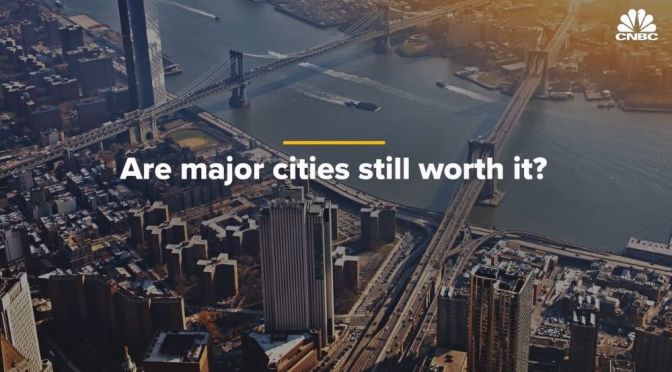
A cost-of-living crisis is unfolding in U.S. major cities. Inflation data shows that costs for items such as rent and groceries are increasing quickly across the Sun Belt and coastal superstar cities. Now years removed from the darkest days of the pandemic, people are asking: Is a return to the city worth it?
Metropolitan regions have sprawled in recent years, raising budget concerns and quality-of-life issues for the people who remain downtown. Meanwhile the absence of commuters is slowing the recovery in leisure and hospitality. Many renters believe that a cost-of-living crisis is brewing in America’s major cities.
New York City is showing up as a hotspot of rent inflation. The average rent for 1-bedroom apartments in Manhattan rose to $3,995 a month in May 2022 — a 41% increase from one year ago, according to Zumper. Sudden, double-digit rent spikes are hitting other hubs, including Chicago, Los Angeles, and Austin, Texas. Zumper data shows that growth is particularly strong in Sun Belt cities such as Miami, where rents have risen to $2,700 a month in May 2022, a 64% increase from a year prior. During the pandemic, workers left the largest U.S. cities.
Two years in, renters have returned but many commuters haven’t as companies negotiate the particulars of a return to the office. Public officials are concerned about lagging transit ridership in cities such as New York. Ed Glaeser, an economist at Harvard University, says cities are becoming more important — not less — in the age of remote work. “When you Zoom to work, you miss the opportunity to watch the people who are older, to watch what they’ve done and to learn from them,” he told CNBC in an interview.
But for renters, a return to increasingly expensive cities might seem like a raw deal, especially if they can do their jobs from home. Researchers say remote work limits firms’ ability to train new workers. Data produced by Microsoft’s workforce suggests that it is more difficult to share in-depth information remotely, which can produce silos within companies’ rank and file.
“A lot of these tech companies, they’re saying you can work remotely,” said Andra Ghent, a professor of finance at the University of Utah. “But, you know, in many cases, they’re also saying, like, we’re not going to pay you quite the same amount.” Many renters believe that a cost-of-living crisis is brewing in America’s major cities. New York City is showing up as a hotspot of rent inflation. The average rent for 1-bedroom apartments in Manhattan rose to $3,995 a month in May 2022 — a 41% increase from one year ago, according to Zumper.
Sudden, double-digit rent spikes are hitting other hubs, including Chicago, Los Angeles, and Austin, Texas. Zumper data shows that growth is particularly strong in Sun Belt cities such as Miami, where rents have risen to $2,700 a month in May 2022, a 64% increase from a year prior. During the pandemic, workers left the largest U.S. cities. Two years in, renters have returned but many commuters haven’t as companies negotiate the particulars of a return to the office.
Public officials are concerned about lagging transit ridership in cities such as New York. Ed Glaeser, an economist at Harvard University, says cities are becoming more important — not less — in the age of remote work. “When you Zoom to work, you miss the opportunity to watch the people who are older, to watch what they’ve done and to learn from them,” he told CNBC in an interview. But for renters, a return to increasingly expensive cities might seem like a raw deal, especially if they can do their jobs from home.
Researchers say remote work limits firms’ ability to train new workers. Data produced by Microsoft’s workforce suggests that it is more difficult to share in-depth information remotely, which can produce silos within companies’ rank and file. “A lot of these tech companies, they’re saying you can work remotely,” said Andra Ghent, a professor of finance at the University of Utah. “But, you know, in many cases, they’re also saying, like, we’re not going to pay you quite the same amount.”




 Boomers Daily