THE NEW YORK TIMES – MONDAY, OCTOBER 6, 2025

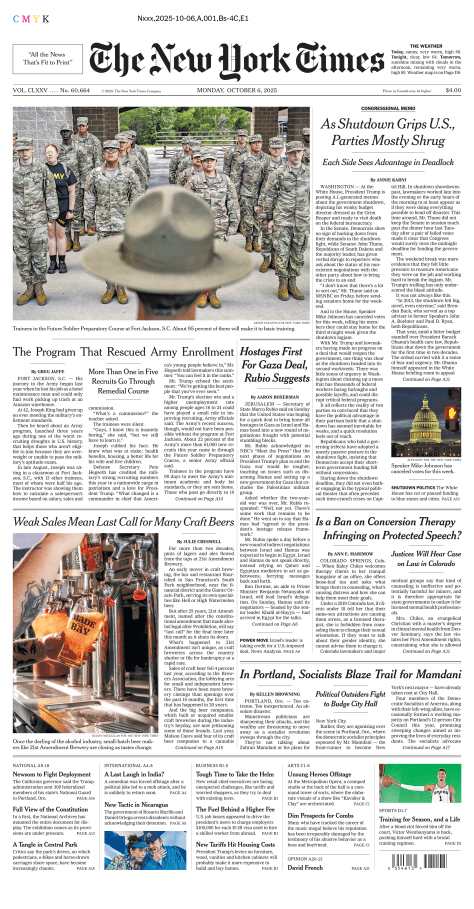
Trump Steps Up Effort to Deploy Guard in Democratic Cities as Judge Blocks Him

A federal judge in Oregon accused the administration of circumventing her order, as the president turned to Texas for troops aimed at Chicago and other cities.

Both Parties Are Resigned to Deadlock as Government Shutdown Takes Hold

Republicans have adopted a mostly passive stance while Democrats dig in for a fight, with both feeling they have the political upper hand.

Supreme Court Returns to Face Trump Tests of Presidential Power

As the justices return to the bench Monday, the court will confront a series of cases central to President Trump’s agenda.

Ravaged by War: Trying to Survive Gaza’s Present, Hoping for a Future

Two years of intense warfare have left Gazans with a dismembered and disordered society. Many have mental and physical wounds that could scar a generation.

Gaza Peace Talks Are Set to Take Place in Egypt

Though significant issues remain to be hashed out between Israel and Hamas, there are some hopes that a breakthrough may be near.

THE LAST LIGHT OF ALEXANDRIA

How Hypatia of Alexandria’s murder marked the moment reason fell to zeal—and why her lesson still echoes in an age ruled by algorithms.

By Michael Cummins, Editor, October 5, 2025

In the waning light of Alexandria’s golden age, a woman stood at the threshold of the cosmos. Draped in the robes of a philosopher, Hypatia of Alexandria taught mathematics as if it were music, astronomy as if it were prayer, and philosophy as if it were the architecture of the soul. She wrote no manifestos and led no armies. She taught. She reasoned. And for this—for the audacity of clarity in a world turning toward dogma—she was torn from the world. Her death was not merely a murder; it was a cultural wound, a severing of the classical from the medieval, of inquiry from ideology. The light she guarded—the flickering flame of secular, public reason—was extinguished in the very place conceived to protect it.

To speak of Hypatia is to speak of a city that believed knowledge could civilize the human spirit. Alexandria, founded by Alexander and tended by the Ptolemies, was the ancient world’s neural network, an experiment in global curiosity. Within its Library and Museum—the first great research institute—scholars mapped the heavens, dissected geometry, and debated the soul’s immortality under vaulted ceilings that smelled of parchment and sea salt. It was in this monumental, decaying marble world that Hypatia was born, around 370 CE, to Theon, the Library’s last known scholar. Her father taught her what Euclid and Eratosthenes had discovered, but she learned what they had meant: that geometry was not sterile abstraction but a form of devotion, a way of approaching perfection through reason.

She inherited the lineage of the ancients—the serene logic of Euclid, the restless measurement of Eratosthenes, the astronomical audacity of Ptolemy—and fused them into something both rigorous and spiritual. In late antiquity, knowledge still shimmered with moral purpose. Neoplatonism, the philosophy she championed, held that all things emanated from a single divine source, and that the human mind could ascend toward it through contemplation and mathematics. Numbers were not quantities but metaphors of being; to trace a circle was to imitate eternity. For Hypatia, geometry was not an escape from the world but its transfiguration—each theorem a small proof of cosmic coherence. It was not rebellion but refinement, a path to God that required no priest—and therefore could not be permitted.

Her genius lay in making the abstract visible. She wrote commentaries on Diophantus’s Arithmetica, clarified Ptolemy’s Almagest, and edited Apollonius’s Conics, ensuring future astronomers could still plot the curves of planets and light. Yet her intellect was not confined to parchment. She improved the astrolabe, designed hydroscopes to measure fluid density, and demonstrated that science was not the enemy of spirituality but its instrument. In Hypatia’s hands, philosophy became a navigation system—an attempt to chart truth in a universe governed by reason.

Imagine her in the lecture hall: morning light slanting through the colonnade, dust motes rising like miniature stars. A semicircle of students—Greeks, Egyptians, Romans, Jews, Christians—sit cross-legged at her feet. “You see,” she tells one, “a circle is not only a form—it is an argument for eternity.” Another asks, “And where is the soul in all this?” She pauses, chalk in hand. “In the harmony,” she says, smiling. The air hums with the audacity of free exchange. In an age dividing along creeds, her classroom was a sanctuary of synthesis.

At night, when the city’s noise dimmed and the harbor lanterns shimmered against the water, she would walk the colonnade alone. The scrolls in her study carried the scent of dust and oil. She read by lamplight until her fingers grew black with soot. To her students, she was certainty incarnate; alone, she seemed to understand that clarity provokes envy—that serenity itself is a kind of heresy. Even the stars she charted seemed to dim slightly under the weight of her foresight.

Her authority rested not on birth or ordination but on rational mastery—an unsettling legitimacy that bypassed both patriarchs and priests. She was an unmarried woman commanding reverence in a public space. Her followers were loyal not to a doctrine but to the discipline of thought itself. That was her heresy.

By the early fifth century, the harmony she embodied had begun to collapse. Alexandria had become a city of sharpened edges: pagan temples shuttered, Jewish enclaves under siege, imperial statues toppled and replaced by crosses. The Roman Empire was disintegrating; in its vacuum rose new centers of power, most formidable among them the Church. Bishop Cyril, brilliant and autocratic, sought to consolidate both spiritual and civic control. The imperial prefect Orestes—Hypatia’s friend and intellectual peer—defended the older ideal of the secular city. Between them stood the philosopher, calm and unarmed, the last civil defense against clerical supremacy.

The city had become a mirror of the empire’s exhaustion. Pagan artisans carved crosses beside the fading faces of their old gods; traders whispered prices under the sound of sermons. In the streets, theology replaced law. Orestes issued decrees that no one obeyed; Cyril’s sermons moved armies. The parabalani patrolled the harbor, their tunics stained from tending the sick and, at times, from beating the unbeliever. What began as civic unrest curdled into ritual violence—not just a fight for power, but for the right to define what counted as truth.

The conflict between Hypatia and Cyril was more than political. It was metaphysical. She represented individual, discovered truth; he, collective, inherited truth. Her worldview required no mediator between human reason and the divine. His authority depended on the indispensability of mediation. To Cyril, Neoplatonism’s notion that one could approach God through geometry and contemplation was blasphemy—it made the soul its own priest. The Church could not tolerate such independence.

One March afternoon, the mob found her carriage. They dragged her through the streets to a church—irony as architecture. Inside, beneath mosaics of saints, they stripped her, flayed her with oyster shells, and burned what remained. Socrates Scholasticus, a Christian historian, wrote simply: “Such a deed brought great disgrace upon Cyril and the Church of Alexandria.” It was not a killing; it was an exorcism. By tearing her apart, they sought to purge the city of its final pagan ghost—the living remnant of Athens’ rational soul.

Orestes, her ally, could not avenge her. The Empire, hollowed by decay, turned away. Cyril triumphed, later sanctified as a saint. The rule of law yielded to the rule of zeal. And so, with Hypatia’s death, an epoch ended. The library’s embers cooled, the lamps of the Museum darkened, and Europe entered its long medieval night.

For nearly a thousand years she survived only as rumor. Then the Enlightenment rediscovered her. Gibbon saw in her death the moment “barbarism and religion triumphed.” Voltaire invoked her as evidence that superstition kills what it cannot comprehend. Hypatia’s revival became part of a broader reckoning—a rebellion against inherited authority. To Enlightenment thinkers, she was the prototype of their own project: the reclamation of reason from revelation.

To later feminists, she became something more. Her murder revealed a longer pattern—the way intellectual women are punished not for ignorance but for illumination. Mary Wollstonecraft read her story as an ancestral warning; Simone de Beauvoir as a prelude to every modern silencing of the female intellect. To them, Hypatia was not just the first martyr of reason but its first woman martyr—the proof that wisdom in a woman’s voice has always been political.

Even now, her image flickers at the edge of cultural memory: the philosopher as secular saint, the teacher as threat. She has become the emblem of every rational mind undone by hysteria. Yet her deeper legacy lies not only in her martyrdom but in her method—the belief that the world is comprehensible, and that comprehension is a moral act.

And what, sixteen centuries later, does her story demand of us? We, too, live in an Alexandria of our own making, a world of infinite information and vanishing wisdom. Our libraries are digital, our mobs algorithmic. The algorithm has become the modern parabalani, shredding context and nuance for the sake of engagement. Knowledge no longer burns by fire; it corrodes by speed. We scroll instead of study, react instead of reflect. What once was a civic agora has become a coliseum of certitude.

Somewhere in a dim university office, a woman corrects her students’ proofs by the light of her laptop. She teaches them to think slowly in a world that rewards speed, to doubt the easy answer, to hold silence as rigor. Outside, the din of the feed hums like an approaching crowd. She doesn’t know it, but she’s teaching Hypatia’s lesson: that the mind’s true courage lies not in certainty but in patience.

Her challenge endures. The purpose of philosophy is not to win the argument but to chart the truth, even when the world insists on remaining lost. She reminds us that every age must relearn how to think freely, and that freedom of thought, once lost, returns only through vigilance.

To honor Hypatia is not merely to remember her death but to practice her discipline: to teach, to reason, to listen. The world will always be noisy, half-mad with conviction. Somewhere, in the imagined quiet of that vanished library, a woman still draws circles on marble, tracing the harmonies of a cosmos we have not yet earned. If she could look up now, she would find the same constellations unchanged—Orion still hunting, Cassiopeia still boasting, the curve of the moon unbroken. The geometry she once traced on marble persists in the heavens, indifferent to history’s convulsions. That, perhaps, was her final comfort: that reason, like starlight, travels slowly but never dies. It only waits for another mind, somewhere in the future, to lift its face and see.

THIS ESSAY WAS WRITTEN AND EDITED UTILIZING AI

THE NEW YORK TIMES MAGAZINE – OCTOBER 5, 2025

Current cover

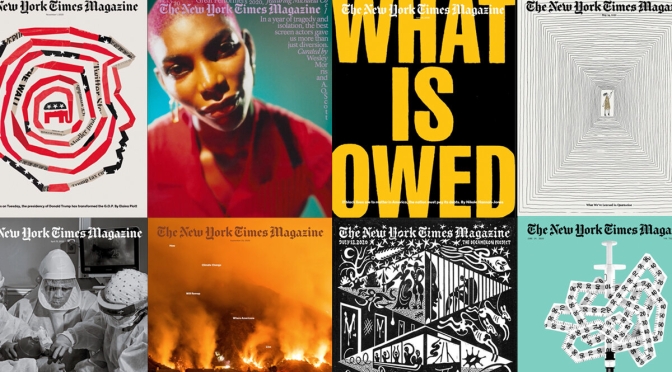
THE NEW YORK TIMES MAGAZINE: The 10.5.25 Issue features Matthieu Aikins and Victor J. Blue reporting on crimes and impunity in the U.S. Special Forces.

They Celebrated Vigilante Justice on the Battlefield. Then They Brought It Home.

Pete Hegseth’s advocacy for service members accused of war crimes, and Trump’s pardons of them, have helped usher in an era of military aggression and disregard for the rule of law. By Matthieu Aikins  and  Victor J. Blue

Did a Green Beret Unit Commit One of the Worst U.S. War Crimes in Decades?

In 2012, after a team member was nearly killed, a Special Forces unit went on a rampage that might have been one of the worst war crimes in recent U.S. history. By Matthieu Aikins and Victor J. Blue

How War-Crime Accusations Against Green Berets Were Denied and Buried

As cases of lawless behavior and extrajudicial killings mounted, the Special Forces had to decide how to respond — and whom to protect. By Matthieu Aikins and Victor J. Blue

THE NEW YORK TIMES – SUNDAY, OCTOBER 5, 2025

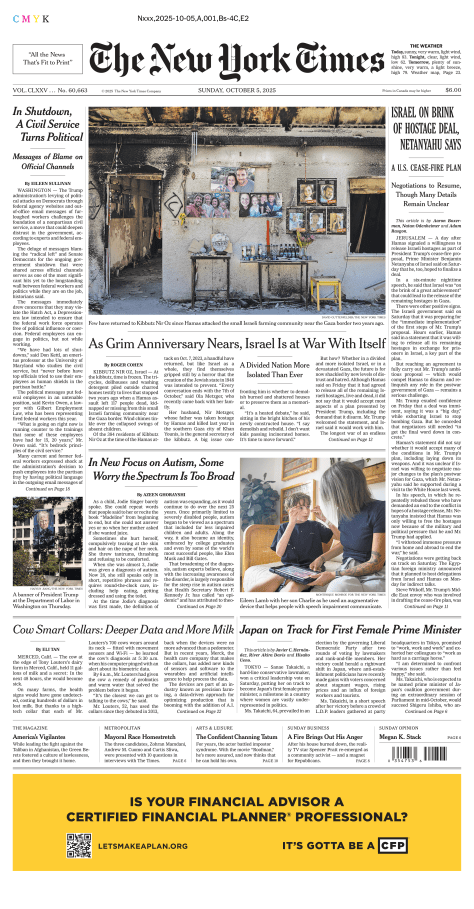
As Grim Anniversary Nears, Israel Is at War With Itself

Two years after Hamas’s Oct. 7 attack, the ensuing conflict has come to challenge Israel’s own image and understanding of itself.

Israel and Hamas Prepare for Talks on Trump’s Plan to End Gaza War

Indirect negotiations through mediators are planned for Monday in Egypt and are expected to focus on swapping hostages for Palestinian prisoners.

A Pacific Gateway Shows the Kremlin’s Grip on Russia’s Vast Expanse

In a country where power is highly centralized, Moscow sets the tone for Vladivostok, 4,000 miles away, complicating ambitions to make it a trading powerhouse.

Russia Targets Ukraine’s Energy Infrastructure With Deadly Bombardment

THE CHRYSANTHEMUM PARADOX

Japan’s first female prime minister promises history, but her ascent may only deepen the old order.

By Michael Cummins, Editor, October 4, 2025

Sanae Takaichi has become Japan’s first female prime minister—a milestone that might look like progress but carries a paradox at its core. Takaichi, sixty-four, rose not by challenging her party’s patriarchal order but by embracing it more fiercely than her male rivals. Her vow to “work as hard as a carriage horse” captured the spirit of her leadership: endurance without freedom, strength yoked to duty. In a nation where women hold less than sixteen percent of parliamentary seats and most are confined to low-paid, “non-regular” work, Takaichi’s ascension is less rupture than reinforcement. She inherits the ghost of Shinzo Abe, with whom she shared nationalist loyalties, and she confronts a fragile coalition, an aging electorate, and a looming Trump visit. Her “first” is both historic and hollow: the chrysanthemum blooms, but its shadow may reveal that Japan’s old order has merely found a new face.

Under the humming fluorescent lights of the Liberal Democratic Party’s headquarters in Tokyo, the old men in gray suits shifted in their seats. The air was thick with the stale perfume of cigarettes and the accumulated dust of seventy years in power. The moment came suddenly, almost anticlimactically: after two rounds of voting, Sanae Takaichi was named leader. The room stirred, applause pattered weakly. She stepped to the podium, bowed with a precision that was neither humble nor triumphant, and delivered the line that will echo through history: “I will work as hard as a carriage horse.”

Why that image? Why not the fox of Japanese cunning, or the crane of elegance, or the swift mare of legend? A carriage horse is strength without freedom. It pulls because it must. Its labor is endurance, not glory. In that metaphor lay the unsettling heart of the moment: Japan’s first woman prime minister announcing herself not as a breaker of chains but as the most dutiful beast of burden. Ushi mo aru kedo, hito mo aru—“Even cattle have their place, but so do people.” Here, in this paradoxical victory, the human became the horse.

In Japan, the ideal of gaman—stoic endurance in the face of suffering—is praised as virtue. The samurai ethos of bushidō elevated loyalty above will. Women, in particular, have long been praised for endurance in silence. Takaichi’s metaphor was no slip. It was a signal: not rebellion, but readiness to shoulder a system that has never bent for women, only asked them to carry it. In the West, the “first woman” often suggests liberation; in Japan, Takaichi presented herself as a woman who could wear the harness more tightly than any man.

The horse metaphor might also be personal. Takaichi was not a scion of a dynasty like her rival, Koizumi. Her mother served as a police officer; her father worked for a car company. Her strength was forged in the simple, demanding work of postwar Japan—the kind of tireless labor she was now vowing to revive for the nation.

For the newspapers, the word hajimete—first—was enough. But scratch the lacquer, and the wood beneath showed a different grain. The election was not of the people; it was an internal ballot, a performance of consensus by a wounded party. Less than one percent of Japan had any say. The glass ceiling had not been lifted by collective will but punctured by a carefully aimed projectile. The celebration was muted, as if everyone sensed that this “first” was also a kind of last, a gesture of desperation dressed in history’s robes.

Deru kugi wa utareru—“The nail that sticks out gets hammered down.” Takaichi did not stick out. She was chosen precisely because she could wield the hammer.

Her rise was born of collapse. The LDP, which had dominated Japanese politics like Mount Fuji dominates the horizon, was eroded, its slopes scarred by landslides. In the 2024 Lower House election alone, it lost sixty-eight seats, a catastrophic erosion. After another defeat in 2025, it found itself, for the first time in memory, a minority in both houses of the Diet. Populist formations shouting Nippon daiichi!—Japan First—had seized the public imagination, promising to protect shrines from outsiders and deer in Nara from the kicks of tourists. Stagnant wages, rising prices, and the heavy breath of globalization made their slogans ring like temple bells.

Faced with collapse, the LDP gambled. It rejected the fresh-faced Shinjiro Koizumi, whose cosmopolitan centrism seemed too fragile for the moment, and crowned the hard-line daughter of Nara, the protégé of Shinzo Abe. In choosing Takaichi, the LDP announced that its path back to power would not be through moderation, but through continuity.

The ghost of Abe hovers over every step she takes. His assassination in 2022 froze Japan in a perpetual twilight of mourning. His dream—constitutional revision, economic reflation, nationalist revival—remained unfinished. Takaichi walks in his shadow as if she carries his photograph tucked inside her sleeve. She echoes his Abenomics: easy money, big spending. She continues his visits to Yasukuni Shrine, where the souls of Japan’s war dead—among them Class A criminals—are enshrined. Each bow she makes is both devotion and provocation.

Hotoke no kao mo san-do—“Even a Buddha’s face only endures three times.” How many times will China and South Korea endure her visits to Yasukuni?

And yet, for all the historic fanfare, her stance on women is anything but transformative. She has opposed allowing a woman to reign as emperor, resisted reforms to let married couples keep separate surnames, and dismissed same-sex marriage. Mieko Nakabayashi at Waseda calls her bluntly “a roadblock to feminist causes.” Yet she promises to seat a cabinet of Nordic balance, half men and half women. What does equality mean if every woman chosen must genuflect to the same ideology? One can imagine the photograph: a table split evenly by gender, yet every face set in the same conservative mold.

In that official photograph, the symmetry was deceptive. Each woman had been vetted not for vision but for loyalty. One wore a pearl brooch shaped like a torii gate. Another quoted Abe in her opening remarks. Around the table, the talk was of fiscal stimulus and shrine etiquette. Not one mentioned childcare, wage gaps, or succession. The gender balance was perfect. The ideological balance was absolute.

This theater stood in stark opposition to the economic reality she governs. Japan’s gender wage gap is among the widest in the OECD; women earn barely three-quarters of men’s wages. Over half are trapped in precarious “non-regular” work, while fewer than twelve percent hold managerial posts. They are the true carriage horses of Japan—pulling without pause, disposable, unrecognized. Takaichi, having escaped this trap herself, now glorifies it as national virtue. She is the one horse that broke free—only to tell the herd to pull harder.

The global press, hungry for symbols, crowned her with headlines: “Japan Breaks the Glass Ceiling.” But the ceiling had not shattered—it had been painted over. The myth of the female strongman—disciplined, unflinching, ideologically pure—has become a trope. Conservative systems often prefer such women precisely because they prove loyalty by being harsher than the men who trained them. Takaichi did not break the mold; she was cast from it.

Other nations offer their mirrors: Thatcher, the Iron Lady who waged war on unions; Park Geun-hye, whose scandal-shattered rule rocked South Korea; Indira Gandhi, who suspended civil liberties during India’s Emergency. Each became a vessel for patriarchal power, proving strength through obedience rather than disruption. Takaichi belongs to this lineage, the chrysanthemum that blooms not in a wild meadow but in a carefully tended imperial garden.

Her campaign rhetoric made plain her instincts. She accused foreigners of kicking sacred deer in Nara, of swinging from shrine gates. The imagery was almost comic, but in Japan symbols are never trivial. The deer, protectors of Shinto shrines, bow to visitors as if performing eternal reverence. To strike them is to wound purity. The torii gates mark thresholds between profane and sacred worlds; to defile them is to profane Japan itself. By weaponizing these cultural symbols, Takaichi sought to steal the thunder of far-right groups like Sanseitō, consolidating the right-wing vote under the LDP’s battered banner.

But the weight of Takaichi’s ideological baggage—the nationalism that served her domestically—was instantly transferred to the fragile carriage of Japan’s foreign policy. To survive, the LDP must keep its coalition with Komeito, the Buddhist-backed party rooted in Soka Gakkai’s pacifism. Already the monks grumble. Nationalist education reform? No. Constitutional militarism? Impossible. Imagine the backroom: tatami mats creaking, voices low, one side invoking the Lotus Sutra, the other brandishing polls. Ni usagi o ou mono wa issai ezu—“He who chases two rabbits catches none.”

Over all this looms America. Donald Trump, swaggering toward a late-October Asia tour, may stop in Tokyo. Takaichi once worked in the U.S.; she speaks the language of its boardrooms. But she campaigned as a renegotiator, a fighter against tariffs. Now reality intrudes. Japan has already promised $550 billion in investment and loan guarantees to secure a reprieve from harsher duties. How she spends it will define her. To appear submissive is to anger voters; to defy Trump is to risk reprisal. Imagine the summit: Trump beaming, Takaichi bowing, their hands clasped in an awkward grip, photographers snapping.

Even her economics carry ghosts. She revives Abenomics when inflation demands restraint. But Abenomics was of another time, when Japan had fiscal breathing room. Reviving it now is less a strategy than nostalgia, an emotional tether to Abe himself.

These contradictions sharpen into paradox. She is the first woman prime minister, yet she blocks women from the throne. She promises parity, yet delivers loyalty. She vows to pull the carriage harder than any man, yet the cart itself has only three wheels.

Imagine the year 2035. A museum exhibit in Tokyo titled The Chrysanthemum Paradox: Japan’s Gendered Turn. Behind glass: her campaign poster, a porcelain deer, a seating chart from her first cabinet. A small screen plays the footage of her victory speech. Visitors lean in, hear the flat voice: “I will work as hard as a carriage horse.”

A child tugged at her mother’s sleeve. “Why is the horse sad?” she asked, pointing to the animated screen where a cartoon carriage horse trudged endlessly. The mother hesitated. “She worked very hard,” she said. “That’s what leaders do.” The child frowned. “But where was she going?”

Outside, chrysanthemums bloom in autumn, petals delicate yet precise, the imperial crest stamped on passports and coins. The carriage horse keeps pulling, hooves clattering against cobblestones, sweat darkening its flanks. Will the horse break, or the carriage? And if both break together, what then?

Shōji wa issun saki wa yami—“The future is pitch-dark an inch ahead.” That is the truth of her victory. The chrysanthemum shines, but its shadow deepens. The horse pulls, but no one knows toward what horizon. The first woman had arrived, but the question lingered like incense in an empty hall: Was this history’s forward march, or merely the perfect, tragic culmination of the old order?

THIS ESSAY WAS WRITTEN AND EDITED UTILIZING AI

BARRON’S MAGAZINE – OCTOBER 6, 2025

BARRON’S MAGAZINE: The latest issue features ‘How Costco, Sam’s Club, and BJ’s Won Over America’

How Costco, Sam’s Club, and BJ’s Won Over America

Walmart is leveraging its scale and technology to make Sam’s Club even more appealing to its loyal shoppers. Why all three warehouse-club chains stand to win.

Their Funds May Not Beat the Market. Their Stocks Just Might.

The fund industry faces big hurdles, but these three asset managers have been unjustly dismissed.

Fair Isaac Stock Scores Big With Pricing Change. Credit Bureaus, Not So Much.

Fair Isaac, the producer of the FICO Score, changed its pricing model, giving it a greater share of the overall credit-scoring revenue.

Foreign Buyers Are Backing Treasury Bonds. It Comes With Strings Attached.

With hedge funds and other investors becoming more dominant, this haven might not be quite as safe as it used to be.

Jobs Gains May Be Stalling, but Markets Keep Driving Growth

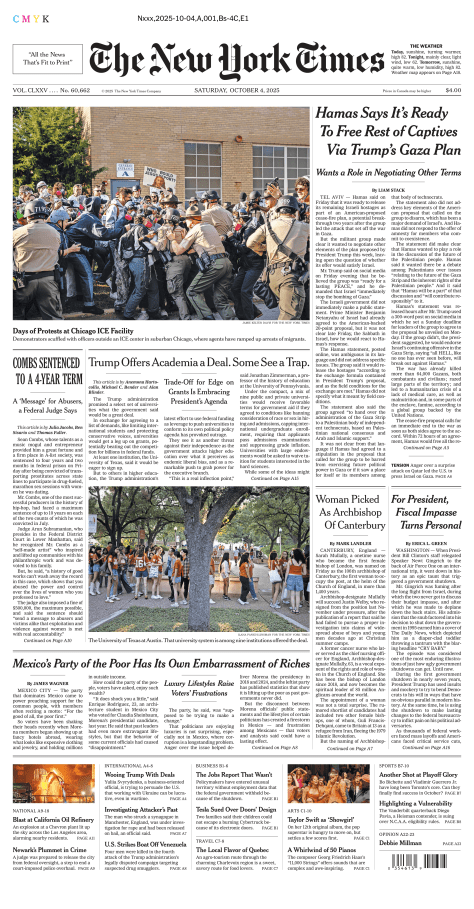
THE NEW YORK TIMES – SATURDAY, OCTOBER 4, 2025

Israel and Hamas Say They’ll Work With Trump’s Gaza Plan, but Gaps Remain

Israel said it would cooperate with President Trump to end the war, but much remains unclear about Hamas’s future and whether it will agree to disarm.

Trump Seizes On Shutdown to Punish Political Foes

President Trump has cut or paused billions in funding to Democratic-run cities and states since the federal government came to a halt.

What Happens When Socialists Are in Charge? Portland Offers a Glimpse.

A West Coast version of Zohran Mamdani’s campaign is playing out in Portland, Ore. But the socialist city councilors are facing significant opposition.

Sean Combs Now Faces Not Just Prison and a Fine, but Shunning

Many who have tracked the music mogul’s career think his reputation has been irreparably damaged by testimony of abusive behavior as a boss and boyfriend.

Reviews: ‘The Week In Art’

THE WEEK IN ART (October 2, 2025): The latest episode feature a new exhibition at the Fitzwilliam Museum in Cambridge, UK, called Made in Ancient Egypt, reveals untold stories of the people behind a host of remarkable objects, and the technology and techniques they used.

The Art Newspaper’s digital editor, Alexander Morrison visits the museum to take a tour with the curator, Helen Strudwick. One of the great revelations of the past two decades in scholarship about women artists is Michaelina Wautier, the Baroque painter active in what is now Belgium in the middle of the 17th century. The largest ever exhibition of Wautier’s work opened this week at the Kunsthistorisches Museum in Vienna, and travels to the Royal Academy of Arts in London next year.

Ben Luke speaks to the art historian who rediscovered this extraordinary painter, Katlijne Van der Stighelen, who has also co-edited the catalogue of the Vienna show. And this episode’s Work of the Week is Robert Rauschenberg’s Bed (1955), one of the most important works of US art of the post-war period. It features in the exhibition Five Friends: John Cage, Merce Cunningham, Jasper Johns, Robert Rauschenberg, Cy Twombly, which this week arrives at the Museum Ludwig in Cologne.

We speak to Yilmaz Dziewior, the co-curator of the exhibition.

Made in Ancient Egypt, Fitzwilliam Museum, Cambridge, UK, 3 October-2 April 2026

Michaelina Wautier, Painter, Kunsthistorisches Museum, Vienna

30 September-22 February 2026; Royal Academy of Arts, London

27 March – 21 June 2026.

Five Friends: John Cage, Merce Cunningham, Jasper Johns, Robert Rauschenberg, Cy Twombly, Museum Ludwig, Cologne, Germany,

3 October-11 January 2026

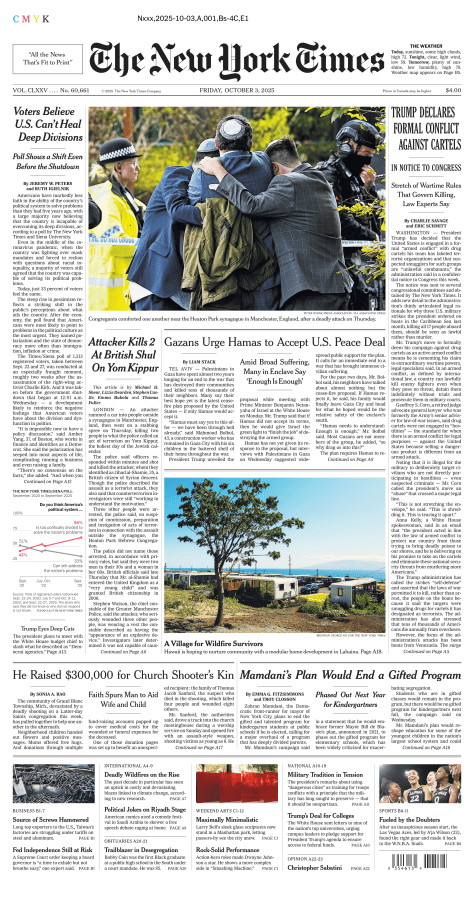
THE NEW YORK TIMES – FRIDAY, OCTOBER 3, 2025

The Jobs Report That Wasn’t Leaves Economists Guessing

The government is expected to withhold employment data because of its shutdown. Policymakers will enter uncharted territory without it.

Deepfakes, Insults and Job Cuts: A Government Shutdown Like No Other

Shutdowns are always unpleasant affairs. But President Trump has used his power in aggressive and strikingly personal ways.

Trump Offered Universities an Invitation for a Deal. Some See a Trap.

Trump officials want schools to sign on to conservative priorities for special treatment. Some in higher education say agreeing would end academic freedom.

Hamas Still Considering Trump Gaza Plan but Rejects ‘Take It or Leave It’ Deal

A senior member of the Palestinian group said that the group would soon announce its position on President Trump’s plan to end the war in Gaza.

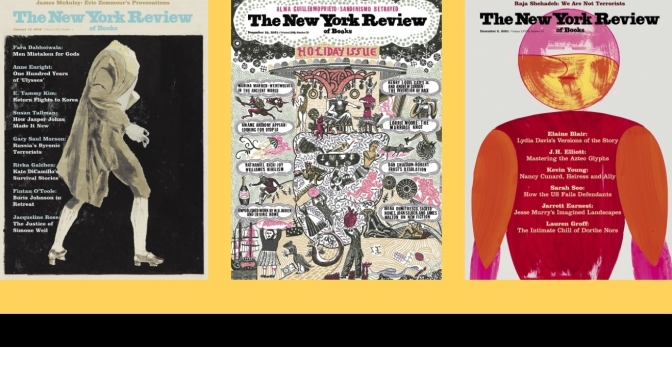
THE NEW YORK REVIEW OF BOOKS – OCTOBER 23, 2025

Home | The New York Review of Books

THE NEW YORK REVIEW OF BOOKS: The latest issue features Jacob Weisberg on deep fake news, Elaine Blair on istoriya feminisma, Eric Foner on the underground railroad at sea, Andrew Katzenstein on Pynchon’s Shadow Ticket, Suzanne Schneider on Friedrich Hayek’s bastard children, Nicole Rudick on Ben Shahn’s compassion, Jay Neugeboren on the working homeless, Vicente L. Rafael on an American massacre in the Philippines, Ariel Dorfman on Pinochet’s favorite Nazi, David Cole on Trump’s summary killings in international waters, a poem by Victoria Chang, and much more.

Algorithm Nation

Fights about digital filtering tools have turned more and more bitter. That’s because of their extraordinary power to shape both political opinion and mass culture.

Invisible Rulers: The People Who Turn Lies into Reality by Renée DiResta

Character Limit: How Elon Musk Destroyed Twitter by Kate Conger and Ryan Mac

Filterworld: How Algorithms Flattened Culture by Kyle Chayka

Equality Without Feminism?

The Soviet Union’s ambitious program of gender equality could never be separated from its abuses of power.

Motherland: A Feminist History of Modern Russia, from Revolution to Autocracy by Julia Ioffe

The Big Cheese

Shadow Ticket is brisker than Thomas Pynchon’s other work, but it’s full of his usual vaudevillian sensibility, and it addresses his favorite theme: how to live freely under powerful systems of control.

Shadow Ticket by Thomas Pynchon